

Employee advocacy works differently for software companies than it does for most other industries. Buyers are technical, the product is often hard to explain from the outside, and the people best placed to make the case are the employees who build and use it.
This guide covers what the leading software companies are doing to turn that into a growth channel, the mistakes that hold everyone else back, and a framework for building a program that works.
Why Software Buyers Tune Out Brand Accounts
Every software vendor’s homepage reaches for the same handful of words: AI-native, enterprise-grade, built to scale. Buyers skip past that copy. They just want to hear it from the engineers and product managers who actually built and use the product.
Software buyers research vendors long before they ever speak to a salesperson: G2 reviews, LinkedIn, increasingly an LLM they’ve asked to shortlist options for them. A brand account is selling something, so buyers read it that way no matter how carefully it’s worded. An engineer or product manager posting under their own name earns the trust a brand account can’t.
The product is often abstract, the buying committee is technical, and the people who can actually validate a claim are the employees building and using it. Software companies that act on this turn that employee credibility into a measurable growth channel.
The Scale of the Gap
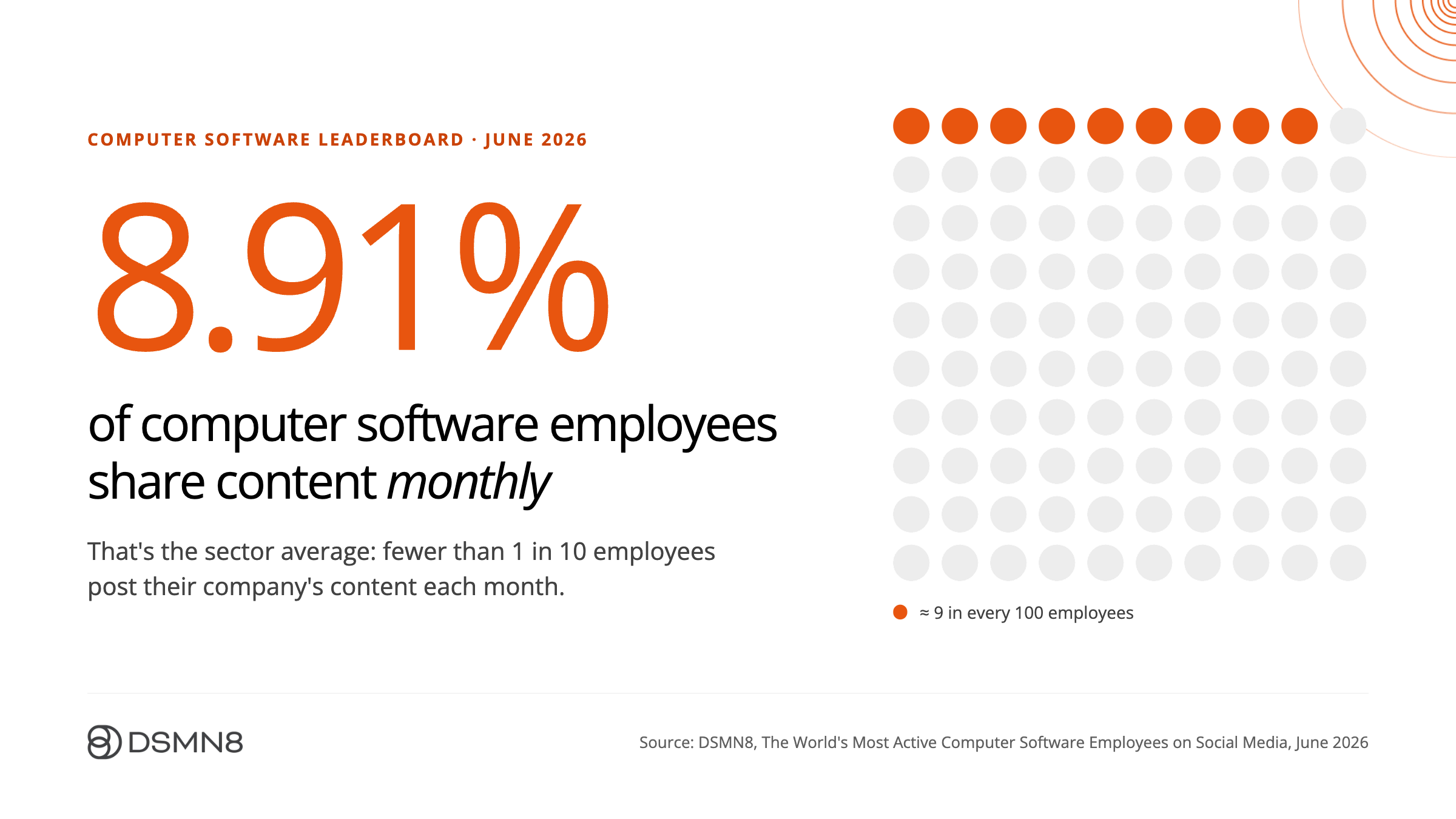
The sector average on DSMN8’s Computer Software leaderboard sits at just 8.91% of employees sharing content monthly.
Even LinkedIn itself ranks only 6th in its own category, behind five companies with a fraction of its name recognition.
It’s a reminder that brand size doesn’t predict how actively its own employees share. See the full leaderboard to see if your company made the ranks.
What the Leaders Do Differently
Three things separate companies that get employee advocacy right from everyone else: how they build trust with buyers, how they get their own people to participate, and how they turn that into pipeline.
Trust and Thought Leadership
Adobe’s Andy Lambert puts it bluntly:
Social media is not a channel. It’s not a tactic, it’s a business strategy.
Andy Lambert, Adobe

The companies winning on trust share four habits:
- Executives model it first, so sharing reads as normal rather than performative.
- New hires get a kit, not a blank page, with branded profile assets and starter content from day one.
- Post templates are a draft employees personalize, not a script to repost word for word.
- AI drafts get guardrails, not a ban, so AI-assisted posts still read like a person wrote them.
The real friction here is time and not wanting to sound like a brand account, more than legal risk.
DSMN8’s 2026 Personalization Report found that when employees edit a post’s caption to sound like themselves, it gains roughly 3x the engagement of an unedited repost. Writing original content? Roughly 9x more engagement.
Demandbase’s Vahbiz Cooper saw this firsthand:
Once we saw them writing their own posts and not just reposting from our page, it felt like the engagement that they were getting was real.
Vahbiz Cooper, Demandbase. Listen to the podcast episode.

The trust angle has a second, newer payoff: software buyers are increasingly using AI tools to research and shortlist vendors before they ever visit a website, and LinkedIn is already the most-cited domain for professional queries across AI search platforms.
HubSpot’s Gabrielle Herrera, who grew HubSpot’s program from a 12-person pilot to a framework open to 9,000+ employees, puts it plainly:
Search used to reward the best SEO. AI search rewards the most trusted, most human-sounding content.
Gabrielle Herrera, HubSpot. Listen to the podcast episode.

An active employee presence is one of the few levers that actually moves that needle.
Celonis has seen what that reach looks like in practice: its employee advocates now reach roughly 1.8M people, against about 375,000 followers on its own corporate channels. As Celonis’s Chris Sheen put it:
If we really want to get the message out there, we have to be using advocates.
Chris Sheen, Celonis. Listen to the podcast episode.

Talent and Culture
Software is one of the few sectors where leadership participation actually outpaces the wider team.
On DSMN8’s Software Development executive leaderboard, 22.07% of US software executives are active on LinkedIn, roughly 2.5x the sector-wide employee rate of 8.91%.
Software’s biggest names already model this: Microsoft’s Satya Nadella ranks #1 among CEOs on LinkedIn by engagement, and SAP’s Christian Klein and AWS’s Matt Garman aren’t far behind. That visibility at the top may be part of why software leans more willingly into this than other sectors.
The blocker to getting time-poor executives active is security. Password-sharing and account access are the usual friction point we see. Password-free delegated access, letting comms teams post on a leader’s behalf without ever sharing a login, removes it.
Executive visibility is one piece of building a culture around sharing. The other is who actually drives adoption day to day. In software, that’s often talent and HR teams, not just marketing.
Dropbox split its rollout by motivation rather than launching to everyone at once: power users already active on LinkedIn got early access, the sales team’s rollout was timed to a product launch, and the recruiting team got pre-written captions built on Dropbox’s key messaging to reduce friction.
Program manager Katherine Keenan sums it up:
Employee advocacy isn’t one-size-fits-all.
Katherine Keenan, Dropbox. Listen to the podcast episode.

At incident.io, a looser version of the same idea runs with no formal program at all, just a culture that started with two co-founders and spread from there, with monthly sessions where employees write posts together. Program manager Megan Batterbury says:
You can’t be a thought leader in an industry you’re not actively posting about.
Megan Batterbury, incident.io. Listen to the podcast episode.

Scale and Pipeline
A handful of enthusiasts will post on their own. Scaling that across a whole company, where attention is scarce, is the real challenge.
Salesloft got its CMO into the pilot group so employee advocacy was perceived internally as a company priority. They then rolled out department by department rather than company-wide on day one.
The program led with value, not brand: timely, relevant content for employees to build their own social media first, with brand reach following as a side effect. It also lived inside Slack, where a dedicated channel highlight new content and posts that needed a boost. As Salesloft’s Heather Wiita puts it:
Place your employee as the hero, and the brand reach becomes the by-product.
Heather Wiita, Salesloft. Read the case study.

Harness had the same problem at a bigger scale. Social posts used to live in a shared document, and technical and commercial teams needed different content for different audiences. Busy employees simply forgot to share because nothing prompted them.
DSMN8 replaced the document with ready-to-share posts split into groups by audience, and allowed employees to opt-in for auto-scheduling, so posts could go out without anyone having to remember. Harness’s Jason Meyers summed up the effect:
Auto-scheduling meant that our teams could essentially just set it and forget it.
Jason Meyers, Harness.
The result: Harness climbed from 54th to 4th on DSMN8’s Software leaderboard in twenty months, and they’ve since reached 3rd place. Participation rose from 18.74% to 31.16%. Reach is roughly 9x the company’s own corporate following, and the program generated $200k+ in earned media value at a $0.31 cost per click.
The Employee Advocacy Mistakes Software Companies Make
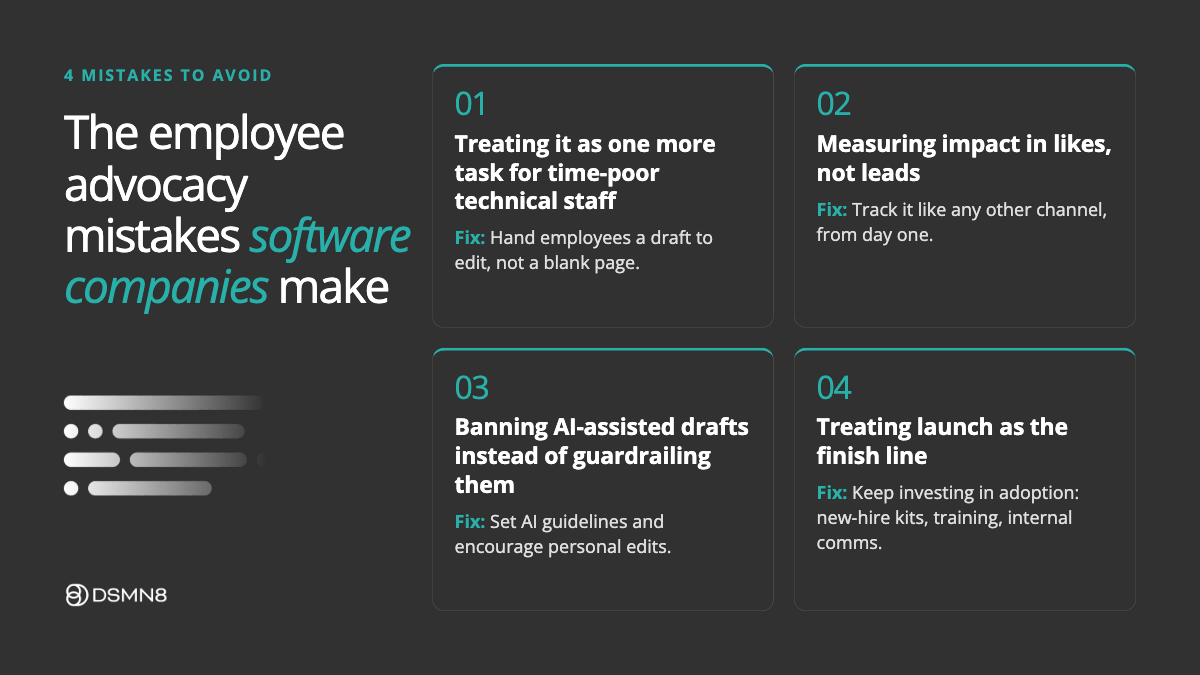
1. Treating It as One More Task for Time-Poor Technical Staff
Engineers and product managers are already stretched, so posting feels like one more thing on the list. Programs that succeed hand employees a draft to edit instead of a blank page, so posting takes minutes instead of time they don’t have.
2. Measuring Impact in Likes, Not Leads
Without being able to connect employee advocacy to software signups or sales pipeline, leadership never sees a reason to prioritize the program, and it stays a nice-to-have. The fix is tracking impact the same way any other channel is tracked from day one, not after the fact.
See our guide on measuring employee advocacy impact.
3. Banning AI-Assisted Drafts Instead of Guardrailing Them
One of the biggest hesitations from employees is sounding like a corporate megaphone. Advocates don’t want to say that they’re “thrilled to announce” your latest product.
They also often have a lack of confidence in their own writing abilities, so they turn to things like ChatGPT. The trouble is, these tools often use generic phrasing and audiences have caught on.
LinkedIn even introduced an “AI Slop” button for users to report content and help clean up the feed.
The solution is a hybrid approach. Provide drafts and encourage personalization, but instead of banning AI outright, give guidelines and guardrails for it. DSMN8’s Personal Voice AI helps your advocates rephrase content to sound more like them.
4. Treating Launch as the Finish Line
A strong rollout with no follow-up will decay fast: one admin posting alone burns out, and engagement drops as soon as attention moves elsewhere. And that’s not even taking into account your employee turnover.
Programs that last continue to invest in user adoption: new-hire kits, continued training and internal comms integrations to meet employees where they are.
G2 runs its “Most Improved” contest every quarter for exactly this reason: it’s a deliberate way to win back posters who’ve stopped showing up, instead of just writing them off.
Want help building this out step by step? Get our free User Adoption Playbook.
A Framework for Building an Effective Employee Advocacy Program in the Software Sector
The checklist below brings together the practices covered in this guide.
Executives Are Active
New Hires Get a Kit, Not a Blank Page
Curated Content Is a Draft for Employees to Personalize, Not a Script
Reminders Live Where People Already Work
AI-Assisted Drafts Are Guardrailed, Not Banned
Content Is Segmented, Not One-Size-Fits-All
Impact Is Tracked to Pipeline
What This Looks Like in Practice
Here’s what that looks like across four software companies running successful employee advocacy programs:
- Celonis: reaches roughly 1.8M people through employee advocates, against about 375,000 followers on its own corporate channels.
- Harness: climbed from 54th to 4th on DSMN8’s Software leaderboard in twenty months, now 3rd, with reach running roughly 9x its corporate following and $200k+ in earned media value.
- Salesloft: scaled past 200 active participants by getting its CMO into the pilot group and rolling out department by department.
- Dropbox: split its rollout by what each group actually wanted, onboarding power users, sales, and recruiting differently.
None of them treated advocacy as a side project. It’s built into how the team already works, from tech stack integrations to company culture.
See How Your Company Compares
Get a free competitor analysis and find out how active your team are, against others in the software industry. Or book a demo to see DSMN8 in action.
Additional Resources
Download the Beyond the Brand Account: The Computer Software Employee Advocacy Report to get the full research this guide is built on.
More content you’ll find helpful:
- Employee Advocacy User Adoption Playbook
- How Does Employee Advocacy Impact AI Search And AEO?
- Why Is Executive Visibility Vital For B2B Trust (Podcast)
FAQ
Does employee advocacy work if our product is technical or niche?
Arguably it matters more! The people who can actually explain a technical product credibly are the engineers and PMs building it. Take Harness for example, which sells a technical developer platform. Their employee advocacy program has a 31.16% participation rate, more than 3x the software sector’s 8.91% average.
How do we get engineers who don’t want to be “salespeople” to post on LinkedIn?
Don’t ask them to sell the product. Ask them to share what they think about the problem they work on. Give them a draft to edit instead of a blank page, and the “salesperson” objection mostly disappears, because they’ll see they’re not expected to act as one.
How long before we see pipeline impact from employee advocacy?
It depends on whether tracking is built in from day one. Programs that wait to add UTM and CRM tracking until leadership asks for proof lose the early data that would have made the case faster. Set milestones at one, three, and six months. Our guide to benchmarking an employee advocacy program has a free template, so you can point to pipeline-relevant data by the three-month mark.

Emily Neal
Emily is SEO Lead at DSMN8. She focuses on organic growth strategy across search and AI search and co-authors DSMN8's original research, including the Employee Advocacy Benchmark Report and edited CEO Bradley Keenan's book. Her background spans SEO strategy, technical web, long-form content, digital PR, and marketing automation.