

What's on this page:
- Executive thought leadership is worth the investment.
- The reach gap is a structural problem, not a content problem.
- What employee advocacy actually does for thought leadership.
- The ROI case for adding advocacy to thought leadership.
- Thought leadership and advocacy: the same investment, working at two different scales.
- Starting the conversation internally.
- Additional Resources
Last Updated: October 1, 2026
You’ve invested in building senior voices on LinkedIn.
There’s a process in place: thought leadership content is being created, and executives are showing up consistently. The strategy is working.
And yet, at a certain point, results plateau.
The problem isn’t the content. It’s the ceiling.
Three executives with a combined audience of 15,000 people can produce excellent content indefinitely, and still leave the vast majority of their potential audience untouched.
This is the gap that employee advocacy is built to close.
Executive thought leadership is worth the investment
Before making the case for advocacy, it’s worth being clear about what thought leadership actually delivers.
Executive content does things no other channel can:
- Senior leaders on LinkedIn build credibility with buyers before a sales conversation ever happens.
- They position a brand as a category authority rather than just a vendor.
- They gain an algorithmic advantage over brand pages on platforms like LinkedIn.
- A CEO’s perspective lands differently than a company post, even when the underlying message is the same.
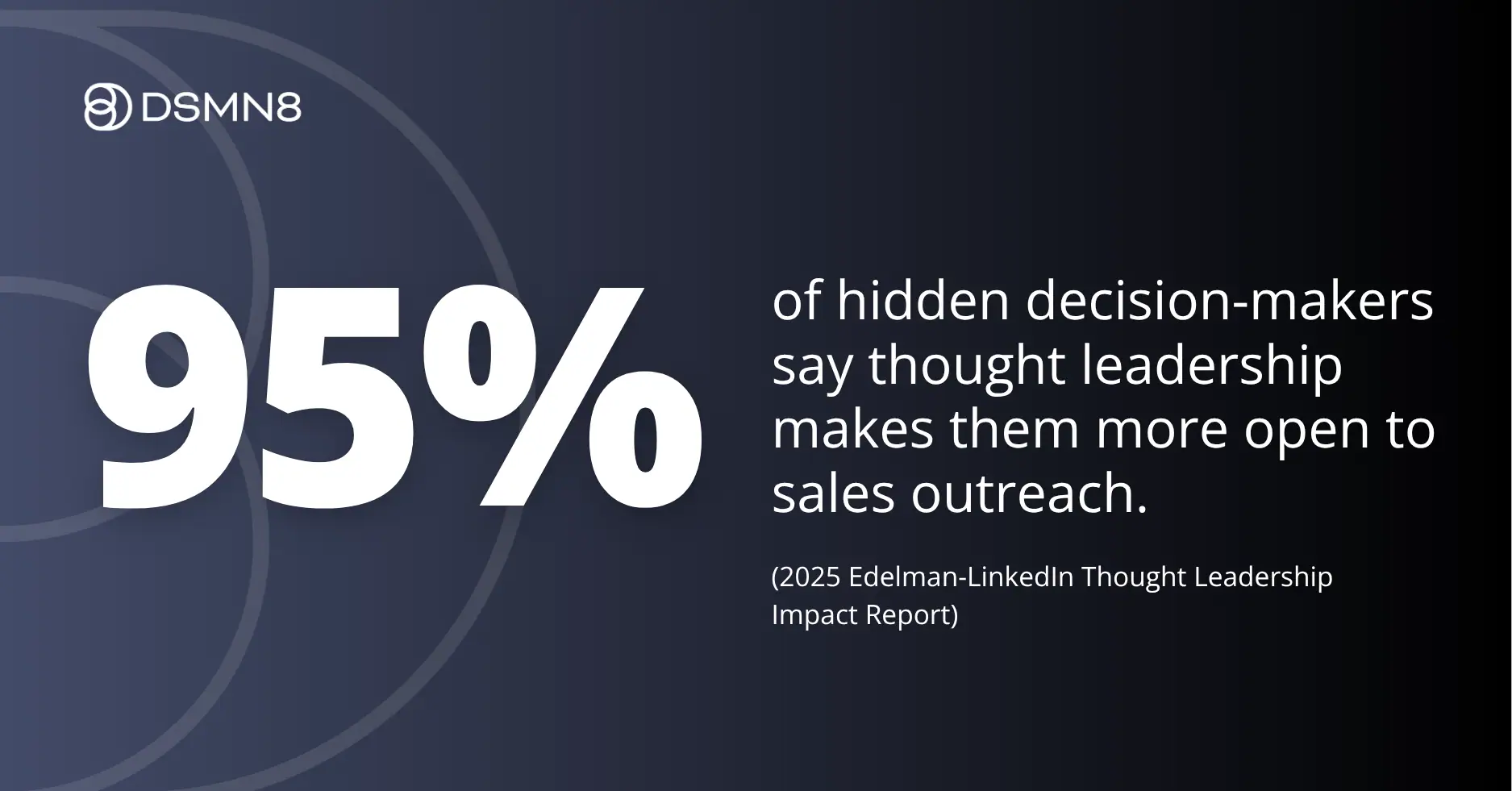
According to the Edelman-LinkedIn Thought Leadership Impact Report, 95% of hidden decision-makers say thought leadership makes them more open to sales outreach. These are people who aren’t even on your radar yet.
And that’s not all. 60% of decision-makers say they’re willing to pay a premium to work with companies that demonstrate strong thought leadership.
So it’s no surprise that the 2026 Employee Advocacy Benchmark Report found that 79.5% of employee advocacy programs involve senior leaders. Executive visibility is now the baseline for a strong program.
Executive thought leadership works. But is it being distributed as effectively as it could be? 🤔
The reach gap is a structural problem, not a content problem
Executive networks do, of course, grow over time, but LinkedIn’s algorithm distributes posts primarily to existing connections, which means reach scales gradually, constrained by the size of the audience an executive has built so far.
Engagement and content quality naturally play a role here in wider LinkedIn reach, but there’s an underlying ceiling when distributing content to a small group of senior leaders.
An advocacy program sidesteps that ceiling entirely.
This is what the difference looks like in practice:
| People sharing | Avg. connections | Potential audience | |
|---|---|---|---|
| Executive-only | 3 | 5,000 | 15,000 |
| Advocacy program | 500 | 1,180 | 590,000 |
Senior leaders typically have larger individual networks; we commonly see executive LinkedIn audiences of 5,000 or more compared to the employee average of 1,180.
But the math still favors scale.
That’s a 39x reach multiplier, not from producing more or better content, but from changing how existing content is distributed.
When you map out a company’s full employee base against how much of that potential audience is currently being reached, the picture is consistent: the vast majority of your potential audience is untapped.
💡 Want to see your company’s specific numbers vs your competitors? Get a free competitor analysis review to find out.

What employee advocacy actually does for thought leadership
Employee advocacy takes the content you’re already investing in and extends its reach far beyond what a handful of senior leaders can achieve alone.
For companies with an existing thought leadership program, the immediate win is amplification: no additional creation required, just wider distribution.
Employee advocacy can be taken further for maximum impact by encouraging original employee-generated content, building a cohort of employee content creators (Barclays is a great example of this), or simply using DSMN8’s Personal Voice AI tool to ensure every employee builds their own unique style and tone.
But you don’t have to start your program with this in place if you’re already focusing on executive personal brands. This means there’s no heavy lift when it comes to content.
Here’s what employee advocacy looks like when layered on top of an existing thought leadership initiative:
The ROI case for adding advocacy to thought leadership
The business case for employee advocacy is well-established, but it’s particularly compelling when framed against the alternative: paid LinkedIn distribution.
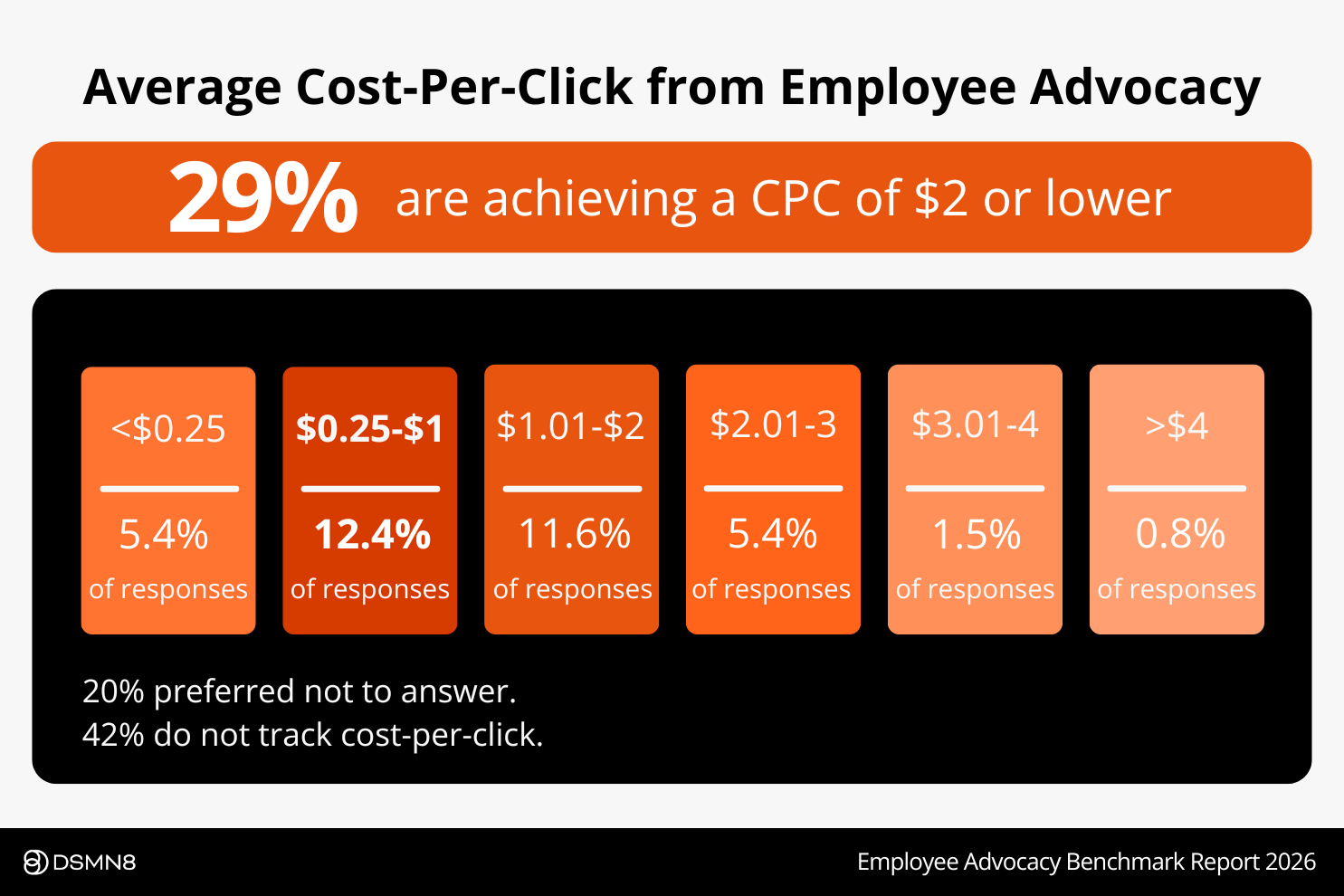
On cost efficiency, the Employee Advocacy Benchmark Report 2026 found that when CPC is tracked, the most commonly reported average from employee advocacy programs is under $1, with only 0.8% of respondents reporting over $4.
Compare that to LinkedIn Ads, where typical CPC ranges from $5 to $10, and the efficiency case makes itself.
The same report includes a telling real-world data point: one program manager reported seeing eight times the reach from their advocacy program compared to their corporate channels. And reach can compound fast: DSMN8 client General Motors reached 20 million people in just 6 months. Check out the case study.
And as we touched on earlier, this doesn’t necessarily require a major lift in content creation, especially if you’re already producing thought leadership.
Our recent analysis of 110,000 employee posts made in Q1 2026 found that text posts generated 3x more impressions than image or video posts. This is the recommended format for thought leadership and industry commentary.
It’s what your executives are already doing; employee advocacy just amplifies it.
Thought leadership and advocacy: the same investment, working at two different scales
The conversation that comes up when marketing and sales teams are looking to get more from LinkedIn is often framed as a choice: invest in executive thought leadership or invest in employee advocacy.
But they aren’t competing budget lines. They’re the same content investment, operating at two different levels of distribution.
Think about it in three layers:
The companies that get the most out of thought leadership investment are the ones running all three layers.

The infographic above shows what this looks like in practice. The executive layer, the employee network, and the company page aren’t three separate strategies; they’re one LinkedIn visibility strategy, operating at three different levels of scale.
For a real-world example of this in practice, this episode of the Employee Advocacy and Influence Podcast is worth a listen.
Megan Batterbury from incident.io explains how executive-led social presence created a culture where employees naturally amplify leadership content, driving significant spikes in website traffic and candidate applications as a result:

Starting the conversation internally
If you’re making the case for adding advocacy to an existing thought leadership investment, the numbers above are your starting point. The questions worth asking:
- How much of your total employee network is currently being reached by your content?
- What’s the earned media value of your current distribution, and how does that compare to your paid social spend?
- If 10% of your employees are already sharing organically, what would a structured program do with the other 90%?
Get your free competitor analysis review to see where you currently stand, and gain insights on your competitors.
If you’re ready to evaluate platforms, our employee advocacy RFP template walks you through the key features to look out for.
Additional Resources
Ready to get started with the #1 employee advocacy platform?
More resources you’ll find helpful:

Emily Neal
Emily is SEO Lead at DSMN8. She focuses on organic growth strategy across search and AI search and co-authors DSMN8's original research, including the Employee Advocacy Benchmark Report and edited CEO Bradley Keenan's book. Her background spans SEO strategy, technical web, long-form content, digital PR, and marketing automation.