

Last updated: 20th August 2026.
Content, Content, Content.
You know you need it, and lots of it.
Especially if you’re running an employee advocacy program.
It can be daunting 😫
Your employees need content to share with their social media networks.
Otherwise, employee advocacy simply won’t work.
But here’s the big question we get asked all the time: what kind of content? 🤔
Get this right, and both your company and your employees’ personal brands will skyrocket.
Today, we’re going to dial in on the types of employee advocacy content you need for your program.
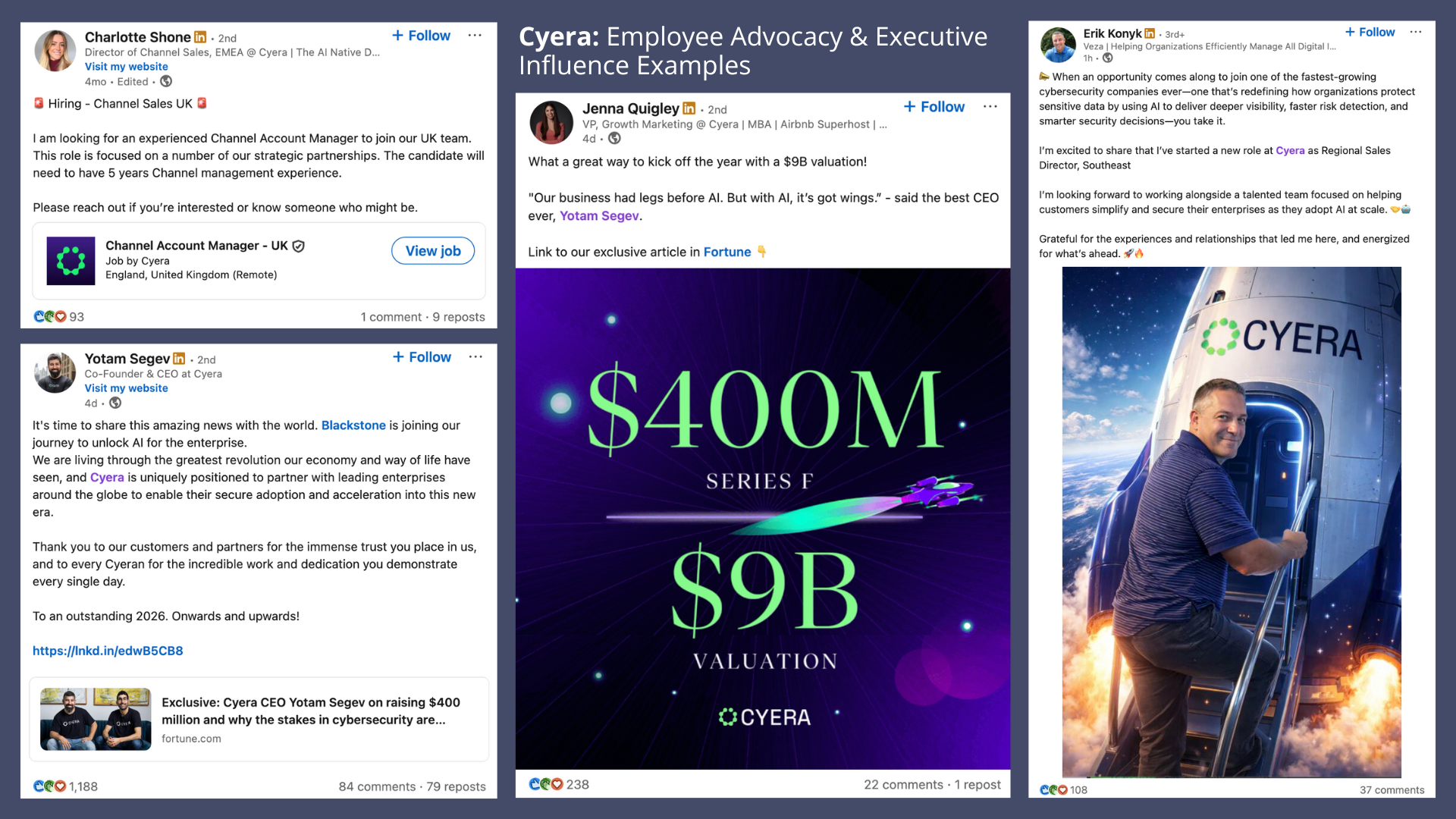
Cyera shares company news in an engaging social-first way. It’s no surprise that they topped our Global Employee Advocacy Rankings in 2025!
Company Content
Of course we have to start with company content.
That’s the priority for most companies when they start an advocacy program.
You want the world to know about your product, your services, new features, and company updates right?
But is that the be all and end all of employee advocacy?
I hate to break it to you, but no 😬
Think about this: would you want to fill your LinkedIn feed with corporate updates? And share that with your friends and professional network?
Probably not. And your employees won’t either.
Here’s why:
Employees aren’t robots who exist to share your company blog posts 🤖
What types of company content can I create?
- Company news, e.g., acquisitions, financials.
- Content about new products or features.
- Promotions or sales.
- Open job positions.
- Awards your company has won or been nominated for.
- Success stories and case studies.
The key here is balance. This type of content is important for your business, but it needs to be used in moderation.
Sprinkle in some company content alongside the other kinds of content we’re about to talk about!
Who Shares it Best?
Senior Leadership, PR Teams, C-Suite
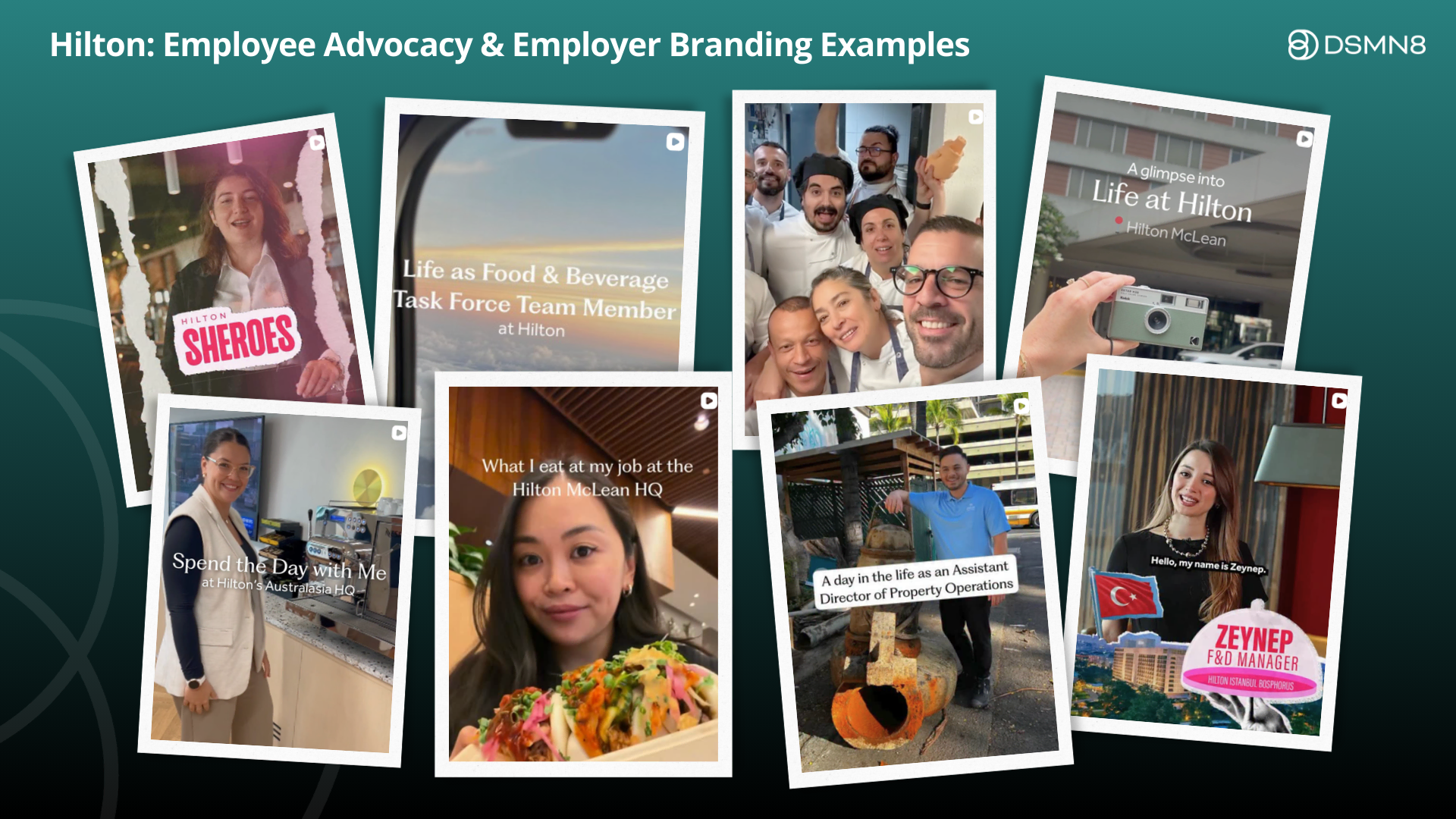
Hilton is a great example of employee-focused employer branding content. Learn more in our interview with employer branding expert Carrie Corcoran.
Employer Branding Content
Employer branding.
It’s become a bit of a buzzword over the past few years, especially since remote working is on the rise.
How do you create and promote a positive company culture when your employees are spread across the world?
Meet employer branding.
Employer branding content influences how people perceive what working at your company is like.
Behind-the-scenes content, employee interviews, and employer-branded hashtags like #LifeAtGoogle. You get what I mean.
Content that shows your workplace culture. Your diversity. Company perks. How your employees follow your company values. How you give back to your local community. The human side of business.
Think about how much employer branding content will help your recruitment process. It’s a no-brainer!
Employer Branding Content Ideas:
- Welcoming new hires.
- Employee stories or spotlights.
- Pics of work social events.
- Personal achievements of your employees, e.g., running a marathon or raising money for charity.
- Behind-the-scenes of employees at work.
- Diversity and inclusion content, e.g, Pride events.
- Professional development events, e.g, conferences or courses.
- Ask your remote workers to share pics of their work-from-home offices!
Who Shares it Best?
HR, Marketing, New Hires, Recruiters
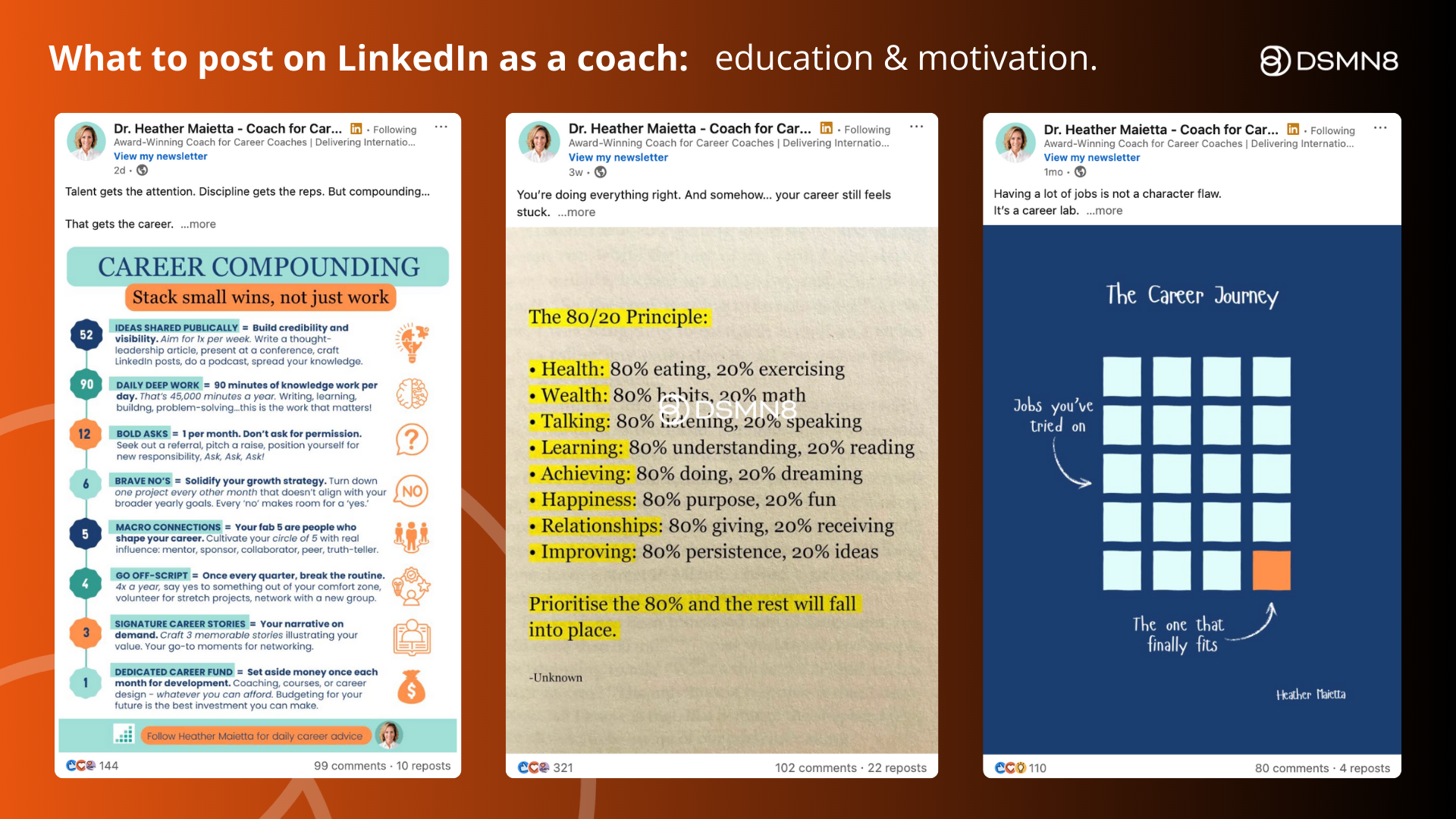
Here’s a great example of how educational content can be made easily digestible on social by Dr Heather Maietta. She grew her LinkedIn audience to 53,000 in just over a year! Find out how and see more examples.
Educational Content
So, you want your employees to build a following on social media?
Well, if they only share company and employer branding content… they probably won’t get very far 🤷🏻♂️
Aside from personal connections like previous colleagues and friends, why would someone follow your employees on LinkedIn if they only talk about their company?
Here’s where you need to get into your ideal audience’s mindset 🧠
What content would they want to see?
It comes down to value.
Does your content actually provide value? 👀
Is your blog post answering a question and providing expertise?
Content needs to serve a purpose, and education is a great one.
Did you know that 62% of LinkedIn users engage with informative and inspiring content?
Got a computer scientist in your company who really knows her stuff? Ask her to share some of her knowledge and write an article about your industry! 👩🏻💻
This doesn’t have to be a 5000-word paper. It could even be a 2-minute TikTok video. Encourage employees to share their expertise, and they could become the next big employee influencer or thought leader.
Creating great educational employee advocacy content can take a bit more work than the other options, but it’s absolutely worth it. 💪
Your followers (and your employees’ followers) are more likely to read and engage with educational content than company news.
It adds to your credibility and shows that your social media presence isn’t all about selling stuff.
Sales, Marketing, Support/Service Teams
Personal Development
Educational content doesn’t all have to be directly related to your business or industry.
Why not ask your c-suite execs to share their top productivity tips? Or give advice to university graduates just starting their careers?
This kind of content is very popular on LinkedIn, and can be super inspiring to your junior employees and interns. A win-win! 🏆
Employee-Generated Content
Before overwhelming your marketing team with all these new content requirements, remember that employee-generated content is a huge part of advocacy.
People trust people way more than brands 🤝
In employee advocacy, authentic employee content is fundamental.
Rather than simply sharing an article, an employee who adds their own insights will demonstrate their expertise and build a strong personal brand.
Employee-generated content will boost your employer branding content by a long way.
Say you’ve had a team-building event or a workshop. You take pictures and post them on the company Instagram page. Great!
What’s even better? Your employees sharing their own photos on own pages, using your hashtag. This demonstrates that employees really are engaged and enjoy working at your company. It feels more genuine!
Potential recruits will absolutely have a look at your company on social media. In fact, Glassdoor reports that 79% of job applicants use social media while job searching 🔍
These potential recruits won’t just look at your official pages, but also at your company hashtags and mentions. If they can see a bunch of positive content from current employees, they’re much more likely to consider applying to work for you.
Plus, in the world of AI, LinkedIn posts are being cited by LLMs. This matters for increasing your brand visibility, and should be considered as part of your SEO/GEO strategy.
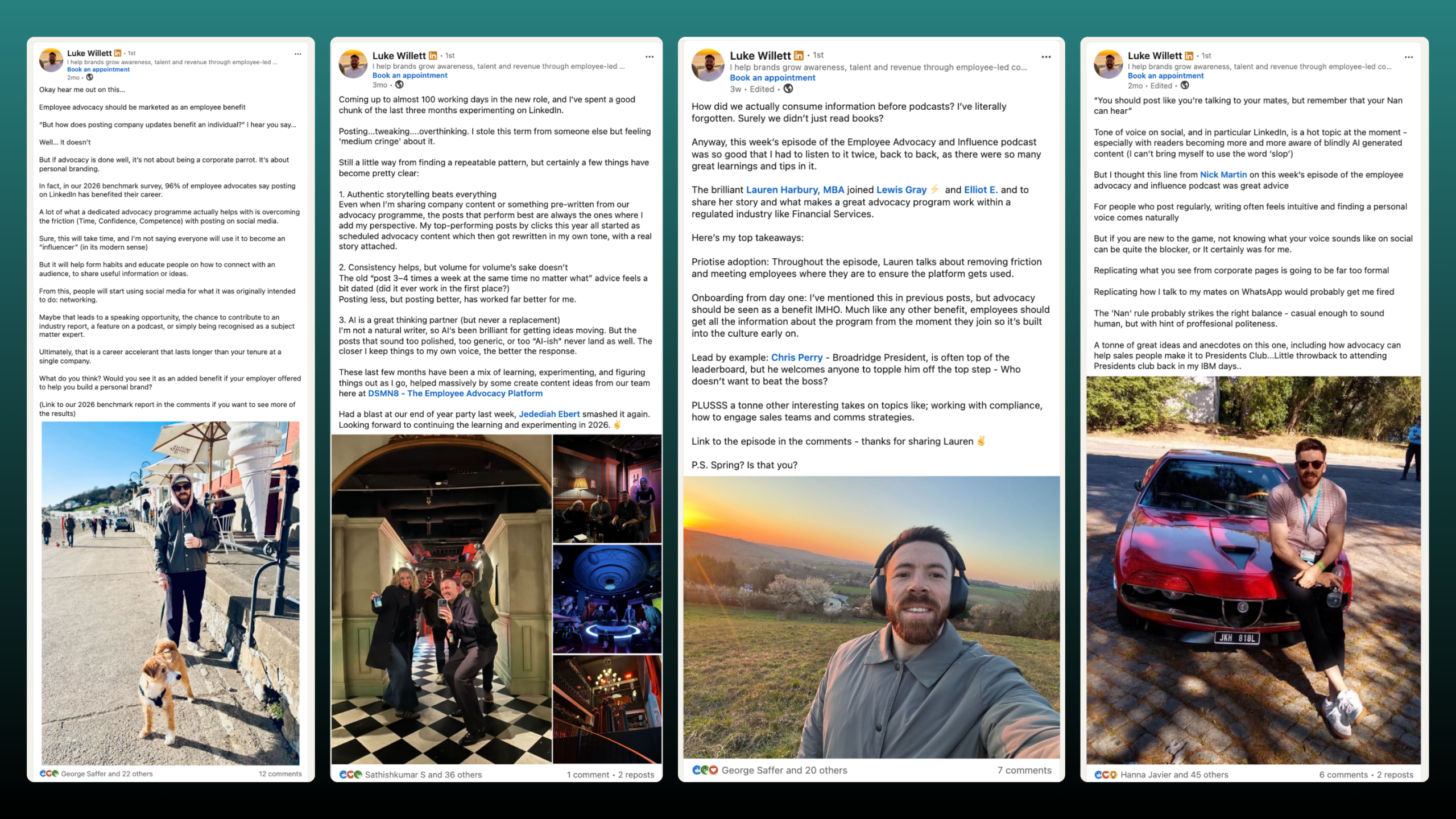
Our very own Luke doing the most with original content 👏 Find out more about how the DSMN8 team uses DSMN8.
How To Encourage Employee-Generated Content
Don’t just tell your employees to ‘create content’.
Give them examples of what you’re looking for.
Ask marketing to give everyone some content creation tips ✏️
Make sure your social media training is up to scratch.
Sounds like a lot of work, right?
Don’t worry, we’ve already created an employee advocacy training plan for you. Oh, and we’ve got a free social media policy template as well!
Most importantly, remember that you can’t force advocacy. Some employees won’t want to participate, and that’s okay.
Consider who your ideal employee advocates are.
DSMN8 CEO Bradley Keenan covered this in a podcast about why you should limit employee advocacy.
A 100% user adoption rate should never be the goal.
Third-Party Content
Definitely try to add third-party content to your advocacy platform where possible.
Whenever your company or product is featured in the media, get your employees to share the content.
Why? Surely I just want to get clicks to our company website?
No! ❌
Employee advocacy is about raising your overall social presence, improving your company image, and enabling employees to build personal brands.
Third-party recommendations and reviews provide the social proof you need ✅
If your company is new or doesn’t have many media features yet, don’t despair.
Here’s another way you can use third-party content for your employee advocacy program:
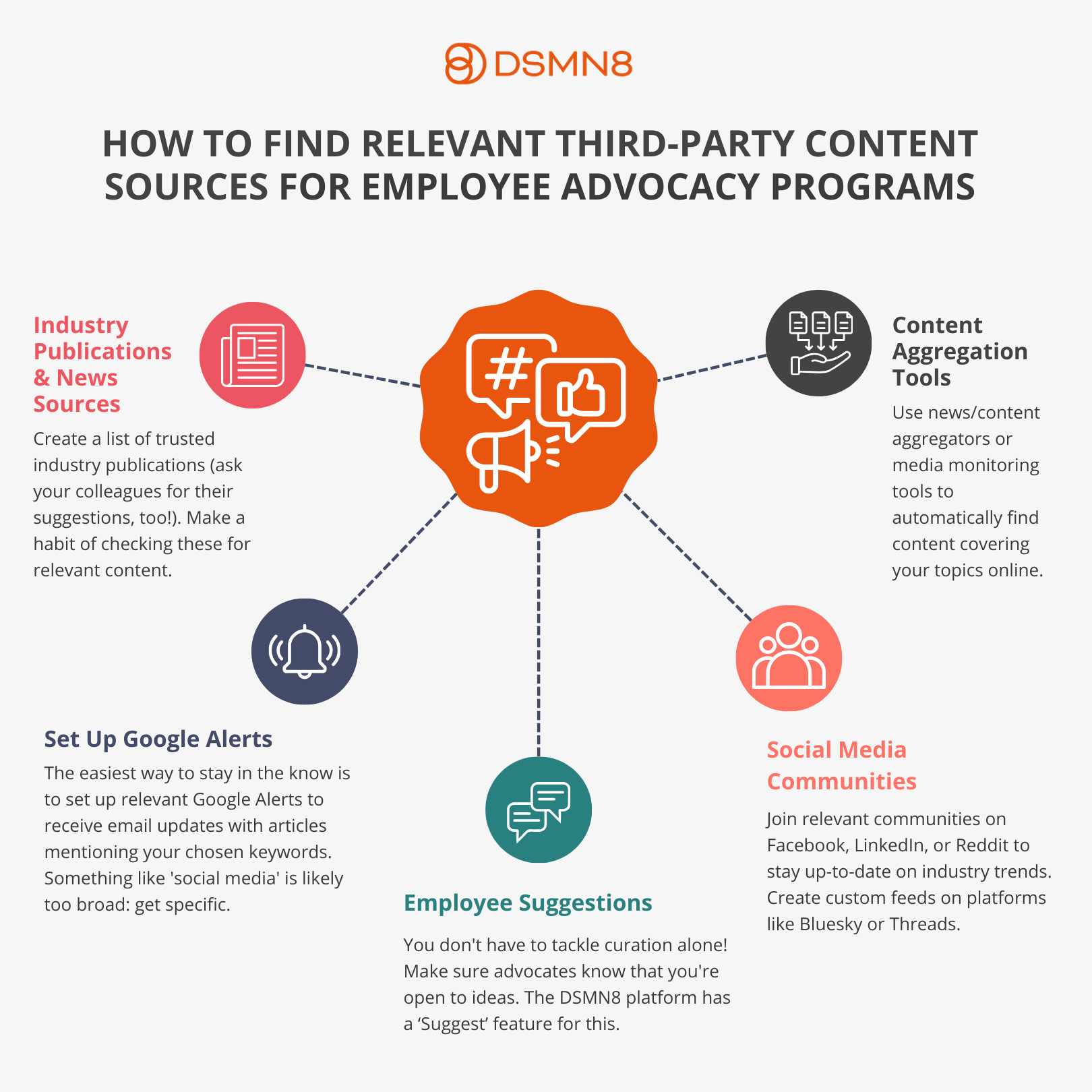
Industry News
What are the biggest media outlets, blogs or YouTube channels in your industry?
For example, if you work in social media, Influencer Marketing Hub and Social Media Today are big names.
Find relevant content from them to share. Add your own insights if you want to take it to the next level 💪
Your audience will see you (and your employees) as helpful. They’re knowledgeable about the latest industry news and add value by providing additional insights. This is the goal.
Plus, if you haven’t built a big content library yet, this will help you out.
One of the biggest issues we see with failing employee advocacy programs is that there simply isn’t enough content for employees to share.
If that’s the case, all of your employees will end up sharing the same piece of content, which doesn’t come across as authentic 😫
Our 2026 Employee Advocacy Benchmark Report found a wide spread here: some organizations publish up to 10 pieces of shareable content a week, while others manage only 1–2. If you’re at the low end, that’s likely why all your employees end up sharing the same post.
Sharing third-party content, especially from established names in your industry, really helps with this problem. It takes a little bit of pressure off your marketing team, too!

Consider trying different content formats like video.
Make It Engaging
There are so many ways to create engaging content these days, from your traditional blog post articles to podcasts to TikTok videos!
If your content is feeling a bit stale, it’s time to switch it up.
Be visual with your storytelling 📸
Make it interactive with polls and quizzes.
Encourage engagement by asking questions in your posts and replying to the comments. To keep things tidy and focus on authentic voices, many brands use tools for advanced moderation of comment sections on Facebook and Instagram, like CommentGuard.
Don’t be afraid to experiment and try something new.
If you haven’t made video content yet, why not dip your toes into it? Turn your written content into a YouTube video. Then, cut them down into TikToks or Reels.
Repurpose the content you’ve already created for different channels.
Work smarter, not harder! 👏
The Key Takeaways
Create content that your employees will want to share, and their followers will want to read.
Yes, your company content is important.
BUT
Combining that with the other types of content we’ve just covered will make your program even better.
Check your advocacy program analytics. What’s working well? Create more of that.
Is something not getting the engagement you hoped for?
Ask for employee feedback. Give them space to voice their opinions about your content.
💡 Top Tip: If you’ve not yet started your employee advocacy program, grab our free employee social media survey to get feedback about your social presence.
A final point to keep in mind is that you don’t have to reinvent the wheel here. Have a look at what works for other brands – within your industry and in general.
Most of all, have fun with it!
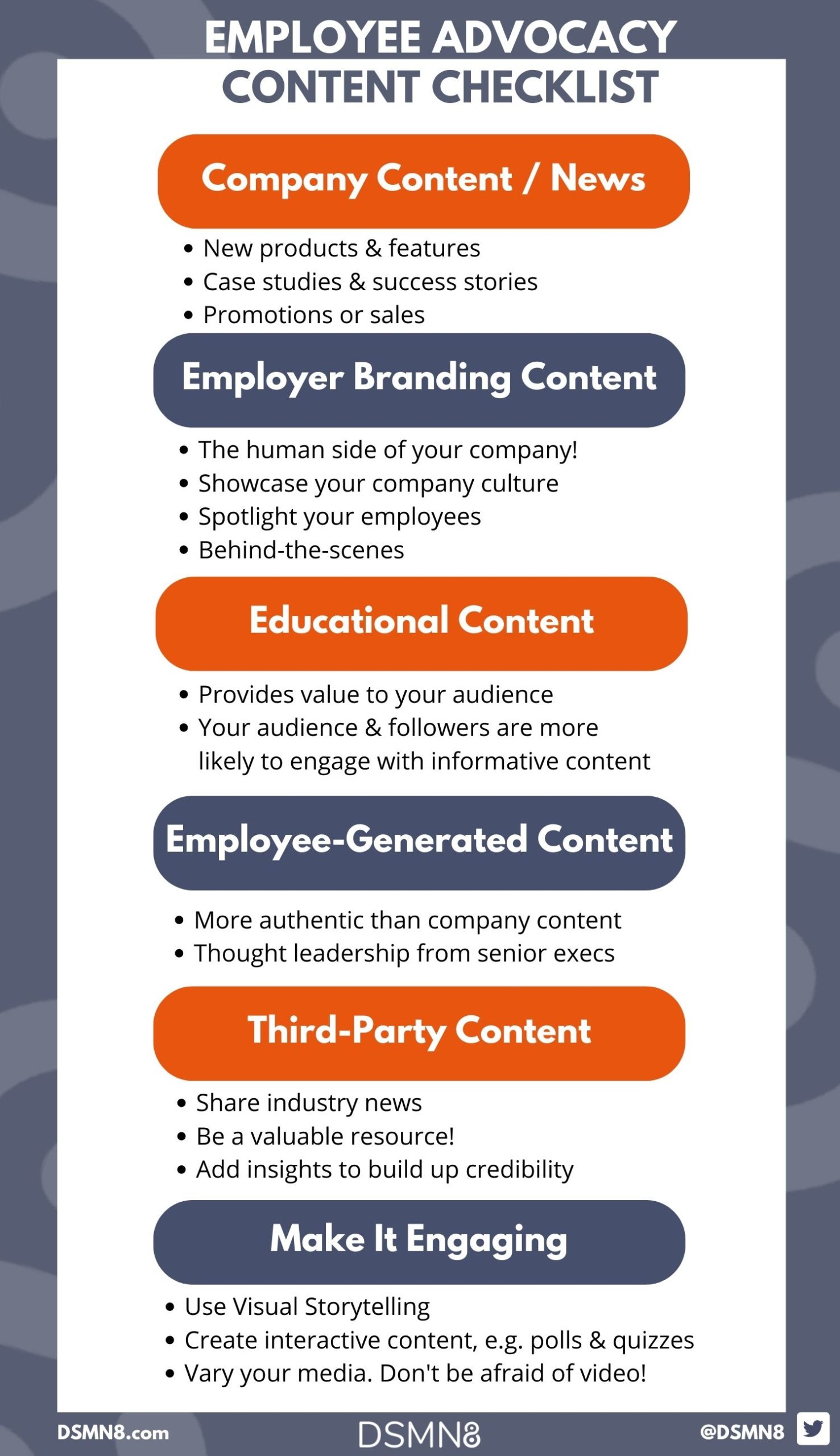
Employee Advocacy Content Checklist
Phew, that was a lot to take in 😅
To help you plan your employee advocacy content, we’ve created a handy PDF checklist. Download it below!
Ready to get started with the #1 employee advocacy platform?
Wondering how active your team already is, and how this compares with your competitors?

Emily Neal
Emily is SEO Lead at DSMN8. She focuses on organic growth strategy across search and AI search and co-authors DSMN8's original research, including the Employee Advocacy Benchmark Report and edited CEO Bradley Keenan's book. Her background spans SEO strategy, technical web, long-form content, digital PR, and marketing automation.