


Last updated: July 15th 2026.
As a marketer, you probably feel like you’re fighting an uphill battle when it comes to content. From maintaining a company blog to various social channels…
You’re creating more and more for less engagement.
Capturing attention online feels more difficult than ever before 😫
There are simply so many more content creators and publications to compete with.
Not to mention the ever-changing social media algorithms!
If you’re in a small marketing team or the only content creator at your company, it can become a tad overwhelming.
But don’t panic!
Content marketing success isn’t all about creating fresh pieces at a faster pace.
Today, we’re covering how to extend the shelf-life or lifespan of marketing content.
Following these 5 steps will help you get the most from every blog, podcast, or social post you create.
1. Make It Evergreen
First, prioritize creating evergreen content.
The types of pieces that stay relevant for a long time, with minimal updating needed.
Always keep in mind when planning your content strategy that a ‘How To’ article will naturally have a longer shelf-life than a ‘2024 Trends’ article.
If your goal is to get more organic clicks from Google, quality evergreen content is the best way to establish a sustainable SEO strategy.
At the enterprise level, advanced SEO tools become essential for managing content across thousands of pages, spotting growth opportunities, and keeping everything aligned with search intent.
You’ve only got so much resource at your disposal, so instead of firing out a bunch of new articles every week, focus on creating content that will stay relevant for a longer period of time.
It’ll also give your social media manager something to re-share when their calendar is looking a bit sparse.
We’ve written a guide on how to create evergreen content, so make sure to check that out for more tips.
2. Give Old Content a Refresh
Don’t let your old content die!
Your company blog shouldn’t be a graveyard 🪦
Plan time for amending older content to keep it up-to-date. An audit every few months should suffice!
For example, if you shared a ‘State of Marketing’ report for your industry 2 years ago, can this be updated with any fresh insights or changes?
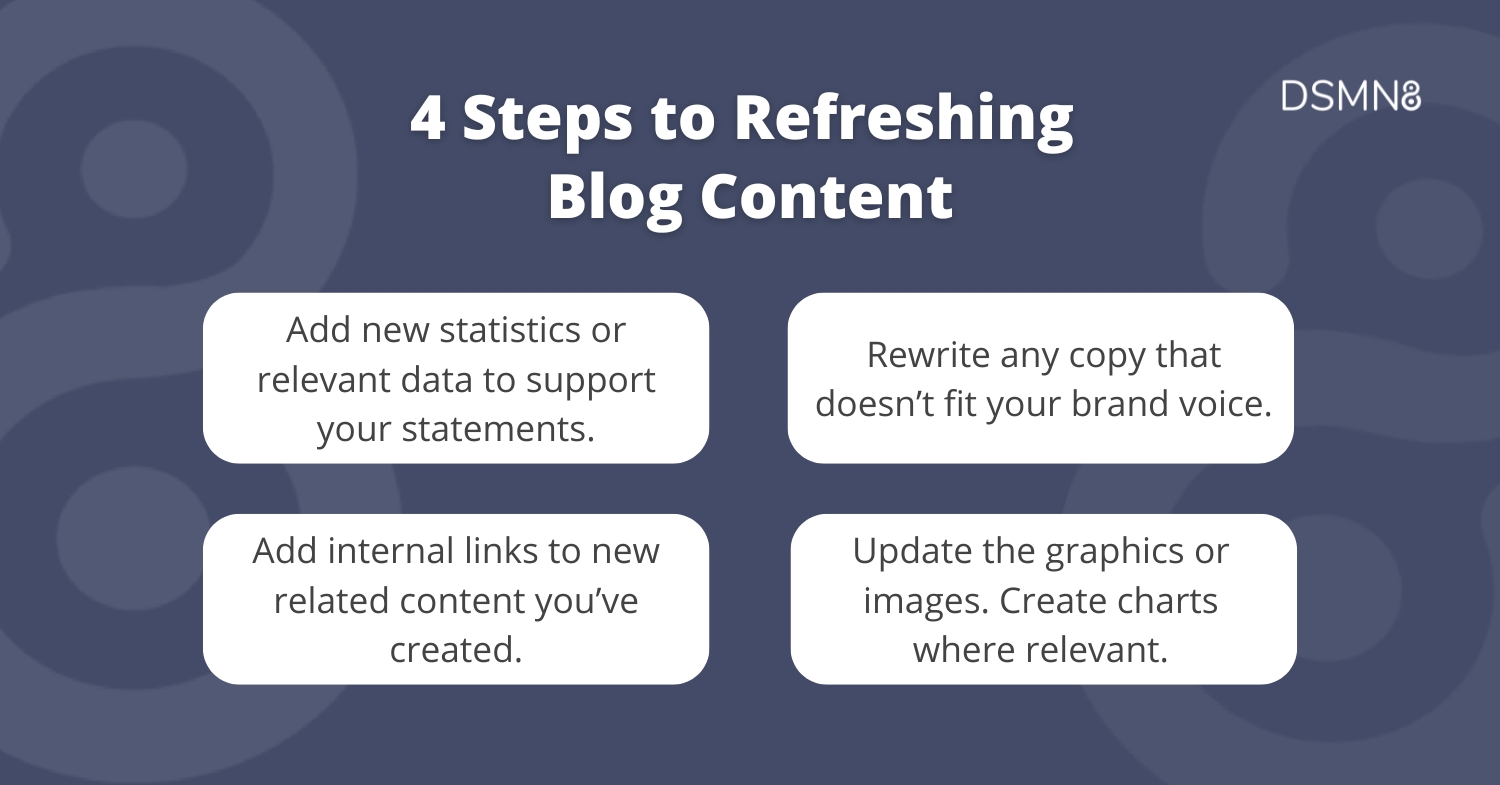
4 Steps for Refreshing Content:
- Add new statistics or relevant data to support your statements.
- Rewrite copy that doesn’t fit your brand voice.
- Add internal links to new related content you’ve created.
- Update the graphics or images.
A content refresh is a way to send positive signals to Google, getting more eyes on your articles. Plus, your updated content can be shared again on social media. A win-win! 🏆
If you’re time-poor, discover your best performing content in Google Analytics, and prioritize updating those first.
3. Same Message, Different Format
Be like Spiderman. The actor changes, but the character is the same 🕷
The content format changes, but your core message remains.
Social media is constantly evolving, the biggest recent example being the explosion of short-form vertical videos.
Repurposing content for different platforms is a big win for small marketing teams and content creators / influencers.
You can reach more people with new formats, while using the work you’ve already created.
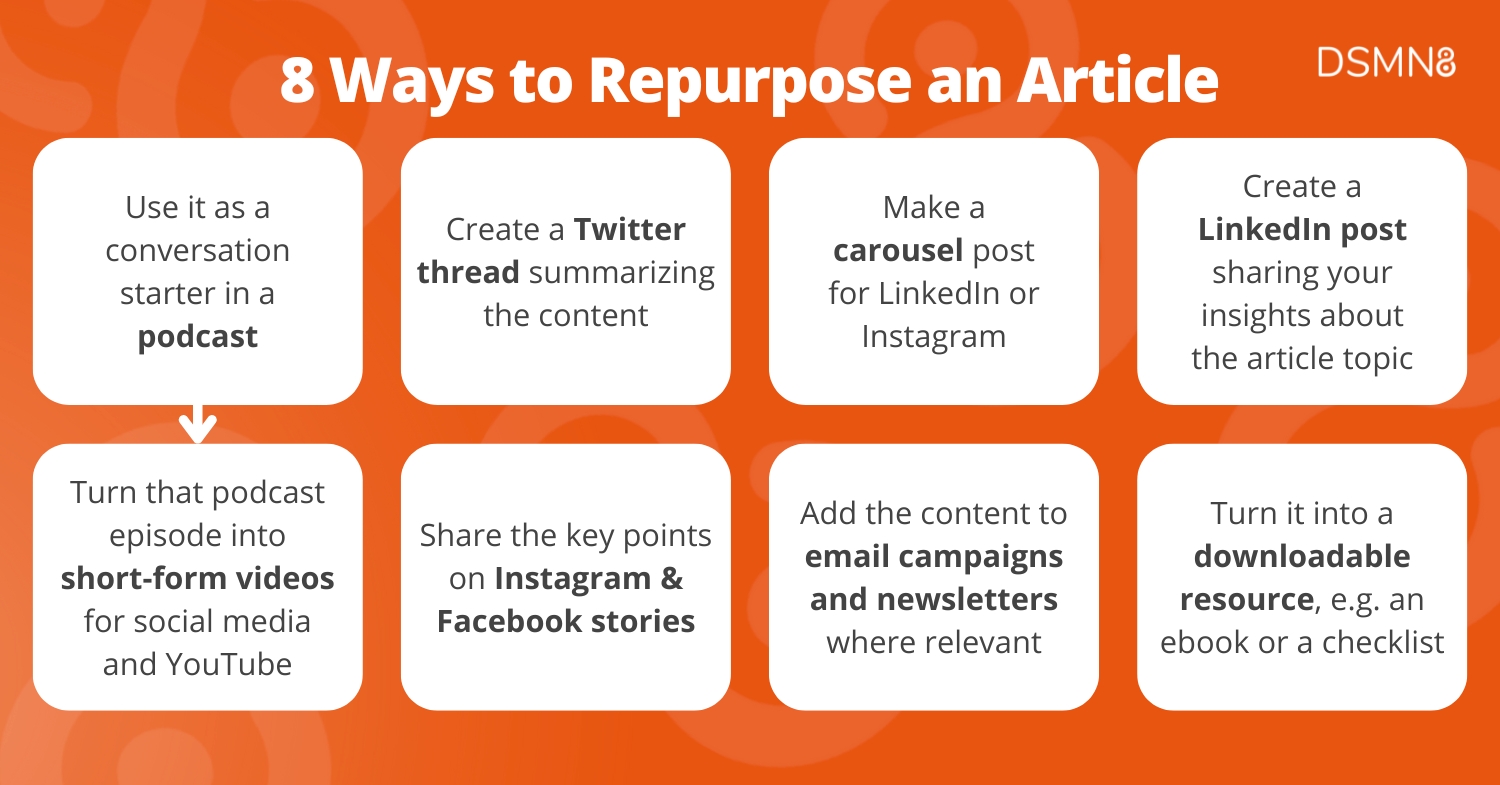
Use Blog Posts as a Starting Point for:
- Twitter threads
- LinkedIn posts
- YouTube videos
- Carousel social posts (LinkedIn, Instagram)
- Podcast episodes
- Short-form videos (TikTok, Reels, YouTube Shorts)
- Instagram stories
- Email marketing campaigns, such as a content series or sharing in your newsletter
- A prompt for your executives to share thought leadership on LinkedIn
Using an array of content formats not only allows you to reach a larger and more diverse audience, but it also extends the longevity of your content overall. This in turn provides more ROI from each piece.
Instead of becoming buried in your company blog or LinkedIn feed, repurposing breathes new life into what you’ve already created 🌱
Remember to follow the best practices of each platform you’re sharing to – repurposing isn’t just copy-pasting across channels.
Writing a great LinkedIn post is different to crafting an Instagram caption. Don’t forget to consider the different social media image sizes and aspect ratios, too.
While this will take more time than simply resharing a link to your article, it’ll drive better results!
If you’re producing a podcast, follow Justin’s approach:
1. We grab a couple of clips from the video and publish them to my LinkedIn, tagging the guest. This keeps me top of mind with my network and prospects.
2. We publish the podcast summary to the website, along with the video from YouTube.
3. These short blog posts are getting picked up by SEO searches and AI searches.
That’s how we get deep-level piece of content quite a bit of spread around the internet. While my agency produces all sorts of content, this content play has the most “bang for buck” repurpose-ability, which is kinda cool.

Justin Vajko, Founder, Dialog Video Marketing.
4. Level Up with Downloadable Content
Go through your top-performing content from the past 6 months and create downloadable assets for them.
I’m talking about ebooks, printable checklists, infographics, data visualization, such as different types of charts and graphs…
It sounds like a lot of effort, but it’s really not.
You’ve already done the research and written the content, so all you need to do is present it in a new way!
4 Reasons to Create Downloadable Resources:
1. Increase the longevity of your content by creating resources that others are more likely to share on social media and link to in articles.
2. Gain more email subscribers by creating ‘gated’ opt-in content like ebooks. To ensure those subscribers actually receive your emails, use an SPF checker to verify your domain and improve deliverability, and complement it with a DKIM checker to confirm that your messages are properly authenticated.
3. Engage your audience in a new way by presenting ideas in a different format.
4. Become known as a helpful authority in your industry!
5. Leverage Employee Advocacy to Promote Content on Social Media
As a marketer, it’s absolutely worth encouraging your team to share content on social media, even if you don’t have an official employee advocacy program.
Why? 🤔
You can reshare and repurpose content on your official brand channels… But the reach will still be limited.
We all know that the LinkedIn algorithm doesn’t prioritize company pages 😫
But what if you ask your colleagues to create and share content?
People are much more likely to read and engage with content by people rather than brands.
When employees share content, it boosts your visibility by up to 561% 🤯
And as your colleagues build their personal brands, you’ll extend the shelf-life of your content.
Remember that as their audiences grow, new followers won’t have seen content posted 3 months ago.
So once you’ve refreshed your content and made it evergreen, they can share it over and over again 😏
All you’ll need to do is provide multiple images and social media captions to avoid everyone sharing the same thing, and you’re good to go.
DSMN8 makes social media easy for employees, empowering them to find and share the content you create, with automation and AI features to streamline the process.
Spend less time on marketing content distribution, while generating better results.
Watch the 90-second platform demo below for a quick overview:
You don’t need to try just one of these strategies alone to increase the longevity of the content your marketing team produces. They can all work well together alongside other areas, such as paid amplification.
Madison explains her approach:
Treat each content asset like a system, not a deliverable. Raw material is a whitepaper or report.
We pull out the best quotes and data and put them into LinkedIn carousels, short designs on a standalone infographic that gets backlinks, and manually type out the best quotes to give to sales as conversation starters. One report will create eight or more derivative assets for different funnel stages and search intents, with a pillar page serving as one of the assets for a supporting article cluster that are used to target long-tail keywords that the pillar wasn’t specific enough to rank for.
The tail is lengthened through employee advocacy, a virtually costless production effort. We create 3-5 different variations of the same post to LinkedIn in the voice of the skeptic, practitioner and leader which each link back to the original asset and continue to drive traffic long after the publish spike dies out.
We do not use paid social media as a crutch, it is our amplifier. When organic posts are successful in the first 48 hours we boost them to paid and also create 15-second motion graphics that we can repurpose to Reels and pre-roll, increasing behavioral signals to boost the organic ranking long after the campaign.

Madison Kirksey, Creative Director & SEO Strategist at Direction.com
Ready to get started with the #1 user-rated employee advocacy platform?
More tips for your content marketing strategy:

Emily Neal
Emily is SEO Lead at DSMN8. She focuses on organic growth strategy across search and AI search and co-authors DSMN8's original research, including the Employee Advocacy Benchmark Report and edited CEO Bradley Keenan's book. Her background spans SEO strategy, technical web, long-form content, digital PR, and marketing automation.