

What's on this page:
- Why Build an EGC Program.
- Step 1: Set a Clear Objective Before You Build Anything.
- Step 2: Put Governance in Place.
- Step 3: Build the Content Ecosystem.
- Step 4: Activate Employees as Creators.
- Step 5: Consider Running EGC as an Employee Advocacy Micro-Program.
- Step 6: Measure Against the Right Objectives.
- Additional Resources
Last Updated: August 14, 2026
Most organizations already understand why employee-generated content (EGC) works.
The data is well established: personal posts outperform corporate ones, employee networks extend far beyond the reach of a company page, and authentic voices carry more weight with both buyers and candidates than polished brand messaging.
The harder question isn’t whether to invest in EGC, it’s how to turn occasional, ad-hoc employee posts into a repeatable, scalable program.
There’s a meaningful difference between having some employees who post sometimes and having an EGC program that consistently produces content across formats, functions, and seniority levels.
This guide covers how to build that program: from setting the right goals and putting governance in place, to activating employees as genuine creators rather than just content distributors, with real examples and insights from program leaders at Barclays and the BT Group.
If you’re new to EGC and want to start with the foundations first, our Ultimate Guide to Employee-Generated Content has you covered.
Why Build an Employee-Generated Content Program
Without structure, EGC tends to follow a predictable pattern: a burst of activity when someone senior mentions it, then a gradual return to silence.
Employees have no clear guidance on what to create and no feedback loop that shows them their efforts matter. So they stop.
A dedicated EGC program gives employees a reason to participate, a process to follow, and visibility into the impact they’re creating. It gives the organization a content pipeline that scales rather than one that depends on whoever happens to feel inspired that week.
If you’re already running an employee advocacy program, an EGC initiative fits naturally within it: a smaller niche group of content creators, who are then amplified by the larger pool of advocates. We’ll cover how to structure that in Step 5!
Step 1: Set a Clear Objective Before You Build Anything
EGC can serve multiple goals, but the content mix, the activation approach, and the metrics you track will all look different depending on what you’re trying to achieve.
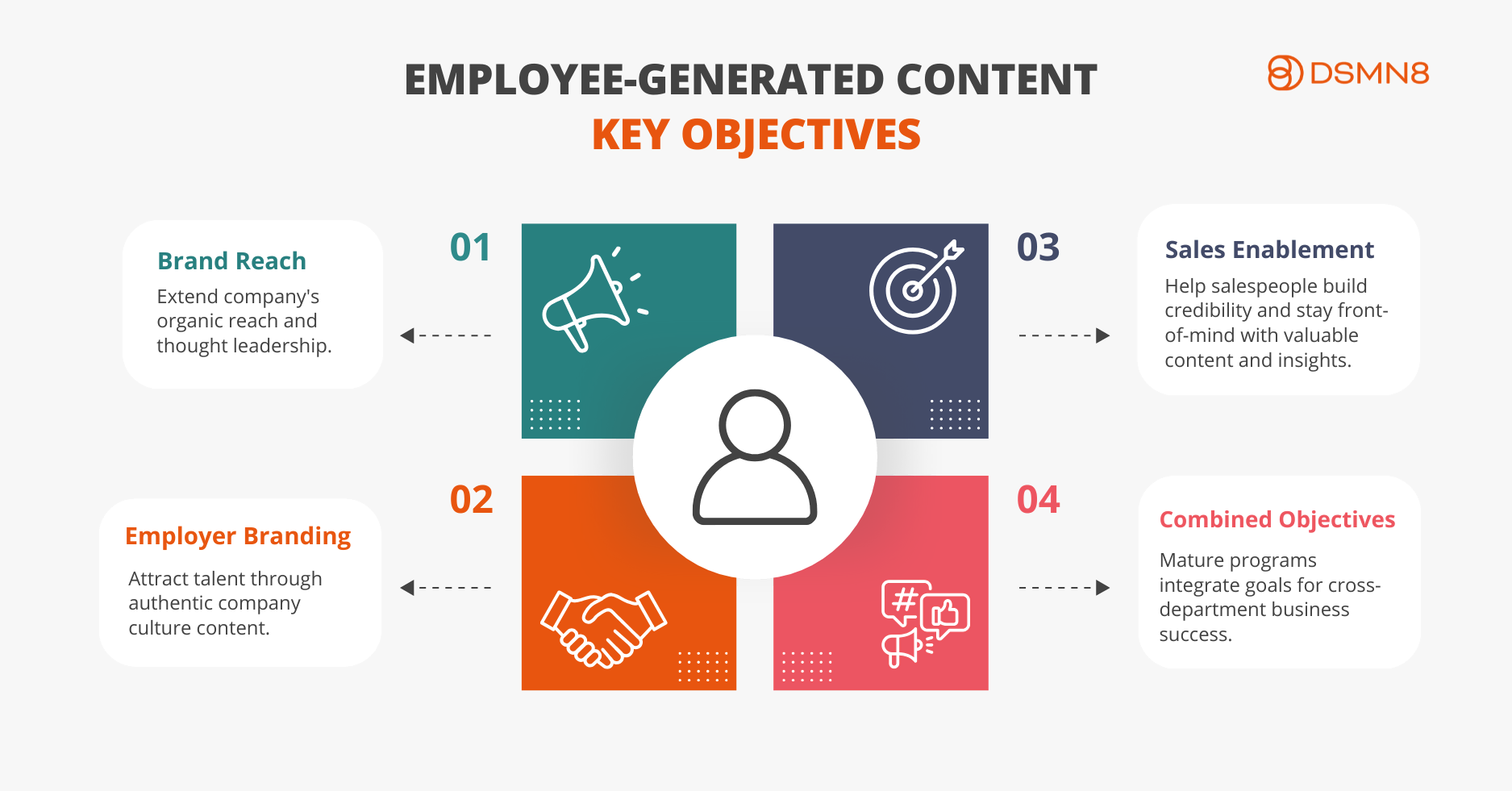
The most common objectives fall into a few distinct categories:
1. Brand reach and thought leadership
The main focus here is extending the company’s organic reach on LinkedIn and beyond, positioning employees (particularly senior leaders and subject matter experts) as credible voices in their industry.
This type of EGC is closer to personal branding and tends to require more investment in coaching and content support for participants.
2. Employer branding and talent attraction
The goal here is to give candidates an authentic window into life at the company through culture content, behind-the-scenes moments, and employee perspectives on their roles and career growth.
This is particularly powerful for recruitment, where candidates are doing more research than ever and are highly attuned to content that feels staged versus genuine.
AI tools now synthesize a company’s social media presence across LinkedIn, Instagram, and other platforms in seconds, giving candidates a picture of your employer brand in a single prompt, including direct comparisons against competitors. Organizations with strong EGC show up well in those results.
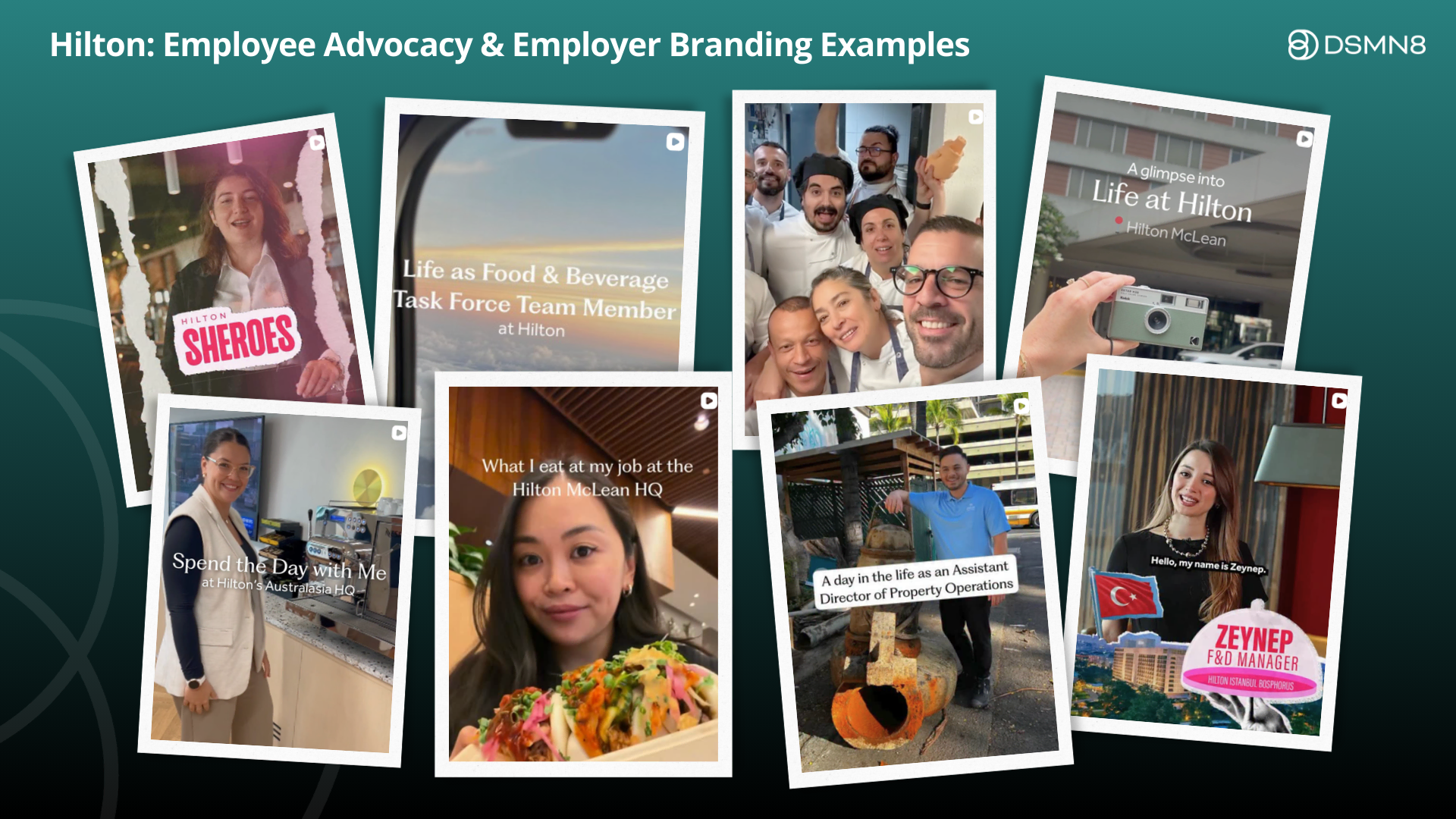
Hilton is a great example of getting this right: they launched a dedicated Instagram channel featuring employee takeovers, cultural spotlights, and behind-the-scenes content spanning regions worldwide.
This is the kind of authentic, employee-led material that surfaces strongly when candidates research the company in LLMs today.
3. Sales enablement
The goal for sales-led EGC programs is to encourage commercial teams to share content that builds credibility with prospects and keeps them visible across long buying cycles.
The content here is more targeted: industry insights, product use cases, customer success stories.
A combination of the above
Many mature programs run all three in parallel, but they typically start with one dominant objective and expand from there.
Once you’ve identified your primary objective, the content types and activation strategy follow naturally from it.
A talent attraction program needs different content than a thought leadership program, and it needs different people involved.
Step 2: Put Governance in Place
This is the step many organizations skip, and it’s the most common reason programs stall after launch.
Establishing clear governance means you’ll have the answers to practical questions employees will ask before they’re willing to participate.
According to the Employee Advocacy Benchmark Report 2026, 13.2% of employees cite company policies as a barrier to participation, and that’s among organizations that already have programs in place. The figure is likely far higher where advocacy or EGC hasn’t even been attempted.
Restrictive or vague social media policies don’t protect the organization; they just ensure employees don’t post at all.

Who is responsible for the program?
In most organizations, EGC programs sit across Marketing, HR, and Communications, which can easily become a situation where everyone assumes someone else is managing it.
Assign a named program owner and, if the program is large enough, representatives from each function.
For more details on how to structure this, our post on employee advocacy program roles and governance covers this in depth.
What are the guidelines?
Employees who aren’t sure what they can and can’t post won’t post at all.
A social media policy designed around fear tends to produce silence, but one designed around empowerment tends to produce participation. Grab our free social media policy template to get started.
Pair it with a social media guidelines document that employees can reference easily, and make both findable rather than buried in your intranet.

Step 3: Build the Content Ecosystem
Rather than asking employees to generate content from nothing, give them the infrastructure to make it easy. The blank page is the most common reason people intend to post and don’t.
Three things you can do to support employee content creators:
Content prompts and inspiration
Many employees want to post but don’t know where to start.
A bank of content prompts organized by theme, format, and objective removes the blank-page problem.
Prompts might include: “Share something you learned this week,” “What does a typical client conversation look like for you,” or “Introduce a team member you work closely with.”
These don’t script the content; they give employees a starting point and let the personality come through.
A centralized content library
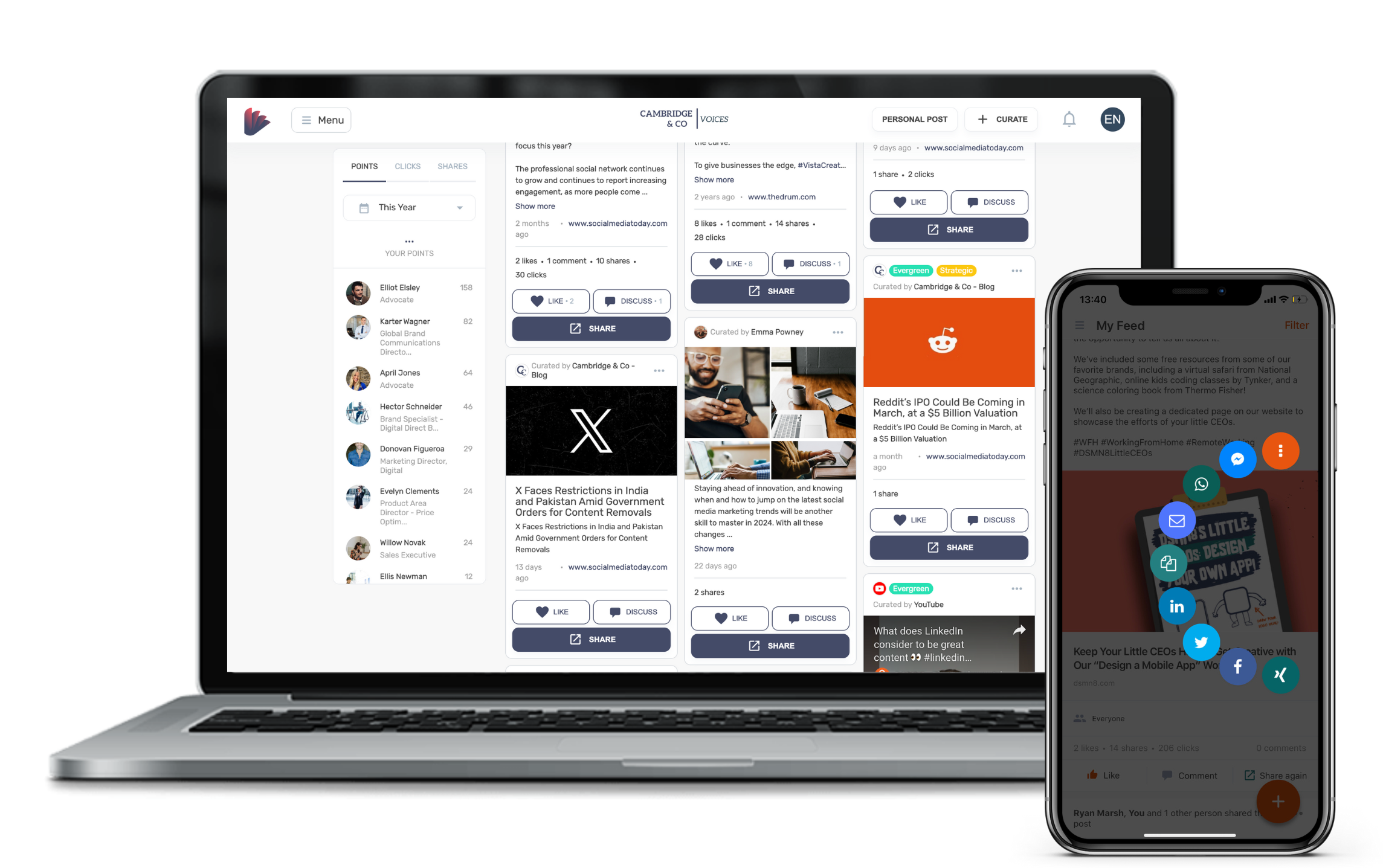
Give employees a library of pre-approved company and industry content they can share with minimal effort. An employee advocacy platform like DSMN8 makes this easy to manage, especially as your program grows.
Not every employee wants to create original posts. Some will only ever share curated content, and that’s a legitimate form of participation.
What matters is that they personalize it: our analysis of over 500,000 employee LinkedIn posts found that even minor caption edits, like adding a personal intro or tweaking a sentence, generate 3x more engagement than sharing content without edits.
DSMN8’s Personal Voice AI feature takes this a step further. Rather than starting from a blank caption or copy-pasting a suggested post unchanged, Personal Voice analyzes each individual’s writing samples and adapts curated content to match their tone, style, and personality.
Recognition and incentives
EGC programs that rely on good intentions alone have a short shelf life.
Building in recognition, such as leaderboards, internal spotlights, or small incentives, sustains participation past the initial enthusiasm.
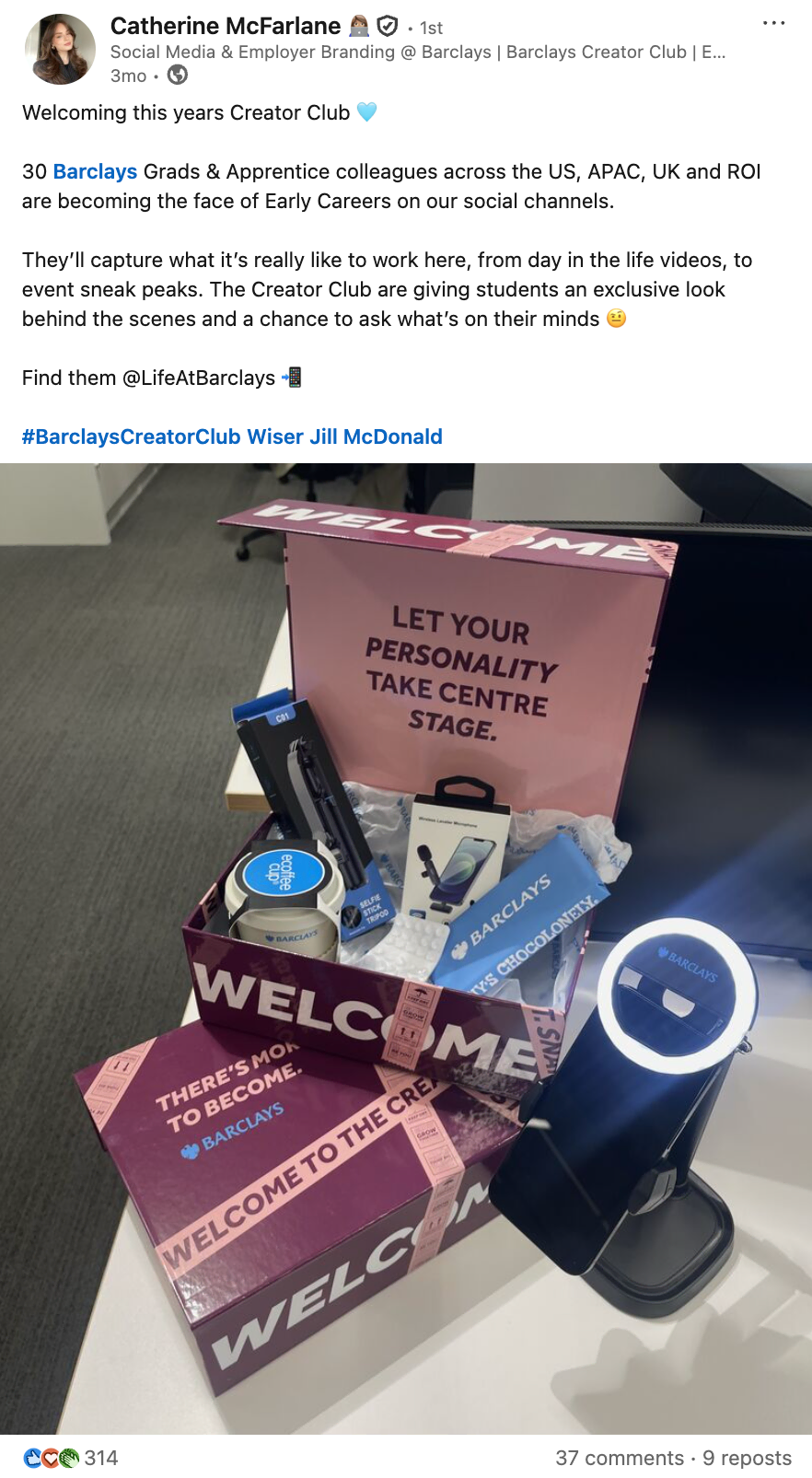
Barclays provided their content creators with a box of branded tools, including a ring light, microphone, and tripod to get started (pictured above). This is a great way to make your content creators feel special, while providing them with tools to succeed!
Step 4: Activate Employees as Creators
There’s a meaningful difference between employees who share approved content and employees who produce original content, and the gap between those two outcomes largely comes down to how well you’ve removed the barriers to creation.
The three most common barriers are: not knowing what to say, not feeling confident on camera or in writing, and not being sure whether leadership actually supports the program.
Address all three explicitly rather than assuming people will figure it out.

Training matters more than most organizations realize
Written guidance alone isn’t sufficient for employees who haven’t built a personal brand before.
Workshops on content creation, personal branding basics, and LinkedIn best practices give employees the confidence to start. And confidence is usually the real blocker, not time or interest!
Don't over-script
This is one of the central lessons from BT Group’s approach to EGC, discussed in detail in the podcast below.
Robyn Fawcett, Social Media Manager at BT, built a Content Creation Academy specifically to train employees as authentic brand ambassadors.
The emphasis is firmly on maintaining individual voice rather than producing uniform corporate content.
BT found that when employees feel they have genuine creative freedom, they participate more willingly and their content performs better. Over-scripted content reads as over-scripted, and audiences notice.
Make senior leaders visible early
Leadership participation signals to the rest of the organization that EGC is a legitimate priority, not a marketing initiative that nobody at the top actually believes in.
When leaders post authentically (sharing real perspectives rather than polished corporate statements), it shifts the cultural permission level for everyone else.
Our Benchmark Report found that 75% of program managers plan to encourage leadership involvement as their top tactic for boosting advocacy participation.
And the business outcomes are better too: a CEO can generate the same level of engagement as a company page with 98% fewer followers.
Step 5: Consider Running EGC as a Micro-Program Within Your Wider Advocacy Program
Not everyone in your organization will want to create original content, and that’s fine.
A well-structured employee advocacy program accommodates different levels of participation: some employees share curated content, some amplify leadership posts, and a smaller group actively creates original EGC.
Trying to turn an entire workforce into content creators at once is one of the fastest ways to burn out your program manager and produce a lot of mediocre content.
The Creator Club model Catherine McFarlane developed at Barclays is a compelling example of what this looks like in practice:
Rather than rolling out a broad EGC initiative across the entire organization at once, they started with a focused group of apprentices and graduates: people who were already active and had a genuine interest in building their personal brands.
Those employees were given creative freedom, specialist workshops, and branded assets to support their content creation, while the wider employer brand strategy benefited from the authentic content they produced.
The results made the case clearly: engagement increased by 1200% when Barclays moved away from polished corporate video and toward genuine employee-led content.
Step 6: Measure Against the Right Objectives
The KPIs you track should map directly to the objectives you set in Step 1. Measuring everything by default produces noise rather than insight.
| Objective | Key Metrics |
|---|---|
| Employer Branding | Sentiment score, engagement rate, and culture content mentions |
| Recruitment | Cost-per-hire, time-to-fill, and referral volume from social |
| Brand Reach | Earned Media Value, organic impressions, website traffic from social |
| Sales Enablement | Lead quality, pipeline attribution, and click-through rate / website traffic |
| Employee Engagement | Active contributor count, eNPS, retention correlation |
A note on Earned Media Value: this is one of the most useful metrics for demonstrating EGC ROI to stakeholders who think primarily in terms of media spend. DSMN8 automatically calculates EMV, showing the equivalent cost if you’d paid for the same reach through social advertising. This helps make the case for EGC efficiently in budget conversations.
For tracking content performance at a granular level, UTM parameters on every shared link give you a direct line from employee posts to website visits, lead form completions, and pipeline. Our analytics and reporting guide covers how to set this up in practice.
Review program data at a regular cadence (monthly at minimum) to identify your top contributors, understand which content is performing, and adjust accordingly.
The companies with the most effective EGC programs aren’t necessarily the ones with the biggest teams or the largest budgets. They’re the ones that made it easy and made it part of their culture.
Additional Resources
If you want to understand how active your employees already are compared to competitors, the free competitor analysis review is a useful starting point.
And if you’re ready to see how DSMN8 supports each of these steps in practice, book a demo, and we’ll walk you through it.
More on Employee-Generated Content:

Emily Neal
Emily is SEO Lead at DSMN8. She focuses on organic growth strategy across search and AI search and co-authors DSMN8's original research, including the Employee Advocacy Benchmark Report and edited CEO Bradley Keenan's book. Her background spans SEO strategy, technical web, long-form content, digital PR, and marketing automation.