

Most advice about LinkedIn content chases the same question: which format performs best? Video? Carousels? Text?
We went looking for a definitive answer and found a more useful one.
After analyzing 110,000 employee LinkedIn posts published through the DSMN8 platform between January 1 and February 16, 2026, the data makes one thing clear: there is no single winning content format.
There is only the format that fits the outcome you need.
Here’s what the data shows.
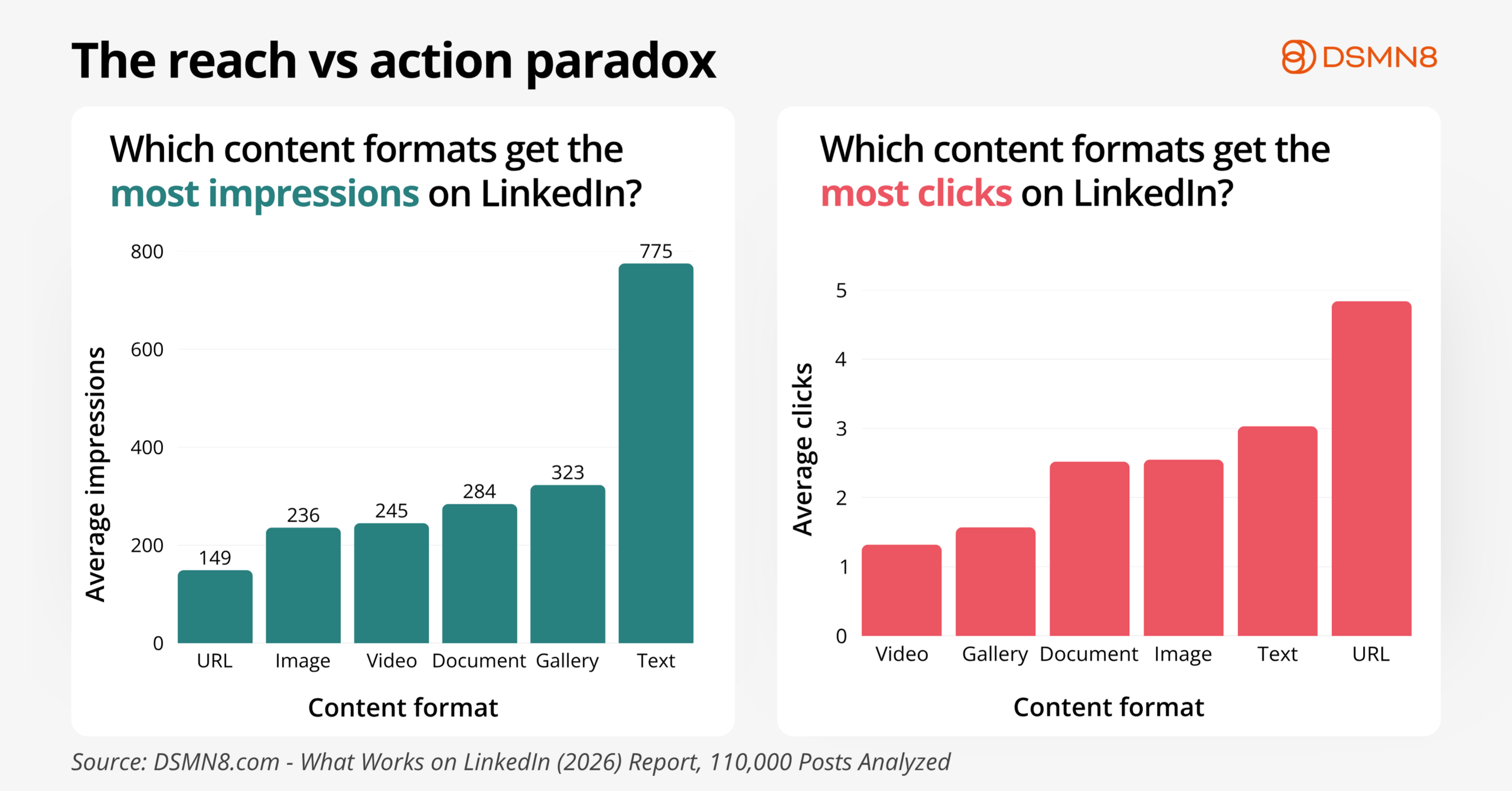
The reach vs. action paradox
The first thing that jumps out of the dataset is a contradiction.
Text posts generate an average of 775 impressions per post, nearly 5x more than link posts (149 avg). By that measure, text is the undisputed winner.
But link posts generate the highest average clicks of any format in the dataset: 4.84 per post, compared to 3.03 for text.
So which format “wins”? Neither. And both.
Visibility and action don’t come from the same format. Reach and conversation don’t either.
This is the core learning from the report: before selecting a format, define the behavior you need the content to produce, then pick the format built to deliver it.
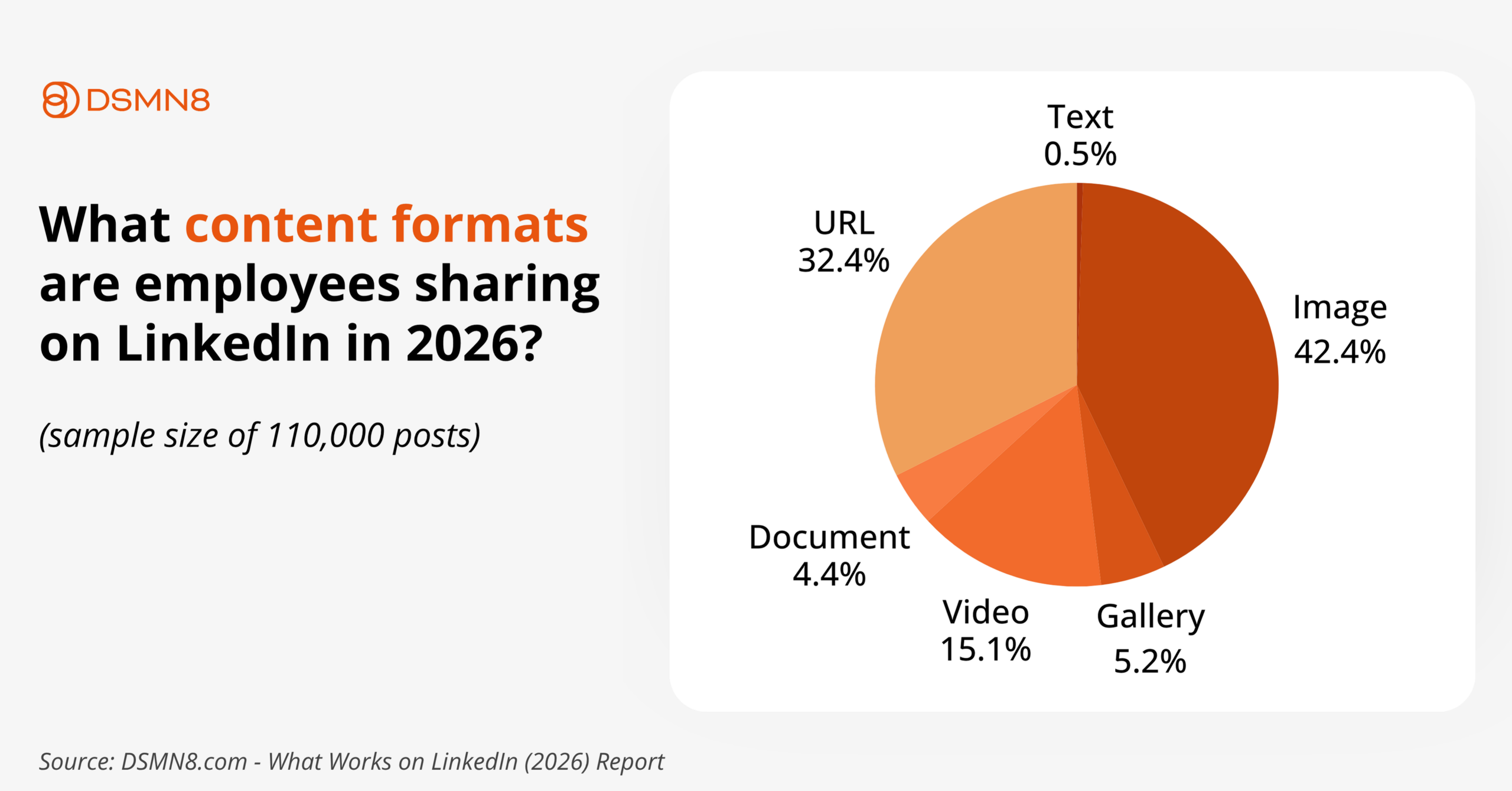
What employees are actually sharing on LinkedIn in 2026
Before getting into performance, it’s worth understanding what the current content mix looks like across employee advocacy programs.
Images dominate at 42.4% of all posts, followed by URL/link posts at 32.4%, video at 15.1%, gallery at 5.2%, document posts at 4.4%, and text at just 0.5%.
That last number is striking. Text posts, the format with the highest impressions in the dataset, make up less than 1% of what employees are sharing.
The gap between what works and what gets used is where most programs are losing ground.
On the findings, Andy Lambert from Adobe says:
“Whilst I am a big believer that there is no ‘one size fits all format’, this data confirms that text posts are the opportunity gap. I personally use text posts more than any other format and they drive the majority of my reach. However, there’s no hiding in a text post; the content needs to be strong.”
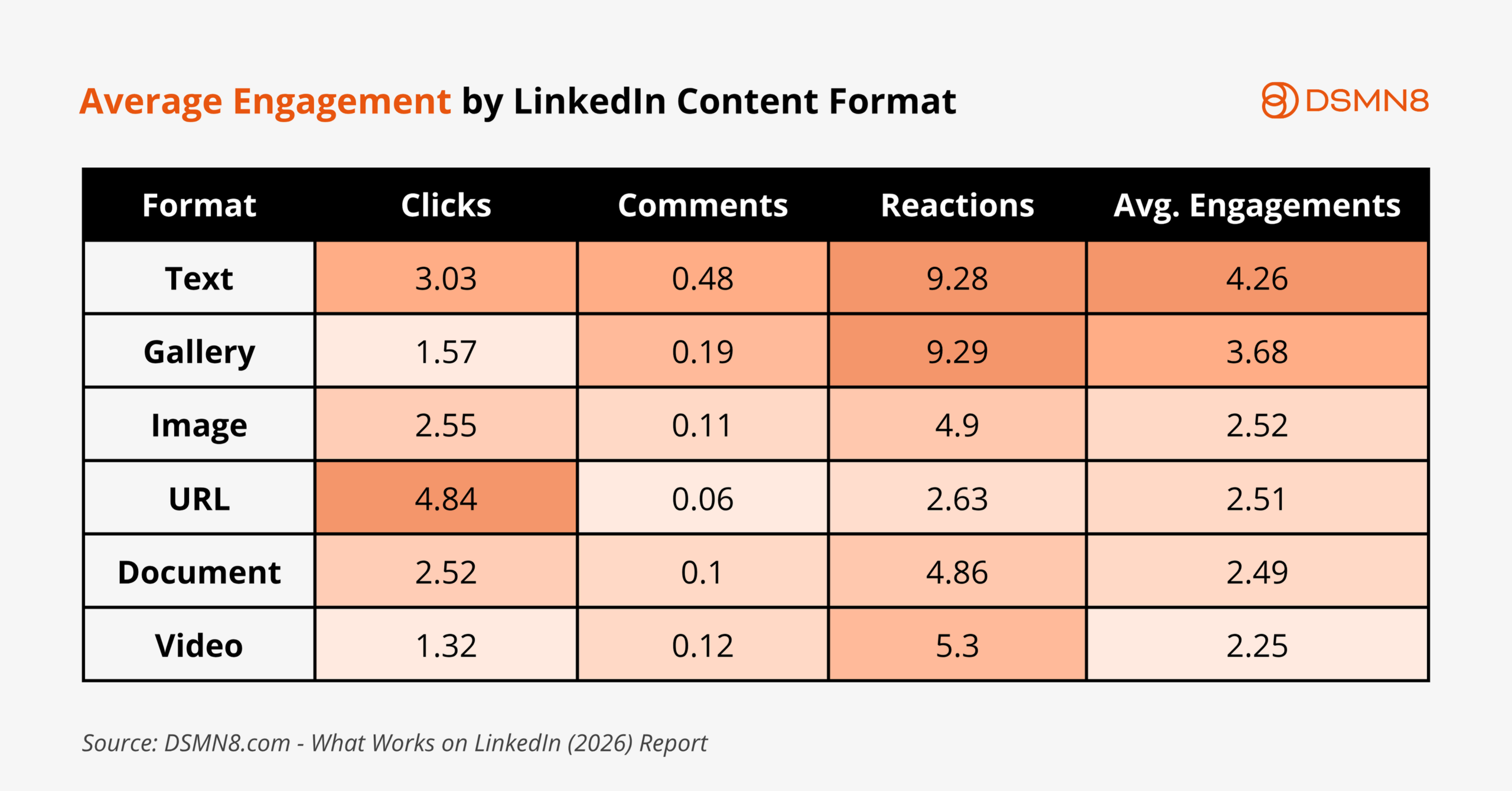
Does content format matter? What the data shows
The short answer is yes, significantly. But not in the way most people expect.
Across 110,000 posts, no single format dominates every metric. Instead, each format leads in a different area:
- strong>Text posts generate the most impressions and the most comments.
- Gallery posts generate the most reactions.
- Link posts generate the most clicks.
- Video achieves the highest engagement conversion rate.
- Document posts drive authority and dwell time.
The format breakdown of what employees are actually sharing makes the opportunity gap clear.
Most programs are heavily concentrated in the formats that deliver the least relative to their usage, and underuse the ones with the strongest returns.
Holly Kerr from AtkinsRealis adds: “We’re often asked what the ‘most effective’ LinkedIn asset is, and the default answer people expect is ‘use an image’. What this research does brilliantly is put data behind what we see in practice: the right format depends entirely on the outcome you’re trying to drive — which will be invaluable in shaping how we train our people.”
The full report breaks down the performance data for all six formats in detail, including average impressions, clicks, comments, reactions, and engagement rate, alongside the deployment contexts where each format performs best.
Match your format to your goal
Rather than asking “which format is best?”, ask “what outcome do I need?”, then work backward from there.
| Business objective | Format to use | Why |
|---|---|---|
| Awareness | Text | 5x more impressions than any other format. Zero production cost. |
| Conversation & engagement | Text + Gallery | Text leads on comments. Gallery leads on reactions. |
| Website traffic | Link/URL | Highest average clicks (4.84). The only format enabling direct attribution. |
| Pipeline & lead gen | Link/URL + Document | URL drives traffic. Document posts convert with reports and gated content. |
| Employer brand | Gallery + Image | Events, culture moments, employee stories. Swiping drives dwell time. |
| Executive influence | Text + Document | Thought leadership at maximum reach. Document posts add authority and depth. |
What this means for your employee advocacy program
Reach and action don’t come from the same format. Text posts generate 5x more impressions than link posts, but link posts generate the most clicks. Both are right. Start with the goal, not the format.
Chasing the algorithm is a short-term strategy. Platform priorities shift: LinkedIn may favor video today, but that won’t be forever. Programs built around a single format are exposed when algorithms change.
The most effective employee advocacy programs don’t pick a winning format and scale it.
They match format to objective, vary content by team and function, and measure what actually moves the business.
Download the report for the complete dataset, the outcome-to-format framework, and the recommended content mix for your program.
Additional Resources
Want to see how active your team is and how this compares with your competitors?
Get a free competitor analysis review.
Ready to get started with the #1 employee advocacy platform?
More LinkedIn guides and reports you’ll find helpful:
Take the 2027 employee advocacy benchmark survey
- Get quoted in the final report
- Early access to the results

Jody Leon
VP of Marketing at DSMN8. With over 20 years of experience in marketing and advertising, Jody leads the DSMN8 marketing team, focusing on brand, demand generation, and growth.