
We polled attendees live during two recent CMO Coffee Talk sessions to find out where B2B marketing leaders really stand on employee advocacy.
Across three polls and up to 139 respondents per question, the results paint a clear picture: most organizations are earlier in their advocacy journey than the conversation online might suggest, and almost none of them are measuring what it delivers.
Here’s what we found.
Most Organizations Don’t Have An Employee Advocacy Program Yet
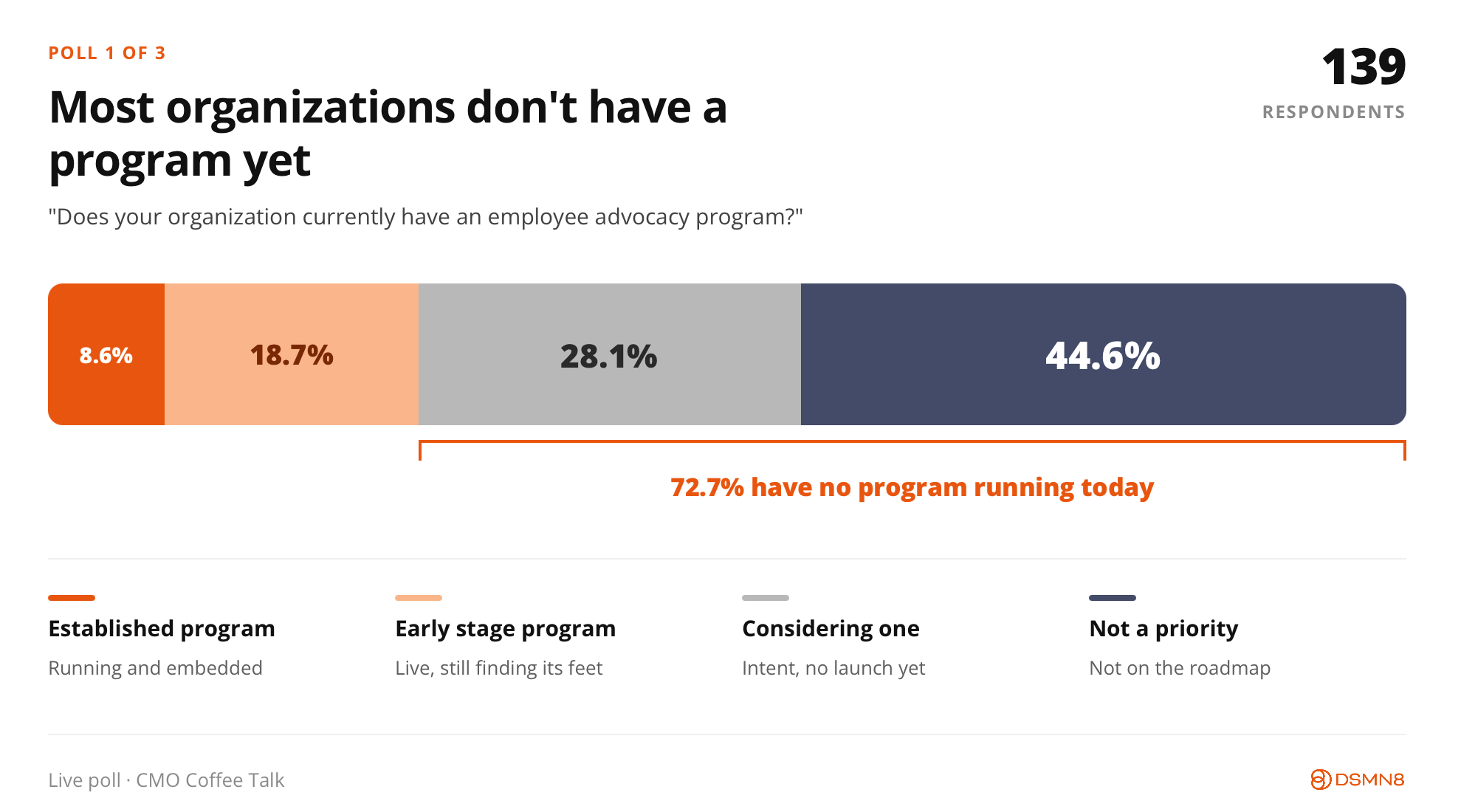
We asked attendees whether their organization currently has an employee advocacy program. 139 people answered:
- 8.6% have an established program
- 18.7% have one, but it’s still early stage
- 28.1% are considering one
- 44.6% say it’s not currently a priority
That means almost three in four attendees (72.7%) have no program running today.
The Programs That Do Exist Are Mostly Early Stage
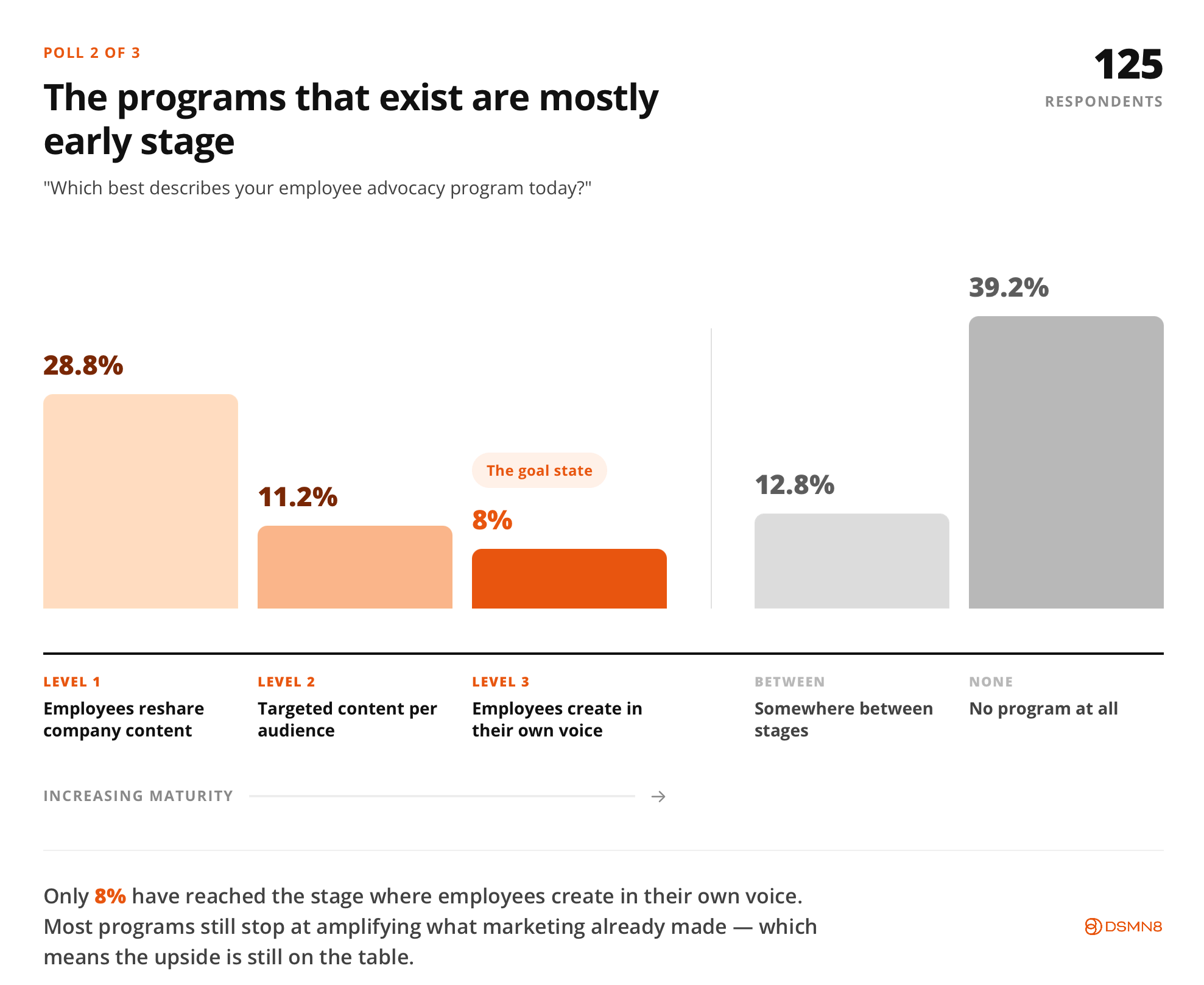
In a separate poll, we asked attendees to describe where their employee advocacy program sits today.
125 people answered:
- 28.8% are mainly helping employees share company content
- 11.2% are creating more targeted content for different audiences
- 8% have employees creating and sharing content in their own voice
- 12.8% say they’re somewhere between these stages
- 39.2% still don’t have a program at all
Only 8% of CMOs say they have reached the most advanced stage: employees creating original content rather than just resharing what marketing produces.
Most programs that exist are still at the simplest level – getting employees to amplify existing company content.
Almost Nobody Is Measuring The Impact
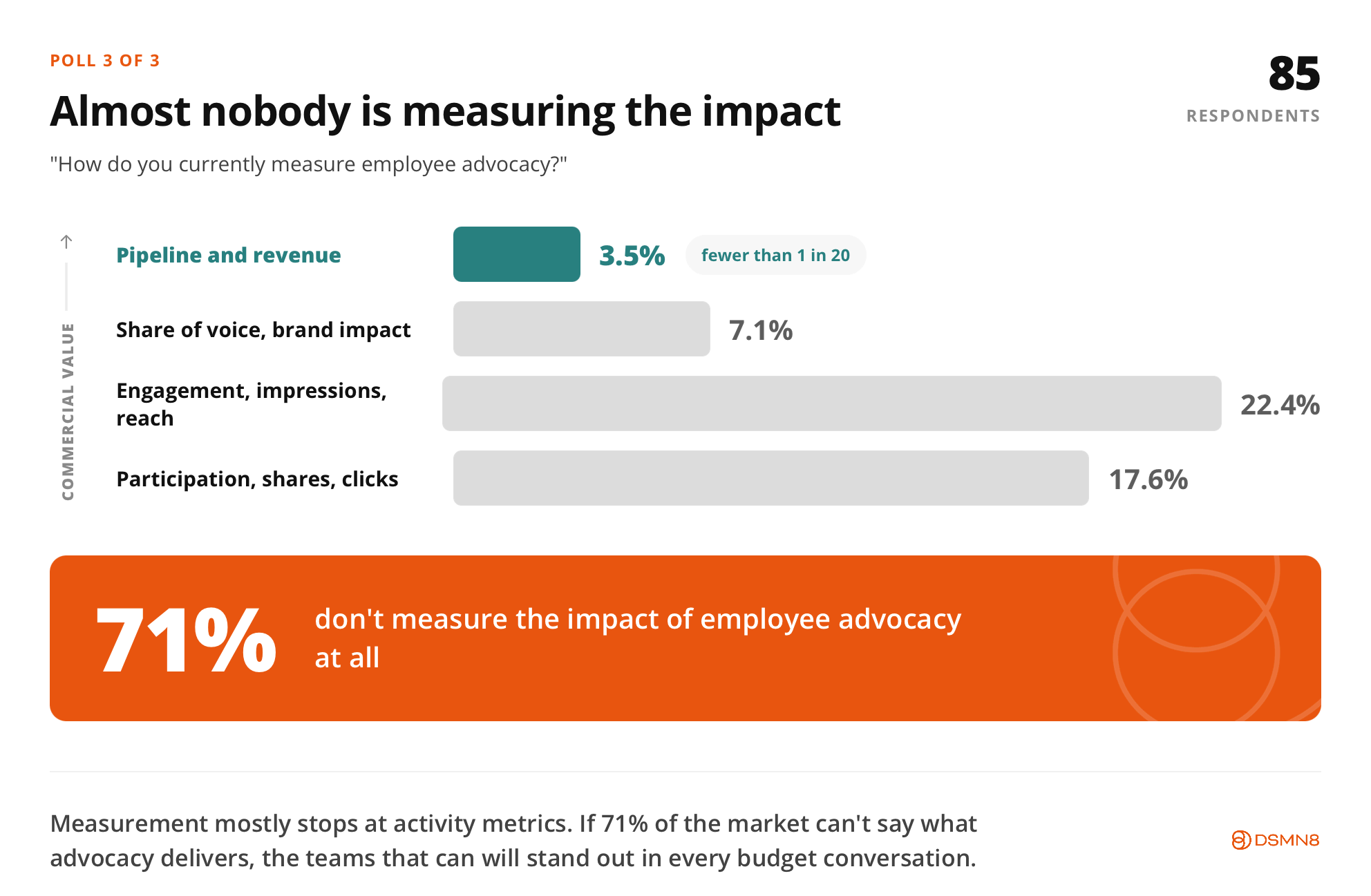
We asked how organizations currently measure the impact of their employee advocacy efforts.
85 people answered:
- 17.6% track participation, shares and clicks
- 22.4% track engagement, impressions and reach
- 7.1% track share of voice and brand impact
- 3.5% track pipeline and revenue
- 71% don’t currently measure it at all
Fewer than 1 in 20 leaders are connecting employee advocacy to pipeline and revenue.
For most organizations, measurement stops at activity metrics, or doesn’t happen at all.
“These numbers match what we hear in almost every conversation we have with marketing leaders. Everyone knows employee advocacy works, but very few teams have the infrastructure in place for effective measurement.”
— Jody Leon, VP of Marketing, DSMN8
What This Tells Us
The picture is consistent as a whole: the programs that exist are early-stage, and almost nobody is proving impact in commercial terms.
This is a young, under-resourced discipline, and the numbers reflect that.
It also means there’s a real opportunity for the leaders who do invest properly and measure results.
If 71% of the market can’t say what advocacy delivers, the ones who can will stand out, both internally when it comes to budget conversations, and externally in how their brand shows up.
If you’re mapping out where advocacy fits in next year’s budget, see our breakdown of where 2027 marketing spend should go.
What To Do About It
If you recognize your organization in these numbers, here’s where to start. Not sure exactly where you land? Take our free maturity quiz to find out in a few minutes.
If you don’t have a program yet.
Start small and specific. Pick one team and one goal rather than trying to launch company-wide on day one. You can always expand over time.
This will give you an early result to build a global business case around.
The Definitive Handbook to Employee Advocacy walks through the full launch process step by step.
If your program is stuck sharing company content only.
Moving to more targeted content doesn’t require a complete overhaul.
It just needs you to provide different employees, teams, or seniority levels with content that’s relevant to their audience.
A sales rep and a product lead shouldn’t be sharing the same post.
If you’re not measuring anything.
Start with employee participation and social media reach – they’re the easiest metrics to capture and give you a baseline. But don’t stop there.
Set a metric that ties back to pipeline, even something as simple as tracking inbound leads that mention seeing an employee’s post from your website forms.
This way, you have a number to defend the program with when budget conversations come around.
If you’re already measuring engagement but not revenue.
This is the group with the most to gain. You likely already have the data infrastructure in place; the gap is usually attribution.
Connecting advocacy activity to CRM data, even loosely, is what separates programs that get renewed budget from ones that get cut when priorities shift.
Follow our guide to get your tracking set up effectively.
These results are from live polling of attendees at CMO Coffee Talk, a weekly community of more than 4,000 CMOs and senior marketing leaders hosted by Matt Heinz of Heinz Marketing and Kelly Hopping, CMO of 6sense.
They reflect the views of marketing leaders who joined those specific sessions, not a broad market survey.
To see how your organization compares to the leaders in this space, our Employee Advocacy Benchmark Report 2026 surveyed 200+ programs, including Cisco, Capgemini, Toyota, and Nissan, covering everything from measurement and ROI to how AI is changing content production.
Take the 2027 employee advocacy benchmark survey
- Get quoted in the final report
- Early access to the results

Jody Leon
VP of Marketing at DSMN8. With over 20 years of experience in marketing and advertising, Jody leads the DSMN8 marketing team, focusing on brand, demand generation, and growth.