

What's on this page:
- How to Find Your LinkedIn Engagement Rate.
- Keep Your Profile Up-To-Date.
- Focus Your Niche.
- How To Create LinkedIn Content That Encourages Engagement.
- Have a Mobile-First Content Approach.
- Incite Discussion in the Comments.
- Engage With Others in Your Industry.
- Audit Your Connections.
- How To Use The LinkedIn Algorithm To Your Advantage.
- Consistency is Key!
- How to Save Time When Creating LinkedIn Content.
Last updated: 12th March 2026.
So, you want more engagement on LinkedIn?
We can see why.
LinkedIn use has skyrocketed in the past few years.
Once a website for simply uploading your resume and finding jobs, LinkedIn has evolved into a full-on professional social media platform.
You can use LinkedIn to build your personal brand, gain career opportunities, network with other industry professionals, and even become a thought leader or influencer.
LinkedIn has become an essential tool for sales, PR, and marketing professionals, but it’s also excellent for freelancers and solopreneurs.
But a huge pain point for many new LinkedIn content creators is getting engagement and increasing visibility.
It can be tough at first to get your name out there! 😫
Follow our foolproof guide to getting more LinkedIn engagement. We’ve helped thousands of employees build their presence on the professional social media platform, so we know what works and what doesn’t.
How To Find Your LinkedIn Engagement Rate
Let’s start at the beginning.
What’s your engagement like at the moment? 🤔
Head to your LinkedIn profile and click on the ‘post impressions’ number under ‘Analytics’ near the top of your profile.
This will take you to an analytics page. Select the time period you’d like to see: 7 days, 14 days, 28 days, 90 days, or 365 days.
By default, the analytics page will only show impressions.
Click on the green ‘impressions’ button and switch to ‘engagements’.
Make a note of the number you see currently, to compare with in the future.
Further down the page, you can also see the demographics of the people who engage most with your posts.
Options include job title, locations, industries, seniority, company size, and even the names of the companies they work for.
Use this to your advantage! Create content for your key engaged connections and followers. If the types of people you want to target are not appearing here, you’ll want to rethink the types of content you’re putting out.
How To Calculate Engagement Rate for a Specific Post
If you want to calculate your LinkedIn engagement rate for a specific post, here’s a quick guide:
There are two ways to calculate your LinkedIn post engagement rate.
The first is based on your follower count.
Add the number of reactions and comments on your LinkedIn post, then divide this by the number of followers you have. Multiply this number by 100 to get your percentage.
The other way is to calculate how many people engaged with your post based on the number who actually saw it.
Click on the LinkedIn post you want to analyze. Under the post, you’ll see the number of impressions.
Again, take the number of reactions and comments, but this time divide it by the number of impressions. Then multiply the number by 100 to get your engagement rate as a percentage.
Keep Your Profile Up-To-Date
We’ve already covered how to optimize your LinkedIn profile, so head there first if you haven’t improved your profile yet.
Be sure to periodically update your LinkedIn profile with any new work experience and qualifications.
If you’ve been in the same job for a while, you can still update the description. If you’ve taken on any new responsibilities, completed any training, or become a mentor, add it. Don’t forget to include what you learned from each role.
Don’t neglect your about section! Your LinkedIn summary should highlight your expertise, career goals, and give a brief overview of who you are and what you do. It’s one of the first things someone will see when checking your profile, before they scroll down to your jobs and education section.
Your LinkedIn summary is the place to demonstrate what your personal brand is all about and encourage people to connect with or follow you.
Don’t simply list your previous jobs and qualifications – it’s kinda boring, and people will see that anyway further down your profile 🙃
So how can you make it engaging, and not sound too braggy? Use storytelling and stay concise.
If you’ve changed career paths, explain why!
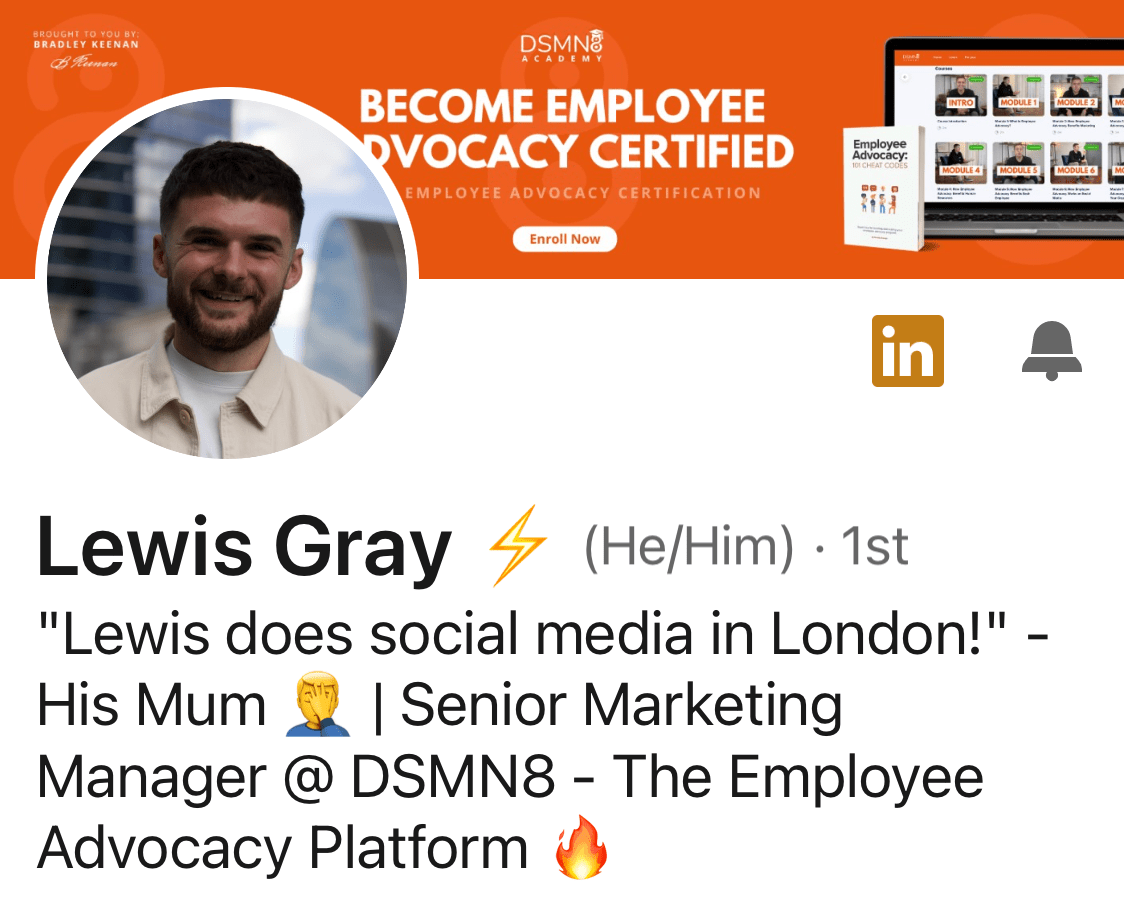
Profile Picture & Cover Image
We’ve covered this already in our LinkedIn profile optimization guide, but it really is important to show who you are with visuals.
Making sure your profile picture is public is imperative.
Think about it: are you more likely to accept a connection request or engage with a post from someone with a visible profile picture or without? We all want to put a face to the words we read online!
The next most important part is your profile picture itself. It’s gotta be professional, sure, but you can have fun with it too! Show off your personal style, and consider using a colorful background behind your image to stand out in the feed.
Your cover image isn’t as important because it’s only visible on your profile, but it’s still something you should be utilizing.
You could upload a pretty picture of the sea… but unless you’re a marine biologist, it’s better to use an image that matches what you do.
Remember that anyone clicking on your profile will probably only browse it for a few seconds before deciding whether to connect with you ⏰
A great way to leverage the cover image space is by creating a graphic with text on Canva. This way, you can highlight the most important things you want people to know.
Here are a few pointers to get started:
- What you do.
- Your job title & company.
- Your social media usernames.
- A few keywords to represent what you talk about on LinkedIn.
- Logos of publications you’ve been featured in, companies you’ve partnered with, or any awards you’ve won.
For extra personal branding points, match the color scheme of your cover image with your profile picture.
Focus Your Niche
After leveling up your LinkedIn personal branding, spend some time thinking about your content.
Putting yourself out there on LinkedIn can feel a bit scary or awkward at first, but getting over that fear is SO worth it.
Start off with a content brainstorm.
Ask yourself these questions:
- What topics do you know a lot about?
- What types of content do your favorite LinkedIn influencers create?
- If you already create content for LinkedIn, what’s working well for you?
Focus on these topics or ‘niches’ that you want to become known for. Keep them to a maximum of 1-3 topics, because no one is an expert on everything! 😅
For example, if you work in SEO, your content niches could be: SEO (of course!), content marketing, and website development.
Add these topics to the hashtags at the top of your LinkedIn profile to make it super clear what you’re all about.
These topics will show up under your LinkedIn tagline, like this: ’talks about’ #SEO, #contentmarketing, and #webdev.

Signify’s Stefanie Del Moral shares some great personal branding tips in the podcast episode above.
How To Create LinkedIn Content That Encourages Engagement
Great, now you’ve got a super engaging LinkedIn profile, and you’ve established exactly what content topics you want to be known for 💪
You’re ready to actually start creating content.
But what kind of content on LinkedIn gets the most engagement?
Well, as an employee advocacy platform with thousands of users posting on LinkedIn, we’ve got the data. From clicks and shares to engagement rate and earned media value, our analytics suite covers it all 🏆
Popular content types do vary per industry, but these tips will guarantee an improvement in your LinkedIn engagement, no matter what you talk about.
1. Don’t Always Post Links!
If you’re only sharing links to your blog posts on LinkedIn, that might be why you’re seeing low engagement.
Think about it this way: what do LinkedIn want from their users?
They want users to spend more time on the platform. They want LinkedIn users to scroll, read, and engage with posts.
Keep this in mind when you create any content for LinkedIn.
You absolutely can share links on LinkedIn. We’ve seen incredible results from our own employees sharing blog posts and podcast episodes on LinkedIn, not to mention the huge ROI our clients have generated from employee clicks.
But you shouldn’t just drop a link and go 👀
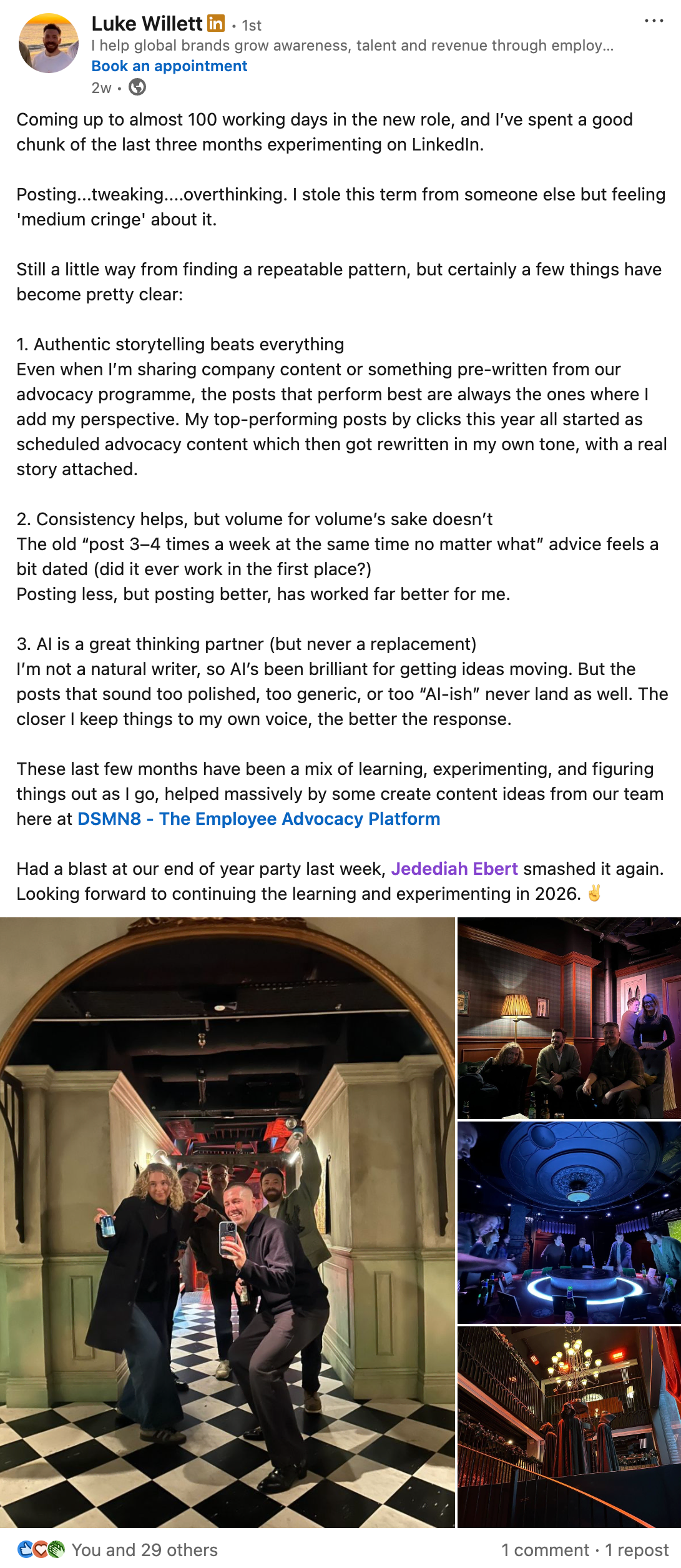
This is also why personalized posts consistently outperform straight reshares: even a light edit adds a voice the algorithm and your network respond to.
How to Effectively Share Links on LinkedIn:
- Write a caption summarizing the article you’re sharing. Why should your connections read it?
- If the article includes any quotes or stats, tag your sources in the caption. They might check out your article and re-share it!
- Your featured graphic or image is super important. Images stand out in the LinkedIn feed. Are your images enticing clicks?
- When sharing the same article more than once, switch up the copy and images so your content doesn’t look stale.
Be sure to read our guide on the LinkedIn Link Preview Updates to learn how to navigate the change in how links are now shown in the feed.
2. Take a Mobile-First Approach
These days, lots of people scroll LinkedIn on their phones.
LinkedIn is still primarily a desktop platform, more so than other social media, as many use it for work.
But, LinkedIn mobile use is steadily increasing 📈
Our study of 500,000 LinkedIn posts revealed that while only 7.9% of employee advocate posts were shared on mobile, they performed slightly better in terms of average engagement:
Here are some actionable tips to make your LinkedIn content easily digestible and scroll-stopping.
2. Use White Space… and a lot of it
It might feel strange at first, but line breaks will become your best friend.
Separating your sentences with white space makes your content easier to skim-read, which is what most readers do.
White space also allows you to emphasize the most important points you’re making.
Don’t forget to use blank space in your graphics too. Especially on mobile, a cluttered infographic with small text can be difficult to read.
3. Use Short Sentences
To put it bluntly: no-one wants to read an essay on their phone.
Be concise!
Make sure to cut out any ‘fluff’ from your LinkedIn posts.
And keep your paragraphs short and sweet. One or two sentences per paragraph is plenty!
4. Remember the ‘See More’
Any written content on LinkedIn gets ‘cut off’ after a line or two, prompting the reader to click ‘see more’ to read the full post.
This makes the first sentence or ‘hook’ even more important on LinkedIn than on other platforms.
You really need to encourage the user to click that ‘see more’ button.
What is your post about? How can you make that sound interesting and exciting?
Here are a few tips for creating a great hook:
- Use numbers, e.g., “10 reasons you should…”
- Use power words to incite an emotional response.
- Feature an interesting statistic from your post at the beginning, e.g., “Employee posts have 800% more engagement than brand posts. This is why…”
- Ask a question.
- Titles between 40 and 49 characters long get the most reach.
- Use AM Institute’s Headline Analyzer to determine the Emotional Marketing Value of your hook.
5. Emojis & Hashtags
Ah, emojis and hashtags. Controversial for sure.
Using emojis effectively breaks up your text and adds a bit of visual interest.
‘But emoji’s aren’t professional!’ 🙈
These days, emojis are everywhere. They’re all over LinkedIn, whether you like it or not.
Try using emojis as bullet points; it really does make a listicle more engaging!
When it comes to hashtags, you can use them on LinkedIn… but be mindful. Don’t include a list of 5+ hashtags at the end of every post.
As of 2026, hashtags aren’t very effective on the platform. We’ve stopped using them altogether!
6. Incite Discussion in the Comments
Engagement isn’t just about the number of likes you get on your post.
If anything, a single comment is worth more than 10 likes!
A comment shows that your content is interesting enough that other industry professionals want to weigh in with their support or further insight.
Ask questions in your posts, but don’t just say ‘thoughts?’ or ‘agree?’ at the end of your post… ask an actual question for people to answer!
Most importantly, reply to every comment you receive. Even profiles with huge follower counts reply to their comments. It shows that you’re open to discussion.
Engage With Others in Your Industry
Engagement goes both ways! 🤝
You can’t expect high engagement on your posts without engaging with others.
Of course, your posts need to encourage discussion, but engaging with others can boost your engagement even further.
If someone leaves an interesting comment on one of my posts, I’m likely to check out their profile and comment on one of their posts.
But please please please don’t just leave a thumbs up emoji as a comment 😫
Audit Your Connections
A higher number of connections or followers doesn’t necessarily mean higher engagement.
It’s all about who you’re connected with.
Spend some time thinking about who your ideal follower is.
What is their job title? What industry do they work in? What content do they consume? Write your answers down. This is your ideal follower.
Need a bit of help on this step?
Remember when we mentioned the LinkedIn analytics page?
Check the demographics of the people who already engage with your posts.
LinkedIn limits connection requests to around 100 per week (20 per business day).
Use them wisely!
Use LinkedIn’s search filters to find people who fit your ideal follower criteria.
When sending connection requests, consider why you want this person in your network.
✅ Do they fit your ideal follower criteria?
✅ Are they active on LinkedIn?
✅ Do they engage with content in your niche?
✅ Are they a thought leader in your industry?
If so, absolutely send the request.
If not, do you really need them in your network? 🤔
If your goal is simply to increase your number of connections and followers, you’re fighting a losing battle here.
Your engagement will plummet if you have a bunch of connections who aren’t interested in what you post.
If you have the time, it’s worth reviewing your current network and removing any irrelevant connections.
❌ No profile picture? Remove.
❌ Hasn’t been active on LinkedIn in years? Remove.
❌ Work in a completely different industry from you? Remove.
❌ Someone you went to school with but never talk to, doesn’t work in a relevant field to you, and isn’t active on LinkedIn? Definitely remove.
How To Use The LinkedIn Algorithm To Your Advantage
We’ve written a guide to the LinkedIn algorithm, so make sure to check that out next!
For now, here are a few tips on how you can use the LinkedIn algorithm to your advantage:
- Encourage discussion by asking questions in your posts.
- Don’t be afraid to be a little bit controversial. Don’t play devil’s advocate for no reason, but if you’ve got an ‘unpopular opinion’ about something in your industry (and evidence to back up your claim), by all means start a debate on LinkedIn.
- Use a variety of content formats, especially rich media. Many creators have seen a boost in reach when using features like polls and carousels.
- Video content is huge right now! LinkedIn itself reported that video content generates 20 times more shares than text posts.
- Don’t over-index on any one format. Our analysis of 110,000 LinkedIn posts from Q1 2026 found that text posts are underused compared to their impact. Experts agree that intent should drive your content choices over trends.
Consistency
Finally, let’s talk about consistency.
You’ve probably heard this one before: consistency is key 🗝
It really is.
But consistency doesn’t mean spending every waking moment on LinkedIn or creating content every day.
Start slowly and find the right content creation schedule for you.
The majority of content creators have full-time jobs!
They find time during their day to engage with others on LinkedIn and share their own posts.
You can do the same. Just 30 minutes a day will boost your LinkedIn presence, and the algorithm will reward you 😇
It’s a cliche at this point, but keep the phrase ‘work smarter, not harder’ in your mind when creating content.
How To Save Time When Creating LinkedIn Content:
1. Planning
Establish which day (or days) you’ll be posting new content to LinkedIn. This creates consistency for your followers, but also for yourself.
Making content creation a regular habit will absolutely help you in the long run.
2. Batch Your Content
Block out some time in your calendar for writing LinkedIn posts 🗓
When do you feel most creative?
Hint: it’s probably not on a Monday morning or a Friday afternoon!
Batching content lets you focus your mind on the rest of your weekly tasks.
Having ready-to-go content will also help you get through periods of writer’s block or lack of inspiration.
3. Repurpose Your Content
There are two main ways to effectively repurpose your content on LinkedIn:
- From content you’ve posted to other platforms.
- From older, evergreen content your new followers haven’t seen yet.
A super easy way to do this is by creating a spreadsheet containing all of your evergreen posts, and the date they were published.
When filling out your content calendar, simply scroll back to a few months ago, and choose a post to repurpose. Reword it slightly or add new insights and switch up the graphics, and you’re done!
4. Scheduling
LinkedIn is currently rolling out native scheduling directly in the platform. This will be an excellent time-saver for all content creators, especially those who prepare their posts in advance.
If you’re working in a large organization, a platform like DSMN8 could be a better solution for your marketing team.
Why? 🤔
DSMN8 makes it easy for your colleagues to share content on LinkedIn, without manually having to post or schedule content themselves.
Simply connect employee’s LinkedIn accounts to DSMN8, and set up auto-scheduling. Our AI-assisted scheduling tool will determine the best times to share posts, or you can choose the times yourself.
You can also select how many days per week (and which days) to share, so your colleagues won’t worry about taking over the LinkedIn feed with too many posts.
Content admins then add their content, by either creating it within the platform or pulling content from other sources (e.g. your company blog).
They can add a variety of images and captions to every post, meaning that when your colleagues share, their posts will look unique. 👏
That’s it, folks!
Follow these steps, and you’ll get more LinkedIn engagement.
It might take some time to see those huge numbers your favorite LinkedIn content creator gets, but you’ll get there.
Remember that LinkedIn influencers are a relatively new phenomenon in the social media space.
Now is the perfect time to lay the foundations while the platform isn’t overly saturated.
Ready to make it easier than ever for your team to be active on LinkedIn?
We can help with that! 👋
Book a demo of our all-in-one employee influence platform.
Want to know how active they already are and how this compares with your competitors?
Want More LinkedIn Tips?


Emily Neal
Emily is SEO Lead at DSMN8. She focuses on organic growth strategy across search and AI search and co-authors DSMN8's original research, including the Employee Advocacy Benchmark Report and edited CEO Bradley Keenan's book. Her background spans SEO strategy, technical web, long-form content, digital PR, and marketing automation.