

Last updated: 13th August 2026.
Many teams trying to scale employee advocacy eventually land on the same workaround: ask employees to run captions through ChatGPT before posting.
It feels like a smart shortcut to avoid copy-paste captions. AI does the heavy lifting, employees spend less time staring at a blank text box, and more content gets shared.
But what you end up with is a situation where everyone’s posts start sounding the same.
And it’s obvious to anyone who sees your content. In your attempts to build trust on social media, you’re unintentionally reducing trust.
Generic AI tools like ChatGPT have no idea who Sarah in sales is, how she talks to her network, or what kind of content earns her the most engagement.
The output makes sense, but it’s not her.
And at scale, when 50+ colleagues are doing the same thing with the same prompts, your employee advocacy program starts to look forced.
DSMN8’s Personal Voice AI was built to solve exactly this.
Why employee advocates reach for ChatGPT in the first place
It’s worth understanding the underlying problem before dismissing the workaround.
Employees don’t reach for ChatGPT because they’re lazy, they reach for it because sharing content feels awkward.
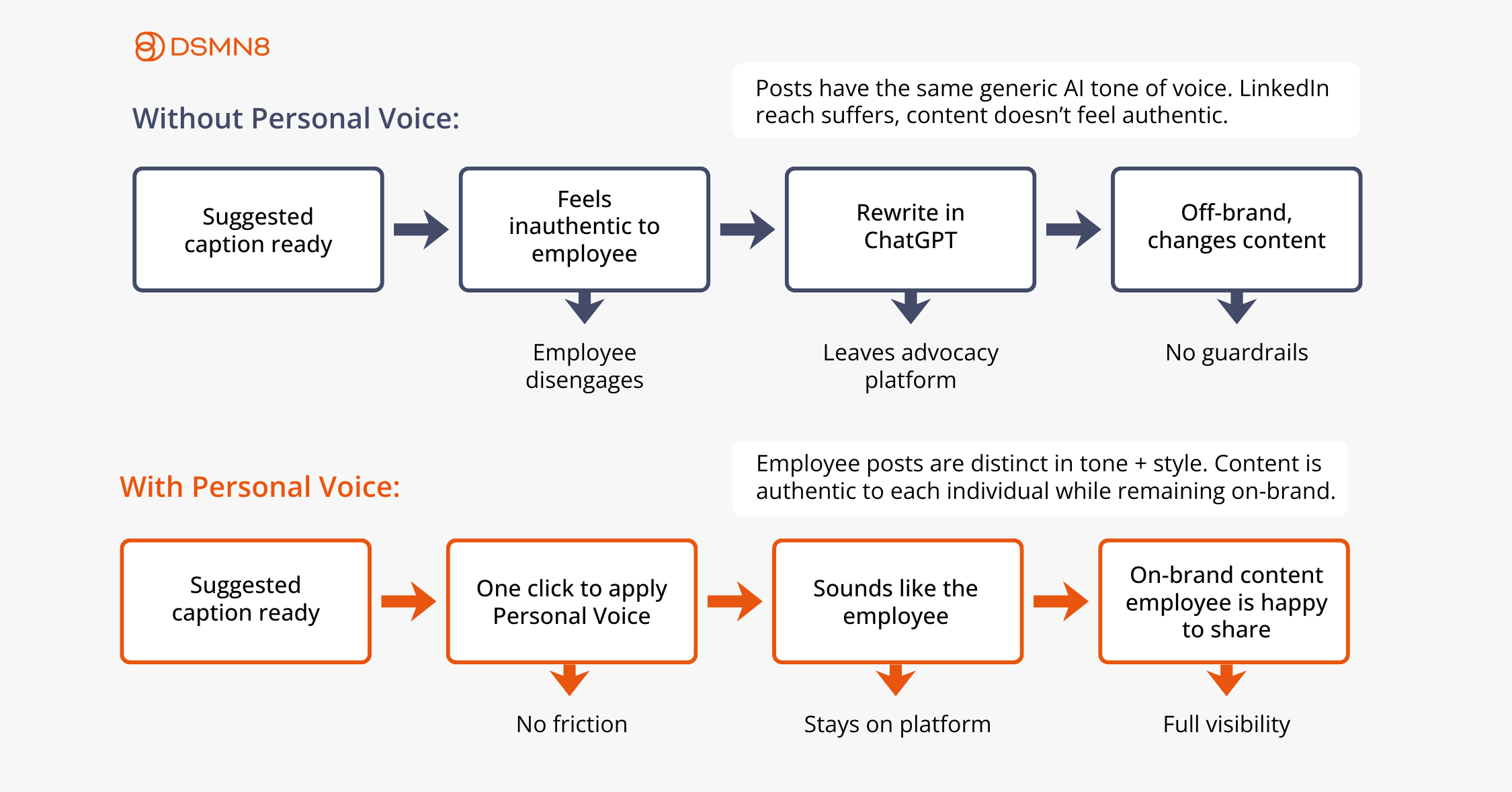
Maybe the suggested captions in their advocacy platform don’t sound like them, rewriting it from scratch takes time they don’t have, and the path of least resistance is to paste it into an AI tool and get something that at least sounds less corporate.
This friction is one of the main reasons advocacy programs can stall. Participation rates drop when employees feel like they’re amplifying the company’s voice rather than their own. The content feels like a task rather than something they’d genuinely want to post.
Personal Voice exists to fix the source of the friction, not just the symptom.
What generic AI actually does to your content
When an employee pastes a company announcement into ChatGPT and asks it to “write a LinkedIn post,” here’s what they actually get: a plausible-sounding caption that could have been written by anyone.
The tone defaults to polished-but-bland. The structure is predictable, and the content is probably full of em dashes and words like ‘delve’ 🙄
Most importantly, there’s zero connection to the employee’s own communication style, audience, or previous posts.
That matters because authenticity is the whole point of employee advocacy.
People engage with content from other people more than brands for a reason.
They want to hear perspectives from others in their industry.
The moment a post stops sounding like it came from a real person with a real perspective, it loses what makes employee-shared content worth sharing at all.
And it’s not just a feeling: in our 2026 analysis of 517,374 posts, personal posts earned 9.2x the engagement of curated content, and even the lightest edit, just a word or two changed, still delivered 3x more engagement than an unedited share.
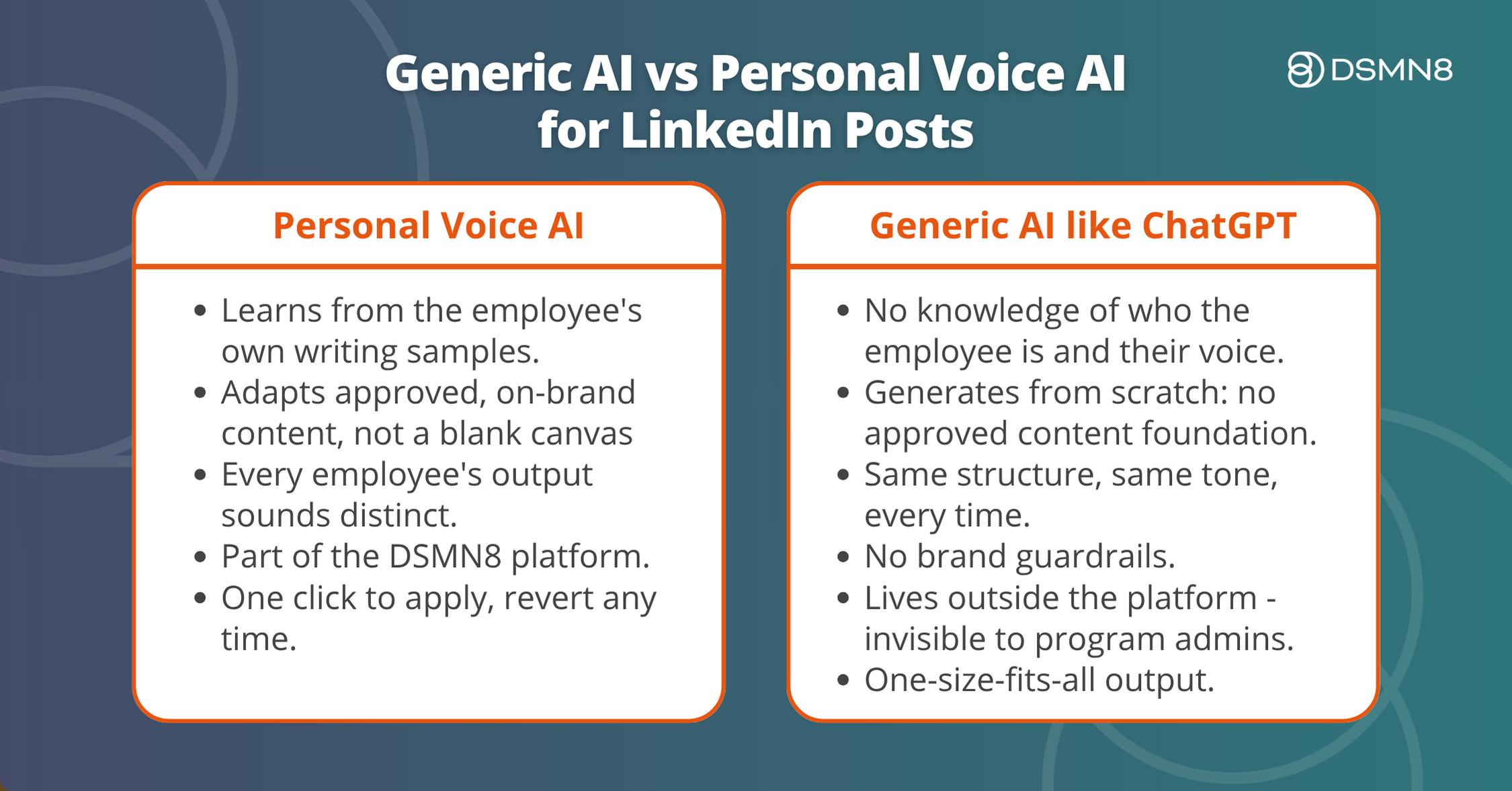
There’s also a practical issue: generic AI has no brand guardrails.
Employees using external tools can inadvertently post content that contradicts key messaging, uses competitor names, or misrepresents product capabilities. There’s no Company Voice layer and no compliance controls.
There’s a LinkedIn algorithm impact, too:
With the rise of AI-generated LinkedIn content, the platform is now looking to change how that content is distributed. Part of this includes “Restrictions on the reach of content that appears to be generated by AI and lacks clear perspective”.
LinkedIn has since gone a step further, letting users directly flag posts that read as AI slop, which cuts a post’s reach outside the poster’s own network.
When content is curated by a program manager, then Personal Voice is applied to add the employee’s tone (based on real writing samples), it’s much less likely to be restricted than generic ChatGPT content that anyone could post.
Of course, adding their own original insights to the content will take it even further, so please do encourage that behavior!
The data backs this up. Our 2026 analysis of over 500,000 LinkedIn posts found that original, employee-written posts earn 9.2x more engagement than curated content, with comments up to 21x higher, exactly the kind of deep engagement signal LinkedIn’s algorithm now rewards most.
What Personal Voice AI does differently
DSMN8’s Personal Voice feature starts from a completely different premise.
Rather than generating content from scratch, it adapts approved, curated content into each employee’s individual style.
Here’s how it works in practice:

For executives using Delegate Access, this becomes incredibly helpful: delegates can manage posts on a senior leader’s behalf while still applying that leader’s established voice, so the output sounds like them before they’ve reviewed the content.
When generic AI is fine, and when it isn't
Using ChatGPT or any general-purpose AI to draft content does have legitimate uses in an employee advocacy context.
Tools like this are especially helpful for creating content ideas, considering different angles, and sourcing data to back up your points.
The problem is using it as a caption-rewriting shortcut for curated advocacy content.
The lack of personalization and brand alignment creates risk.
Personal Voice AI turns content from “here’s an approved post” to “this sounds like me, I’m happy to share this,” without requiring employees to leave the platform, copy-paste into an external tool, and hope that the result doesn’t accidentally say something off-brand or worse, make up products or features that don’t exist.
The bottom line
AI has a real role to play in employee advocacy.
Making it easier for employees to share content in their own voice is genuinely valuable both for encouraging personalization and user adoption.
But that value depends on the AI knowing whose voice it’s adapting, what the brand guardrails are, and what approved content it’s working with.
Generic AI tools know none of those things. DSMN8’s Personal Voice does.
Ready to see it in action?
Additional Resources
Wondering how active your team is on LinkedIn, and how this compares with your competitors?
Get a free competitor analysis review.
More on AI in Employee Advocacy:

Emily Neal
Emily is SEO Lead at DSMN8. She focuses on organic growth strategy across search and AI search and co-authors DSMN8's original research, including the Employee Advocacy Benchmark Report and edited CEO Bradley Keenan's book. Her background spans SEO strategy, technical web, long-form content, digital PR, and marketing automation.