

What's on this page:
- How does employee advocacy affect recruitment marketing performance?
- Employee advocacy vs employee referrals vs employer branding.
- The 3 tiers of advocacy recruitment metrics.
- 1. Visibility and reach metrics.
- 2. Engagement and traffic metrics.
- 3. Recruitment outcome metrics.
- How do you measure employee advocacy for recruitment?
- What advocacy platform features matter most for measuring recruitment?
- Additional Resources.
- FAQ.
Last updated: 17th August 2026.
A candidate scrolling past your corporate careers account keeps scrolling. The same role shared by someone who actually works on the team makes them stop.
That difference is the case for employee advocacy in recruitment: people trust a person over a logo, and in hiring, that trust is what turns reach into applications. The catch is proving it, which means tracking the metrics where the trust shows up.
Employee advocacy improves recruitment metrics across three layers: visibility, engagement, and hiring outcomes. At the visibility layer, it lifts reach, shares, and earned media value for your careers content. At the engagement layer, it raises click-through rates and careers-page traffic. At the outcome layer, it influences application volume, source of hire, cost per hire, time to fill, and offer acceptance.
The talent acquisition, recruitment marketing, and employer brand teams that keep their advocacy budget are the ones that connect visibility to hiring results. Below is the full set of metrics worth tracking, grouped by how close each one sits to an actual hire. Each one is defined below, along with how to measure it using your advocacy platform analytics and UTM-tagged links.
How does employee advocacy affect recruitment marketing performance?
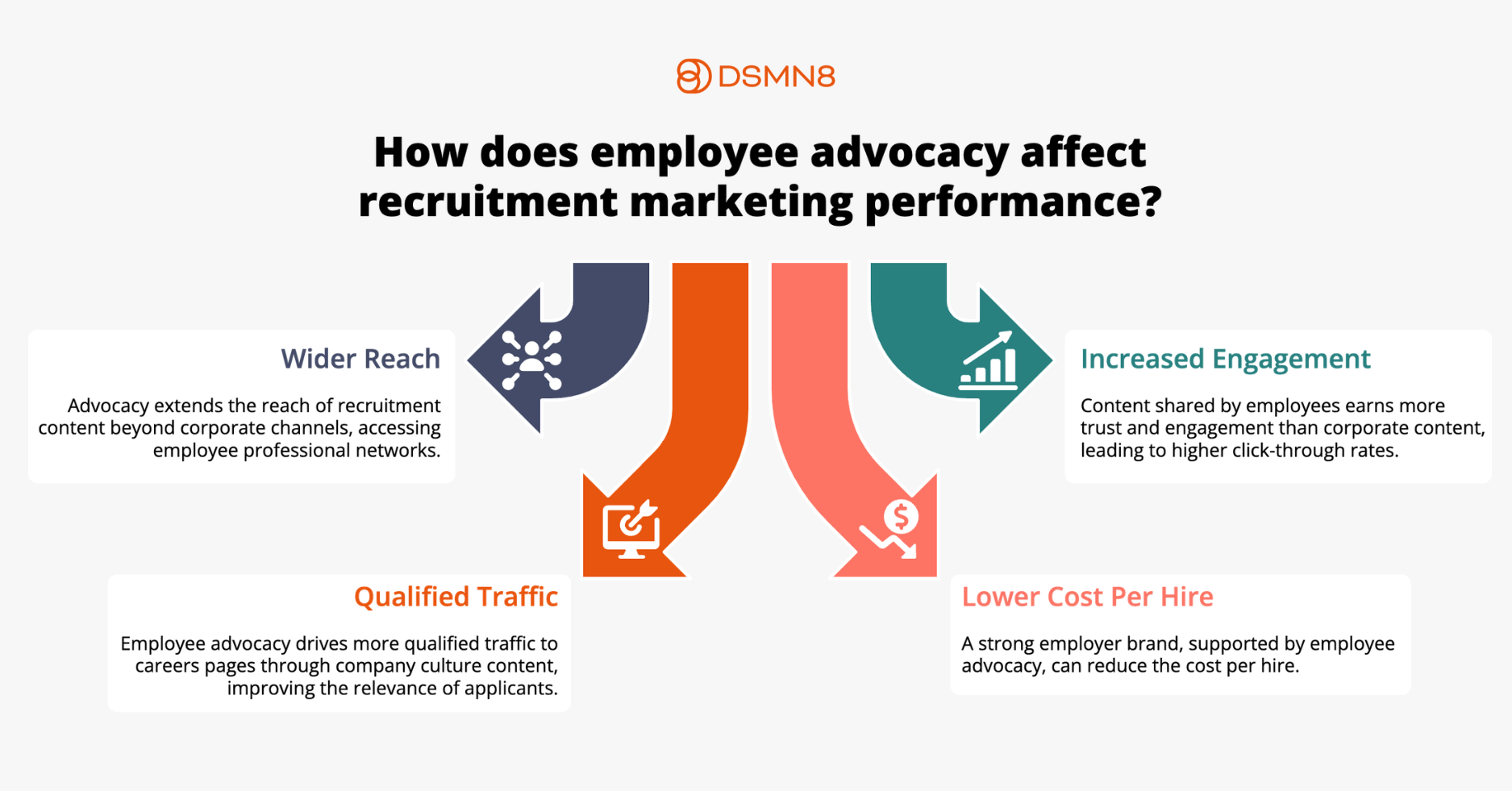
Employee advocacy affects recruitment marketing performance by changing who carries your message and how far it travels. When employees share open roles and culture content from their own profiles, that content reaches networks your corporate careers page cannot, and it arrives with the implicit endorsement of a real person.
That endorsement is the most significant element. Candidates trust people over brands, and content shared by employees consistently earns more engagement than the same content from a company handle, with LinkedIn reporting double the click-through rate. The effect compounds in competitive markets, where polished corporate messaging is easy to scroll past, and a first-hand account from a future colleague stands out.
In practice, this shows up as wider reach on hiring content, more qualified traffic to your careers pages, and a warmer top of funnel that feeds the rest of your recruitment marketing. Research on employer brand points the same way, with a strong, actively managed employer brand linked to lower cost per hire and a larger pool of qualified applicants.
This is what Aparna from Odessa experienced when managing a recruitment-focused employee advocacy program:

”Reinforcing your brand’s values, mission, and vision through the language and media you use externally definitely helps in cultivating pride internally. When employees consistently see their identity reflected and celebrated, they become your most credible ambassadors. And in recruitment, there’s no stronger differentiator than a workforce that genuinely embodies and champions the brand.
Aparna MenonMarketing Specialist @ Odessa
Employee advocacy vs employee referrals vs employer branding
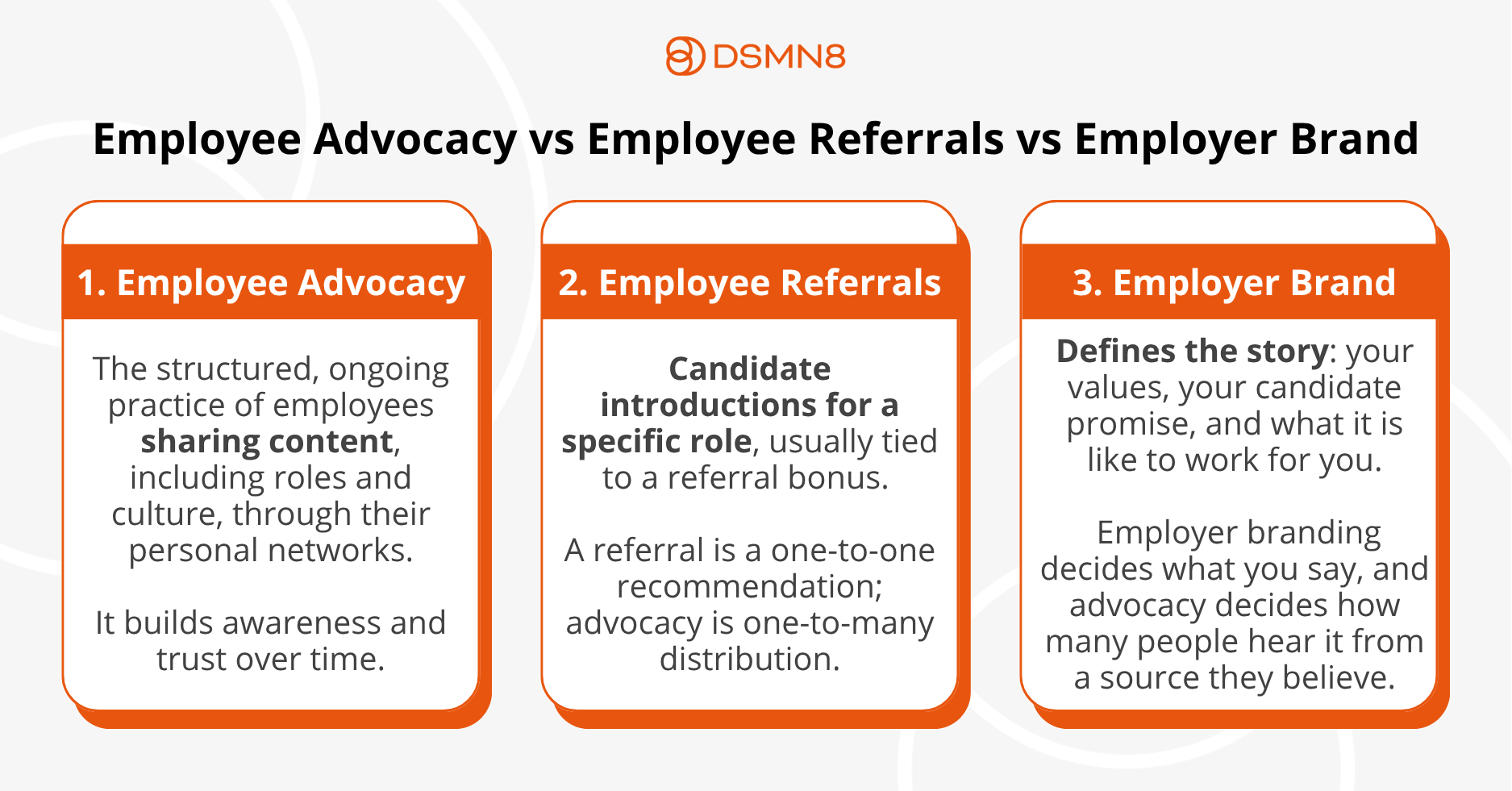
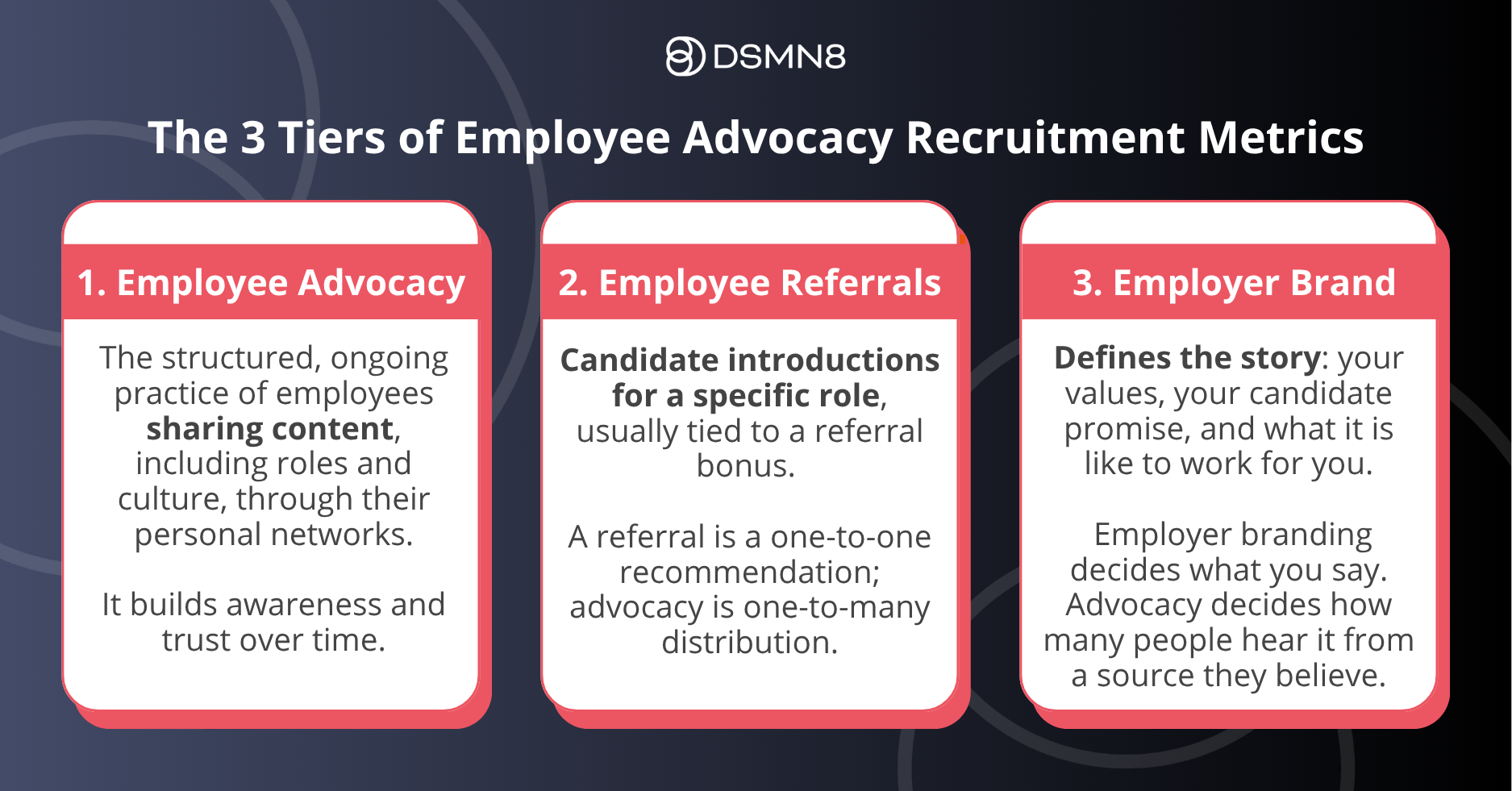
Employee advocacy is the structured, ongoing practice of employees sharing company content, including roles and culture, through their personal networks. It builds awareness and trust over time.
Employee referrals are candidate introductions for a specific role, usually tied to a referral bonus. A referral is a one-to-one recommendation; advocacy is one-to-many distribution.
Employer branding defines the story: your values, your candidate promise, and what it is like to work for you. Advocacy is how that story travels. Employer branding decides what you say, and advocacy decides how many of the right people hear it from a source they believe.
Advocacy is measured by reach, engagement, and influenced applications. Referrals are measured by referral rate and referral-sourced hires. The two overlap when an advocacy share leads to a formal referral.
The 3 tiers of advocacy recruitment metrics
Group your metrics by which stage in the hiring journey they sit. Each tier answers a different question.
- Visibility metrics: is the program active and is it amplifying our hiring content?
- Engagement metrics: is that content resonating with the right people and pulling them toward our roles?
- Outcome metrics: is advocacy influencing who applies, who we hire, and what that hire costs?
Visibility is the easiest to measure but, on its own, the weakest proof of value. Outcome metrics are the hardest to attribute cleanly, but the ones leadership cares about most. Engagement metrics are where advocacy program management and content strategy have a big impact. You should monitor and report on all three where possible.
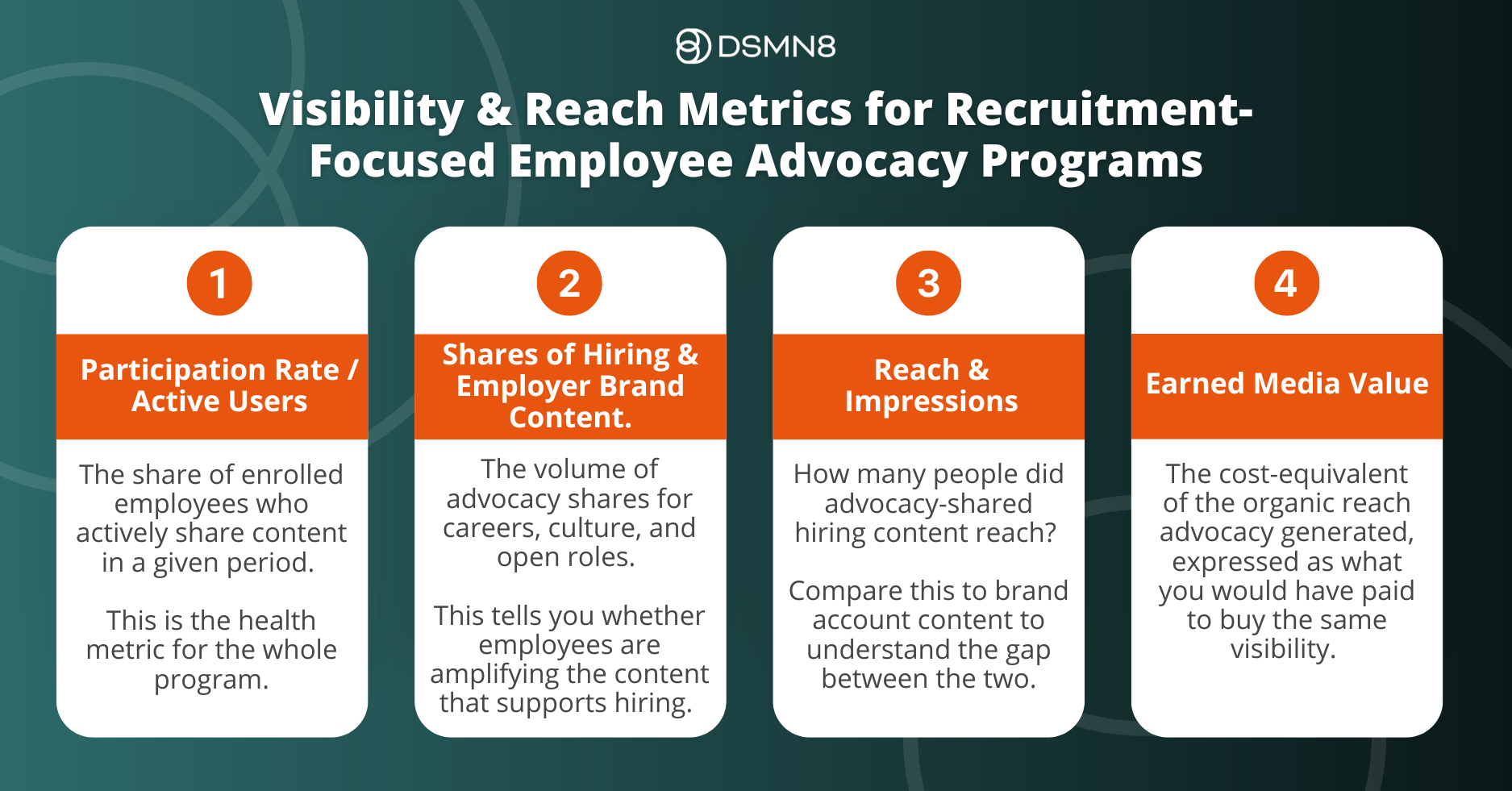
1. Visibility and reach metrics
These are the metrics that prove the program is active and putting your hiring content in front of more people.
Here you’ll want to look at figures like:
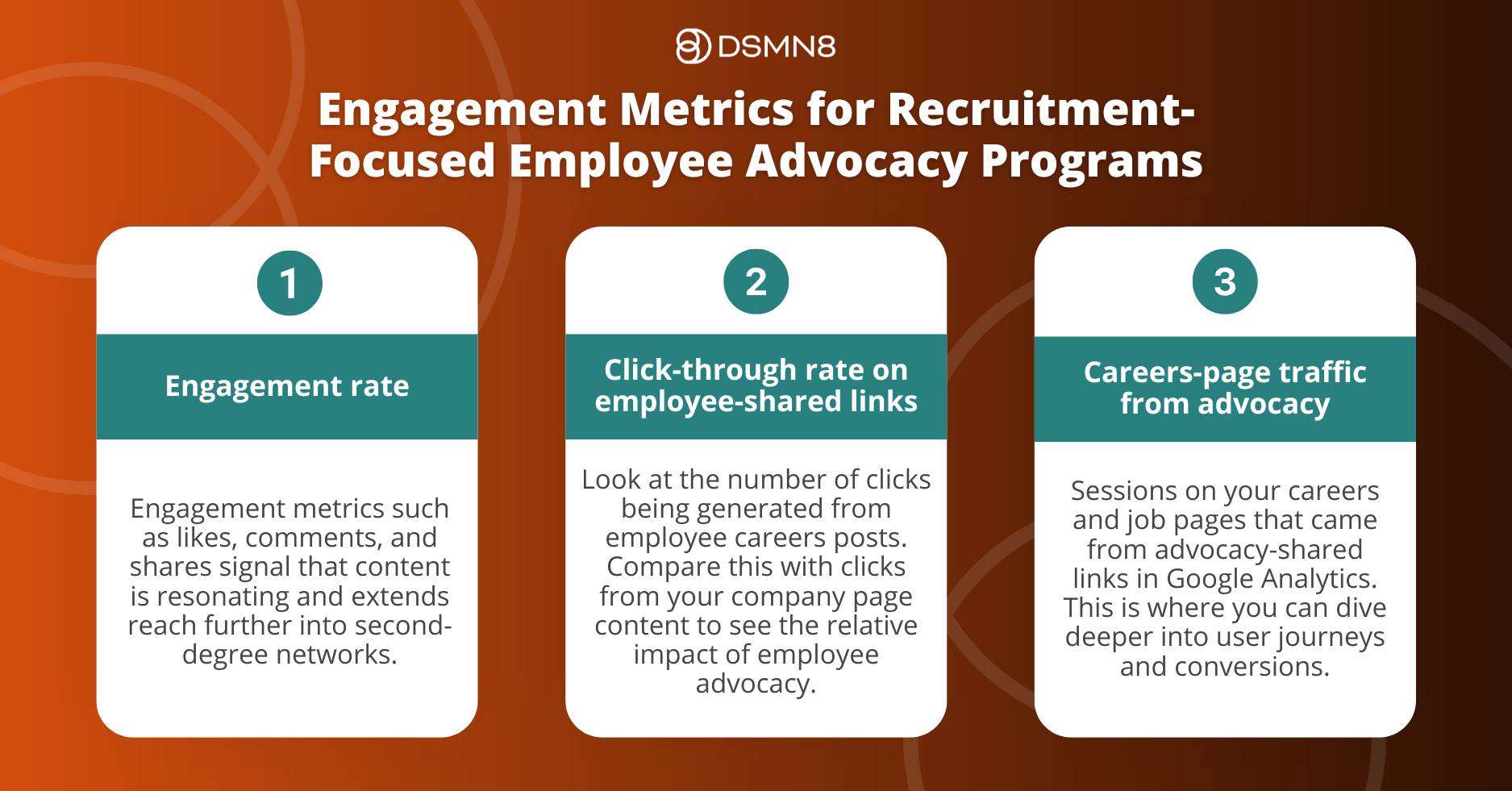
2. Engagement and traffic metrics
The next step is to understand how people engage with employee-shared content. These metrics will prove your program is working by moving candidates towards your careers pages and open roles.
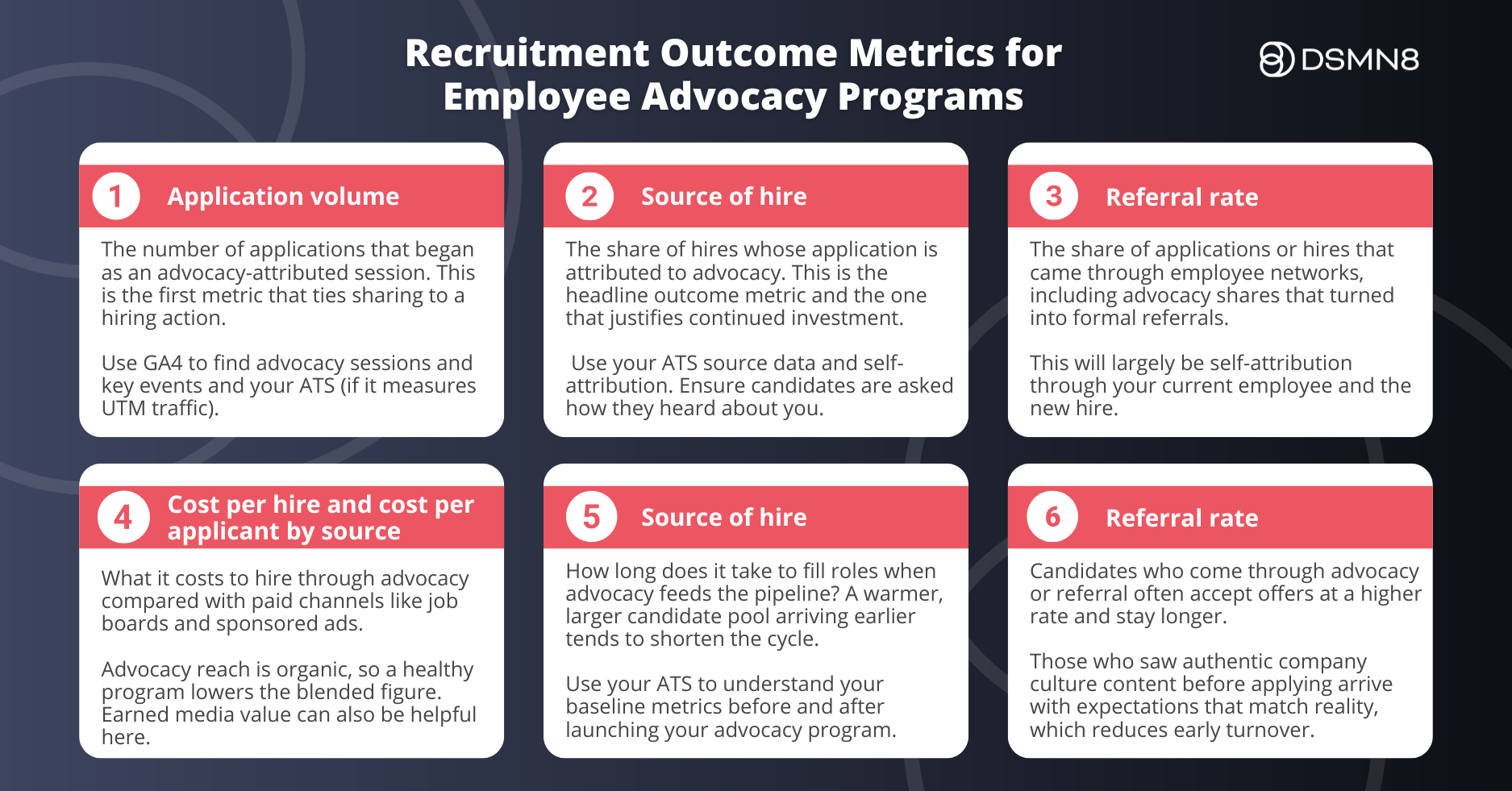
3. Recruitment outcome metrics
These are the metrics leadership asks about. They’re also the hardest to attribute cleanly, because candidates touch several channels before they apply, so treat them as advocacy’s contribution rather than its sole effect.
How do you measure employee advocacy for recruitment?
Each metric above names where its number lives. What ties them together is consistent source naming: tag advocacy links with UTMs in DSMN8, then filter reports in GA4.
The way Applicant Tracking Systems monitor links varies by platform, so you’ll need to check how links are tracked and ensure UTM naming conventions are used to attribute employee advocacy where possible.
If this isn’t achievable with your ATS, use DSMN8 metrics, GA4, and self-attribution to understand where applicants are finding you.
Consider a multi-touch attribution approach: the candidate may have originally found you on LinkedIn through an employee post, then signed up for your newsletter, and ultimately applied via a link in an email.
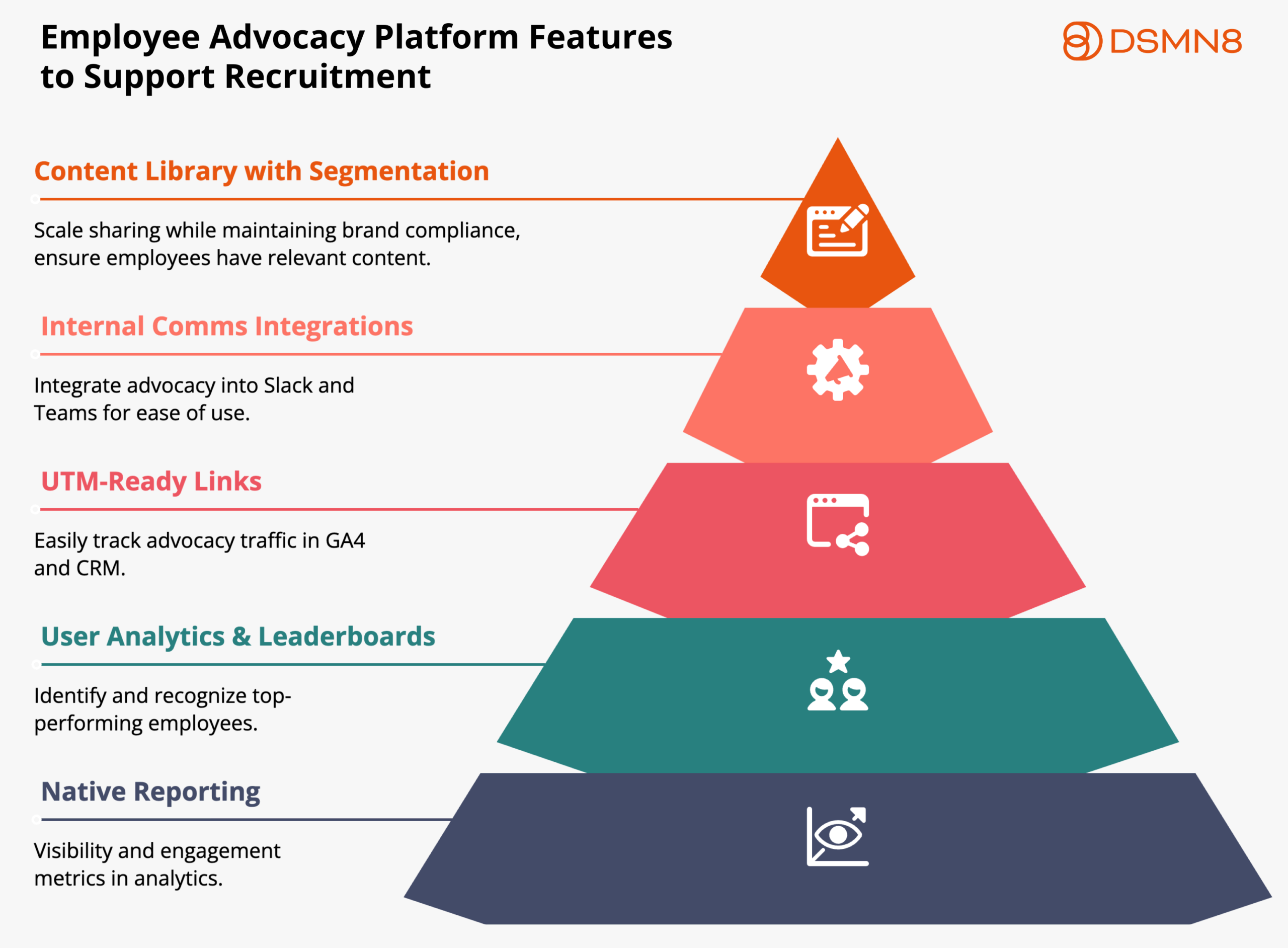
What advocacy platform features matter most for measuring recruitment?
For teams that need to prove recruitment impact, especially across multiple regions, the employee advocacy platform features that matter are the ones that make measurement and compliant scaling possible:
Watch the 90-second demo video below for a quick overview of the DSMN8 platform:
Additional Resources
Want to see how active your team is on LinkedIn, and how this compares with your competitors?
Get your free employee advocacy audit.
Ready to get started with the top-rated employee advocacy platform on G2?
More on how employee advocacy supports recruitment and employer branding:
FAQ
How do you measure employee advocacy in recruitment?
Measure it in three tiers: visibility metrics like participation rate, shares, reach, and earned media value; engagement metrics like click-through rate and careers-page traffic; and outcome metrics like source of hire, cost per hire, and time to fill. Tag advocacy links with UTMs so the traffic is identifiable, and align your source naming across your advocacy platform, GA4, and your ATS.
What is the difference between employee advocacy and employee referrals?
Employee advocacy is the ongoing, one-to-many practice of employees sharing company content through their networks to build awareness and trust. An employee referral is a one-to-one introduction of a specific candidate for a specific role. Advocacy often leads to referrals.
Does employee advocacy reduce cost per hire?
It can, because advocacy reach is organic and offsets spend on job boards, sponsored posts, and agency fees. To prove it for your own program, track cost per hire by source and compare advocacy-sourced hires with paid channels in your ATS.
Which recruitment metrics improve fastest with advocacy?
Visibility and engagement metrics move first, often within weeks: reach, shares, click-through rate, and careers-page traffic. Outcome metrics like source of hire and cost per hire follow once advocacy-sourced candidates work through the hiring pipeline.
Take the 2027 employee advocacy benchmark survey
- Get quoted in the final report
- Early access to the results

Emily Neal
Emily is SEO Lead at DSMN8. She focuses on organic growth strategy across search and AI search and co-authors DSMN8's original research, including the Employee Advocacy Benchmark Report and edited CEO Bradley Keenan's book. Her background spans SEO strategy, technical web, long-form content, digital PR, and marketing automation.