

Ask someone who benefits from employee advocacy, and most will say “marketing.” It’s a reasonable assumption. The content, the reach, the brand awareness… classic marketing metrics.
But when you take a closer look at how advocacy programs actually operate, you get a different story.
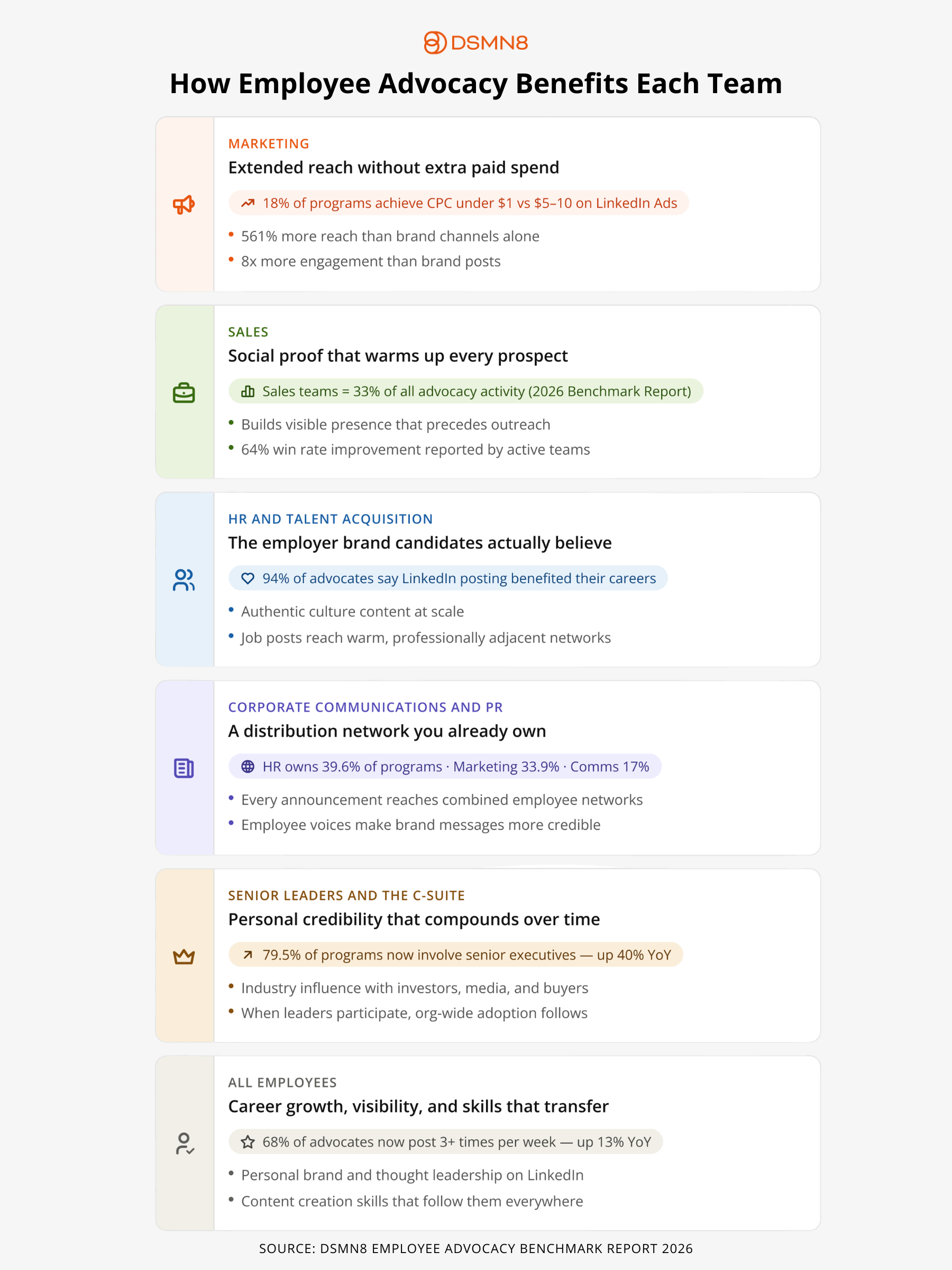
The 2026 Employee Advocacy Benchmark Report shows sales teams are now the most active participants (33% of activity), and program ownership sits across HR (39.6%), Marketing (33.9%), and Corporate Communications (17%).
Plus, 79.5% of programs now involve senior executives.
Employee advocacy has moved well beyond marketing’s remit.
Every team that focuses on customers, candidates, or revenue has something concrete to gain from getting involved.
This post breaks down the specific benefits for each team and what a well-run program looks like in practice for each one.
Marketing: More Reach. Less Ad Spend.
Marketing teams are usually the ones who build and manage an employee advocacy program, which means they’re often the first to see results, and sometimes the first to be surprised by how big those results can be.
The headline benefit is reach. Employee-shared content generates up to 561% more reach than the same content posted through brand channels alone.
Every employee who shares a blog post, report, or product update is extending the content’s distribution to a network of professionals on LinkedIn.
Engagement follows reach. Content shared by employees generates 8x more engagement than content shared by brand channels. Audiences respond differently to content from a person than to content from a logo. The trust is higher and the LinkedIn algorithm treats it better.
And let’s not forget the cost efficiency. DSMN8’s 2026 Benchmark Report found that 18% of programs achieve a cost-per-click under $1, with 29.4% seeing costs under $2. This is well below LinkedIn Ads benchmarks of $5-$10.
For marketing teams, employee advocacy delivers:
- Extended organic reach without additional paid spend.
- Higher engagement rates on content across LinkedIn and beyond.
- A lower cost-per-click on traffic driven through employee networks.
- A distribution channel for every content format: blog posts, reports, videos, carousels, and podcast episodes.
- Social proof that supports demand generation and pipeline influence.
Awin is a great example of how the imapct can compound over time: employee shares via DSMN8 became one of the highest referrers of traffic to the Awin website, turning employee advocacy into a core part of their marketing strategy.
Check out the Awin case study, and listen to the podcast below to hear about Sarah Ruzgar O’Connell’s strategy:
In DSMN8, marketing teams can feed content directly into the platform, assign it to the right employees using teams and groups, and offer multiple caption and image variations so posts don’t look identical across hundreds of profiles.
Auto-scheduling removes the friction for busy employees and keeps the program active without requiring daily manual effort.
💡 Learn more: Employee Advocacy for Marketing Teams.
Sales: Social Selling That Actually Scales
Sales teams have become the most active participants in employee advocacy programs, and it’s not hard to see why.
The buying journey has changed. Prospects research the people they’ll work with before taking a call. A blank LinkedIn profile, or one that hasn’t been updated since 2021, is a missed opportunity.
Employee advocacy solves the cold-start problem for social selling.
Rather than expecting every salesperson to create original content from scratch, an employee advocacy program provides them with a steady stream of relevant, brand-approved content they can share with a single click.
Over time, consistent sharing builds a visible professional presence and a reputation for being plugged into industry conversations.
This matters because trust is what moves B2B deals forward. Buyers are more likely to engage with a salesperson who appears active, knowledgeable, and connected than one who has no visible presence at all.
One program manager in the 2026 Benchmark Report cited a 64% win rate improvement on opportunities when their team shared consistently.
For sales teams, employee advocacy delivers:
- A consistent LinkedIn presence that warms up prospects before outreach.
- Brand-approved content that positions salespeople as informed, credible voices.
- Increased reach into prospect and customer networks through authentic sharing.
- Support for social selling initiatives and account-based marketing.
- Analytics on which shared content drives traffic and engagement, providing signals on what resonates with their audience.
For salespeople who want to go further, DSMN8’s Personal Voice AI helps them generate posts in their own tone rather than sounding like branded copy. Delegate Access supports senior sales leaders or executives who want a visible presence but need help managing the day-to-day posting.
💡 Learn more: Employee Advocacy for Social Selling.
HR and Employer Brand: Your Culture, Visible From the Outside
HR teams manage the highest proportion of employee advocacy programs globally: 39.6%, according to the 2026 Benchmark Report. It makes sense, there’s a strong employee advocacy use case for HR: presenting a positive image to support employer branding, employee engagement, and recruitment.
Candidates research companies the same way buyers research vendors.
They look at who works there, what those people post, and whether the company’s values are lived rather than just listed on a careers page.
Employee advocacy gives HR teams a way to surface authentic, human content at scale: team events, behind-the-scenes moments, employee milestones, culture posts.
Employees’ LinkedIn connections tend to be professionally adjacent, such as former colleagues, industry peers, and people in relevant roles. When an employee shares a job opening or a culture post, it reaches a warm audience of potentially qualified candidates that a paid job ad may not.
This all has a direct effect on hiring quality and cost. The people who apply are more aligned with what the company actually is.
For HR and employer brand teams, employee advocacy delivers:
- Authentic employer brand content distributed through employee networks at scale.
- Wider reach for job postings into warm, professionally relevant audiences.
- Reduced reliance on paid job advertising for brand and culture content.
- Better candidate pipeline quality through more accurate first impressions of the organization.
- Internal engagement benefits: employees who share feel more connected to company goals and culture.
The internal dimension is underrated. The 2026 Benchmark Report found that 60% of programs cite increasing employee engagement and morale as a key objective.
Programs that give employees ready-to-share content, including internal news, team achievements, and company milestones, report stronger cross-functional connectivity, particularly in remote and international organizations.
The data from employees themselves reinforces the value: 94% of employee advocates say posting on LinkedIn has benefited their careers. When HR communicates advocacy as something that helps employees grow professionally, not just a channel for company messaging, participation follows.
In DSMN8, HR teams can use custom newsletters to distribute internal content alongside external-facing posts, segment advocates by team or region, and use polls to gather employee feedback directly through the platform.
Employee advocacy also complements the broader shift toward AI tools for HR teams — while AI handles screening, scheduling, and repetitive workflows, human-generated content remains the most trusted signal for candidates evaluating employers.
💡 Learn more: Employer Branding | Talent Acquisition | Employee Communications.
Corporate Communications and PR: A Distribution Network You Already Own
Corporate communications teams face a content problem most don’t openly discuss: they produce a lot of high-quality material that doesn’t travel far enough.
Press coverage, executive commentary, product announcements, crisis responses, thought leadership… most of it gets published and then largely disappears, read by whoever already follows the brand channel.
Employee advocacy changes that. When every employee is a potential amplifier, a major announcement reaches the combined networks of everyone who shares it.
For a company with several hundred employees on LinkedIn, that can represent hundreds of thousands of additional impressions from a single piece of content, without any paid media behind it.
The credibility factor is equally important. A press story shared by the company page carries less weight than the same story shared by 15 people across product, sales, and operations. It looks like genuine organizational pride in what the company has built.
For corporate communications and PR teams, employee advocacy delivers:
- Broader distribution for press releases, media coverage, and product announcements.
- Employee amplification that makes brand messages feel more credible and authentic.
- A channel for executive thought leadership content that reaches beyond their followers.
- Faster speed of distribution for time-sensitive announcements.
- Support for narrative management during significant company milestones or sensitive periods.
79.5% of programs now involve senior executives.
Among those programs, 45% of leaders actively share content, 29% are highly engaged and set an example for the broader organization, and 25% actively encourage and mentor other advocates.
When communications teams can point to leadership participation as evidence that the program matters internally, user adoption across the wider organization tends to follow.
In DSMN8, comms teams can share content across every major format (articles, videos, carousels, podcast clips, LinkedIn carousels) and route it to the right employees. Content sources like company blogs and news feeds can be directly connected to the platform, enabling new content to be efficiently curated for employees to share.
💡 Learn more: Employee Advocacy for Corporate Communications and PR.
Senior Leadership: Personal Brand Meets Company Credibility
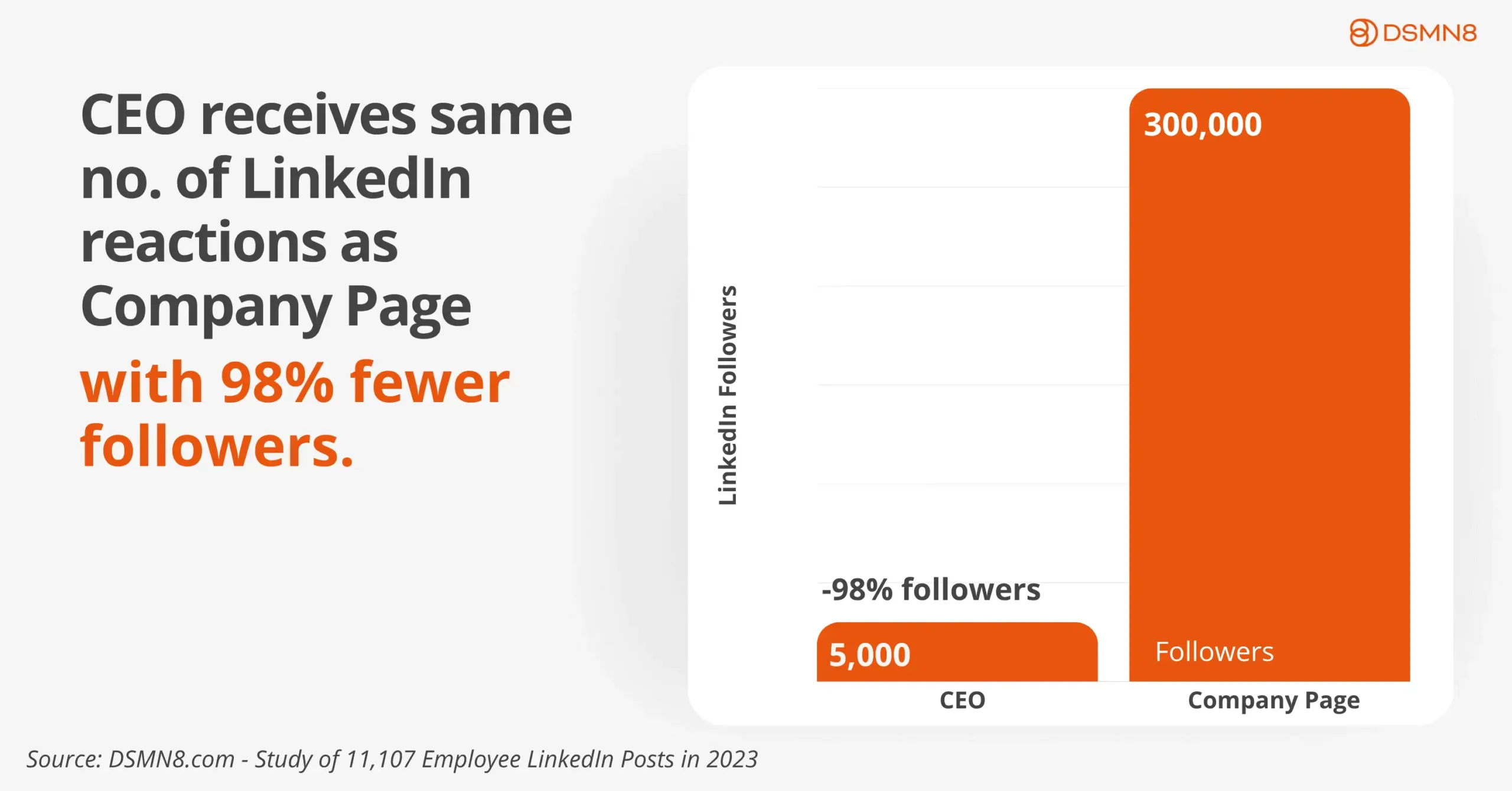
Senior leader participation is the single factor most consistently associated with high-performing advocacy programs.
This is not coincidental. When executives are active on LinkedIn, it signals to the rest of the organization that the program is worth taking seriously. It sets a visible standard. It demonstrates that advocacy is a strategic priority, not a marketing experiment.
But the benefits for senior leaders personally are just as significant as the organizational ones.
An executive with a consistent, well-developed LinkedIn presence becomes a credible voice in their industry.
They attract inbound attention from journalists, conference organizers, investors, and potential customers who wouldn’t engage with a brand page but will engage with a person they’ve seen sharing valuable perspectives.
The 2026 Benchmark Report shows that executive involvement has accelerated significantly: participation is up 40% compared to 2025. For programs that don’t yet involve leadership, getting executives active on social media is the top priority for the year ahead.
For senior leaders, employee advocacy delivers:
- A personal brand that builds credibility, trust, and industry influence over time.
- Visibility with investors, media, and senior decision-makers in customer organizations.
- A platform for thought leadership content that extends beyond the company’s own reach.
- Cultural authority: when leaders participate, advocacy adoption across the organization increases.
- Talent attraction: senior voices sharing their vision and values are a powerful signal to prospective hires.
The biggest barrier that consistently comes up is time. Most executives understand the value of a LinkedIn presence but struggle to find the bandwidth to maintain one consistently.
DSMN8’s Delegate Access feature is designed specifically for this situation. A trusted team member can draft and schedule content on behalf of an executive, maintaining their presence and tone without requiring them to manage day-to-day posting. Personal Voice AI means any content drafted on their behalf can match their natural style rather than sounding like a corporate press release.
💡 Learn more about DSMN8’s Executive Influencer Platform.
All Employees
Every section above describes what a team or function gains from employee advocacy at an organizational level. But none of it happens without the individuals who actually participate, and they need a reason to show up consistently that goes beyond “it helps the company.”
The good news is that there are personal benefits to getting involved. According to the 2026 Benchmark Report, 94% of employee advocates say posting on LinkedIn has benefited their careers.
That covers everything from expanded professional networks and increased visibility with senior leaders to being approached for speaking opportunities or media features.
Participating in an advocacy program also builds transferable skills. Creating content, developing a point of view, and learning to communicate value publicly are capabilities that follow employees wherever their careers take them.
The practical barrier is usually lower than employees expect. With a platform like DSMN8, sharing takes seconds – content is pre-approved, captions are ready to post or easy to personalize, and scheduling handles the timing.
For the full picture on what individual employees gain from getting involved, see The Benefits of Employee Advocacy for Employees.
Additional Resources
Ready to get started with the #1 employee advocacy platform?
Wondering how active your team already is, and how this compares with your competitors?
Get a free competitor analysis review.
More on Employee Advocacy:

Emily Neal
Emily is SEO Lead at DSMN8. She focuses on organic growth strategy across search and AI search and co-authors DSMN8's original research, including the Employee Advocacy Benchmark Report and edited CEO Bradley Keenan's book. Her background spans SEO strategy, technical web, long-form content, digital PR, and marketing automation.