
Last Updated: October 7, 2026
Most advice on executive thought leadership assumes working with one person: the CEO. It falls apart the moment a marketing or comms team is asked to support five, ten, or twenty executives at once.
That’s the situation most enterprise teams are actually in.
In reality, the CEO isn’t the only person prospects, employees, and journalists are following. VPs of engineering, regional GMs, practice leads, and CFOs are all expected to show up on LinkedIn now, and someone has to make that possible without becoming a full-time ghostwriter for a dozen people.
This is what “executive thought leadership support” really means: not a content strategy for one leader, but an operational system for a team supporting many.
If you are building a plan for a single executive’s personal brand, our 30-day executive LinkedIn playbook covers that in detail. You’ll also want to check out our guide to CEO personal branding, and, if you’re still making the case internally, the impact of an executive’s social media presence.
This one is for teams looking to scale it across their leadership team. How do you run the same process without it collapsing or needing to hire an agency?
What Executive Thought Leadership Support Involves
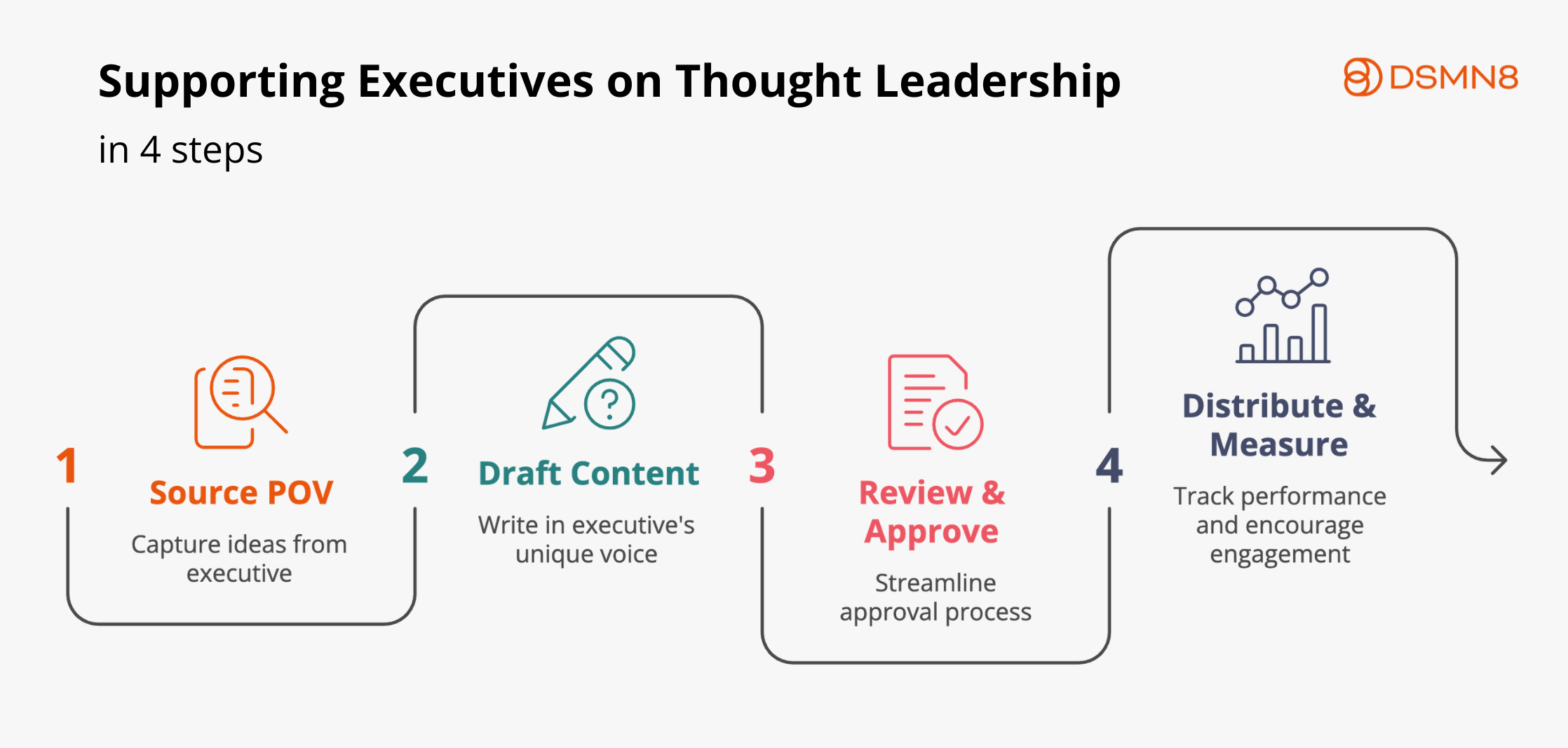
If we take away the buzzwords, supporting executive thought leadership at a team level comes down to four key parts:
1. Sourcing point of view.
Someone has to get a POV out of an executive’s head and into a shareable format.
That might mean a 15-minute voice memo, a recap of a client call, or a reaction to industry news. The raw material has to come from somewhere.
2. Drafting in that executive’s voice.
This is where most programs fail. A VP of sales and a VP of engineering should not sound identical online.
If every executive’s posts read as if they came from the same template, the program comes across as manufactured. Audiences notice this, and engagement drops.
Our latest data report examines the importance of personalization in detail, drawing on analysis of over 500,000 LinkedIn posts from 2026.
3. Review and approval.
Executives are busy.
A workflow that requires them to go back and forth over email or Slack to approve content will get abandoned within a month.
Approval needs to fit into how they already work, not add extra stress.
4. Distribution and measurement
Always keep in mind that publishing isn’t the finish line.
Someone needs to track how the content is performing and encourage the wider team to engage.
To maintain buy-in, you need to show the impact.
Why This Breaks Down at Scale
Each of these steps is manageable for one executive with an assistant or support from someone in marketing/comms.
Multiply by ten, and you can see where the cracks begin to show…
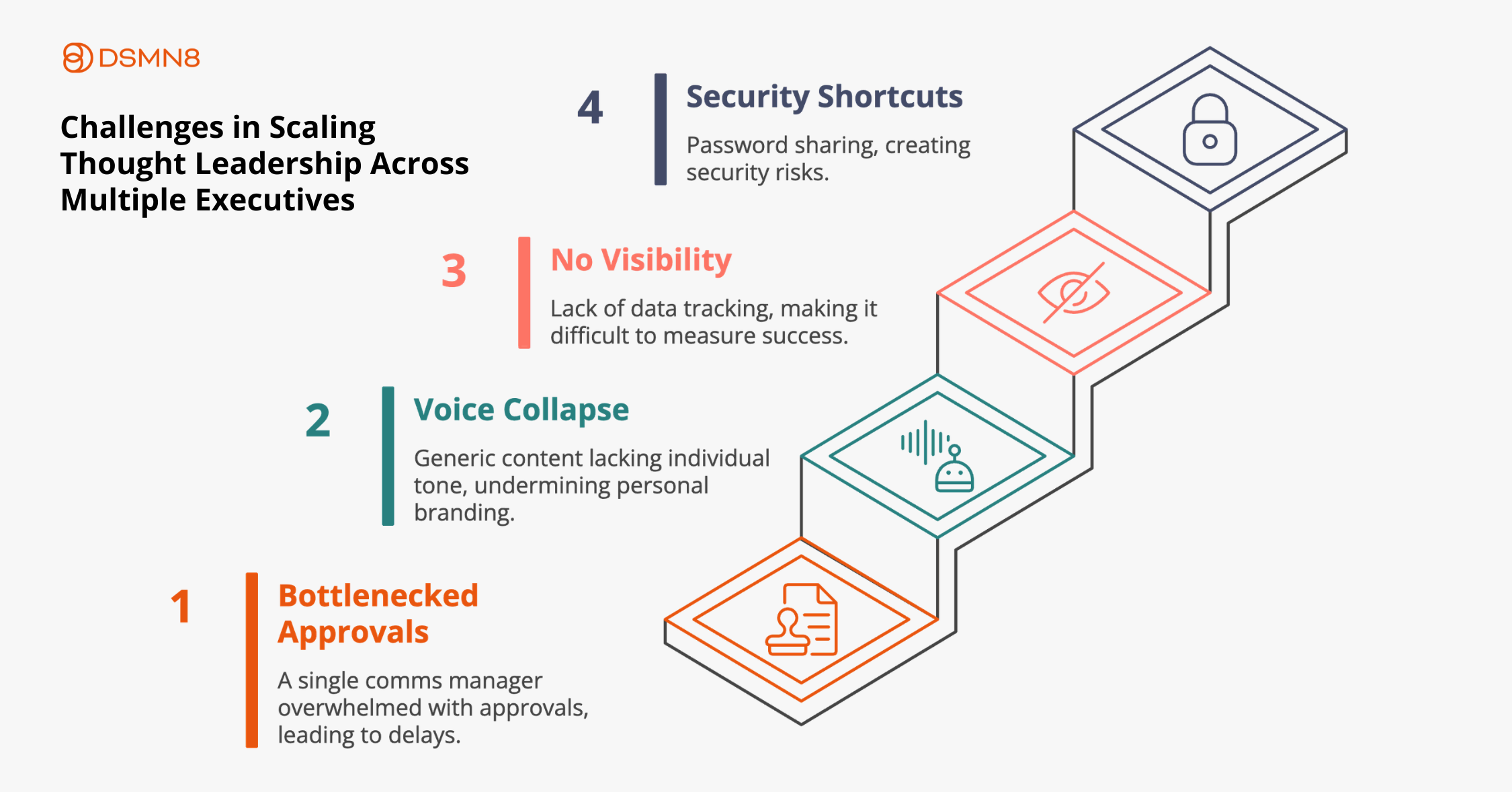
1. Bottlenecked approvals.
One comms manager working on every executive’s personal brand is a recipe for disaster.
When they’re out sick, on vacation, or swamped with other priorities, ten people’s LinkedIn profiles go quiet.
2. Voice collapse.
Without a system for capturing individual tone, most teams default to a generic ChatGPT voice or take the same approach as brand channels.
This results in content that feels corporate rather than personal. This undercuts the entire premise of executive thought leadership!
3. No visibility.
Leadership asks “is this working?” and nobody has a clean answer, because tracking lives in scattered spreadsheets, personal notes, or simply doesn’t exist.
Any time requirements from senior leadership need to be justified, and if you can’t do that with data, be prepared for this to be deprioritized when things get busy.
If you’re still building that case internally, our data on the impact of executive social media presence is hard to argue against!
4. Security shortcuts.
Under time pressure, teams sometimes resort to password sharing so someone can post directly from an executive’s account.
That’s a real risk. Senior leaders are often targets of hacking attempts and phishing scams. Sharing a CEO’s password with a junior marketer just isn’t a good idea.
Our guide to executive social media security covers what secure delegation actually requires, so we won’t repeat it here.
We all know that sharing passwords isn’t a good idea, but when you’re under pressure to post on behalf of 10 execs, it sometimes feels like the only way.
A Framework for Supporting Multiple Executives
The fix isn’t to work harder within the same process.
What works for supporting one CEO simply isn’t best practice for an entire C-Suite and beyond.
Let’s build a repeatable, scalable system instead.
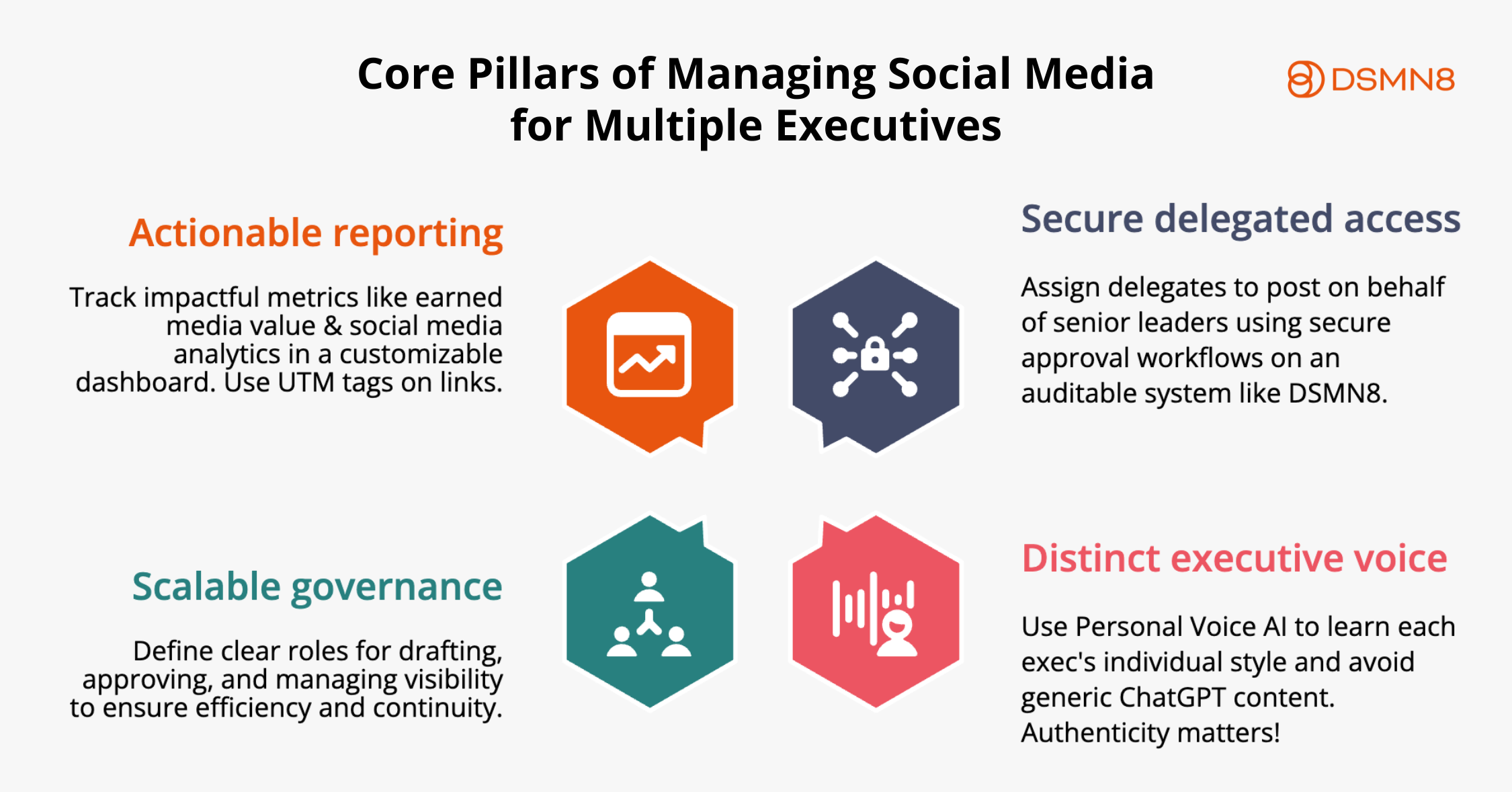
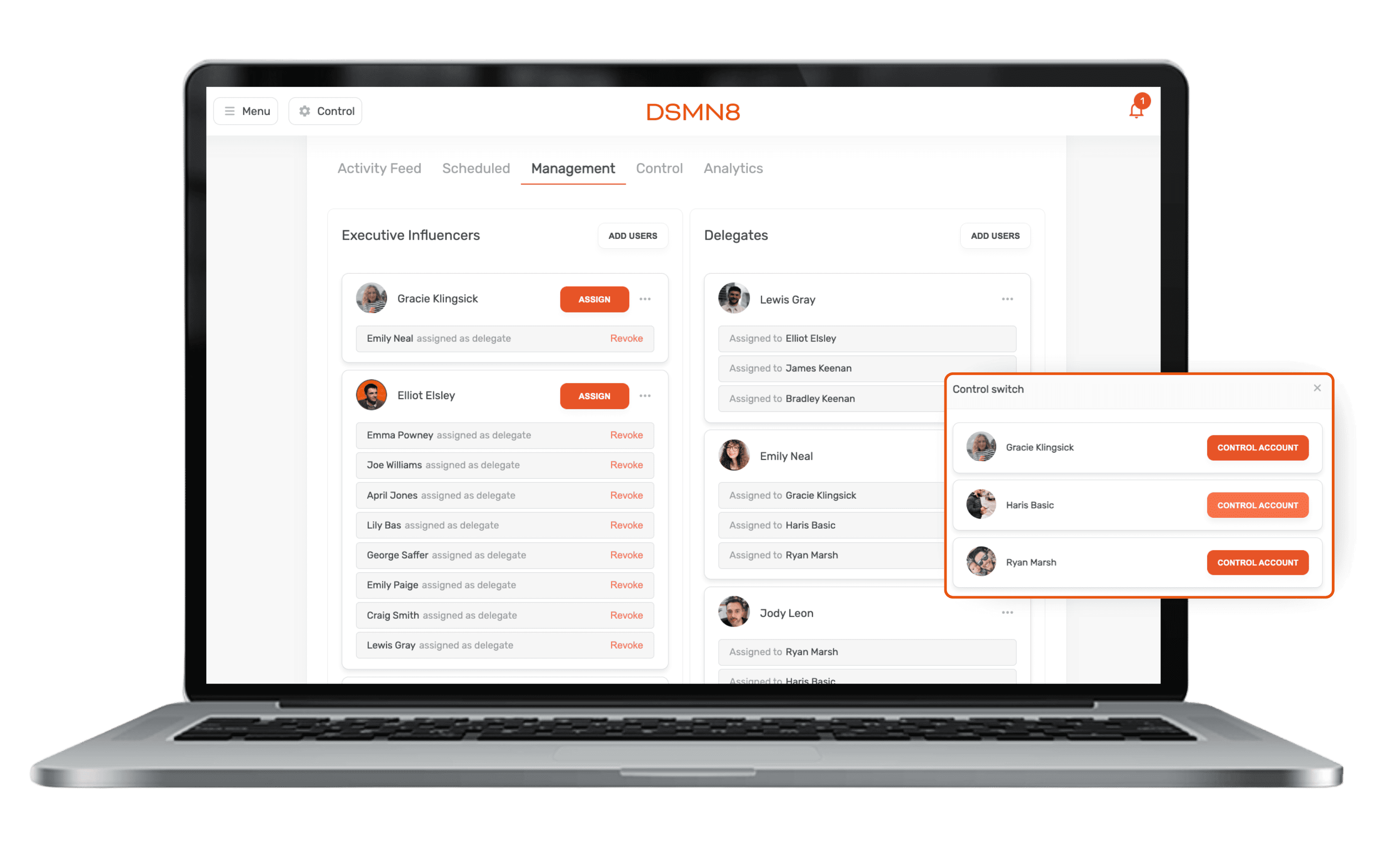
1. Secure delegated access, not shared passwords.
You should be able to post on behalf of any willing exec in your org without them having to hand over their password.
This is table stakes for any executive influencer or thought leadership program.
Our delegate access guide walks through how this works in practice.
But to break it down briefly, the DSMN8 platform has a system where you can assign delegates to post on behalf of senior leaders.
It includes approval workflows and is auditable. So you know which content curator is acting on behalf of each executive, and it’s easy for them to approve or decline content before it goes live.
Platform-wide data backs this up. Across 62 organizations running executive influencer programs with DSMN8, delegates draft 56% of executive posts while executives personally publish 62% of shares, and delegate-created content reaches 2.8x further than self-authored posts. See the key findings from The Executive Voice, or get the full report.
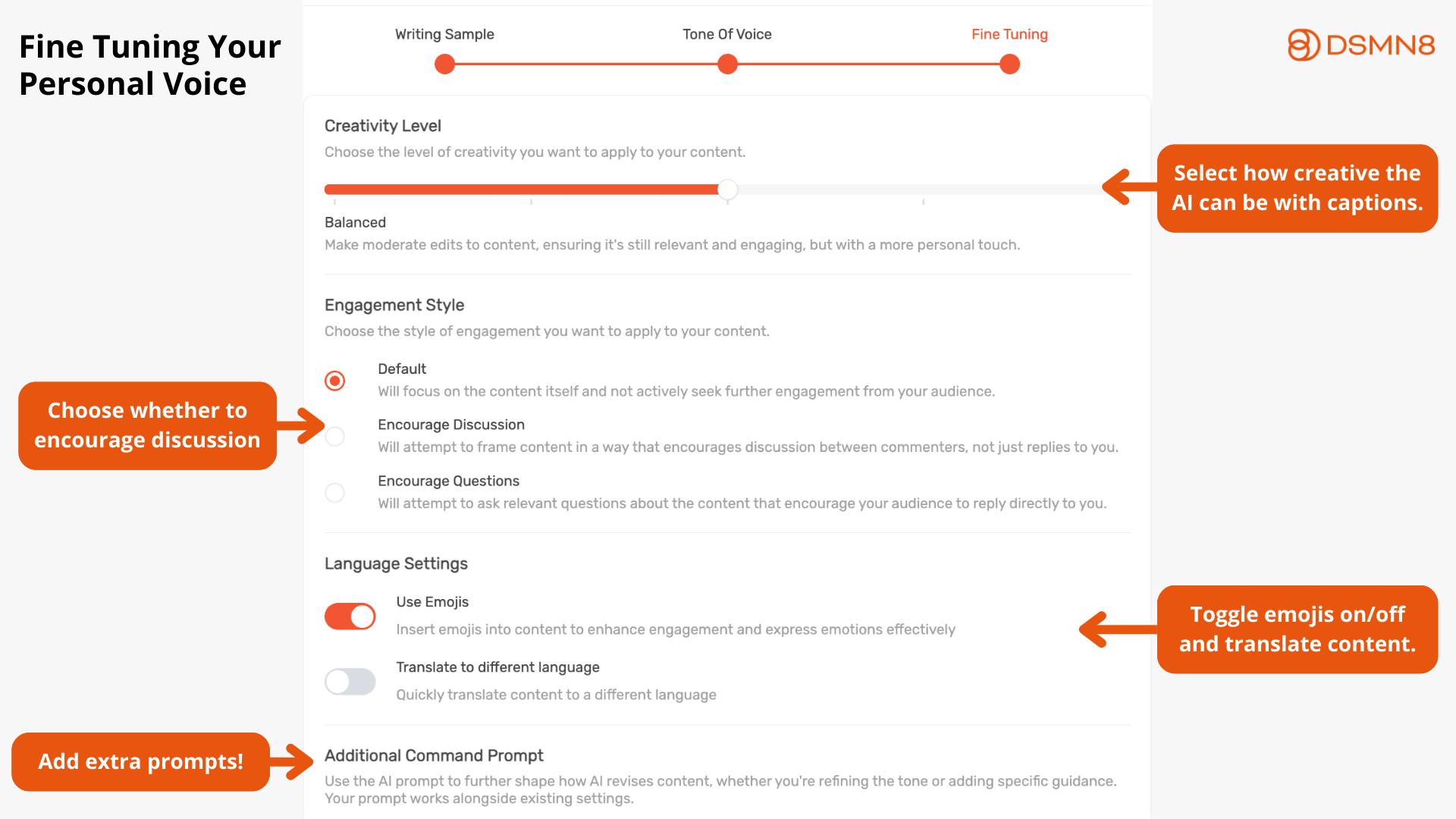
2. A distinct voice per executive, not a shared template.
The instinct to write an AI prompt and reuse it across every leader is understandable, but it has a negative impact on credibility.
In our recent analysis of over 500,000 LinkedIn posts, personal posts that carried a clear individual voice saw a 9.2x engagement premium over company-curated content, and even light personal edits produced a 3x uplift.
For the full breakdown of these findings, including how the effect varies by post format, see our analysis of the H1 2026 personalization data.
There’s a real difference between “sounds like a real person” and “sounds like everyone else”.
This is precisely the problem Personal Voice AI is built to solve: it learns each executive’s actual tone from their past posts or writing samples, so a VP of engineering and a VP of sales don’t end up sounding like the same person wrote both.
3. Governance that doesn’t depend on one person.
A program supporting multiple executives needs defined roles: who drafts, who approves, who has visibility into what’s pending, and what happens when someone is unavailable.
Our guide to structuring an employee advocacy program with clear roles and governance, and our piece on why programs need multiple stakeholders both cover this in more depth.
The short version: if the whole system depends on one person never being out of office, it isn’t a system yet!
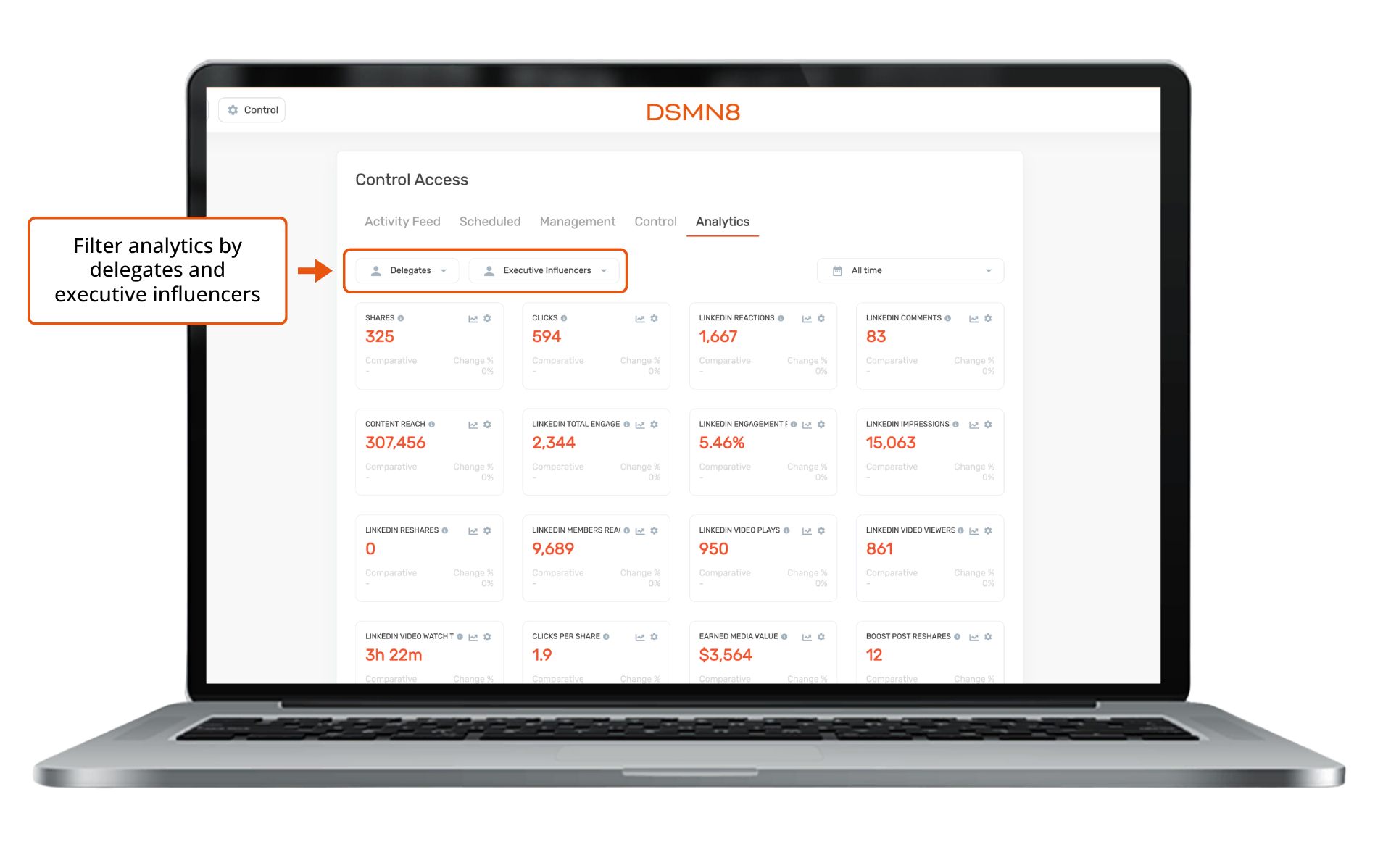
4. Reporting leadership will actually care about.
Executives don’t need to see every single social media metric.
But they should know whether their presence is having an impact, and whether it’s translating into anything tangible for the business.
When managing an executive through the DSMN8 platform, program managers will be able to track all the metrics that matter in a customizable dashboard.
No more asking your CFO to check their LinkedIn analytics and copy-paste the numbers for you… or logging into their account to do it yourself.
There are two other methods I find useful for demonstrating the value as a marketer:
- Earned media value. This is the cost-equivalent comparing organic performance to paid social. The DSMN8 platform has this built in, but you can use our free calculator. We also ran the full comparison between employee advocacy and paid social if you need the underlying numbers.
- UTM tracking. Content that gets shared through DSMN8 automatically has UTM parameters, meaning you can track the impact in Google Analytics and your CRM. This means I can say “our CEO’s LinkedIn post last week led to a meeting booked with sales”.
Choosing Executives and Getting Them On Board
Everything above assumes you know which leaders you’re supporting.
Most programs expand by taking whoever volunteers, which tends to produce three executives from the same function (usually marketing and sales) covering the same subjects.
Map your leadership team against the areas the business needs visibility in. By division, so each part of the company has a voice. By key topic, so someone owns AI, and someone owns supply chain. By region, if you’re pushing into a specific market.
If you already run an employee advocacy program, participation data will show you where the executive gaps sit.
These executives already know the benefits; they’re seeing your CEO posting. Maybe they’ve heard of your advocacy program. But this hasn’t moved them enough to start posting.
What does move them is their own goals: speaking slots, podcast invitations, a LinkedIn Top Voice badge, career opportunities.
Ask each leader what they want from their social media presence before you write a word of content for them.
Then keep the program worth being in.
Early access to content, material that the general program doesn’t get, and a clear expectation that inactive members come off the list. It’s an exclusive club.
What This Looks Like in Practice
One DSMN8 global enterprise client started their executive program in December 2025, after launching employee advocacy across the wider business first.
They used participation data from their advocacy program to find the gaps: some divisions had no executive voice at all. Those became the shortlist, with the goal of one recognized thought leader per division.
Content is assigned by topic and region. One leader is known for AI expertise, another was selected because the company is pushing into a specific US market and wanted a senior voice based there.
Eight months in:
- 32 executives: 31.9 clicks per share
- 700 advocates in the wider program: 3.1 clicks per share
The CMO compared those two numbers and expanded the program.
Each content curator started with four or five executives to manage after setting up their Personal Voice in the platform.
After the expansion, those executives now have two or three delegates each, so no single person is a bottleneck.
Executives started asking to join, and many now write their own original content rather than relying on a delegate!
Analytics are shared with the execs, so they can see how their content is performing.
Managing this through the DSMN8 platform makes it scalable and secure.
Watch the short video below to see it in action:

Executive Thought Leadership Support: Quick Framework Recap
Framework for Supporting Executive Thought Leadership: Step-by-Step Process
Source point of view
Gather this from executives in the format that’s easiest for them (voice notes, call recaps, quick reactions).
Draft content
In each executive’s distinct voice using Personal Voice AI, not a shared template or identical prompt.
Delegate access securely
Use DSMN8’s delegate access functionality to enable marketing/comms to act on behalf of execs without password-sharing.
Assign program governance roles
So the program doesn’t depend on one person to manage 8 executives.
Simple approval workflows
Content gets sent to executives for a simple yes/no opt-out process before it gets posted through the DSMN8 platform. This prevents review bottlenecks while giving execs a say in the content.
Report on performance
DSMN8 platform analytics mean you can see LinkedIn analytics for each executive without logging into their account. Plus, automatic UTMs on links mean impact is visible in Google Analytics and CRMs.
Expand! Select and enroll additional executives
Use data to secure buy-in for program expansion. Choose priority leaders by division, topic, or regional coverage gap.
Additional Resources
Book a demo to see how DSMN8 supports executive influence and employee advocacy at scale.
Want to see how active your executives currently are on social, and how they compare to your competitors?
Get your free executive influence report.
- Why is Executive Visibility Vital? Podcast episode with Lori Grey, expert consultant who has worked on executive brands at orgs like KPMG and Deloitte.
- The Executive Voice: platform-wide data on delegate access, posting pace, and content format from 62 organizations running executive influencer programs.
- 30-Day Executive Visibility Playbook.
- How Employee Advocacy Works Alongside Executive Influence.
Frequently Asked Questions
What does executive thought leadership support include?
At a program level, it covers sourcing content ideas from executives, drafting in each leader’s individual voice, routing approvals efficiently, securely delegating account access, and reporting on both visibility and business impact.
How is this different from executive ghostwriting?
Ghostwriting typically describes one writer producing content for one executive. Executive thought leadership support describes the broader system, tools, workflows, and governance, needed to do this consistently across multiple leaders without every executive requiring a dedicated writer.
How many executives can one comms team realistically support?
It depends more on the workflow than the number. A team without delegated access and defined approval routing in platforms like DSMN8 will struggle past two or three executives. With the right system in place, the same team can typically support a much larger group, since the bottleneck shifts from headcount to whether the process is designed for scale.

Emily Neal
Emily is SEO Lead at DSMN8. She focuses on organic growth strategy across search and AI search and co-authors DSMN8's original research, including the Employee Advocacy Benchmark Report and edited CEO Bradley Keenan's book. Her background spans SEO strategy, technical web, long-form content, digital PR, and marketing automation.