
Last Updated: August 25, 2026
“Let’s just get employees to engage with company page posts for now.”
It’s one of the most common starting points we hear from marketing teams thinking about LinkedIn growth.
It’s not a bad instinct, asking a few people to click “react” or “reshare” on the exact post you’ve already written is about as low-friction as employee involvement gets, and it already beats posting from the company page alone.
But it’s just one small part of what employee advocacy can do. Let’s take a look at the bigger picture, and what you’ll be leaving on the table.
The case for company page engagement only
Asking employees to react or reshare to company page and/or CEO LinkedIn posts keeps everything in one place.
The message doesn’t change hands: what goes out is exactly what marketing wrote, just seen by more people.
No one has to write anything, personalize anything, or understand what’s on-brand.
If you’re a small team, or you’ve never run anything like an advocacy program before, this is the lowest-risk way to get employee networks working for you.
The problem is stopping there.
Where it breaks down: personalization and reach
Though getting your team on board to react to, reshare, and even comment on your company page content will give you a bit of a boost in the algorithm.
But the data shows that LinkedIn company pages have a real ceiling when it comes to reach.
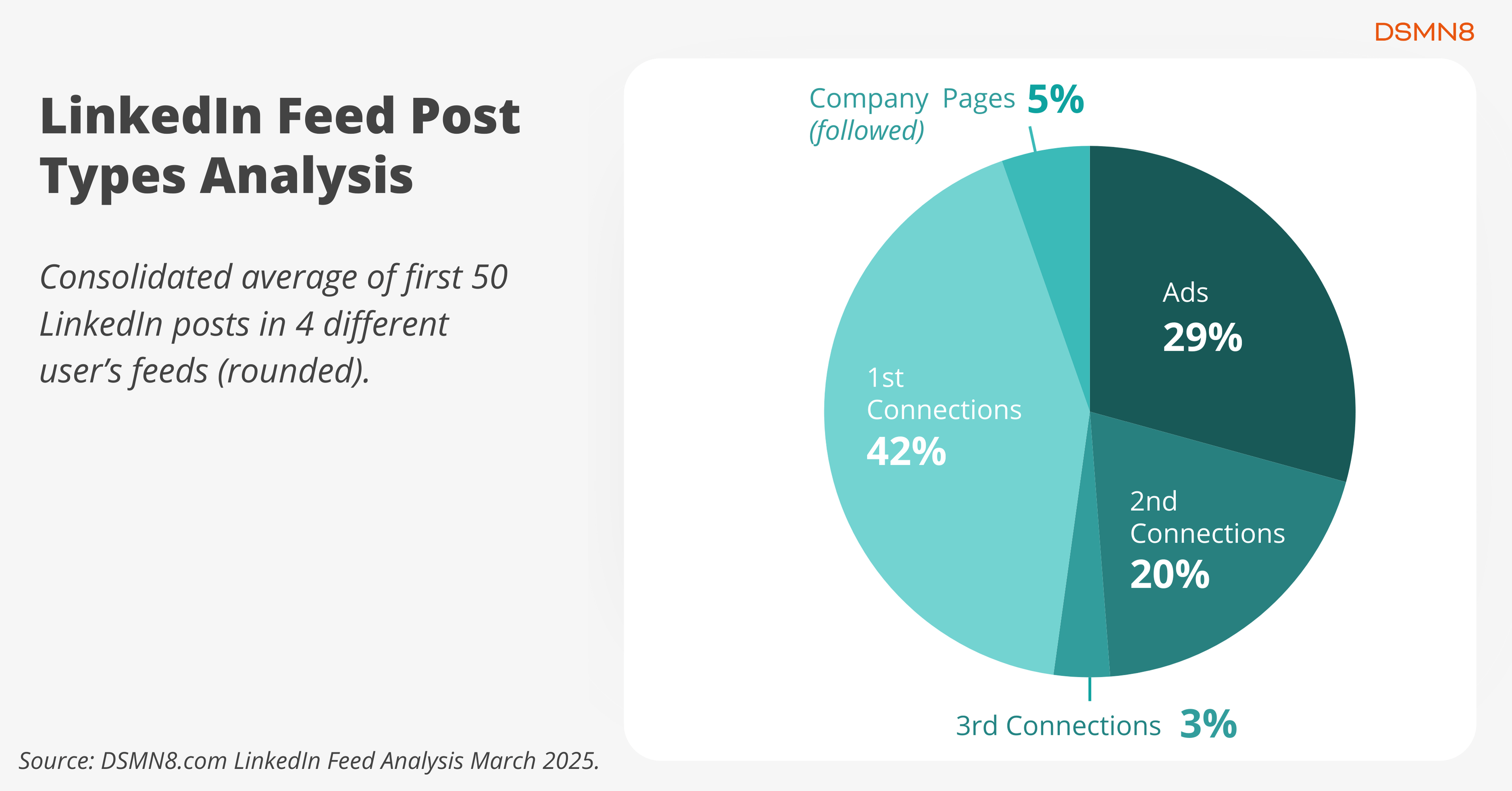
Company pages start from a smaller base than most teams assume.
In our own analysis of live LinkedIn feeds, company pages accounted for an average of just 5.37% of the posts people actually saw.
And not a single organic company page post appeared in a feed without engagement from someone in that user’s own network first.
That’s exactly why starting with getting employees to ‘boost’ company content is a sensible first move.
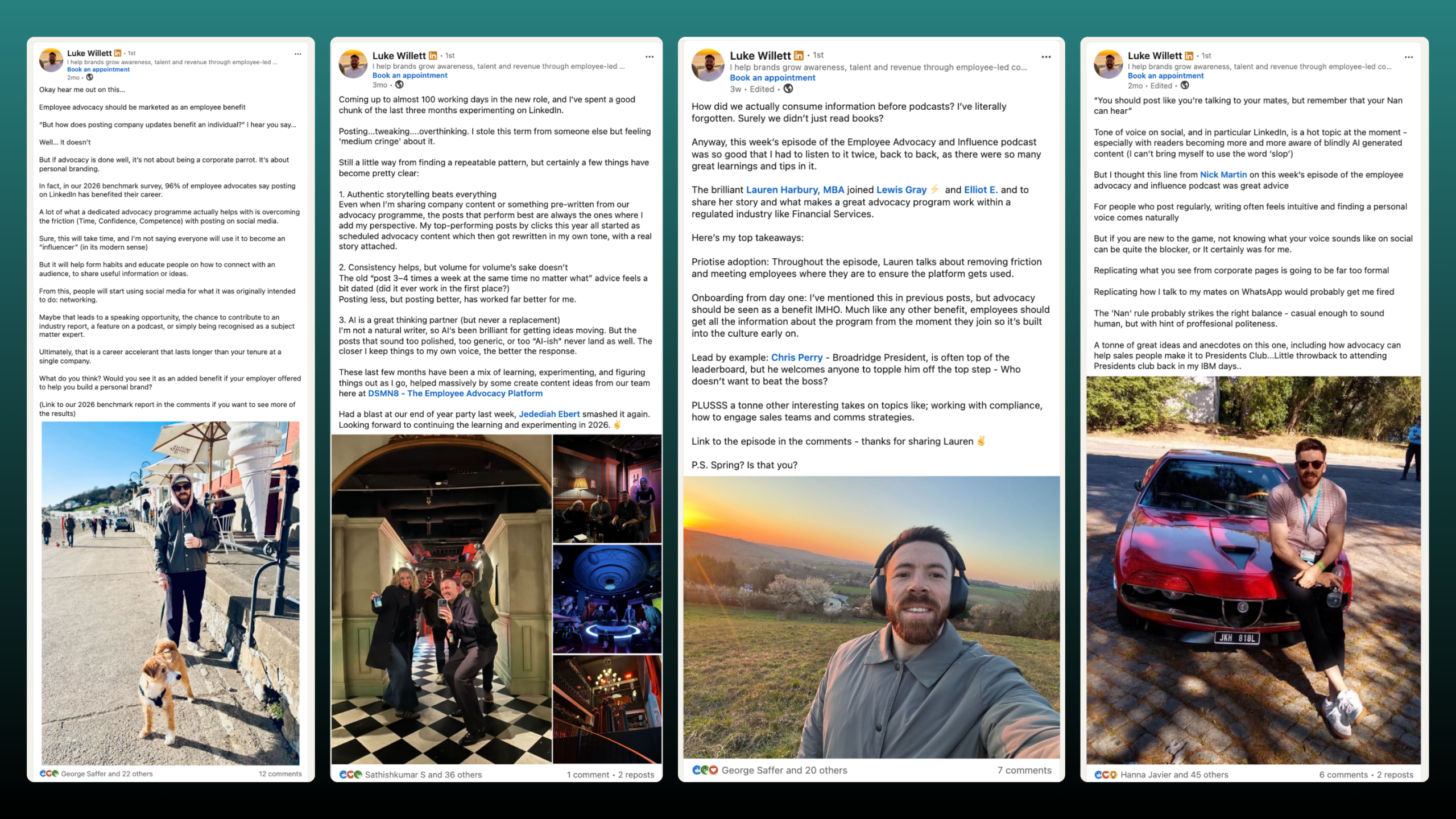
Personalization matters.
The gap that’s left is personalization, and we can now put a number on it. Our study of 517,374 LinkedIn posts shared through the platform in H1 2026 measured exactly this:
Original posts created by employees earned 9.2x more engagement than unedited shares of curated posts.
And even editing just a single word or two led to 3x more engagement!
This gap is widening, too.
By June 2026, the personal-post advantage had grown to 12x, up from 9x in January.
💡 The takeaway? On LinkedIn, audiences and the algorithm want to see original content, not just reshares.
The CEO advantage
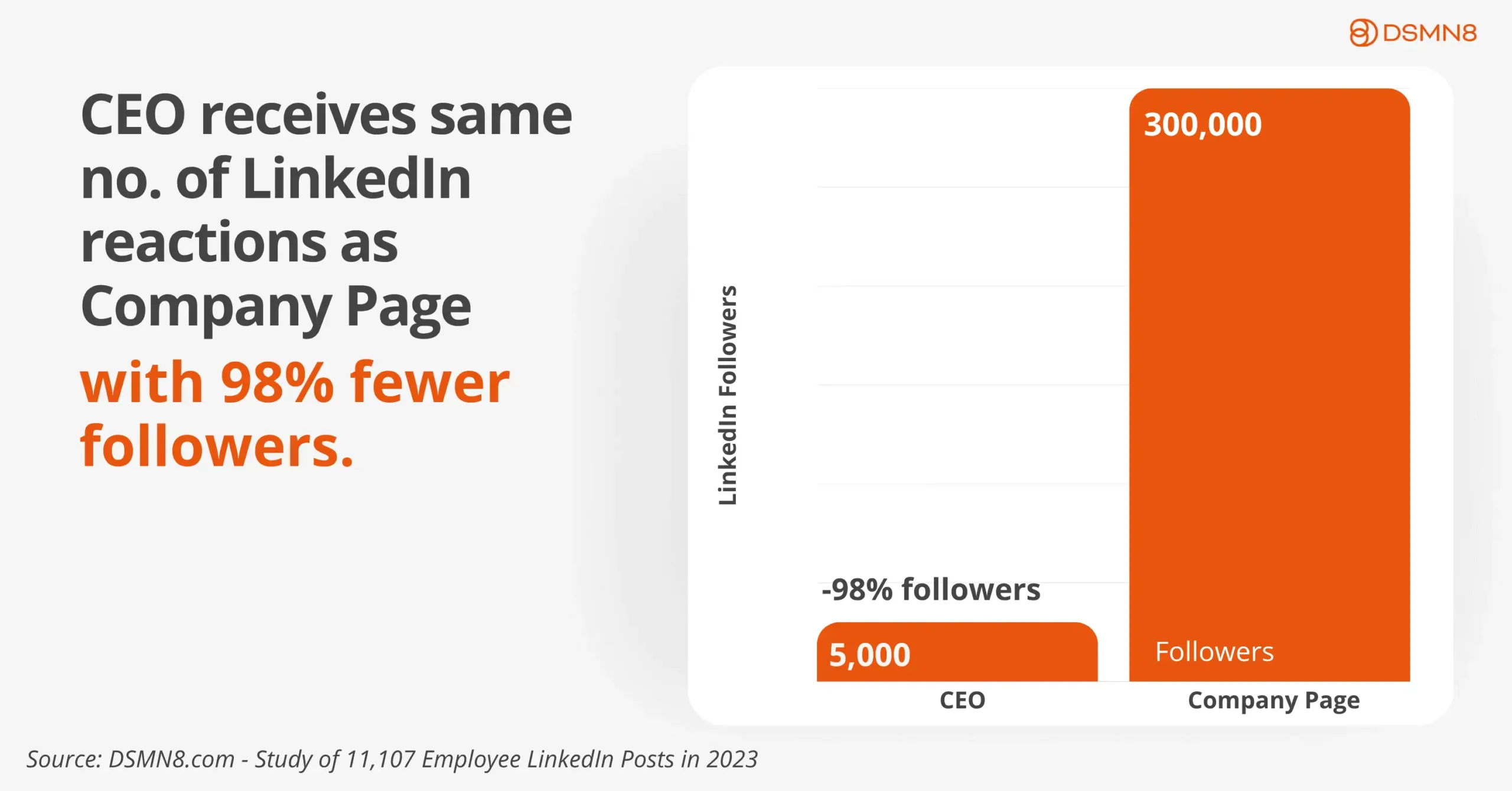
Our study of 11,107 employee posts from one civil engineering firm revealed the dramatic influence a senior leader can have on LinkedIn.
Their CEO had 5,000 followers, vs. 300,000 followers on the company page.
Yet, the CEO’s content received the same level of engagement.
That’s with 98% fewer followers.
It’s all about trust
This all illustrates how much more a personal account can do with a fraction of the audience.
Reshares give you some of the personal-profile advantage; personalized posts give you meaningfully more of it; and when senior leaders are involved, you’re operating at a completely new level.
It all comes down to trust.
Social media users will always trust and engage with real people over brand accounts.
Reshares and ‘boosts’ only vs. full employee advocacy
Here’s a full side-by-side comparison revealing the difference between reshares/boosts and a full employee advocacy initiative:
| Reshares Only | Full Employee Advocacy Program | |
|---|---|---|
| Content voice | Single company voice, shared as-is | Many voices, each adding their own commentary |
| Cadence | Occasional — tied to select announcements and big posts | Ongoing — a steady presence via a regularly updated content library |
| Engagement per post | Limited | Up to 9.2x for fully personal posts; ~3x even for a light, one-line edit |
| Reach beyond the page | A real improvement over page-only | Compounds further as more employees build a regular habit |
| Employee effort | Minimal — one click | Higher, but curated — a library to draw from, with AI personal voice support, not a blank page |
| Talent brand & sales signal | Limited — occasional bursts tied to specific posts | Ongoing — candidates and prospects see a consistent, varied employee presence |
| Resilience over time | A good stopgap; capped by how often you post something worth resharing | Grows as participation grows, not tied to any single announcement |
Engagement figures are from DSMN8’s 2026 study of 517,374 LinkedIn posts shared through the platform in H1 2026.
The Bottom Line
Getting employees to react and reshare company content is a good first step, not a mistake.
It already beats relying on the company page alone. DSMN8’s Boost Post feature does exactly this (and integrates with your internal comms tools to make it as easy as possible for your team).
What it’s missing is the compounding part: the engagement lift that comes from personalization, and a regular cadence that doesn’t depend on waiting for something “big enough” to ask people to share.
If “start light” is genuinely the goal, it’s absolutely worth starting this way.
But to truly leverage the possibilities from employee and executive social, a full advocacy program is the answer.
Book a demo to see what this could look like for your team.
Additional Resources
Want to see how active your employees are on social media and how they compare to your competitors?
Get your free employee advocacy audit.
More guides & data you’ll find helpful:
- Stop Copy-Pasting Employee Advocacy: 500,000+ Posts Analyzed.
- Employee Advocacy Benchmarks for 2026: Report Findings.
- Employee Advocacy for AI SEO: Your Secret Weapon in the Age of ChatGPT.
Frequently Asked Questions
What is the ROI of employee advocacy vs reshares and reactions on company page posts?
Reshares get a single post in front of more people at almost zero effort. Full advocacy adds the 3-9x engagement lift that comes from personalization, plus a steady cadence that doesn’t depend on waiting for a “big enough” announcement. The ROI case is less about paid spend (there isn’t any here) and more about how much of the available reach and engagement a reshare-only setup is leaving unclaimed.
Do we have to make employee advocacy mandatory for it to work?
No, and it shouldn’t be. Opt-in participation with a group of genuinely engaged employees consistently outperforms a mandated, low-enthusiasm rollout.
How many employees actually need to participate before it moves the needle?
Fewer than most teams expect. Since even a light, one-line edit delivers roughly 3x the engagement of an unedited share, a small, consistent group of advocates who personalize their posts can outperform a much larger group that’s only reacting or resharing as-is.

Emily Neal
Emily is SEO Lead at DSMN8. She focuses on organic growth strategy across search and AI search and co-authors DSMN8's original research, including the Employee Advocacy Benchmark Report and edited CEO Bradley Keenan's book. Her background spans SEO strategy, technical web, long-form content, digital PR, and marketing automation.