
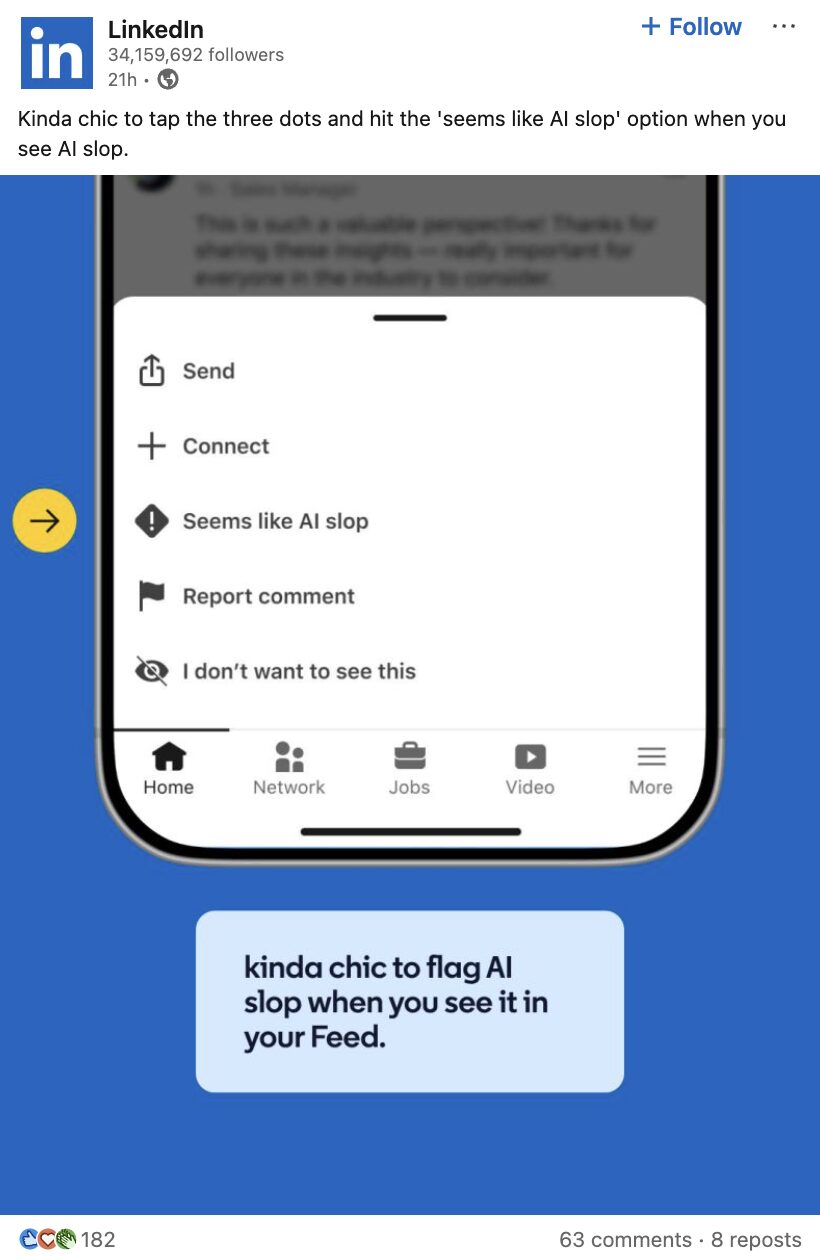
In late July 2026, LinkedIn added a “Seems like AI slop” option to the ellipsis menu on posts and comments.
Users can flag anything that reads as low quality or overreliant on AI, and LinkedIn uses that feedback to decide how far a post travels outside the poster’s own network.
LinkedIn’s chief product officer, Hari Srinivasan, called tackling AI slop “a top priority for all of us”, tied to a broader goal of keeping the feed built around real people and real expertise.
The same week, LinkedIn retired its own “enhance your post” AI writing tool, replacing it with a proofreading feature that corrects grammar and clarity without changing the person’s underlying voice.
LinkedIn is admitting that AI-written captions, including the kind its own tools used to produce, are part of the problem it is now penalizing.
The practical reality for anyone running a content program on LinkedIn is that posts reading as generic AI can be flagged by users and those posts will lose reach.
Why Employee Advocacy Programs are Especially Exposed
When 10 employees post the same caption about the same piece of company news, it might appear like “AI slop”, even if your marketing team wrote it.
This all ties in to the kind of employee advocacy that we’ve been tackling at DSMN8 for many years: the inauthentic kind.
Simply put, copy-paste employee advocacy is not what we recommend.
This is why our team built Dynamic Display (multiple captions & images for every post) years ago, and how that evolved into Personal Voice AI – making it easy for your employees to personalize content to sound like them.
Find out more on how to ensure employee advocacy doesn’t look like spam in this podcast episode with Emily Paige Jones, Director of Customer Success:

Our platform data revealed that even changing just 1% of a curated post caption leads to 3x more engagement on LinkedIn.
Original employee-generated posts get over 9x more engagement.
These findings are based on over 500,000 posts shared via DSMN8 in the first half of 2026.
This shows that even before the AI slop button was introduced, LinkedIn’s algorithm was prioritizing authentic employee participation.
How to Audit Your Program This Week
If you’re an employee advocacy program manager, it’s worth taking a bit of time to audit the content your team are producing, and what your advocates are sharing.
Have a look at:
1. Curated post captions.
Are post captions being produced for different personas, e.g., sales and marketing vs senior leadership or engineering?
Taking a one-size-fits-all approach means that posts often sound like they’re coming from a company account, or AI.
Ideally, different content will be curated for different teams and groups, such as departments or regions. This means that not only will you have multiple captions, but the content itself will be more varied and relevant for your advocates and their audiences.
But as a minimum, we recommend 5 different post captions for every piece of content uploaded to DSMN8.
2. Employee shares for your most recent piece.
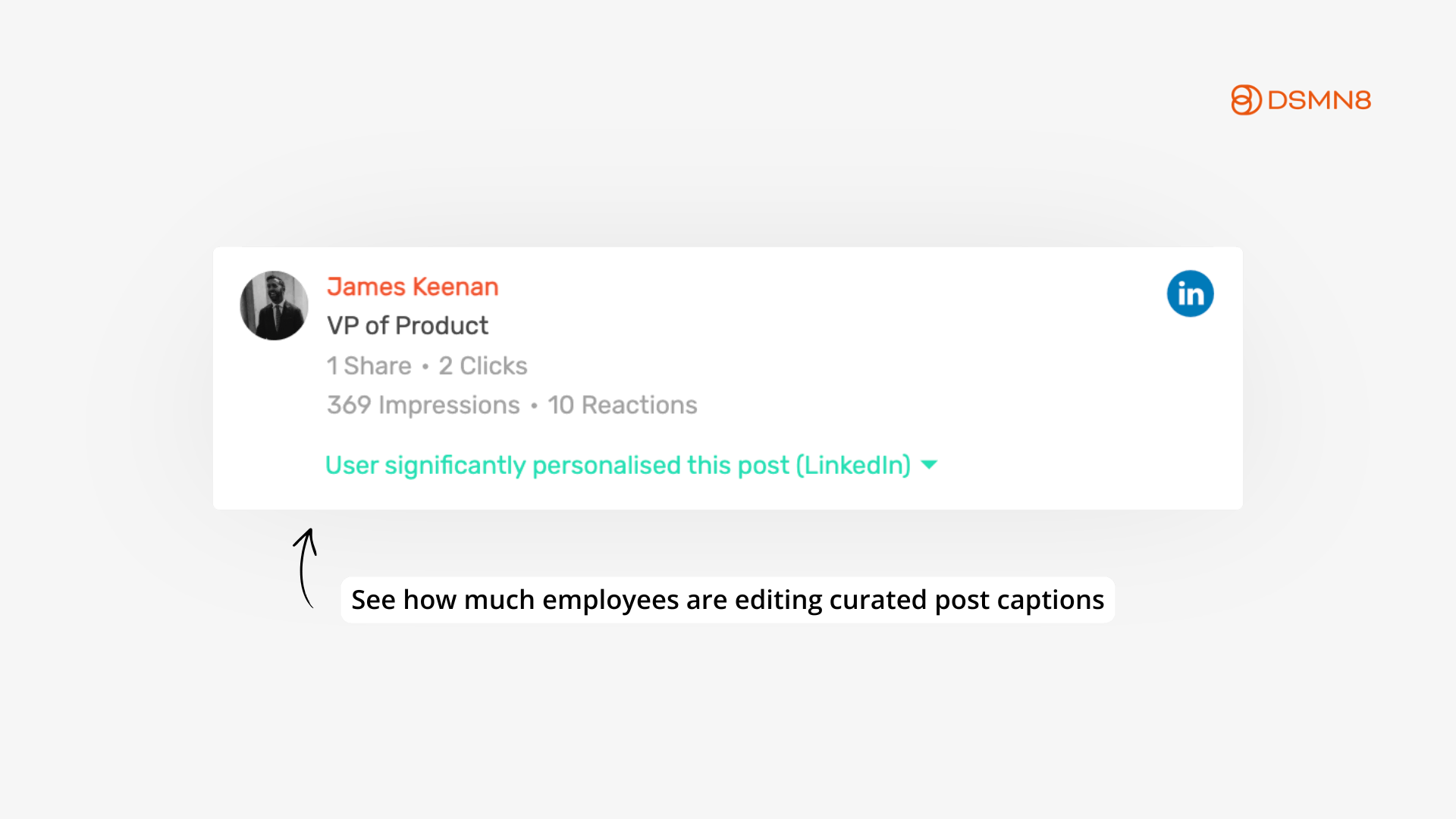
Are your team members actually editing the captions before sharing?
Are they using Personal Voice AI?
DSMN8 shows you the level of editing for each share, so you can validate this.
If you aren’t already encouraging editing, this is your sign to do so!
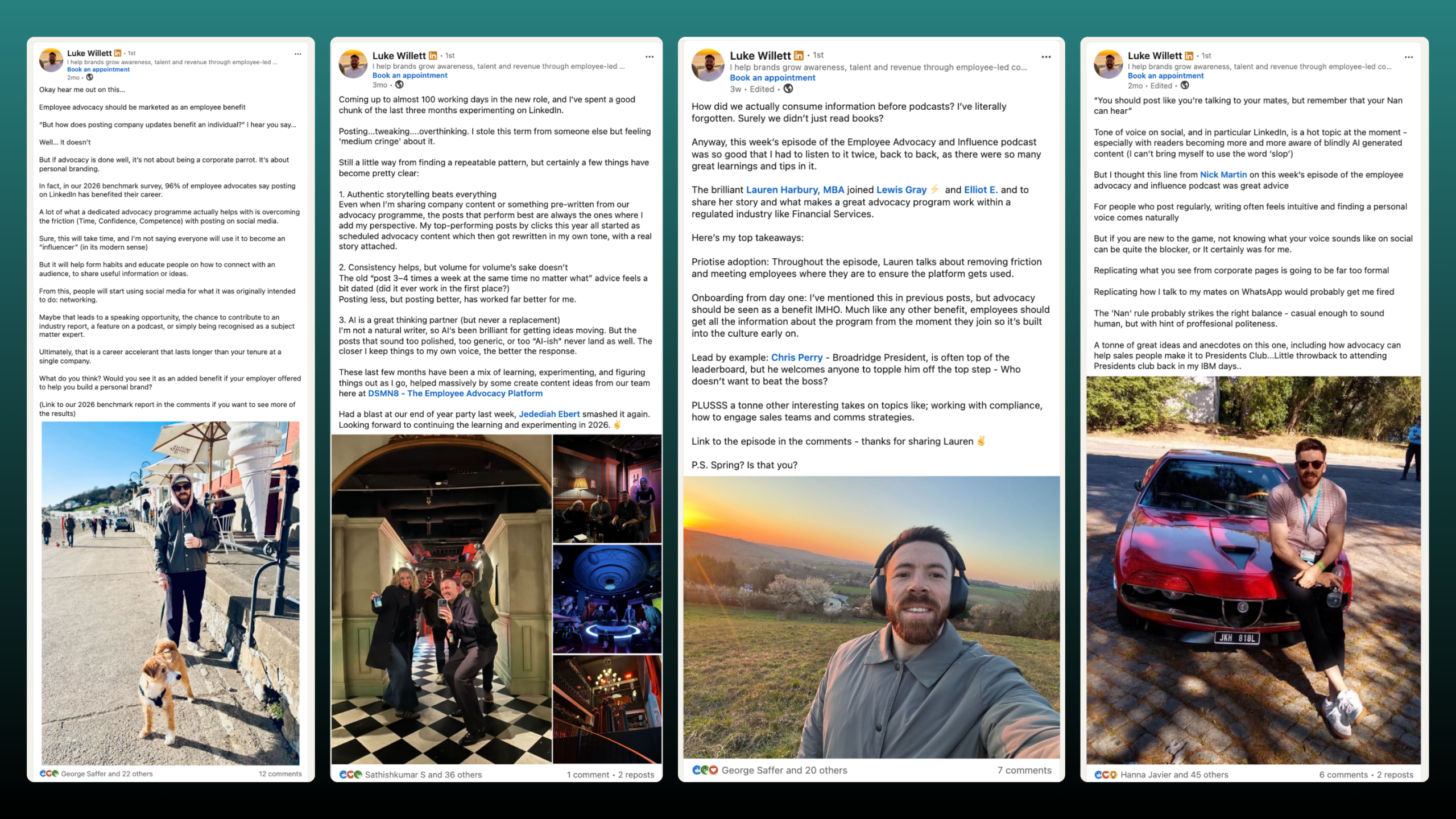
3. Original employee-generated content
This is where the magic happens.
Once your employees feel comfortable creating original posts sharing their expertise, they’ll start to build their networks faster and become known within your industry.
You can see some great examples above from DSMN8 team member Luke Willet!
We recommend providing training and resources where possible (you’ll find our resource hub helpful), and starting with senior leadership to set the example.
Have a look at how many ‘Personal Posts’ are being shared through the DSMN8 platform, boost your colleagues who are making the effort, and remind everyone that this is encouraged.
How Personal Voice AI Helps
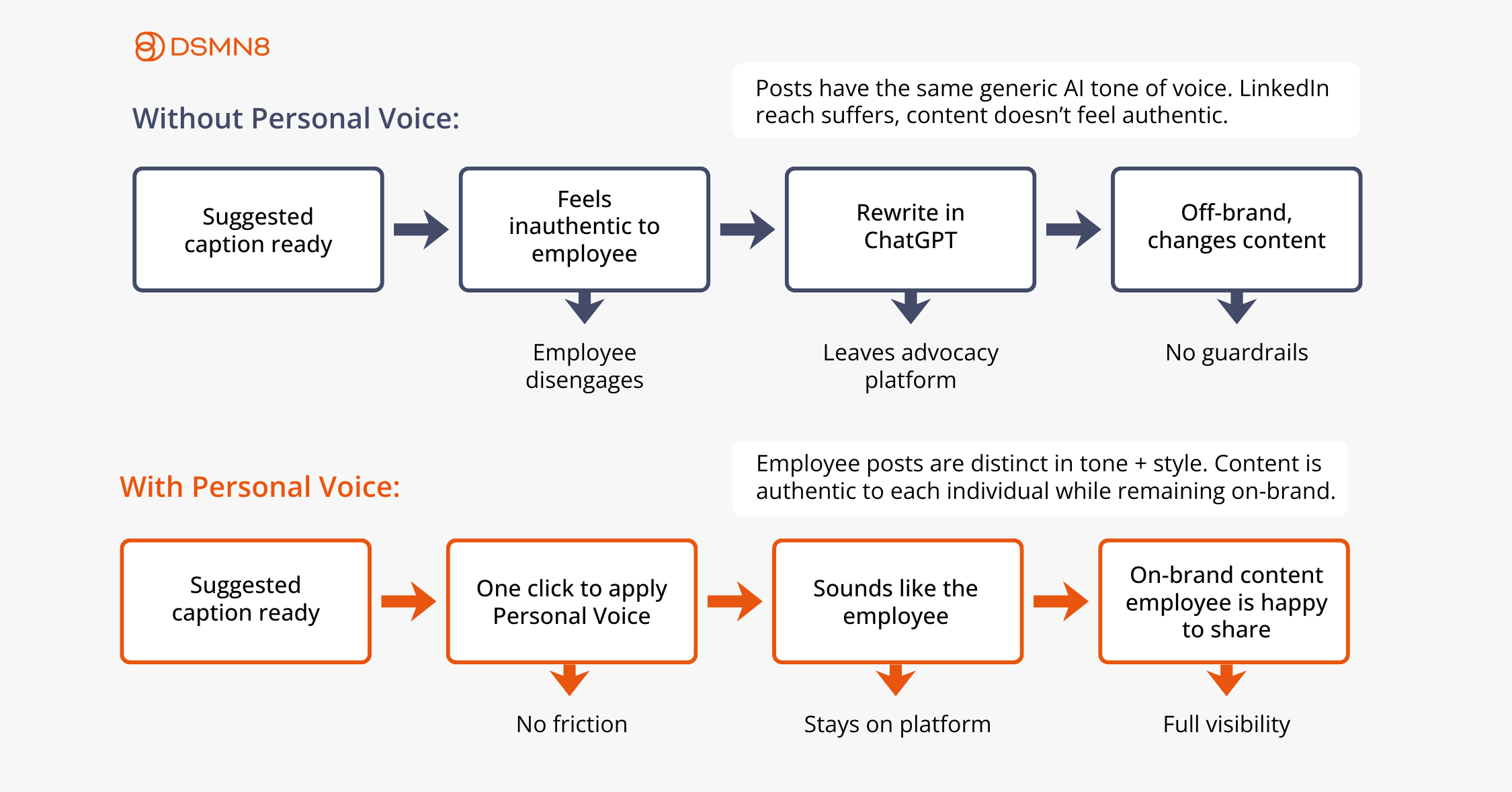
This is the part of the problem AI can actually help you with, provided it is used to add variation rather than remove effort entirely.
Personal Voice AI works by analyzing how an individual employee naturally writes, then generating caption rewrites in that style rather than in one generic voice.
Done well, this turns ten identical captions into ten that each sound as if they came from a different person, because they did. Employees should check and tweak posts further if needed before sharing.
It’s a whole world away from generic ChatGPT!
Plus, these generated captions will follow your Company Voice, meaning brand guidelines and requirements are followed. If your team members are using their own AI tools, these guardrails won’t necessarily be in place.
Check out our full guide on how Personal Voice works for more info.
Additional Resources
Book a demo to see how DSMN8 can help you launch and scale an effective employee advocacy program in 2026.
Want to see how active your employees currently are on social, and how they compare to your competitors?
Get your free employee advocacy audit.
More guides & data you’ll find helpful:
- Stop Copy-Pasting Employee Advocacy: 500,000+ Posts Analyzed.
- Employee Advocacy Benchmarks for 2026: Report Findings.
- Employee Advocacy for AI SEO: Your Secret Weapon in the Age of ChatGPT.
Frequently Asked Questions
What is LinkedIn’s AI Slop button?
It’s an option under the three-dot menu on any post or comment that lets users flag content that reads as low-quality or AI-generated. LinkedIn feeds those reports into the models it uses to decide how far a post travels outside the poster’s own network.
Does using AI to help write a caption automatically trigger a flag?
No. It’s a manual flag made by users in the feed. It’s about how a post reads, not whether AI was involved anywhere in drafting it. A caption that has been edited into an individual’s own voice and contains valuable insights doesn’t carry the same risk as unedited copy-paste AI content.
What happens to LinkedIn posts flagged as ‘AI Slop’?
LinkedIn reduces the post’s reach outside the poster’s own network rather than removing it outright. The report also feeds into LinkedIn’s classifiers, which is the mechanism it’s using to widen detection over time.
Is LinkedIn relying on automated detectors to enforce this?
Not exclusively. Srinivasan has said LinkedIn is deliberately weighting human reports over automated detection, since AI detectors are still prone to false positives. The button is the primary signal it’s using to train its models on what actually reads as slop.


Emily Neal
Emily is SEO Lead at DSMN8. She focuses on organic growth strategy across search and AI search and co-authors DSMN8's original research, including the Employee Advocacy Benchmark Report and edited CEO Bradley Keenan's book. Her background spans SEO strategy, technical web, long-form content, digital PR, and marketing automation.