
Running employee advocacy on your own is more common than you might think.
This is your survival guide: what to automate so it doesn’t all fall on you, what DSMN8’s own data says about how much time this should actually take, and how to make the case for more support when you need it.
Who Is This Guide For?
This is for anyone running employee advocacy solo, or close to it, at a mid-market or enterprise account.
Your title might be social media manager, marketing manager, or comms lead, and advocacy likely is one job among several, not your whole role.
Want the basics of the role itself first? Start with What Does an Employee Advocacy Program Manager Do? and The Life of an Employee Advocacy Program Manager.
This guide picks up from there: how to keep a program running well without a full team, and how to make the case for more support when you need it.
Where Do Advocacy Programs with One Manager Actually Struggle?
If you’re running this alone, you’re not doing it wrong! Most solo-run programs don’t struggle because the strategy is bad, but they can falter in three specific, fixable places.
📥 Content supply dries up. Curating fresh, shareable content takes longer than most people budget for, and it’s usually the first thing to slip when something more urgent comes up. Many programs have multiple content curators for this reason, with one main program managers.
📊 Reporting gets inconsistent. Without dedicated time to pull and analyze data, reporting either stops happening or turns into a rushed, once-a-quarter scramble for metrics that isn’t actionable and doesn’t reveal the true success of your program.
🔄 There’s no succession plan. If the one person running the program leaves or changes roles, the program often disappears with them, because nothing’s documented and nobody else was trained to keep it going.
We asked Lewis Gray, who runs DSMN8’s own employee advocacy program, what challenges he has faced. He said:
How Much Time Does This Actually Take? (And What You Can Automate)
Here’s a number that might surprise you.
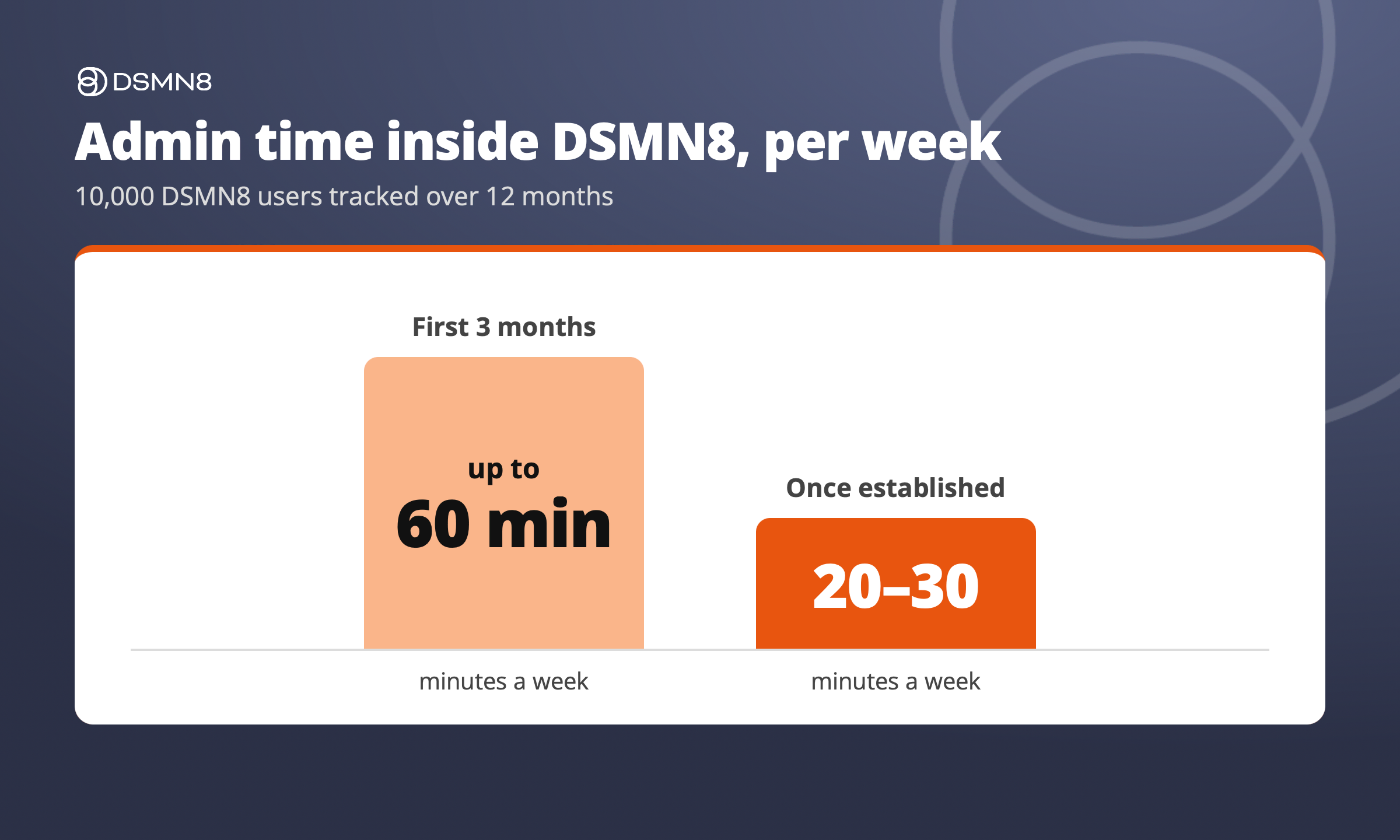
Across 10,000 DSMN8 platform users tracked over 12 months, admin-level users spent an average of just 22 minutes a week inside the platform, once a program was past its first few months. Full breakdown.
That number is higher early on. In a program’s first three months, admin time averages up to 60 minutes a week, and some individual weeks hit nearly 2 hours 46 minutes.
So the platform itself usually isn’t where your time goes.
The real pressure comes from the work around it: sourcing content, building reports, and training advocates. Here’s what you can do to cut that down.
✍️ Content sourcing. DSMN8’s Content Library pulls content automatically from sources you set up, like your company website, blog, jobs page, and social pages, so you’re not sourcing new material from scratch every week. Employees can suggest content too.
📧 Dynamic email lists. Set a cadence once and reminders go out to invited employees automatically, so chasing non-responders isn’t a separate task on your list. Newsletters featuring your latest content keep advocates engaged without you drafting an email every time.
🧭 Onboarding and succession. A documented onboarding flow, plus DSMN8’s training resources and templates, makes getting new team members involved easy, and the program survives if you’re out or move roles.
📈 Reporting. The analytics suite gives you a real-time dashboard for reach, engagement, and earned media value, so you’re not rebuilding a report from scratch every time leadership asks.
We asked Lewis which of these he leans on most running DSMN8’s own program:
How Do You Make the Case for More Support?
Most employee advocacy business cases are written for someone asking to fund a brand new program. You already have a program running, so the ask is smaller and much easier to make: support for the work around the platform, not the platform itself.
Here’s how to build it, without a pitch deck:
Separate platform time from everything else
DSMN8’s own data shows admin time inside the platform averages 20 to 30 minutes a week once a program is established. If leadership thinks that’s the whole job, show them what it doesn’t capture: sourcing content, building reports, training advocates.
Track the surrounding work for two or three weeks
Log time spent on things that don’t show up in platform usage data, like drafting content briefs, chasing approvals, or prepping leadership updates. Multiply by your loaded hourly cost.
Name what isn’t getting done because of it
Time spent on manual sourcing and reporting is time not spent on the parts of the job that need judgment, like building executive engagement or refining messaging.
Frame it as protecting what’s already working, not funding something new
You’re not asking for budget to grow the program. You’re asking leadership to protect the reach, pipeline, or visibility it’s already driving.
Keep the ask small
A few hours of automation setup or a scoped block of Managed Services support for the overflow work is a much easier yes than a dedicated hire. If a bigger ask is genuinely justified, build to it in stages.
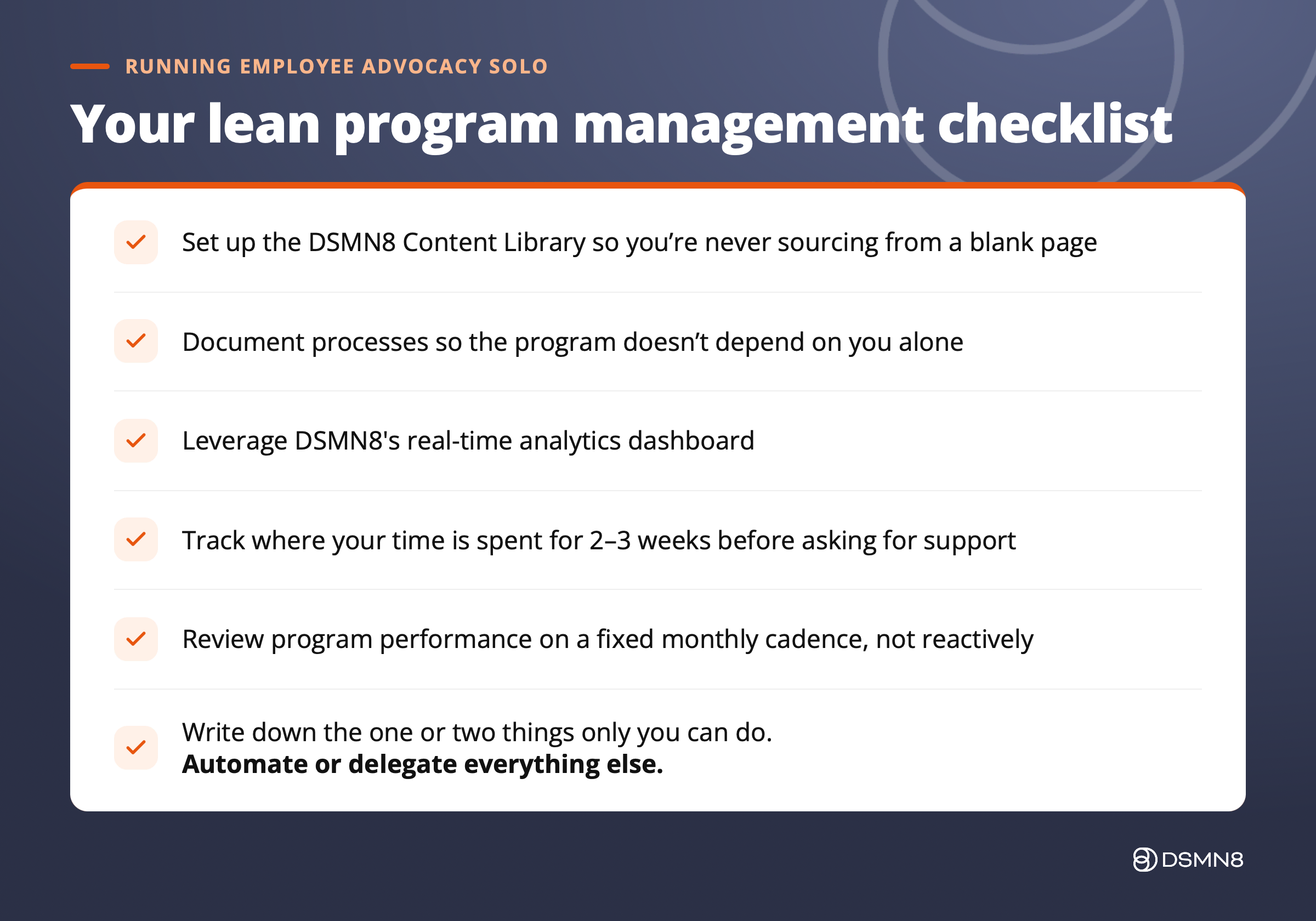
Your Lean Program Management Checklist
Bookmark this one for when things get busy.
- Set up DSMN8’s Content Library so you’re never sourcing from a blank page.
- Document your onboarding flow so the program doesn’t depend on you alone.
- Use the real-time reporting dashboard instead of building reports by hand.
- Track your own hours for two to three weeks before asking for more support to see where you need the most help.
- Review participation and content performance on a fixed monthly cadence, not reactively.
- Write down the one or two things only you can do, and automate or delegate everything else.
When Should You Bring in More Help?
Automation buys you time, not an unlimited ceiling. At some point, a growing program outgrows what one person can run well, however efficient the setup. That’s not a sign you’ve done anything wrong, it’s a sign the program is working.
Brittney Gilbert was hired specifically to run employee advocacy at Global Payments. In her experience, advocacy programs usually get tacked onto an already overstretched social media manager as one more task on a long list.
Her role as a dedicated program manager is what actually lets their program scale, and stay consistent over time. But even Brittney, with the role built around her from day one, says that past a certain point, “it definitely requires more hands on deck.” Hear more in the full episode:

The honest signals you’ve reached that point:
- You’re consistently behind on content no matter how automated the queue is
- Reporting is accurate but you have no time left to act on the findings
- The program’s growth has outpaced what automation can sustain
At that stage, it’s usually a choice between a dedicated hire and bringing in outside support without adding headcount.
If this sounds like where you’re headed, talk to your Customer Success Manager about Managed Services support, or get a sense of what we can help with on the Managed Services page.
Not using DSMN8 to manage your advocacy program yet? Book a Demo!

Emily Neal
Emily is SEO Lead at DSMN8. She focuses on organic growth strategy across search and AI search and co-authors DSMN8's original research, including the Employee Advocacy Benchmark Report and edited CEO Bradley Keenan's book. Her background spans SEO strategy, technical web, long-form content, digital PR, and marketing automation.