
Employee advocacy software tracks who shared what, when, and how it performed on social media. In Germany, that’s exactly the kind of data a works council has a legal right to review before a new tool goes live. So if any of your employees are in Germany, it’s worth understanding the process before you plan your advocacy program launch.
Why This Comes Up When You Roll Out Employee Advocacy in Germany
If you’re rolling out an employee advocacy program to a German workforce, the works council (Betriebsrat) question will usually come up before launch. That’s because employee advocacy tools log who shared what, when, and how it performed: data a German works council has a legal right to weigh in on before it goes live.
This isn’t a reason to delay, panic or scale back your plans.
It’s a well-established process: most B2B SaaS tools that touch employee activity, from HR systems to Slack, Microsoft 365, and CRM platforms, have already been through it. This guide covers what triggers works council involvement, what a works agreement typically needs to cover, how long it realistically takes, and how DSMN8 is designed to make approval easier.
We are not lawyers, and nothing here is legal advice. See the note at the end for how to use this with your own counsel.
What a Works Council Is, and Whether You Have One
A works council (Betriebsrat, also called a staff council) is an elected body of employees with statutory co-determination rights under the Works Constitution Act (Betriebsvereinbarungsgesetz, BetrVG). It isn’t a union, and it isn’t mandatory, but any workplace with five or more permanent employees eligible to vote can elect one, and only three employees (or a union) need to request an election to start the process.
Not every eligible company has one. As of 2023, 36% of private-sector employees in Germany were covered by a works council, but coverage rises sharply with company size:
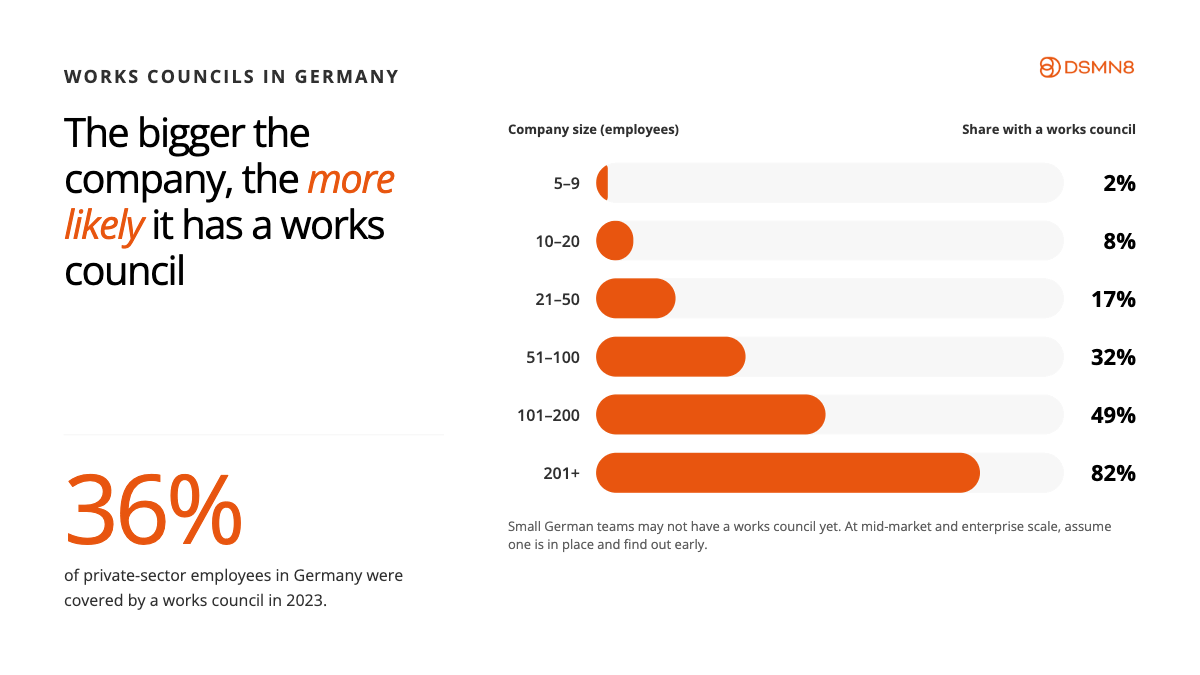
The practical takeaway: if your German team is small, there’s a reasonable chance no works council exists yet, and the question may not apply.
At mid-market and enterprise scale, it’s safer to assume one is in place and find out early, rather than discovering it once the rollout is already underway.
Why Employee Advocacy Software Triggers Co-Determination
The key clause is Section 87(1) no. 6 BetrVG. It gives the works council co-determination over the introduction and use of any technical device “designed to monitor the behaviour or performance of employees.”
Two things make this broader than it sounds:
- “Suitable for monitoring” counts, not just “built for monitoring.” Since a 1975 Federal Labour Court ruling, the courts have read “designed to monitor” as “capable of monitoring,” regardless of the employer’s intent. Even an Outlook calendar or an Excel sheet with a sum function has been found to trigger it.
- Employee advocacy platforms clearly qualify. The platform records who shared what, when, and how often, and features like leaderboards turn that into a visible performance comparison between named employees. That’s exactly the kind of data Section 87(1) no. 6 is meant to put a works council’s eyes on.
The practical result: a German company (or multi-national corporation with employees in Germany) generally needs a works agreement (Betriebsvereinbarung) in place before rolling out employee advocacy software because the law requires employee representatives to agree the scope and safeguards up front.
Other Rules That Can Also Apply With It
A few other rules often apply alongside Section 87(1) no. 6:
- Section 87(1) no. 1: rules of conduct. If the company issues a social media policy or house rules for how employees use the advocacy program, that can itself require co-determination, separate from the monitoring question.
- Section 90: early information duty. The employer must inform the works council about new technical systems while they’re still being planned, early enough for the council’s input to actually shape the rollout, not after the contract is signed.
- GDPR, layered on top. A works agreement doesn’t replace a GDPR legal basis; it can only specify how an existing one (typically Article 6(1)(b), performance of the employment contract, or 6(1)(f), legitimate interests) is applied under GDPR Article 88. A December 2024 CJEU ruling (C-65/23) confirmed that works agreements are reviewed against the full GDPR: a signed agreement doesn’t make unlawful processing lawful. In practice, works council and data protection sign-off usually happen together, often with the company’s DPO in the room.
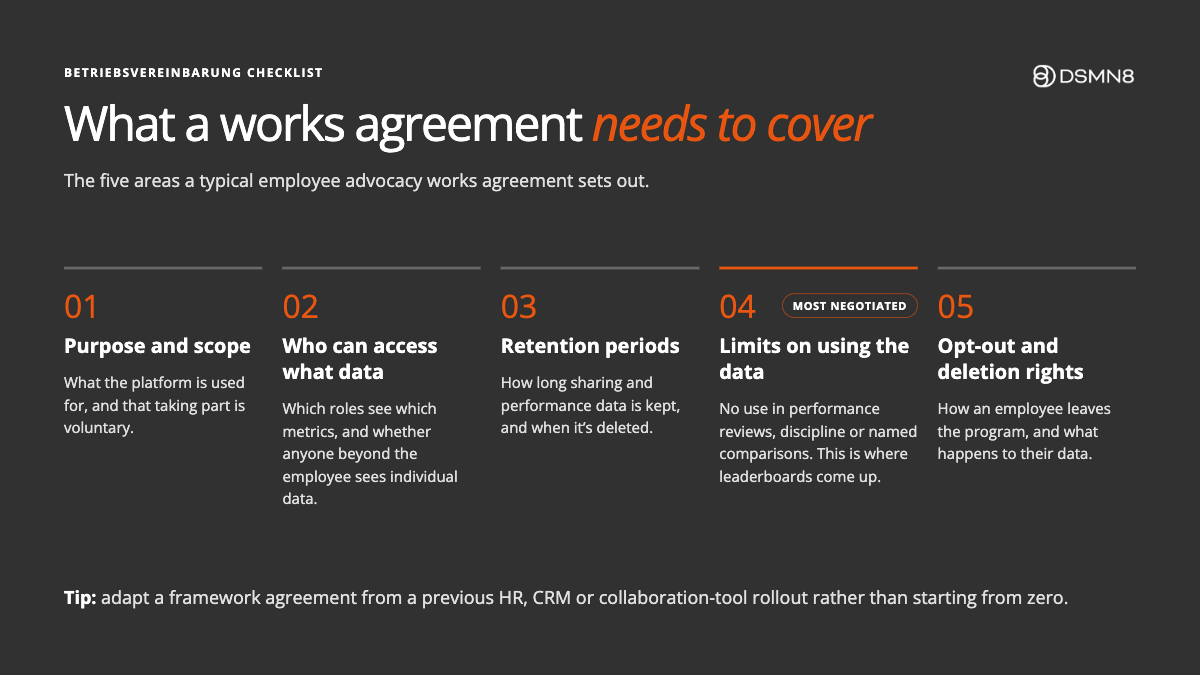
What a Works Agreement (Betriebsvereinbarung) Needs to Cover
A works agreement is a negotiated contract between the employer and the works council. For an employee advocacy rollout, it typically sets out:
- Purpose and scope: what the platform is used for, and that use is voluntary.
- Who can access what data: which roles (admins, managers, HR) can see which metrics, and whether individual performance data is visible to anyone beyond the employee themselves.
- Retention periods: how long sharing and performance data is kept, and when it’s deleted.
- Limits on using the data: explicit restrictions on using advocacy data in performance reviews, disciplinary decisions, or comparisons between named employees (this is usually the most negotiated point, and where leaderboards come up).
- Opt-out and deletion rights: how an employee leaves the program and what happens to their data when they do.
The agreement doesn’t need to be written from scratch each time. Many companies adapt an existing framework agreement from a prior software rollout (HR system, CRM, collaboration suite) rather than negotiating from zero.
How Long It Takes and Why It Varies
There’s no fixed timeline in the law, and it genuinely varies by company.
A cooperative works council that already has a framework agreement covering similar tools can sign off in a few weeks. A contentious negotiation, or a works council dealing with the topic for the first time, can run several months, and if the two sides can’t agree, it can escalate to a conciliation committee (Einigungsstelle), which adds further time.
What tends to drive the variance:
- Works council experience. Councils that have already negotiated agreements for HR systems, Microsoft 365, or CRM tools move faster, since the template and the issues are already familiar.
- Company size and structure. Larger, more unionized organizations tend to have more formal (and slower) processes; a group-wide works council (Gesamtbetriebsrat) can also add a layer if the rollout spans multiple German sites.
- Whether leaderboards and visible performance data are involved. This is consistently the most contested item, and tends to take longer to settle than access and retention terms.
- Whether legal and the DPO are involved from the start. Looping them in early, alongside Section 90 notice, avoids a second round of negotiation when GDPR issues surface late.
Plan for it accordingly: this is rarely a quick yes/no, but it’s also rarely a true blocker. Treat it as its own process to run alongside the rest of the rollout, not a gate that has to clear before anything else can start. The same logic applies in other regulated environments: treating legal and compliance as partners from day one, rather than a hurdle to clear at the end, tends to get programs live faster.
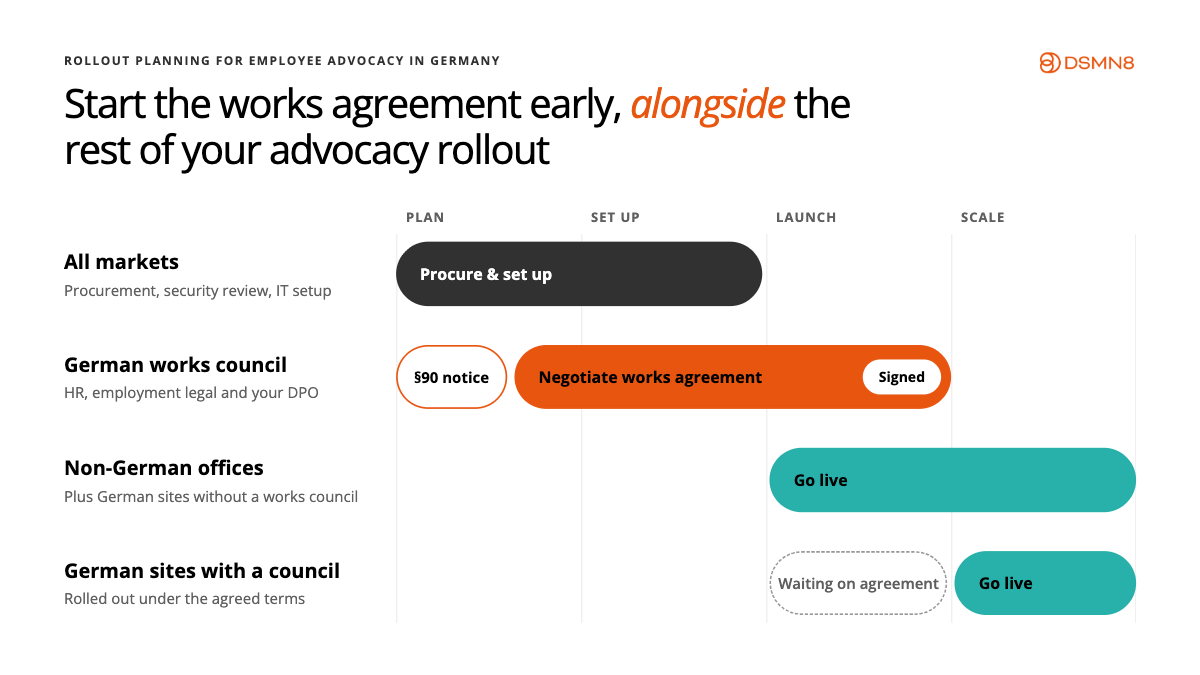
What This Means for Your Employee Advocacy Launch
- Project/program owner: put works council approval on the plan from day one, with its own timeline alongside procurement, security review, and IT setup. Don’t leave it until launch week.
- HR / employment legal: own drafting or negotiating the works agreement, in consultation with your data protection officer and the works council. Starting from a template or an existing framework agreement (from a prior HR or collaboration tool rollout) is usually faster than drafting from scratch.
- IT / rollout team: sequence go-live so non-German offices, or German sites without a works council, can start immediately, while the German works agreement runs in parallel. Hold off enabling leaderboards or other visible performance data for German employees until it’s signed.
How DSMN8 Is Built to Make Approval Easier
Several things about how DSMN8 is built already address common works council concerns:
Fully optional, never mandatory.
No employee is required to sign up or use DSMN8 to use social media at work; nothing is gated behind it.
Opt-in, not opt-out.
Employees can join via a self-serve sign-up page (for example on the company intranet) rather than being individually invited, and can delete their account at any time.
Employee benefit outweighs company benefit.
The platform is designed around giving employees easier access to shareable content and visibility for their own career; the business case is secondary to that.
Custom Terms & Conditions at sign-up.
Each company can set its own terms so employees know exactly what they’re agreeing to.
Leaderboards and other visibility features can be switched off.
Since leaderboard-style performance comparison is usually the most contested item in a works agreement, removing it removes a common sticking point entirely.
Highly configurable beyond that.
Most other features can be adjusted or removed to match what a works agreement requires.
Content is a recommendation, not a restriction.
Suggested posts don’t stop employees sharing whatever they choose through other means.
None of this replaces the legal requirement to negotiate a works agreement, but it narrows what actually needs to be negotiated. It mirrors the approach regulated-industry programs elsewhere take when building trust with governance and compliance teams before rollout.
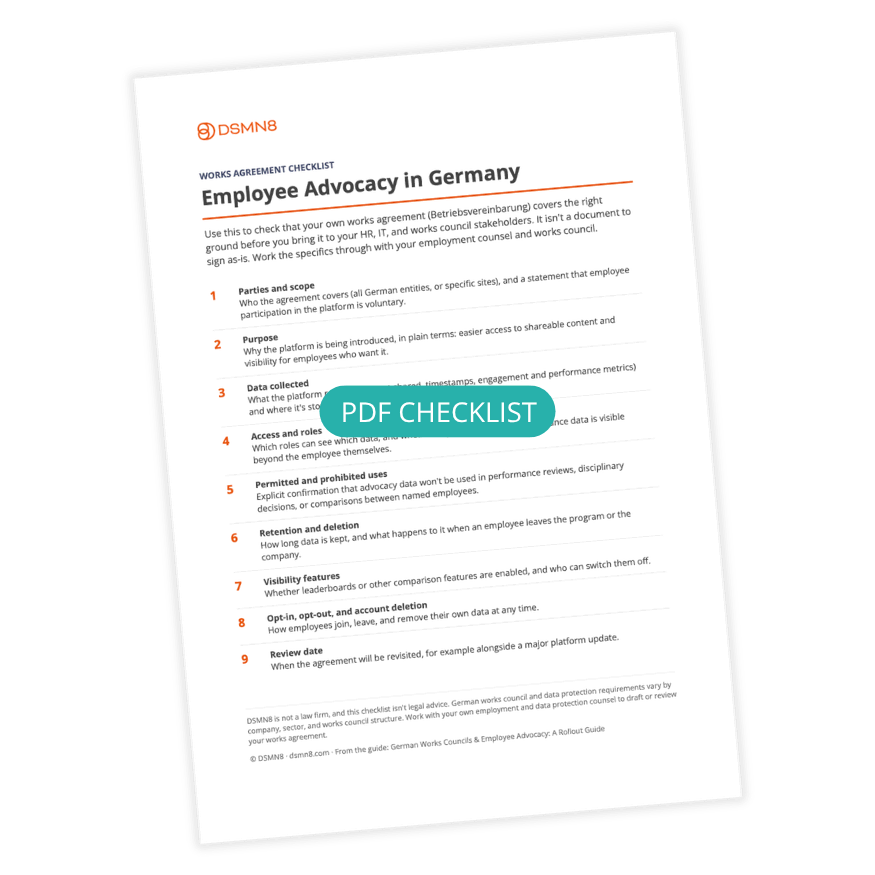
Get the Works Agreement Checklist
A German works agreement for employee advocacy typically needs to cover nine things: parties and scope, purpose, data collected, access and roles, permitted and prohibited uses, retention and deletion, visibility features, opt-in and opt-out, and a review date.
We’ve put the full outline, with a line of guidance under each point, into a free one-page checklist you can use to check your own works agreement before bringing it to your HR, IT, and works council stakeholders.
For a wider view of how employee advocacy programs are run today, see our Employee Advocacy Benchmark Report 2026, based on 187 respondents across 48 countries.
Ready to launch a compliant employee advocacy program?
FAQ
Do we need a works agreement even if our German team is small?
Only if a works council exists. A works council can only be elected where there are five or more permanent employees eligible to vote, and even then it requires an election to be triggered, and many small teams don’t have one. Confirm this before assuming either way.
Does a works agreement covering other software also cover DSMN8?
Usually not automatically. A general IT or data-use framework agreement may partially cover it, but introducing a new system is typically treated as a fresh “introduction” under Section 87(1) no. 6, especially given advocacy-specific features like leaderboards. It’s worth checking rather than assuming coverage.
Can we go live in other countries while the German works agreement is still pending?
Yes. The works council requirement is specific to German employees (and, for a group-wide rollout, potentially a Gesamtbetriebsrat). Other markets can proceed on their own timeline.
What if the works council objects specifically to leaderboards?
Turn leaderboards off for German users, or platform-wide, while the rest of the agreement proceeds. This is the single most common point of friction and the easiest one to resolve, since the feature is fully optional.
Who should actually own drafting the works agreement?
Typically your HR or employment legal team, in consultation with your DPO and the works council. DSMN8 isn’t a party to the agreement, but can provide a product overview, data-handling documentation, and configuration options to speed up drafting.
This Isn’t Legal Advice
DSMN8 is not a law firm, and this article isn’t legal advice. German works council and data protection requirements vary by company, sector, and works council structure, and the law continues to evolve (notably around GDPR and works agreements). If you’re planning a German rollout, work with your own employment and data protection counsel to draft or review the works agreement.
If you want to talk through how DSMN8’s settings map onto your specific works agreement, including leaderboards, access controls, and data retention, reach out to your DSMN8 contact.
Sources

Emily Neal
Emily is SEO Lead at DSMN8. She focuses on organic growth strategy across search and AI search and co-authors DSMN8's original research, including the Employee Advocacy Benchmark Report and edited CEO Bradley Keenan's book. Her background spans SEO strategy, technical web, long-form content, digital PR, and marketing automation.