

Fear.
Dread.
Panic.
Just a few emotions that might spring to mind…
…when you consider letting your colleagues run riot on social media 😱
After all.
As a marketer (or as a comms wizard).
You’ve spent your whole career mastering your craft.
Learning what to say.
What not to say.
How to convey a message.
How to deal with crisis communications.
Empowering your colleagues to post more on social media goes against everything you know.
ESPECIALLY in regulated industries.
Think financial services, pharmaceuticals…
Heck, even the gaming industry.
The less they say, the better.
Right? Right.
…or is it? 🤔
What if I told you that the tides had changed?
And that employee advocacy was not only now possible in these industries.
But also:
- Safe
- Available to all employees
- Immensely beneficial
You’d probably think I’m mad.
But stay with me here…
Today we’re covering how to make employee advocacy risk-free in regulated industries.

Historically, social media has been a taboo subject in regulated industries.
(pretty much since inception).
However, whether accelerated by the pandemic or not, digital transformation has swept across all industries.
And thus social media has become an even more powerful way to build a brand and communicate with the audiences most important to you.
Companies choosing to ignore this transformation risk being left behind.
And miss opportunities to:
- Connect with their customers where THEY are
- Attract new business
- Increase talent attraction
and much (SO much) more.
So, irrespective of industry.
Let’s first jump into the benefits of having a social media presence.
And why employee advocacy is so important.
(Feel free to skip to the part you really want to read) 👇

Why This Should be Encouraged
Now, if you made it here.
You may already be familiar with the fundamentals and the benefits of employee advocacy 🙏
But let’s focus on those first, and see how they impact regulated industries.
If you work in a regulated industry, public trust/perception will be a huge factor 🙏
So, let’s start there!
It’s no secret that public trust in corporations has taken a hit in recent years 📉
Though it seems to have improved over the past year in many regulated industries, there’s no denying that news shared by company-owned channels simply isn’t as trusted as content shared by individuals (specifically, said company’s employees!)
Now, what would you say if I offered you a follower increase of 200,000+ people? You’d probably bite my hand off, right?
Well, employee advocacy programs can seriously impact the size of your audience.
We know that the average employee has 1,180 connections across all social channels.
So, not only are they more trusted, but each employee brings with them a potential new audience of over 1,000 people.
If you were able to onboard a conservative 200 employees to your program, that opens up a window of opportunity in the form of 200,000+ people (200 x 1,180) seeing your content! 🔥
By limiting yourselves to just one channel (your company handle), you limit your reach to just your direct followers as thousands of potential buyers/employees remain untouched.
Try our Free Reach Calculator to see what increase you could expect!
If people don’t trust company pages, then seeing a story, claim, or a piece of research backed by someone they know increases the chance of the article being received well.
What’s more is that if you’ve managed a company social media page, you’ll know that algorithms are getting tougher and tougher to break through, and they generally prefer people over brands.

The Most Common Mistakes
First Mistake: Insisting on posting on behalf of employees
Red flag 🚩
After years in the space.
And having worked with hundreds of clients.
In every industry you can imagine.
We KNOW that the key to great employee advocacy is authenticity ✨
Something you lose the second you insist on posting on your employees’ behalf.
There are certainly ways to work around this 👍
For example, by giving employees the choice to automate their posting using pre-approved content (if they’re far too busy to do this themselves but want to take part).
The trouble we’ve seen, however, arises when companies aren’t using an employee advocacy tool and employees aren’t given a say in what’s posted and what’s said.
For the employee, it can feel incredibly uncomfortable and intrusive.
Similarly, it removes any idea that employee advocacy benefits more than just the company.
Employees might feel that their accounts have been hijacked as just another channel to promote the company rhetoric.
Remember that employee advocacy should benefit the employee just as much as the company in the shape of improved personal branding and social selling ability.
If done correctly, employee advocacy can yield tremendous benefits for your employer brand and can seriously elevate your employee engagement levels.
Second Mistake: Only allowing select ‘VIP’ employees to participate
The most common examples we see are:
- Inviting marketing teams only
- Inviting specific certified/qualified individuals only
- Inviting the C-Suite/leadership teams only
This is a major limitation.
And one that can seriously hold your program back 🙅♂️
“Why?”
You have a sea of potential within every employee’s network.
Why limit your possibilities?
There’s so much more that your wider workforce can contribute to your program.
After all, you don’t have to ONLY share company content.
Employees sharing third-party industry news can seriously impact their personal brand by positioning themselves as experts.
Which, in turn, can generate new business 💰
Fact: 82% of B2B buyers are more likely to trust someone as a result of thought leadership content.
And hey, is there more trust in “the little guy”?
Edelman’s 2022 Trust Barometer showed that 63% of people think business leaders are purposely misinforming their audiences.
That’s a 7 point increase from last year.
A piece of content coming from the “average” employee potentially holds more weight!
Plus, insider stories and employee experiences can seriously boost your employer brand and elevate your talent attraction efforts.
Which leads me to the last common mistake… 🥁
Third Mistake: Only sharing company news
It’s not all about the company 🤦♂️
While this sounds blunt (and perhaps a tad assumptive), it’s important to put yourself in the shoes of someone who follows one of your colleagues/employees.
People are waking up to the old ways of employee advocacy.
And most will quickly spot a bit of company-backed posting 👀
How will it look to them if all your employees post is link-only company news?
Pretty inauthentic, right?
Any healthy employee advocacy program needs an array of content types (from more than one source) in order to keep it both authentic and impactful.
Of course, in regulated industries, you have to be careful about which publications you promote 🔒
Which is why, historically, most have chosen to share company news and nothing more.
However, any good employee advocacy platform will require admin users to vet any content before it’s suggested for sharing.

Alleviating Risk & Making EA Safe
So, probably the #1 reason you’re here…
“How can we make this work for us?”
I said at the beginning that things had changed and, hopefully, this next section will help to alleviate any concerns or fears you may have around starting an employee advocacy program.
Note: While most great employee advocacy platforms should have these features, I’m speaking specifically about DSMN8 here.
First, let’s look at the 3 most common fears people in these industries have around employee advocacy.
Then, we’ll build a case around them.
- You’re afraid employees will post something that makes the company look bad
- You’re worried someone will share confidential information
- You think social media is for marketers and “VIPs”

Risk One: So, you’re worried someone will say something that will land the company in a whole world of trouble?
Understandable! 👍
We’ve all read the stories.
Whether it’s a disgruntled employee calling out their employer.
Or someone wording something wrong and giving their post a whole new meaning.
Employee blunders can be detrimental to your company’s overall perception.
Fortunately, we recognized this risk from day dot.
And built a range of features that allow admin users and the company to control the messaging while empowering employees to share themselves.
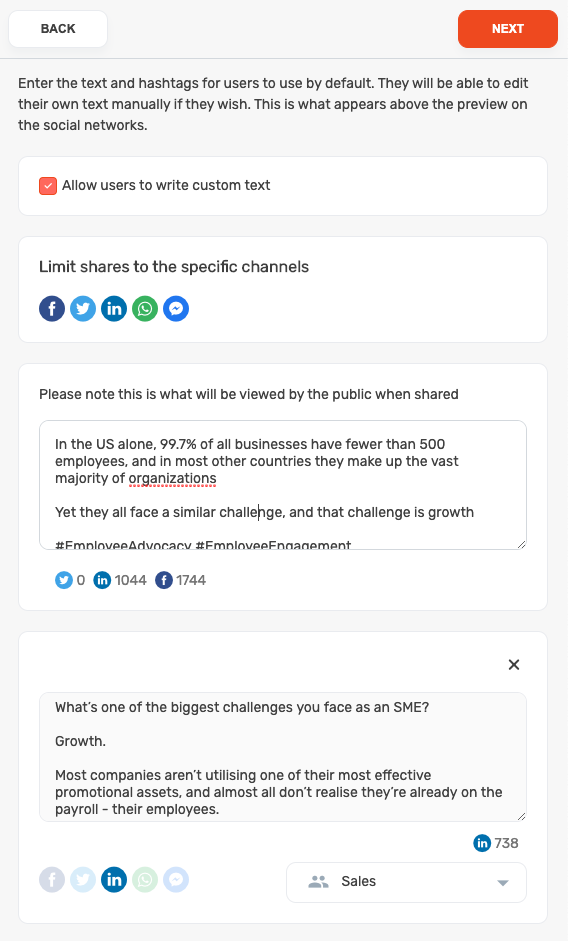
Our “post captions” feature encourages admins to write “recommended text” when curating a piece of content for employees to share.
The “post caption” is the personal message which is added to posts shared on social media.
Admins can write as many as they wish so that employees can choose something that sounds more like their tone of voice.
How does this alleviate this risk?
Because if you choose, you’re able to limit employee shares so that they may only share the piece of content using the pre-written recommended post caption.
By doing this, you’re able to control the tone of voice across and messaging across social networks 💪
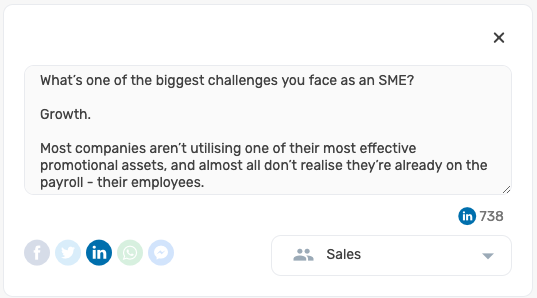
This can be made even more tailored to each employee by creating team/social channel-specific captions
In the example below, the post caption is specific to the Sales team when sharing to LinkedIn 👇
Risk Two: Okay, maybe you’re worried someone will share something confidential?
Sheesh, you don’t what THAT getting out!
Another horror story 👇
Employee uploads office photo.
Employee neglects to notice confidential information written on the whiteboard in the frame.
Other employees reshare it.
The company lands itself in hot water 😰
Fortunately, within the DSMN8 platform, zero pieces of content will be made available for sharing without having been screened beforehand.
This is because only a dedicated team of pre-selected admin users are able to approve and curate content for sharing.
Whether it’s from a content source they’ve set up or a photo submission from a colleague, nothing makes it to the feed without approval.
Perhaps you’ve got something that’s due for release, but you don’t want anyone to access it and risk leaking it beforehand?
Admin users (and only admin users) will be able to curate and schedule content to go live (visible in users’ DSMN8 feeds for sharing) at a later date 📆
These admin users will be the only ones who can access and view the schedule, eliminating any chance of somebody accessing something that’s not yet ready to be made public.

Risk Three: You limited social media usage to marketers and “VIPs” because only they can be trusted?
Frankly, I can understand why.
Marketers & comms teams, for example, are typically pretty social-savvy!
And it’s their job to communicate on behalf of the company, after all 🤷♂️
Senior leaders, CEOs and the wider C-Suite are usually all too familiar with the risks associated with social media and tend to tread more carefully as there is more at stake.
But are you missing a window of opportunity by neglecting the majority of your workforce?
And are your business leaders likely to make time for social media at all?
Let’s be honest, they’re a busy bunch! 🐝
Of course, your leaders have tremendous influence and should lead by example, so in any instance, it’s a good idea to start by inviting them!
However, we know now from the previous 2 points that we have the ability to make employee advocacy safe for any and all employees.
So, firstly, how can you get everyone else involved?
Without a doubt, the first step lies in communicating the employee benefits.
Remember, employee advocacy is a two-way street and should benefit the company and the employee alike.
Simply asking employees to get involved won’t be enough, especially not in the long run 👎
There’s a whole range of employees out there with varying personality types and so, naturally, not all of them will want to get involved.
More importantly, you will have plenty who see the value, but either don’t have the confidence to write their own posts or simply can’t find the time,
That doesn’t mean we can’t make it easy for them to do take part.
In fact, we recently put together what we call “The Pyramid of Employee Influence” (shown below) which identifies 5 key groups of employees, their attitudes to sharing, and how you can get them more active on social.
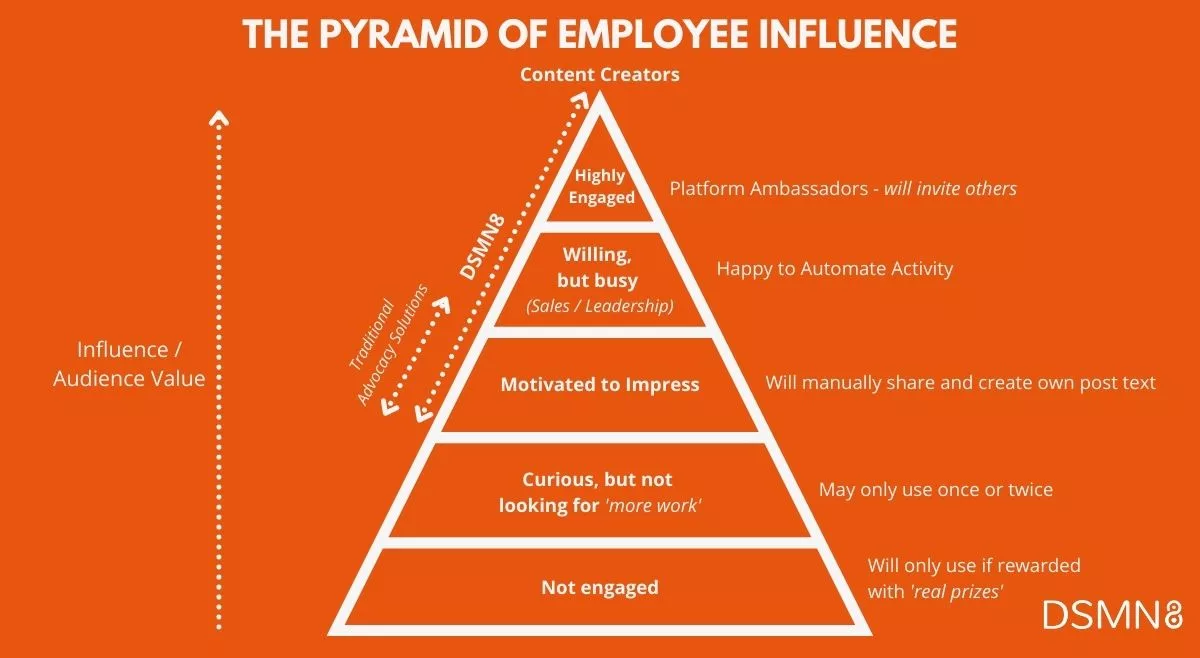
For those restricted by time, you have our automation features.
Setting up an automation allows users to automatically share relevant content to their LinkedIn networks without having to do so manually. DSMN8 runs in the background and keeps sharing posts for you.
Sounds like forced sharing?
This is not the case.
The choice to do so lies entirely with each employee.
They have full control over how many pieces of content they share over a period of time and can limit their shares to content that’s been allocated to their department/team.
Remember admin-written “text captions” from earlier?
Each automated that goes out will be a piece of admin-approved and fine-tuned content that has been pre-curated specifically for each employee.
So, not only can you get more employees involved to maximize results, but you can ensure that doing so is entirely risk-free for the company and the employee.
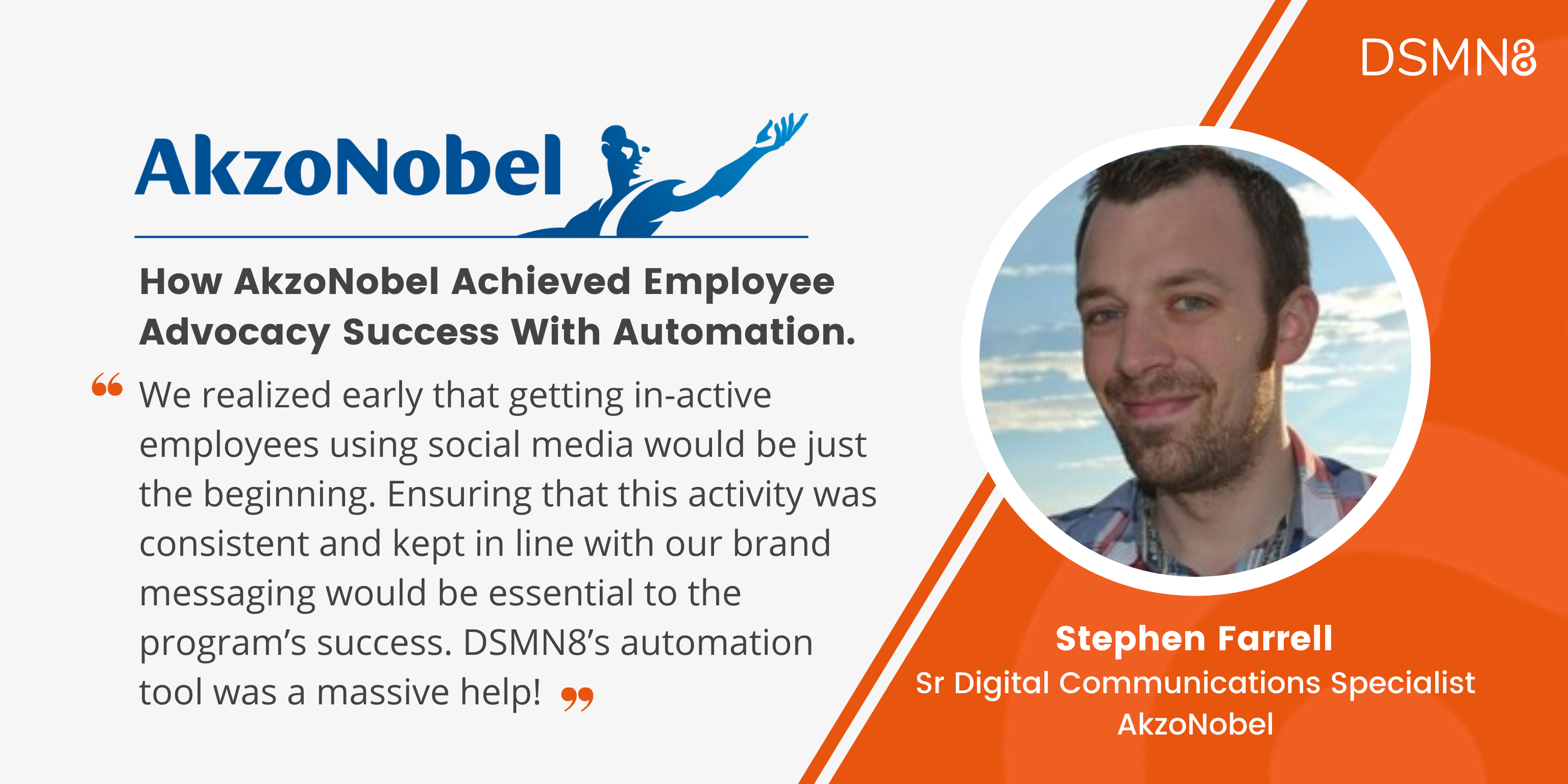
DSMN8 is currently helping hundreds of companies thrive with employee advocacy.
From companies in pharmaceuticals to financial services and even the gaming industry. Take Philip Morris International as an example: in one of the most tightly regulated industries in the world, they reached over 11.5 million people through employee advocacy with DSMN8 — read their full case study here.
We’ve made it possible for any organization to leverage their employees’ influence on social media.
No company left behind! 💪
Ready to kickstart your employee advocacy program?
When it comes to making employee advocacy safe and accessible for all, we’ve got you covered.
More on Employee Advocacy in Regulated Industries:
- 10 Law & Legal Employee Advocacy Cheat Codes
- 3 Challenges of Employee Advocacy in Law Firms
- How Regulated Industries are Leveraging Employee Advocacy
Watch the podcast episode below to find out how Maike Jansen, Employee Advocacy Lead at Dentsu Benelux, ensures brand safety and compliance:

Lewis Gray
Senior Marketing Manager at DSMN8. Lewis runs DSMN8's own employee advocacy program, putting the platform into practice from the inside, hosts The Employee Advocacy Podcast, and launched the Employee Advocacy Certification Course. His background in sales informs his approach to demand generation and B2B content strategy.