
Last updated: 17th August 2026
Running employee advocacy without a dedicated tool works at a small scale, but it breaks down fast once you’re relying on manual sharing, spreadsheet tracking, or repeated copy-paste requests to employees.
The main gaps are attribution (you can’t prove what’s working), authenticity (identical posts from multiple employees look like spam), and adoption (there’s no reason for employees to keep coming back).
Below is what each of those gaps costs you, and what closes them.
Key Insights:
- Manual employee advocacy programs can’t attribute shared content to pipeline or revenue, since there’s no UTM tracking or analytics layer connecting posts to outcomes.
- Identical, simultaneously posted content reads as inauthentic to overlapping employee networks, which suppresses reach rather than building it.
- Gamification (leaderboards, rewards) is one of the most reliable levers for adoption, and it’s difficult to run manually at any scale.
Analytics
Analytics
Without a doubt…
This is the most important one.
If there’s one thing every marketer cares about, it’s attribution.
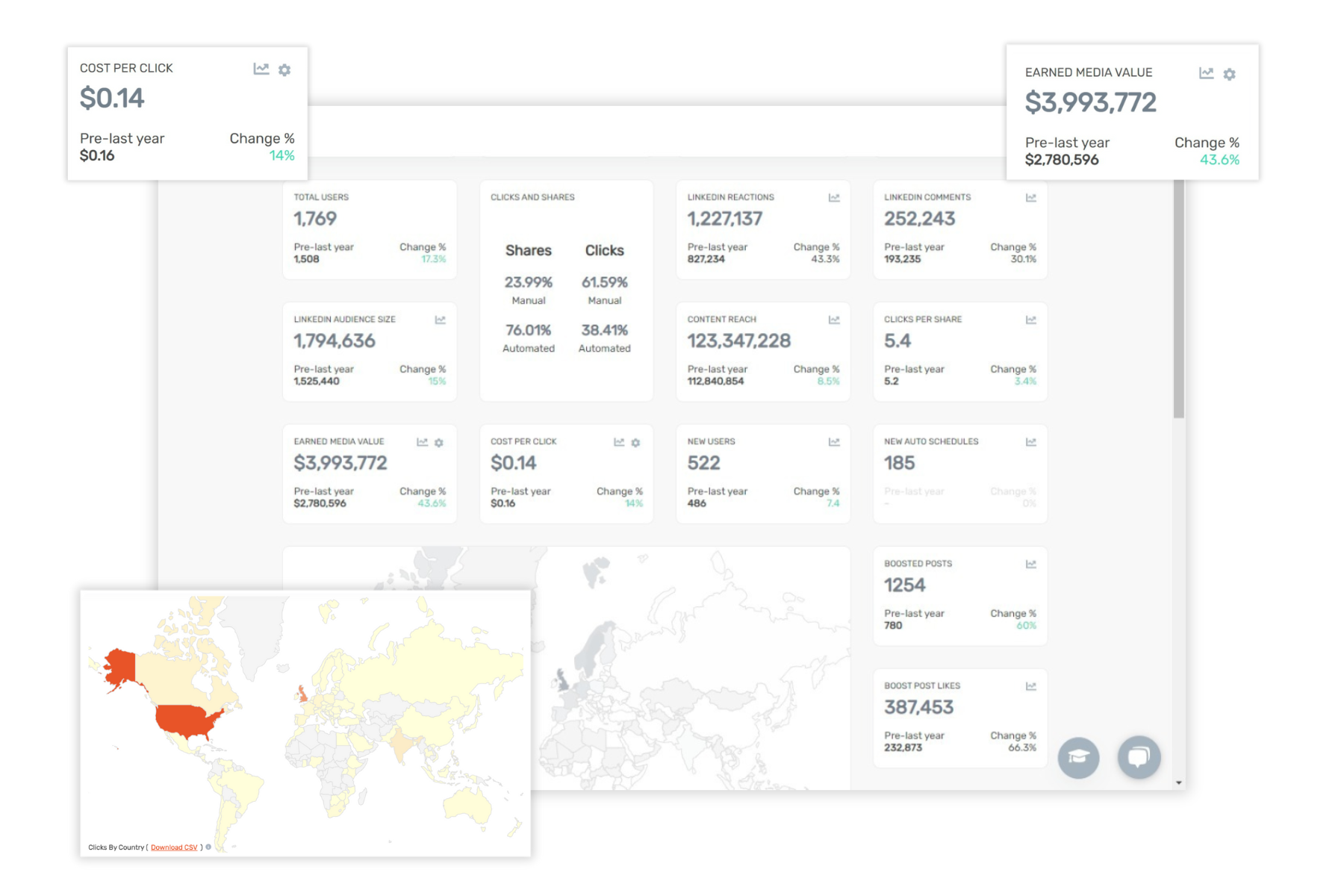
Without an employee advocacy tool with an analytics function, you’ll never be able to see (or prove) the impact of your and your employees’ efforts.
Seeing how your program performs will also help you refine your strategy. For example, if you saw that a particular employee was generating heaps of engagement, it would be in your best interest to ensure they continue sharing.
More importantly, it will highlight which content resonates with your employees’ networks (and your target audience). We’ve repeatedly seen clients tweak their broader content strategy based on content performance in their employee advocacy program.
Better still, a tool like DSMN8 comes equipped with personal analytics, so every employee can see the impact they’ve made.
This can be a tremendous asset when it comes to keeping people motivated, as it tells your employees in real time that they’re making a difference.

Plus, with DSMN8’s customizable UTM tracking, you can take your analytics to the next level by connecting the dots between social media and business impact, allowing you to attribute results in tools like Google Analytics or your CRM.
DSMN8 lets you add custom parameters to all links shared and filter them by teams, groups, events, campaigns, and content sources within the platform.
This means you could, for example, see exactly which content shared by a sales team member for a particular campaign drove sign-ups for your latest webinar.
Content Variation & Personalization
Okay, so here’s a big one, and I kind of feel like this should be at the top of the list because this is probably the MOST common one 😬
Imagine finally getting more of your employees to post your content on social media, only for it to look like spam in their audiences’ feeds.
Why? Because you’ve asked them all to share the same piece of content simultaneously.
If you consider that there’s typically a significant degree of overlap among employees’ networks, it can appear inauthentic and forced… as if they’ve been told or pressured to share that content by their employer.
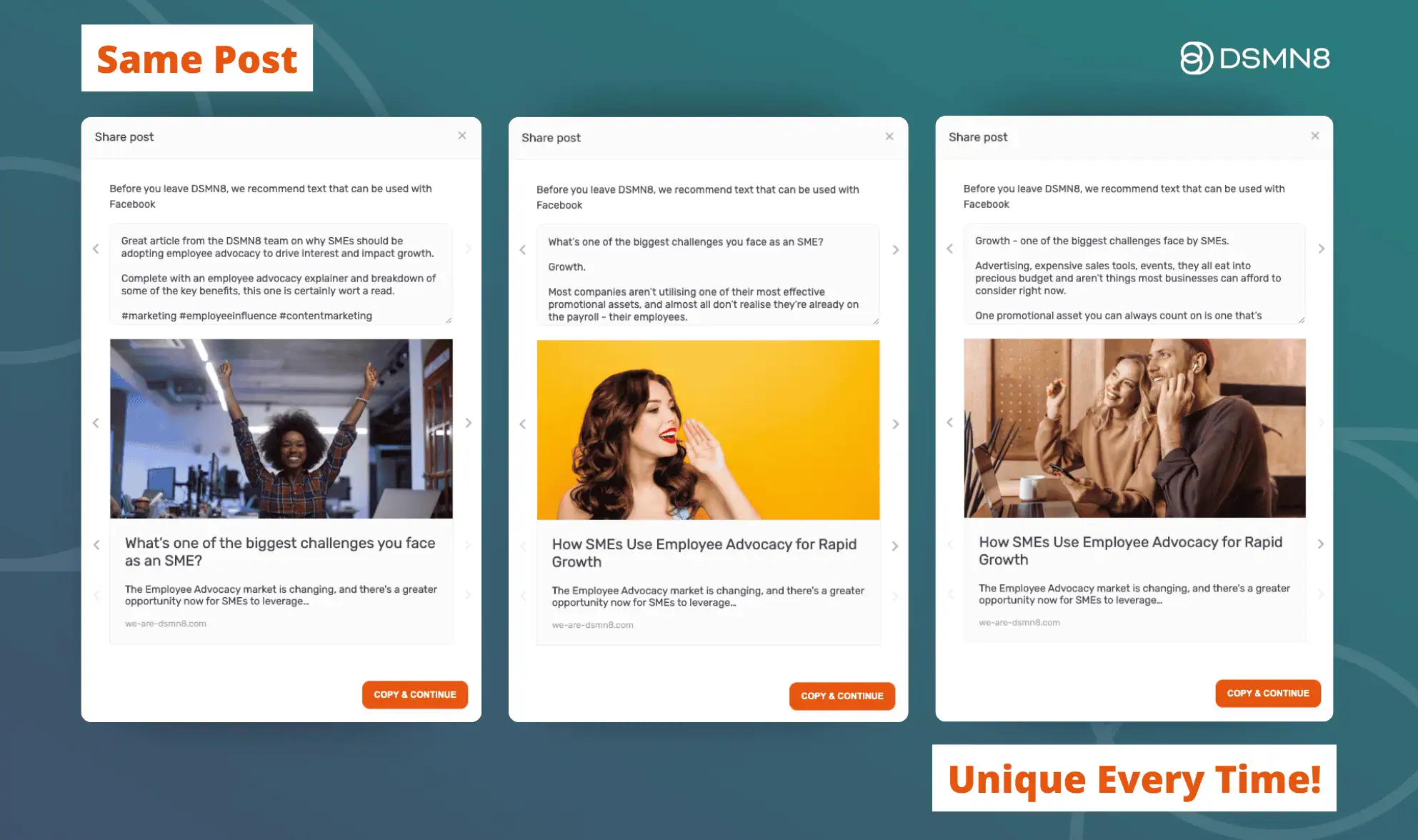
With an employee advocacy tool like DSMN8, you can ensure that each employee’s share looks totally unique.
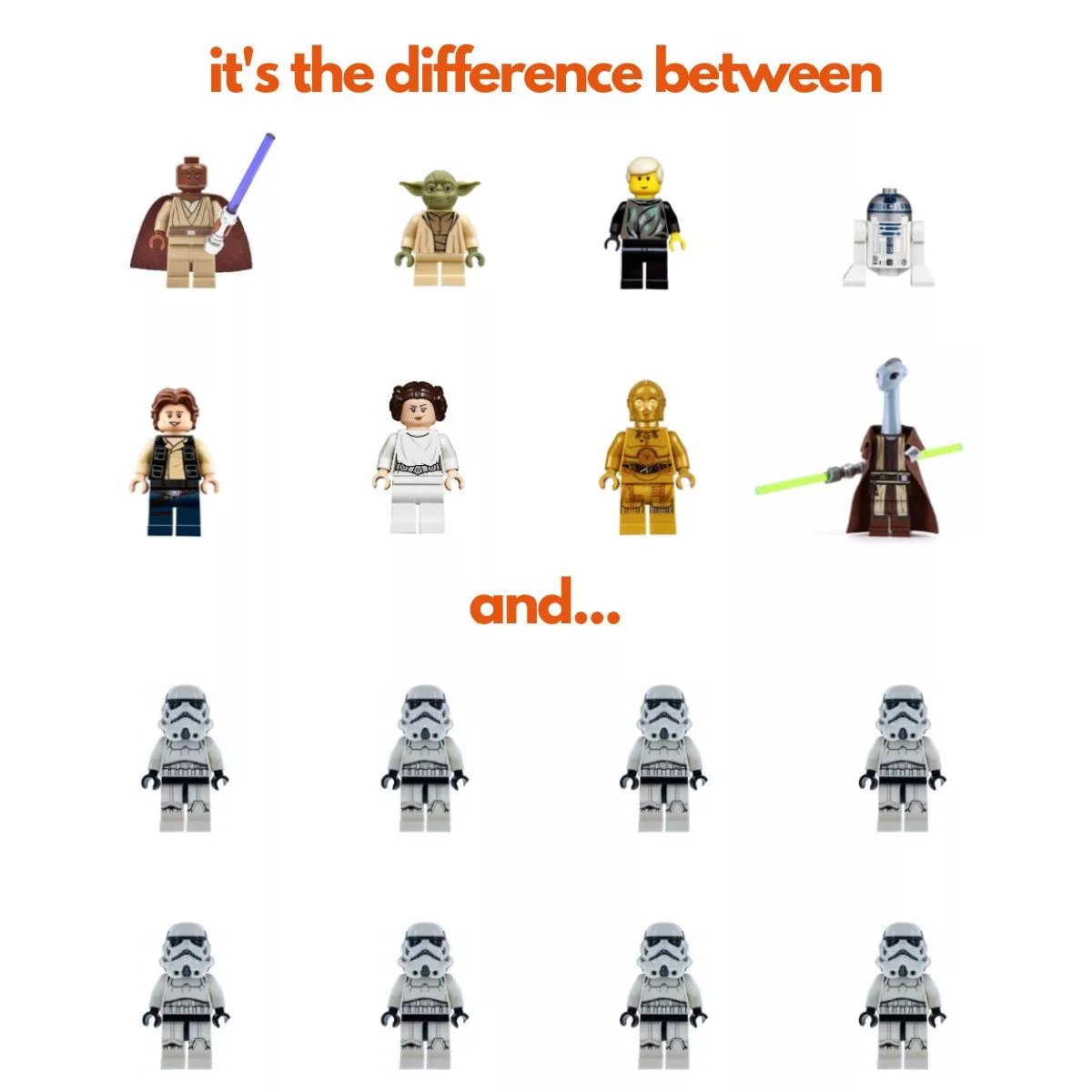
Think of it as the difference between your employees looking like Stormtroopers…
Or a team of Jedi Knights 💪
DSMN8’s Dynamic Display feature means the same content can be posted to social media, but presented and delivered differently by each employee. Without Dynamic Display, your employee advocacy program quickly loses its authenticity.
To take this even further, your team can use Personal Voice AI to customize their post captions. This feature analyzes employee LinkedIn posts or provided writing samples to understand their tone of voice and style, which can then be applied to any post in one click.
Content Segmentation
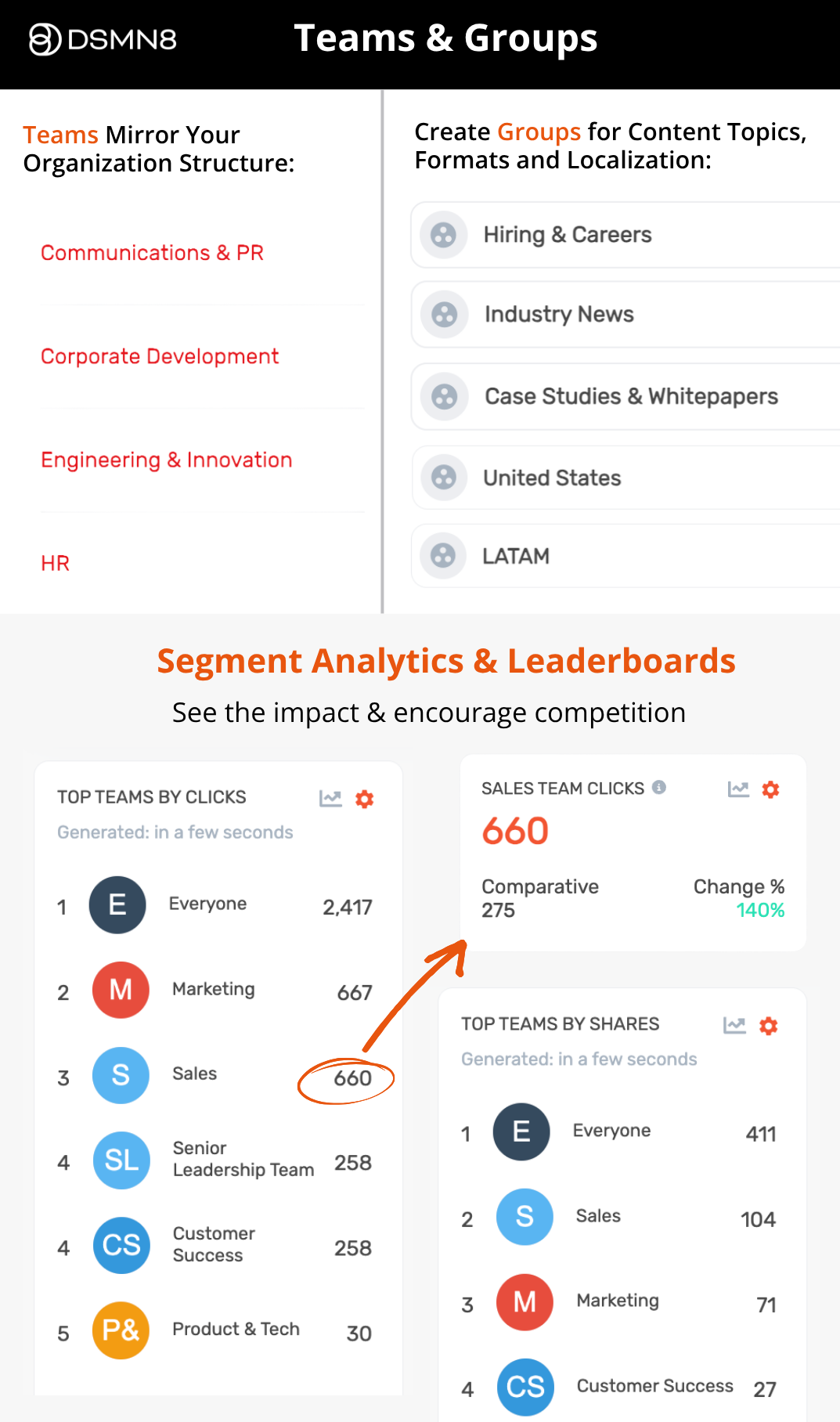
Content segmentation allows you to get the right content in front of the right people.
Sure, this could, in theory, be done manually (e.g., you send a piece of content to a bunch of people in sales to have them share it), but it would be both time-consuming and challenging to scale.
With DSMN8, you can assign users to specific teams and groups so they only see content relevant to them and their networks.
This is a great way to get better results from your program while making it feel more personalized for your advocates.
Gamification
Okay, this one is widely debated because gamification results can vary depending on the company and the people involved.
However, some questions people often ask after managing an employee advocacy program for some time are:
“How can I get people involved in this new initiative?”
“How can I keep people coming back to this app?”
“How can I drive maximum results from this?”
Well, you make it fun 🤩
Gamification, in the form of leaderboards and rewards, is a proven way to get more employees involved.
Leaderboards showcase top sharers and highlight those who are making the biggest impact.
This works because the friendly, competitive nature of winning drives more activity.
Plus, gamification can quickly improve adoption rates and can seriously help you get your program off the ground. It creates a buzz, which leads to curiosity and then participation.
One DSMN8 client offered up their latest tech and smartphones as prizes, which tripled user adoption rates!
Related Podcast Episode
Ready to get started with the #1 employee advocacy platform?
Wondering how active your team already is, and how this compares with your competitors?
FAQ
Can you run employee advocacy without a tool?
Yes, on a small scale. Some companies start by asking a handful of employees to share content manually. The challenges appear as the program grows: no attribution, identical posts across networks, and no easy way to keep people engaged over time.
What's the biggest risk of manual employee advocacy?
Losing authenticity. When employees post identical copy at the same time, it reads as coordinated rather than genuine, which can reduce reach and trust with their networks rather than building it.
When does a company typically need an employee advocacy platform?
Usually once a program grows past a small group of consistent sharers, or once leadership asks for measurable results (engagement, reach, pipeline influence) that manual tracking can’t provide.
More Resources You’ll Find Helpful:

Lewis Gray
Senior Marketing Manager at DSMN8. Lewis runs DSMN8's own employee advocacy program, putting the platform into practice from the inside, hosts The Employee Advocacy Podcast, and launched the Employee Advocacy Certification Course. His background in sales informs his approach to demand generation and B2B content strategy.