
Last Updated: October 13, 2026
Your employees influence your brand, whether you realise it or not. The only question is: are you empowering them to shape the conversation in your favor?
By tapping into the collective power of your most valuable asset, your employees, you can amplify your message, boost engagement, and distribute authentic content that resonates with your target audience.
Whether you’re just beginning to explore employee advocacy, aiming to turn your team into in-house influencers, or need a helping hand through launching a program, this guide will help you every step of the way!
We will cover:
- What is employee advocacy, and what are employee influencers?
- The key benefits of employee advocacy.
- The future of influencer marketing.
- The business case for an employee advocacy program.
- A step-by-step guide to ensuring success from your program.
- Plus, a masterclass from Dropbox on the first 60 days of launching a program.
So, let’s get started, shall we?
Foundations
First, let’s clear up the key definitions you’ll need to know:
What is Employee Advocacy?
Employee advocacy is the promotion of an organization or its products/services by its employees.
An employee advocate creates positive exposure for your company by sharing content on social media, “advocating” for your products or services. This typically occurs on the platform known for professional networking: LinkedIn.
In a nutshell, employee advocacy is word-of-mouth marketing by employees on social media.
What is Influencer Marketing?
Influencer marketing is a form of social media marketing that involves the promotion of a product, service, or company by an influencer: someone with a significant social media presence.
Influence can be on a macro scale, like MrBeast (the world’s biggest YouTuber with 366 million subscribers), or on a micro level, e.g., 10,000 followers in a niche community.
Anyone with internet access can build a following, and their content can influence purchase decisions and audience behavior.
What are Employee Influencers?
Employee influencers are exactly what their name suggests: influencers, but employees.
They can be considered employee advocates or ambassadors, but they go beyond simply sharing brand-approved content. An employee influencer also creates their own original social media content.
The other key element here, of course, is influence. An employee content creator is more likely to have grown a larger professional network of followers and connections than their peers who only share pre-approved posts.
There’s one simple reason for this: creating original content is more likely to resonate on social media because it feels genuine.
Even simply rewording pre-approved content into your own tone of voice will make it more engaging and less ‘corporate’.
Why Employee Advocacy Matters Now
Social Media Influencers: Benefits and Challenges
As with any marketing initiative, working with social media influencers comes with pros and cons. Let’s explore some of them:

Why Work with Influencers?
Collaborating with social media influencers helps build a brand’s credibility beyond traditional advertising.
Let’s say, for example, a well-known beauty influencer endorses a new product on their Instagram or TikTok.
People follow these creators because they believe they can learn from them – their content provides value. A product recommendation is, therefore, likely to be trusted, leading to sales for the brand.
A 2024 study revealed that a huge 74% of consumers have made a purchase as a direct result of an influencer’s endorsement.
When influencers promote products or services, it doesn’t come across as pushy or as ‘in-your-face’ as brand advertising.
The audience has chosen to follow the influencer and their content, and so are less likely to be annoyed and ‘tune out’ when they share branded or sponsored posts.
Types of Influencers
Influencers aren’t a monolith; there are many different kinds!
These are the types most likely to be effective at boosting your brand, beyond the macro influencers with millions of followers:
1. Monogamous Influencers:
A monogamous influencer represents only one brand per industry to maintain authenticity. By limiting brand collaborations and focusing on long-term partnerships, influencers build credibility, ensuring consistency and trust.
2. Micro-Influencers:
A micro-influencer has a strong social media presence with a smaller, niche following. Their highly engaged audience trusts their expertise, making their recommendations more relatable, impactful, and trustworthy.
3. Employee Influencers:
Employee influencers, as the name suggests, promote the companies they work for. When employees thrive in a strong company culture, they naturally share their experiences, often before official advocacy programs launch.
In 2019, LinkedIn found that employee-shared content drove a 30% engagement increase, outperforming branded content.
With an advocacy platform, this impact scales. 72% of companies now use one to manage their programs, according to The Employee Advocacy Benchmark Report 2025.
Challenges of Influencer Marketing
It’s not always plain sailing with influencer marketing.
There have been many widely publicized instances of poorly executed influencer marketing campaigns, not to mention the potential for fake or ‘bot’ followers 😬
In the UK, the ASA sets out guidelines for influencer marketing, which ensure all sponsorships are disclosed as advertisements, even if the campaign involves gifted or ‘PR’ products without payment. Similar rules are enforced by the FTC in the United States.
Why Employee Influencers are the Future
Over the past decade, traditional influencer marketing has evolved from celebrity endorsements to smaller-scale social media influencers.
However, this growth is slowing as shifting consumer attitudes make brands rethink who their most impactful advocates are.
Stricter guidelines on sponsored content, driven by missteps in influencer marketing, have led to consequences for even reputable influencers.
Meanwhile, rising consumer awareness of data tracking and the use of ad blockers (used by 31.5% of users) is diminishing the effectiveness of traditional ads.
Have You Got Any Employee Influencers Within Your Ranks?
Here’s the thing all marketers should keep in mind: not every employee will make the ideal advocate or influencer.
Some of your team might not use social media, and others may not be interested in building a public personal brand.
The first people you call on should be the ones who are already active.
If they’re talking about your company, their work, or posting on LinkedIn… they’re the ideal candidate for an employee advocacy program! Search your company name or campaign hashtags to find them.
You’re also likely to have a bunch of creative folk amongst your ranks. Uncover the talented writers, photographers, or content creators in your team.
Finally, look to your senior leaders, especially your CEO. Executives are likely to have built large networks throughout their careers and wield significant influence both inside your company and externally.
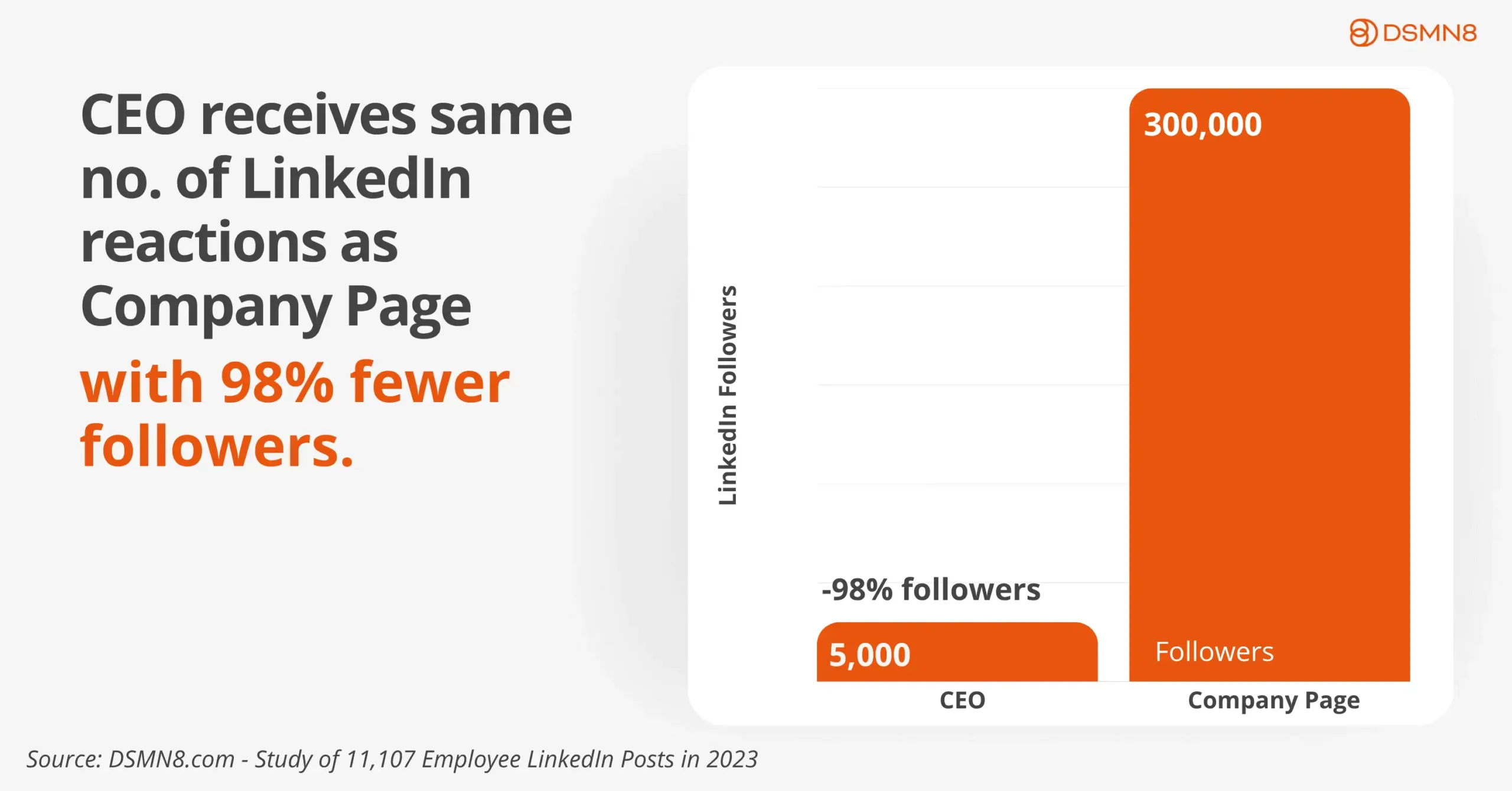
Our study of 11,107 employee LinkedIn posts revealed that CEOs can achieve the same level of engagement as a company page, even with 98% fewer followers.
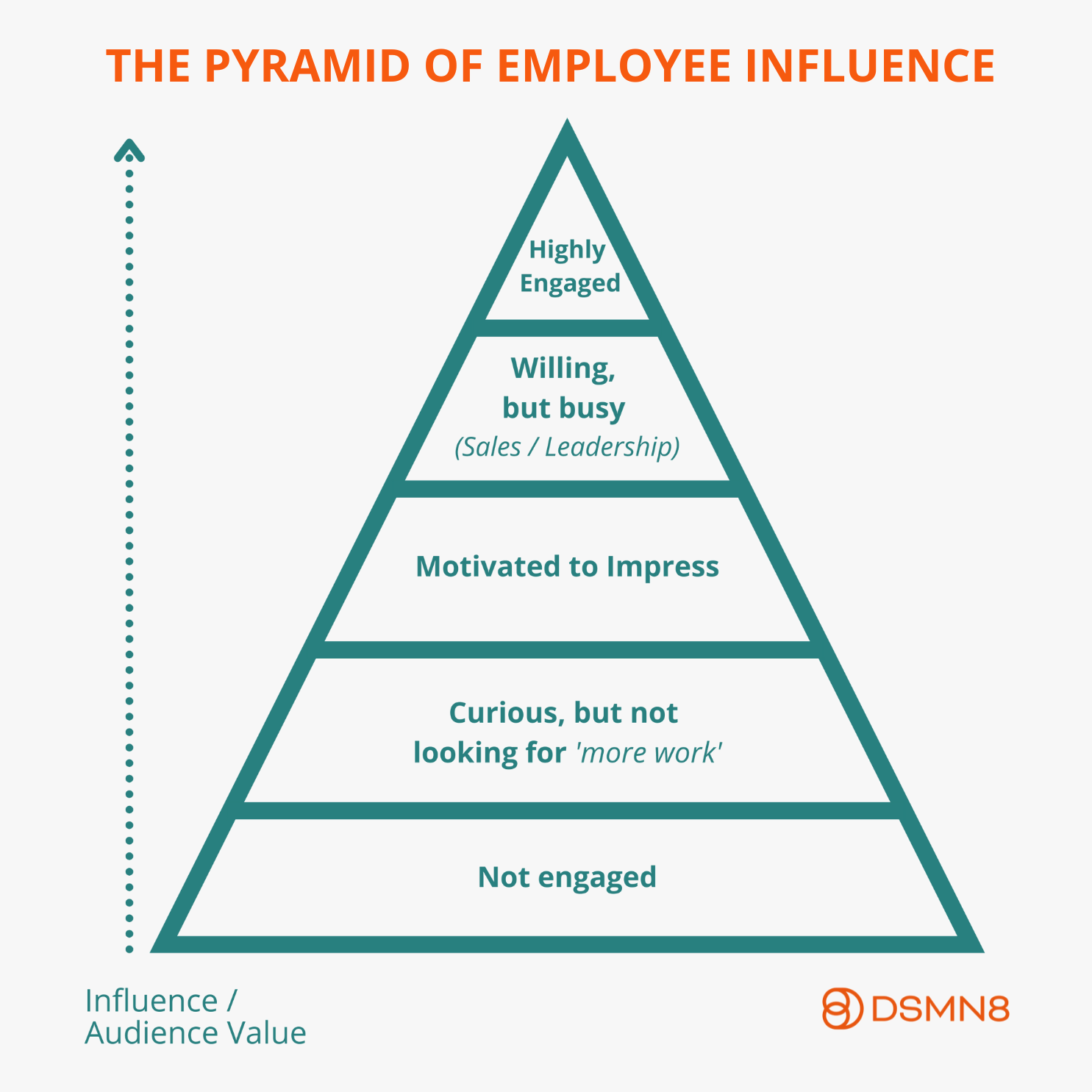
Use our Pyramid of Employee Influence to help guide you when planning who to invite:
Why is Everyone Talking About Employee Advocacy and Employee Influencers?
Employee advocacy isn’t a buzzword; it’s a powerful tool for brands.
While engagement and communication have long been corporate priorities, we see leveraging employees’ voices externally as the natural next step in brand strategy.
Authentic employee advocates and influencers drive sales, boost retention, and attract top talent.
So, why is everyone talking about this now? Here are eight trends putting employee advocacy in the spotlight.

1. Employee-Generated Content is Authentic
A staggering 92% of buyers trust peer content over brand messaging, according to research by Nielsen.
Activating your team on social media builds personal brands, positions employees as thought leaders, and strengthens marketing efforts.
💡 Quick Tip: Crowdsourcing employee content scales your social media output while adding an authentic perspective.
2. Declining Trust in Brands
The 2019 Edelman Trust Barometer revealed that trust brands is fleeting, while authenticity matters more than ever, especially for Millennials and Gen Z consumers.
Brands turned to influencer marketing to address this, but rising costs and declining trust have made buyers skeptical of sponsored content.
Now, companies are cultivating in-house influencers for a cost-effective, credible alternative.
This also increases content control, ensuring that the creator isn’t recommending your product/service one week and your competitor’s the next.

3. Maximizing Content Reach and Engagement
Social media favors people over brands.
LinkedIn posts written by employees outperformed pre-written shares by over 9x, from our analysis of 500,000 posts made in 2025.
Smart brands are maximizing reach by having their leaders share key strategic content and getting employees to amplify it.
💡 Wondering how active your employees are on LinkedIn and how this compares with your competitors? Get a free report to find out.
4. Social Selling
Sales pros know social selling, but here’s a refresher: it’s using social media to engage prospects and stay top of mind. Employee advocates excel at this.
By sharing helpful and relevant content, your sales team will build personal brands and industry credibility. In turn, this reflects positively on you.
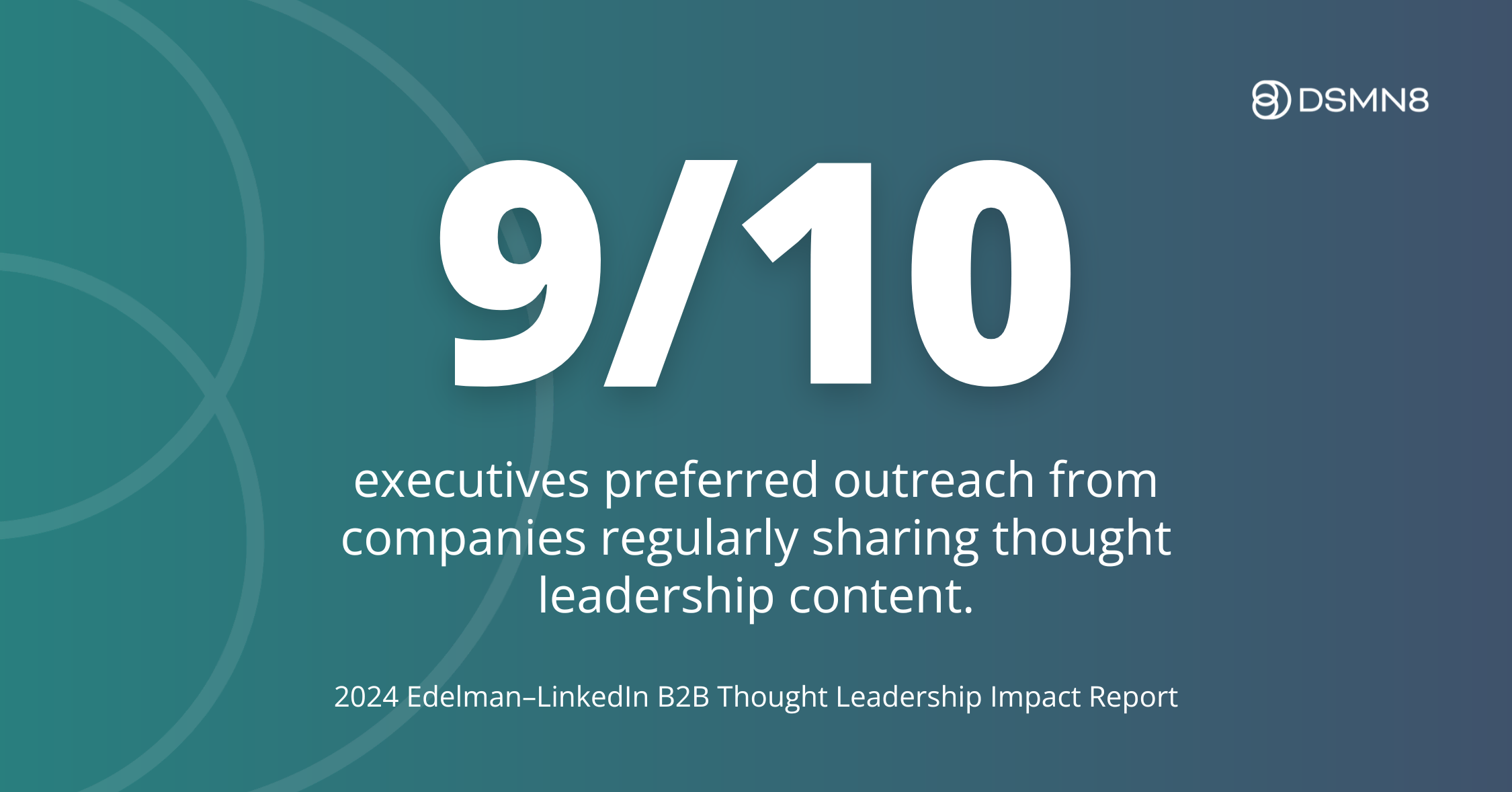
In 2024, Edelman found that 9/10 executives preferred outreach from brands regularly sharing thought leadership content.
💡 Quick Tip: Help employees shine by mixing company content with third-party industry insights and encourage them to create original posts.

5. The Rise of Employer Branding
Employer branding and employee advocacy go hand in hand.
With 96% of companies linking employer brands to revenue and LinkedIn reporting a 50% boost in qualified candidates, perception of your culture is key.
In the social media age, the best way to showcase company culture? Let employees tell the story.
6. Reducing Paid Media Budgets
Employee advocacy tools are becoming an invaluable asset for companies looking to reduce paid media and production budgets and amplify existing marketing content.
As influencer fees rise and impact declines, many brands are shifting focus to in-house creators. This supports scaling content while keeping budgets in check.

7. Empowering Employees
Employees are a company’s most valuable asset, and investing in them drives productivity and growth.
In fact, the 2025 Employee Advocacy Benchmark Report shows that 61% of organizations now view employee advocacy as crucial.
Clear, curated content boosts employees’ confidence in sharing on social media, making them effective brand ambassadors. Providing the right support and tools is key.
💡 Quick Tip: Start by updating your social media policy with our customizable template.
8. Scaling Content Creation
Creating content at scale is a major challenge for companies of all sizes.
Even large companies with dedicated teams often struggle to drive engagement and ROI.
Employee advocacy platforms like DSMN8 help scale content distribution without sacrificing quality.
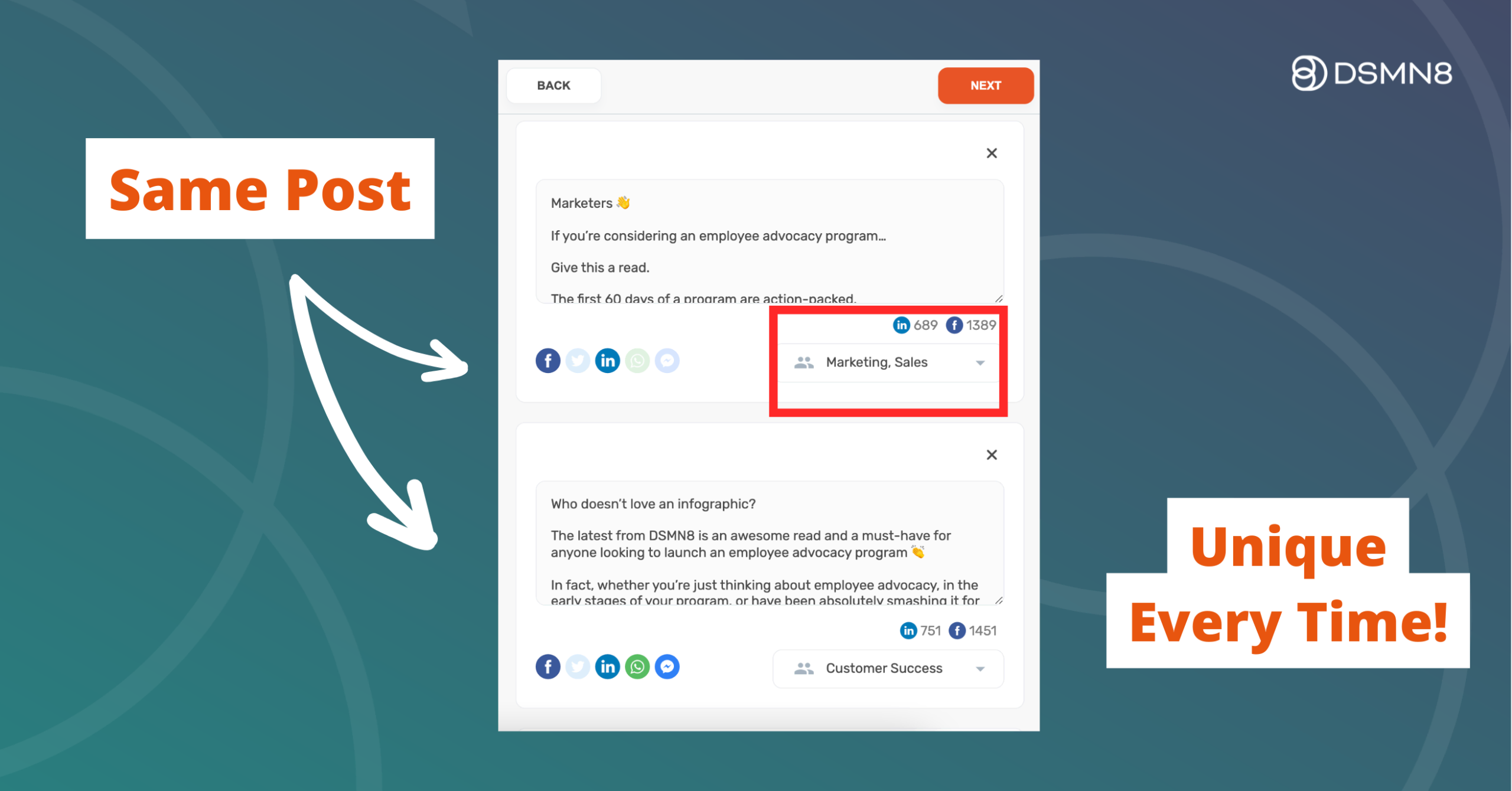
By adding multiple preview images, titles, and captions, employees can share unique variations of the same post.
The Benefits of Advocacy for Employees
We’ve covered how employee advocacy benefits brands, but why would employees want to participate?
Well, building a professional presence on LinkedIn helps support career growth, positioning yourself as an expert in your sector, and can even lead to exciting opportunities like awards!
And of course, it’ll increase internal visibility with senior leadership, and shows that you’re a team player who wants the company to thrive.
Let’s break down the main benefits for employees:
To see how these benefits break down by department, from marketing and sales to corporate communications and senior leadership, read The Benefits of Employee Advocacy for Every Team.
The Business Case for Employee Advocacy
Ready to launch your own advocacy program?
Gaining senior management’s approval can be daunting and time-consuming. Before pitching, ensure you have the data and strategy to make a strong case.
An employee advocacy program offers many advantages, but six key benefits stand out:
- Amplified content distribution.
- Enhanced social selling opportunities.
- Crowdsourced content creation.
- A stronger employer brand.
- Empowering employees.
- Performance marketing.
1. Amplified Content Distribution
Your marketing team creates great content, so why not give it the reach it deserves?
Consumers trust people they know over traditional ads, making employee advocacy more credible and impactful than corporate pages or influencers.
- 79% say user-generated content influences their purchases.
- 88% trust recommendations from peers most.
- Just 3% of employees sharing content boosts LinkedIn engagement by 30%.
📈 Want to see your advocacy potential? Use our free reach calculator!
2. Maximize Social Selling
Social selling helps salespeople engage with prospects on social media, ensuring they’re top of mind when buyers are ready.
An employee advocacy program simplifies content sharing, positioning sales teams as industry experts.
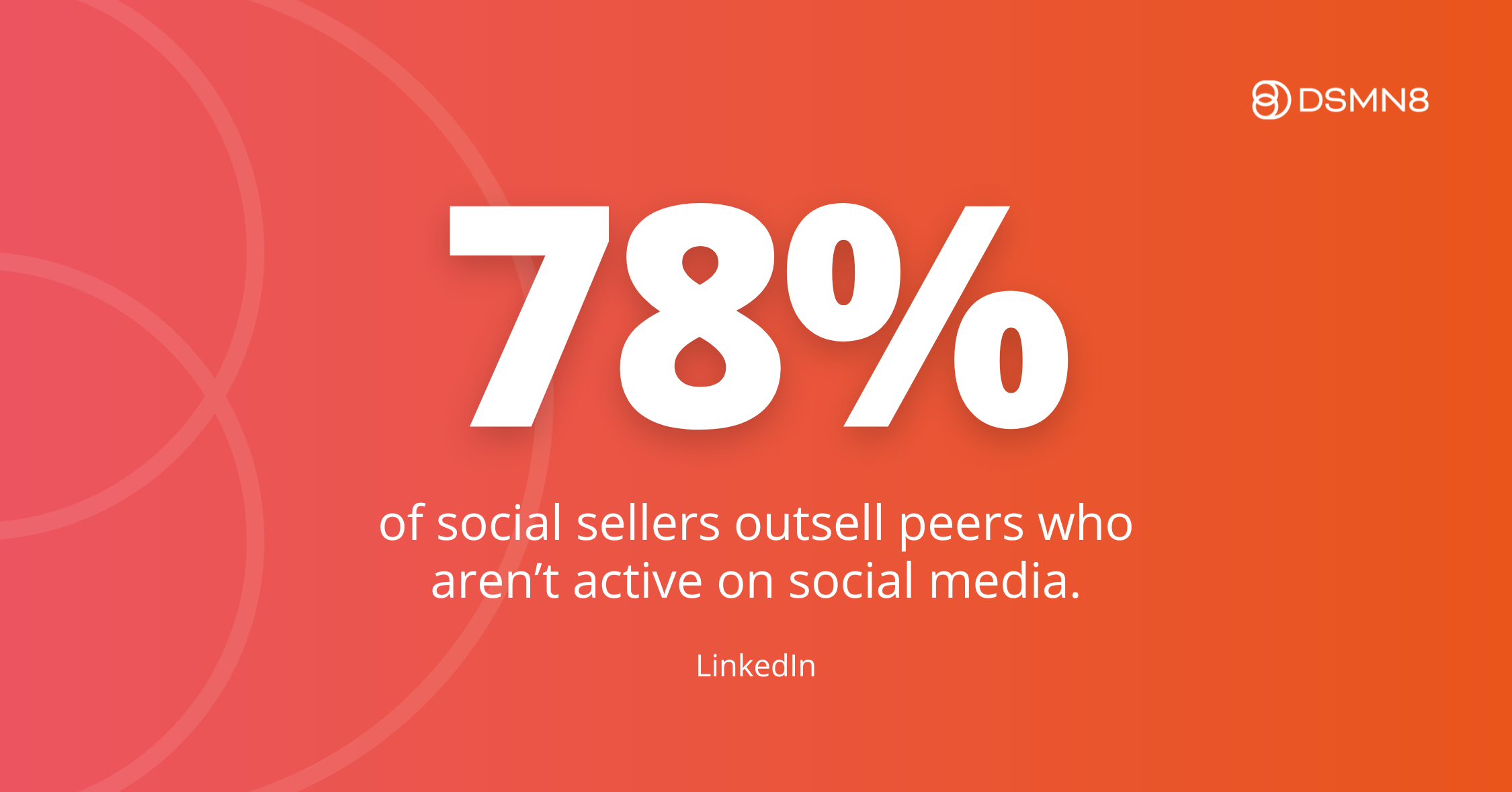
LinkedIn reports that 78% of social sellers outsell peers who aren’t active online.
3. Crowdsource Content
Creating authentic content at scale is challenging.
Social media managers can’t be everywhere, and freelance writers often lack industry insight.
Employee advocacy platforms let employees capture and share behind-the-scenes moments, enabling marketing teams to crowdsource high-quality content while saving time and budget.
Employers gain authentic content, while employees build their personal brands and industry credibility 🤝
Empowering employees to create content fosters a sense of belonging and a strong company culture.
4. Employer Branding
In the age of social media, employer branding is crucial for attracting top talent and shaping public perception. Employees are the most authentic advocates for your brand.
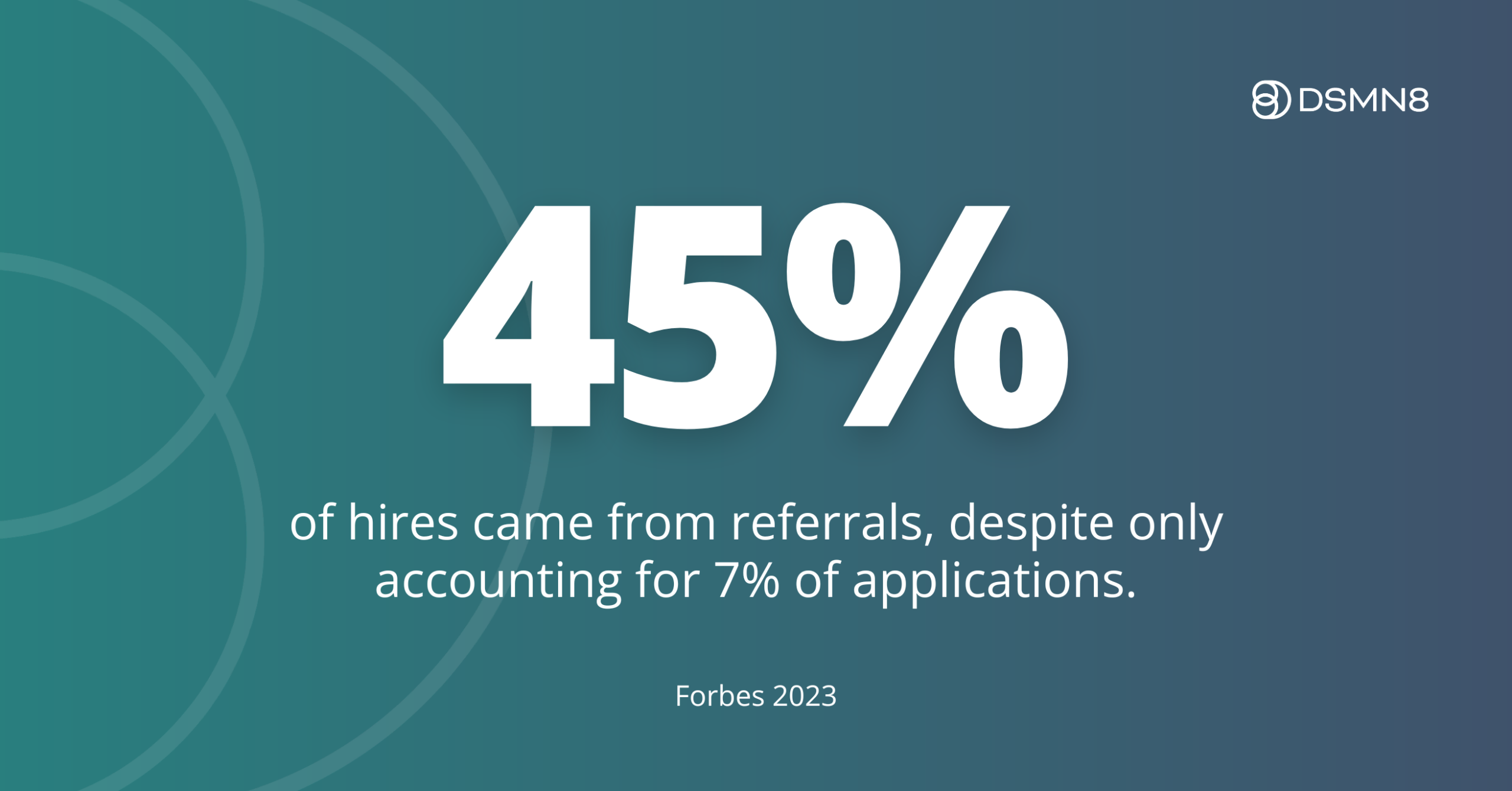
In 2024, 77% of U.S. HR professionals struggled to find candidates, yet in 2023, Forbes reported that referrals made up just 7% of applicants but 45% of hires.
Encouraging employees to share job opportunities is a cost-effective way to recruit top talent while strengthening your employer brand.
5. Employee Engagement
Many companies see employee advocacy as just a marketing tool, but it also boosts employees’ careers.
Advocacy programs enhance personal branding, open doors to networking and speaking opportunities, and improve professional growth.
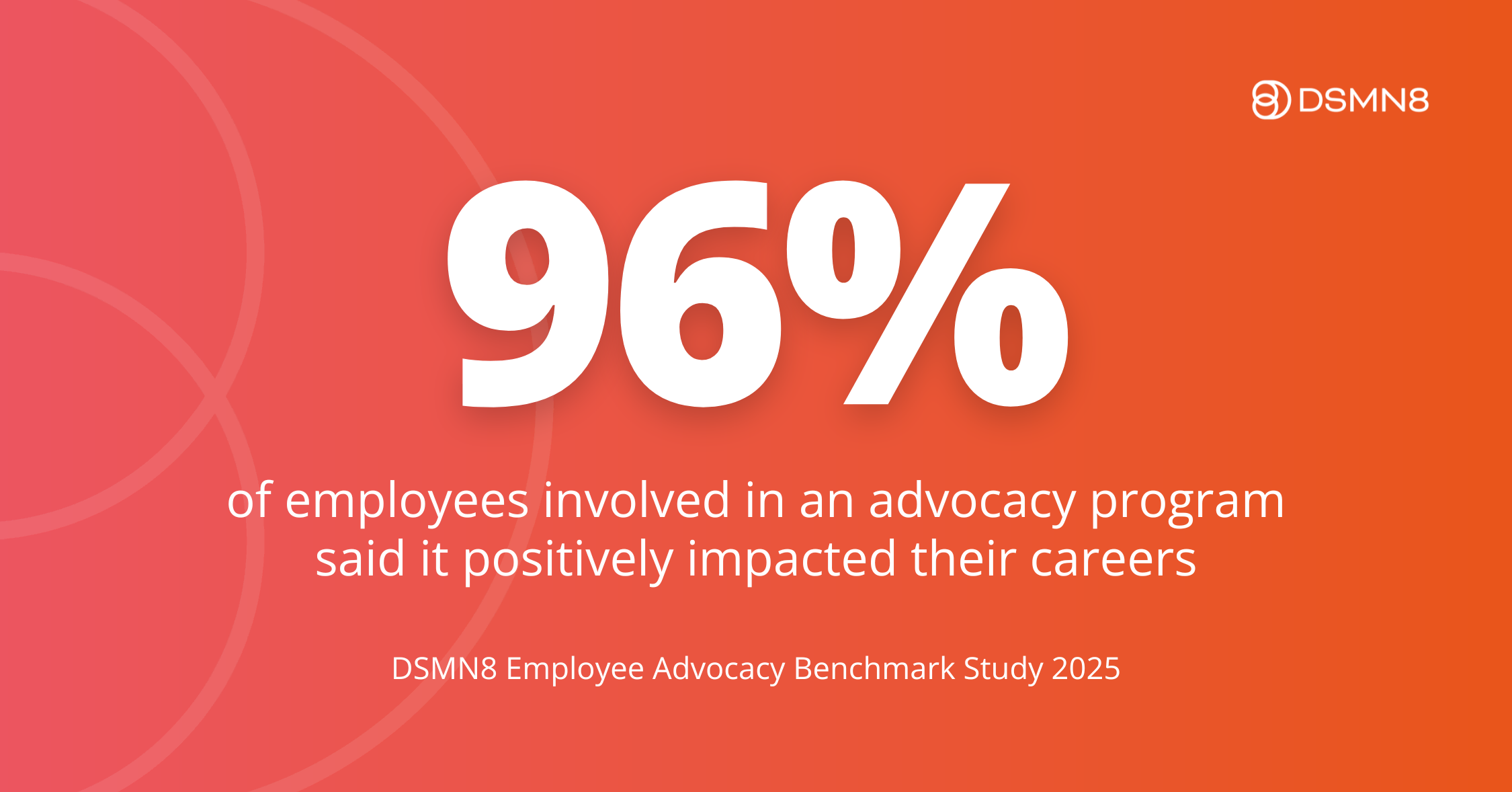
A huge 96% of advocates in our 2025 Benchmark Report said social media positively impacted their careers.
Platforms also serve as training tools, offering pre-approved content to boost product knowledge and ease social media concerns, helping onboard new hires efficiently.
A great example is Krauthammer, a Swiss training consultancy, which launched an advocacy program with DSMN8. Clear guidelines and support empowered employees to share confidently, benefiting both them and the company.
Check out our guide on the benefits of employee advocacy by team to learn what sales, HR, marketing, corporate comms & senior leaders gain from getting involved.
📊 Want the latest data? Get the 2026 Employee Advocacy Benchmark Report.
6. Performance Marketing
An employee advocacy program can significantly reduce paid media costs.
On LinkedIn, the average cost per click (CPC) was $5.26, while companies using DSMN8 see < $1 CPC. AWIN achieved a CPC of just $0.23.
Employee advocates drive high engagement and website referrals at a fraction of traditional marketing costs.
📊 Curious about your potential ROI? Try our free calculator.
Key Statistics
- 96% of employees believe posting on social media has positively influenced their careers (The Employee Advocacy Benchmark Report 2025).
- LinkedIn posts written by employees outperformed pre-written shares by over 9x, from our analysis of 500,000 posts made in 2025.
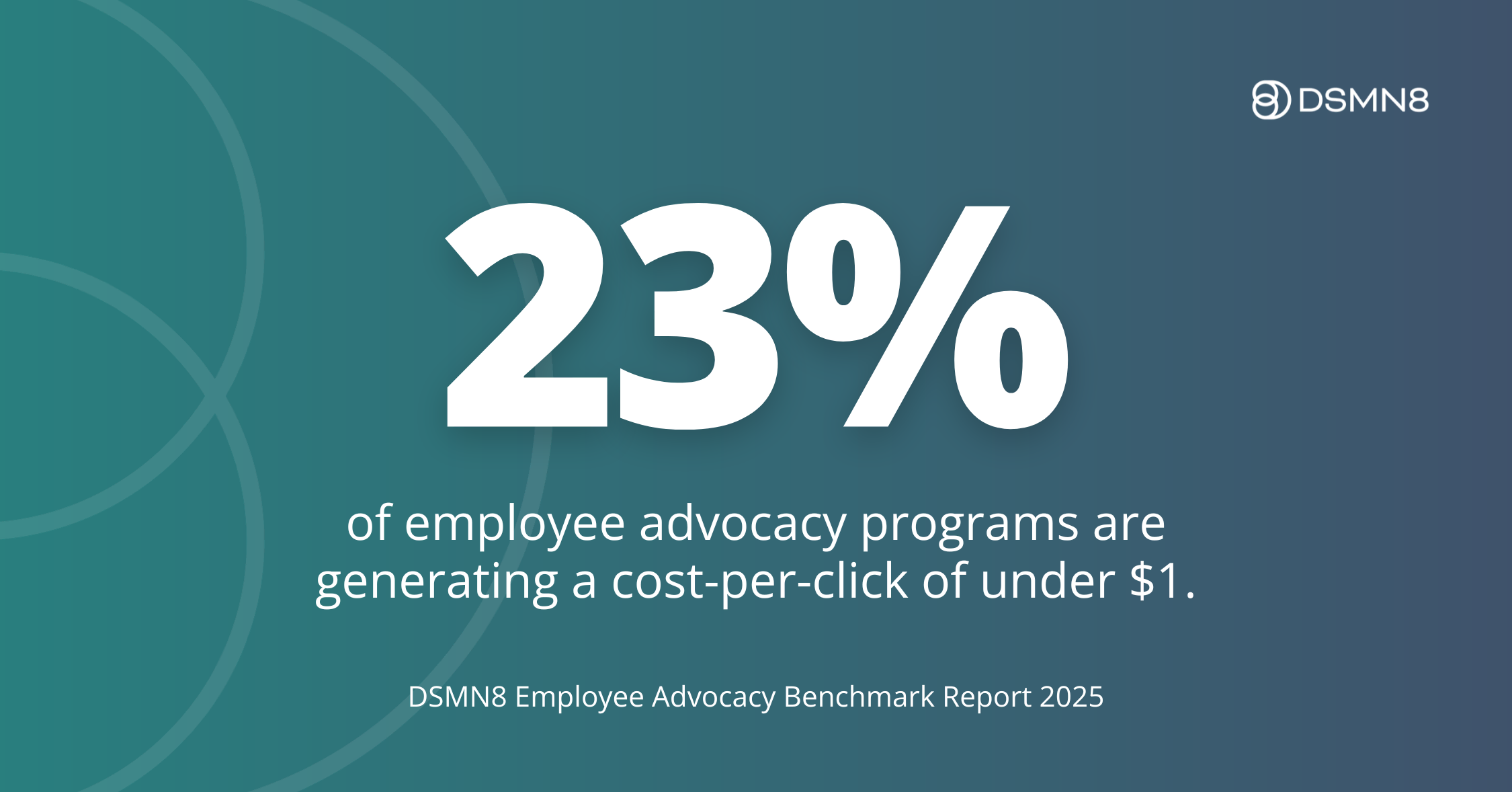
- 23% of employee advocacy programs are generating a cost-per-click of under $1 from employee shares (DSMN8 Employee Advocacy Benchmark Report 2025).
- A CEO with 5,000 followers on LinkedIn reaches the same amount of engagement as a company page with 300,000 followers (DSMN8 study of 11,107 LinkedIn posts).
- 73% of employee advocacy program managers are planning to get leadership involved as a top priority in the coming year (Employee Advocacy Benchmark Report 2025).
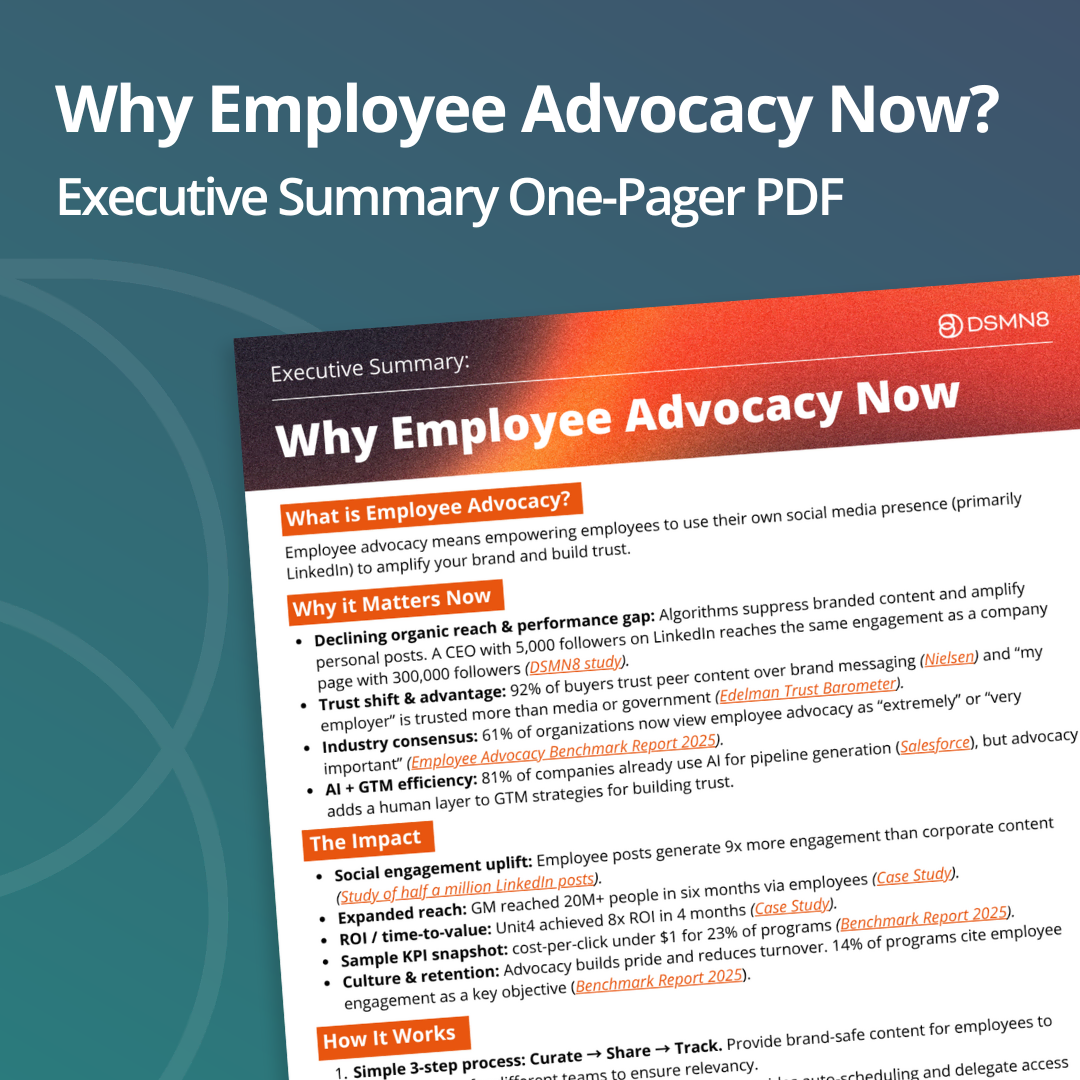
Executive Summary: Why Employee Advocacy Now
Download the executive summary PDF to share with your leadership team to support gaining buy-in for a program:
How to Run an Employee Advocacy Program
Buyer’s Guide for Employee Advocacy Software
We’ll admit, we’re a little biased. But if you’re searching for the ultimate employee advocacy platform, DSMN8 is the name to know. That said, let’s put our bias aside.
To ensure your chosen vendor will set you up for success, we highly recommend following this buyer’s guide. You can also download our vendors’ must-have checklist to help you evaluate essential features for your program.
1. Leaderboards & Rewards
Gamification elements like competitive leaderboards, rewards, and prizes make employee advocacy fun and engaging.
Tapping into their competitive nature is a strong motivator for many employees and will encourage signups and consistent participation.
One brand that championed this with DSMN8 is Chinese tech titan Huawei.
Recognizing the power of their employees to support business objectives, they offered up their latest smartphones, shopping vouchers, and exercise tech as rewards for top performers. Read the case study.
💡 Quick tip: Rewards don’t have to be constant! Use them during holidays or as surprise prizes to boost engagement.
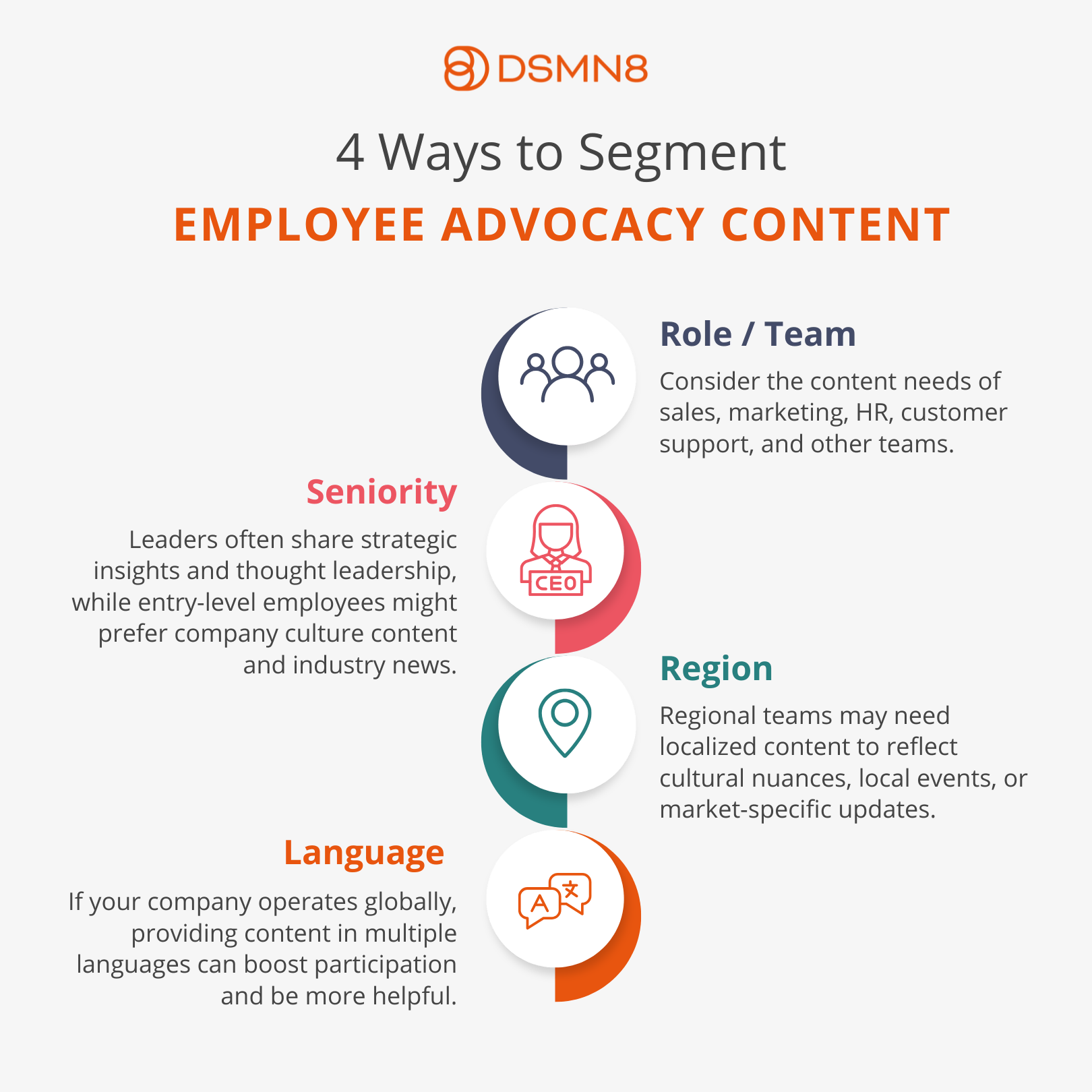
2. Segmenting Users & Content
A one–size-fits-all approach simply doesn’t work for employee advocacy.
Would your organization’s product development team want to share the same content as a salesperson? Probably not.
Segmenting users ensures they see relevant, localized content.
This engages both employees and their networks more effectively.
In multinational companies, regional leaders should curate content to suit different languages and cultures, preventing overload on one admin.
3. Personalization & Original Content
Unique, authentic-looking content is a must-have for any employee advocacy program.
Top platform vendors will allow admin users to include multiple images and post captions for every curated piece. This prevents your employees from sharing identical posts, which won’t appear original to their networks (or the algorithm).
Take a Netflix-style approach to engaging your audience. Rather than using the original poster artwork, they source high-quality images from their films and TV shows. Netflix then changes its preview artwork, aiming to entice users who were not attracted to the old images with new ones.
💡 Quick Tip: Adding 5 images, 5 post captions, and 5 link titles creates 125 different variations!
4. Mobile App
Top vendors typically offer both desktop and mobile apps, but always double-check. If you’re onboarding non-desk-based employees, a mobile app is essential!
With mobile access, your employees can engage anytime, anywhere, driving higher participation. A seamless mobile experience makes advocacy accessible and convenient for your team.
Push notifications further boost engagement by instantly alerting employees when new content is available to share.
5. Customer Success & Support
Before you launch an employee advocacy program, it’s vital that you have a strategy in place to ensure it’s a success.
Without proper guidance, this can be a tricky process. A great vendor will guide you through the process from inception to post-launch, and you will typically have a dedicated customer success manager to help you along the journey.
6. SSO Integration
Single Sign-On (SSO) simplifies employee access by allowing a single username and password to log into multiple products that your organization uses.
This enhances security while streamlining the login process.
Look for SSO as a key feature to drive adoption, improve user experience, and ensure security compliance!
🔒 Grab our Employee Social Media Security Checklist to share with your team to ensure they follow best practices.
7. Notifications & Email Newsletters
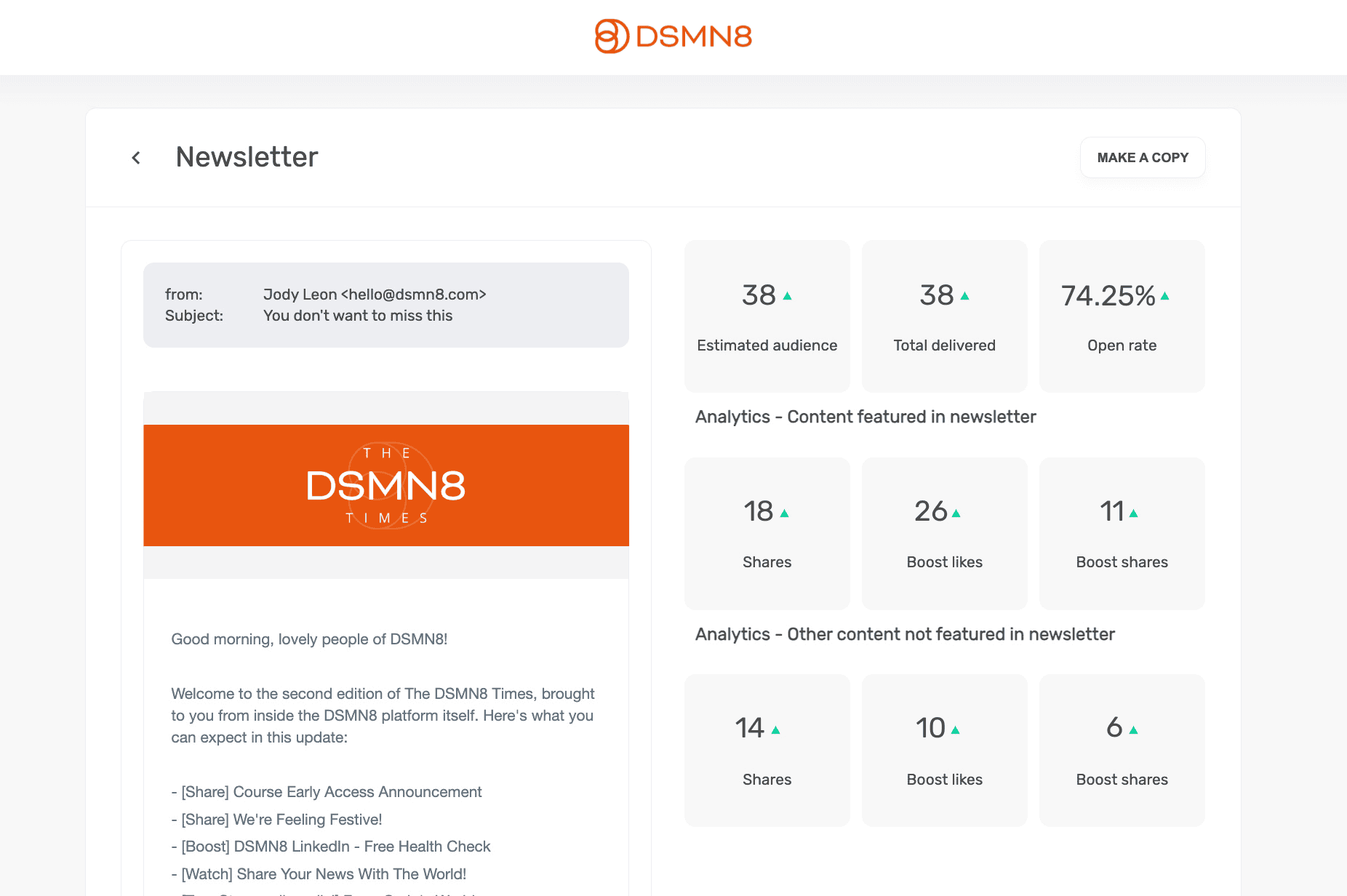
Notifications play a crucial role in sustaining user engagement.
By alerting employees when they’re tagged or mentioned, notifications serve as gentle prompts to return to the platform. This keeps participation high.
Email newsletters are another great way to let advocates know about fresh content.
8. Multilingual Functionality
This is a feature we’ve come to expect from any software, yet surprisingly, many companies fall short.
While your program may launch in the U.S. today, ensure your vendor can support future expansion into non-English-speaking markets.
9. ‘Boosting’ Executive and Company Posts
Employee advocacy isn’t all about sharing content. Engaging is important, too!
Make sure your platform includes a feature like DSMN8’s ‘boost post’. This makes it easy for employees to like or share LinkedIn posts by your executive influencers (e.g., the CEO) and your company page in one click.
This helps distribute the content further without your team needing to rely on the feed algorithm to show the freshest posts.
10. Managed Services
Top platform providers like DSMN8 offer a fully managed service.
Our team takes on tasks such as curating content and managing users so you can focus your efforts elsewhere.
In other words, customer success will do all the “heavy lifting” so that you can refine your strategy and focus on the more important tasks like performance analysis and content planning.
Vendor Feature Comparison Chart
Download our printable vendor feature comparison table to make choosing the right employee advocacy platform for your organization easy.

Building Your Employee Advocacy Program: Before Launch
Before implementing an employee advocacy program, ensure these key factors are checked off. A program’s success often hinges on these elements!
Company Culture
The key to getting employees to create and share brand content is a strong company culture.
Company culture (essentially your brand’s personality) shapes the work environment and drives engagement.
Employees are unlikely to advocate for a company they don’t enjoy working for!
Before launching an advocacy program, assess your culture. It takes time to build a positive, productive environment, so don’t skip this step.
Start by reviewing Glassdoor feedback and your CEO’s approval rating to gauge how people really feel about your organization.
Do You Have Content?
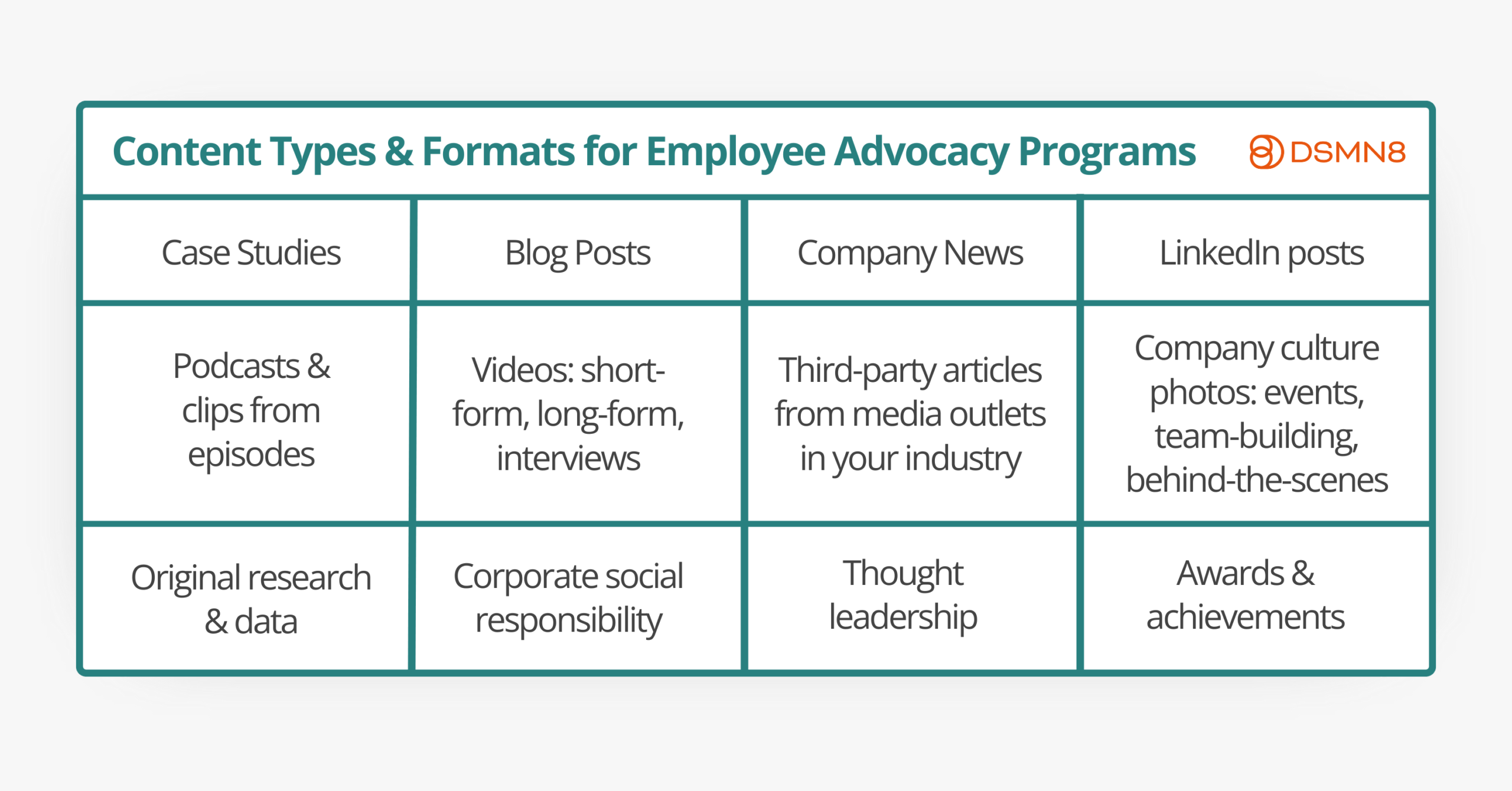
For employee advocacy to succeed, you need a steady flow of engaging, valuable content to share.
This includes blogs, press releases, videos, podcasts, and thought leadership posts. Audit your content sources and how often they’re updated.
Or perhaps you’re starting an influencer program to increase your content output in a more cost-effective, organic way.
In this case, equip employee influencers with creation tools and social media training to help them produce authentic content and grow their personal brands.
Create a Platform Identity
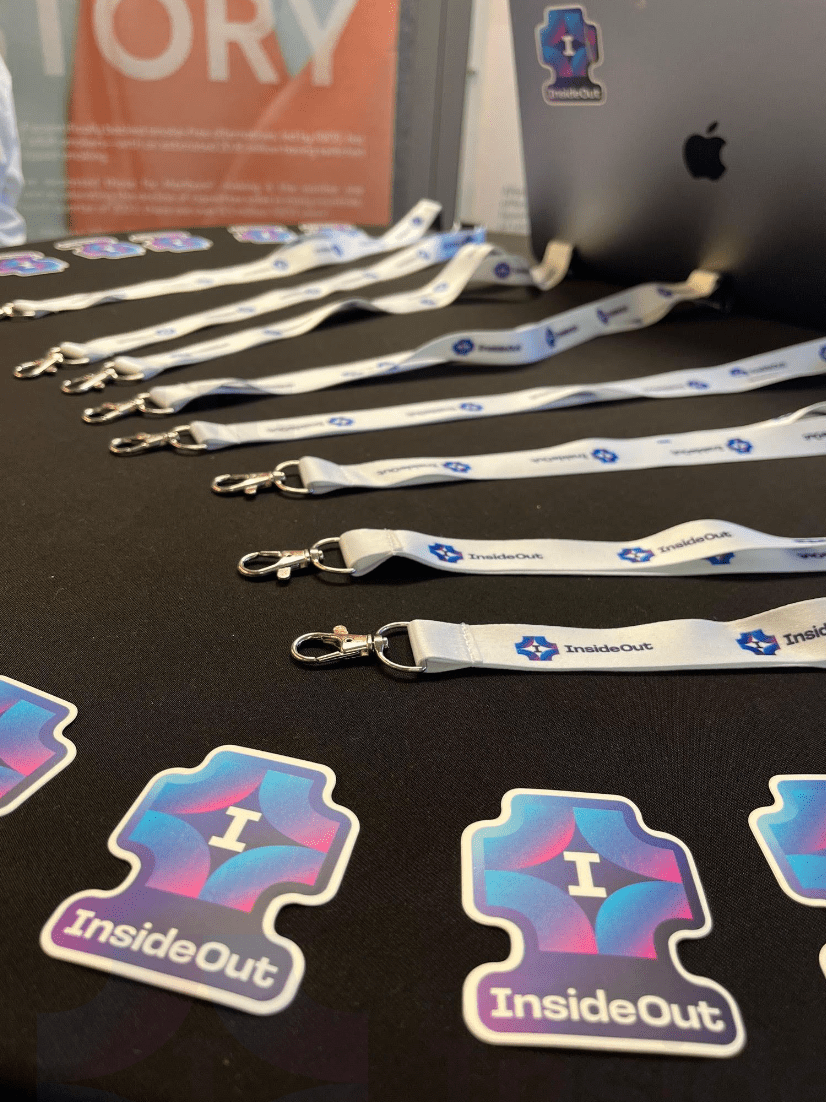
Have you decided on a name for your advocacy platform? Naming it will help build early buzz and reinforce your program’s purpose.
Aim for something that reflects your brand while clearly communicating the initiative’s goals.
Your goal is to position it as a company-wide movement, not just another tool.
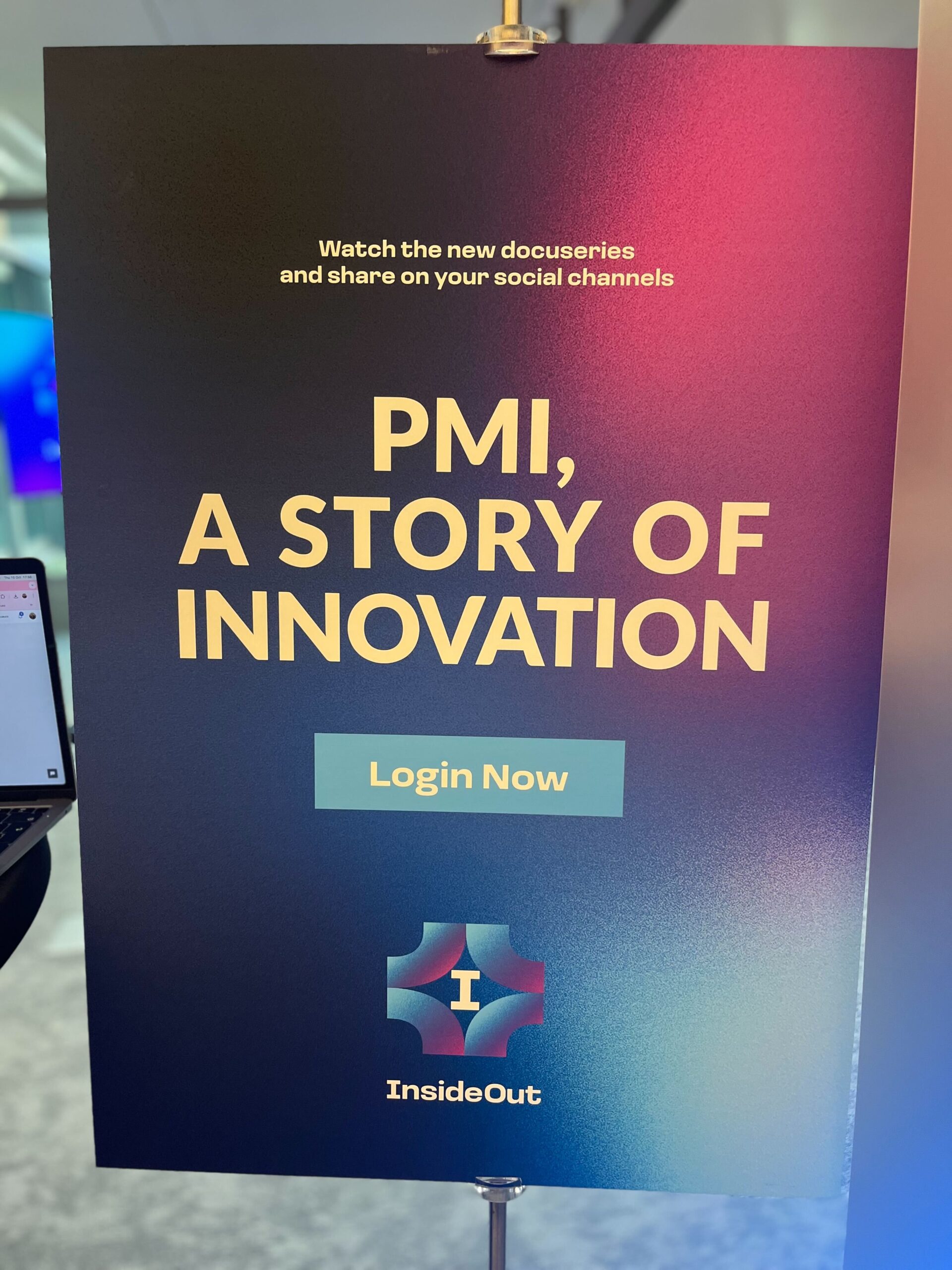
PMI nailed this with their Inside Out program, turning employees into brand champions with a full identity and branded merch.
Who Will You Invite?
Planning a pilot before launch? Choose your first advocates wisely.
Finding ideal advocates can seem daunting, especially if you’re an enterprise company with thousands of employees.
Start by searching your company name and relevant hashtags on LinkedIn, X, or Threads to find employees already sharing content.
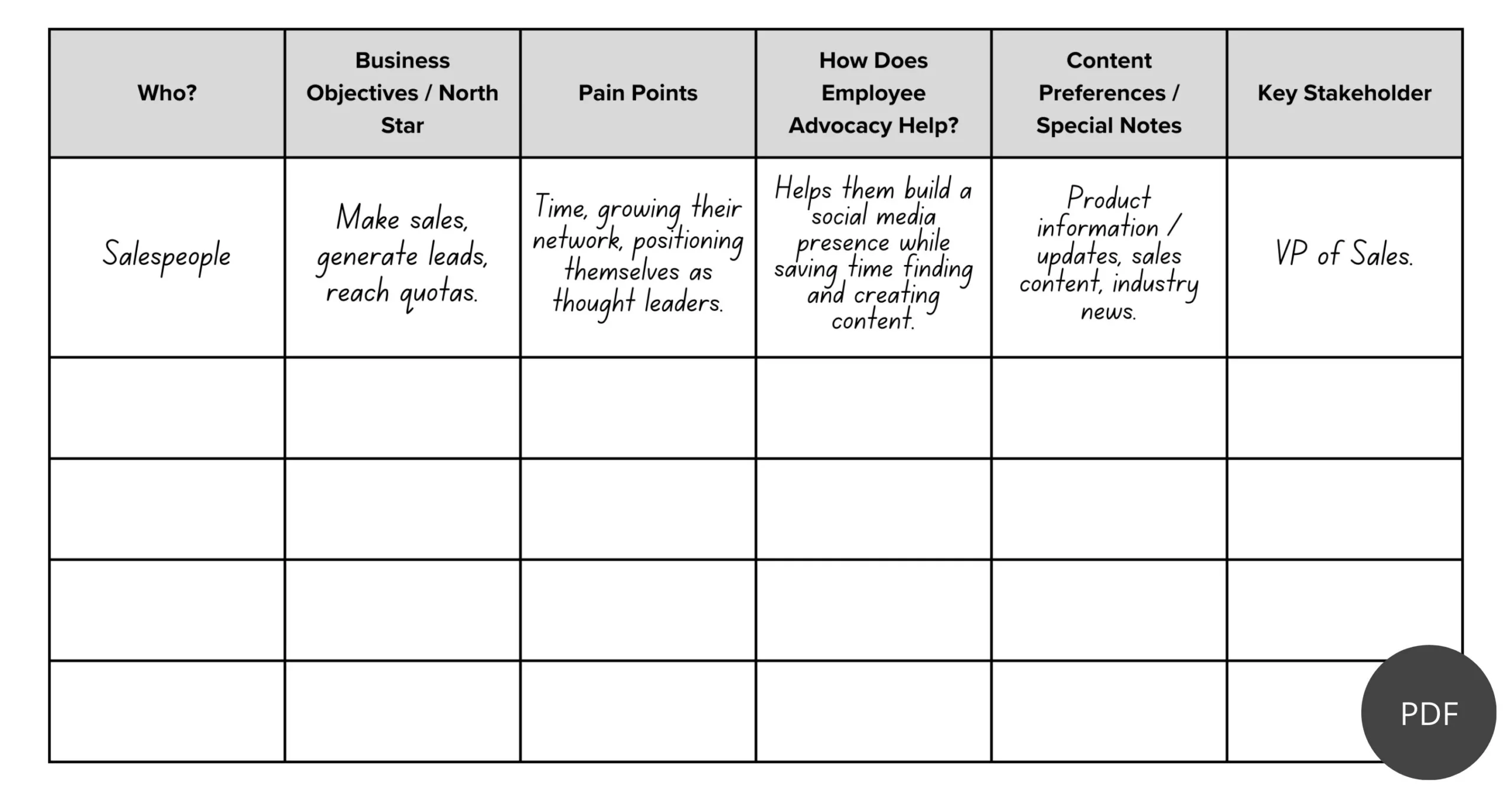
Use our Ideal Advocate Profiles worksheet to plan out your approach:
Getting senior leadership involved early gives your program instant credibility. When employees see your C-Suite leading by example, they’re more likely to join in.
Or for a more representative view of how your platform will perform company-wide, consider using traditional sampling methods instead.
Opening Communications Before Launch
Pre-launch communications are your chance to spark excitement and curiosity ahead of rollout.
Use email campaigns or internal comms channels to build awareness, especially if messages come from senior leaders or the CEO. Their buy-in adds credibility and boosts adoption.
Make sure to connect with department heads to highlight how their teams will benefit from the program.
How Are You Going To Launch?
The way you choose to launch your program is important to consider because it can significantly influence user adoption and employee enthusiasm.
Reflect on how your company has previously introduced and announced initiatives. What has been successful for you in the past?
There’s no need to reinvent the wheel here. Traditional communication methods, such as placing posters around the office can raise awareness. Similarly, hosting lunch-and-learn events can be equally effective.
5 Ways to Promote Your Advocacy Program Internally:
|
In-office |
Create a promotional message on digital screens at your office, or put up flyers. Add a QR code or link to make signing up easy. |
|
Intranet & internal comms |
Add a link or section for the program on your intranet or internal comms solution. If using a platform like DSMN8, integrate with software like Slack or Microsoft Teams. |
|
Company events |
These are a great opportunity to spark interest in your program. Make it easy to sign up in the moment. Encourage your existing advocates to create original content at these events to drive further interest. |
|
Onboarding plan for new employees |
Align with HR to make sure that your employee advocacy program is explained to all new hires, with key info about joining. |
|
All-hands meetings |
Share the progress you’ve made, and spotlight your advocates. This recognition for their efforts supports continued participation, and encourages more people to sign up! |
💡 Quick tip: Never underestimate the power of video! Leverage executive influence by getting a senior leader to announce the program launch with a short video.
Building Your Employee Advocacy Program: During Launch
You’ve checked every box, now it’s time to launch!
This moment sets the tone for how your program will run and gives employees a clear roadmap for what’s next.
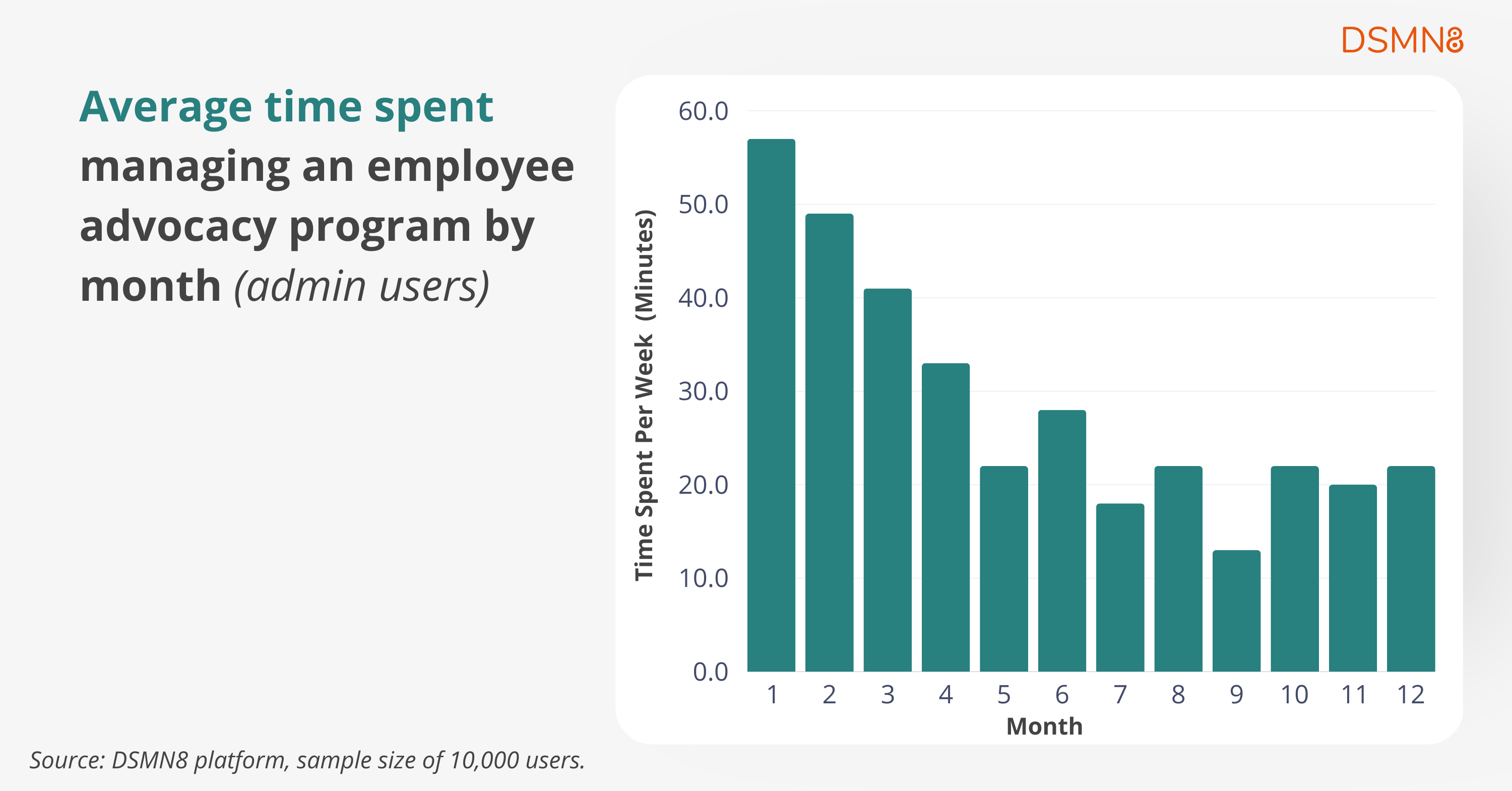
At DSMN8, we’ve found that admins may spend up to an hour per week on the platform early on, but this quickly decreases, so don’t worry if it feels time-intensive at first!
Have Content Ready to Share
When employees sign up, they’ll likely dive in and want to share content right away.
Make sure the platform is well-stocked. Nothing kills momentum like logging in to find just two blog posts!
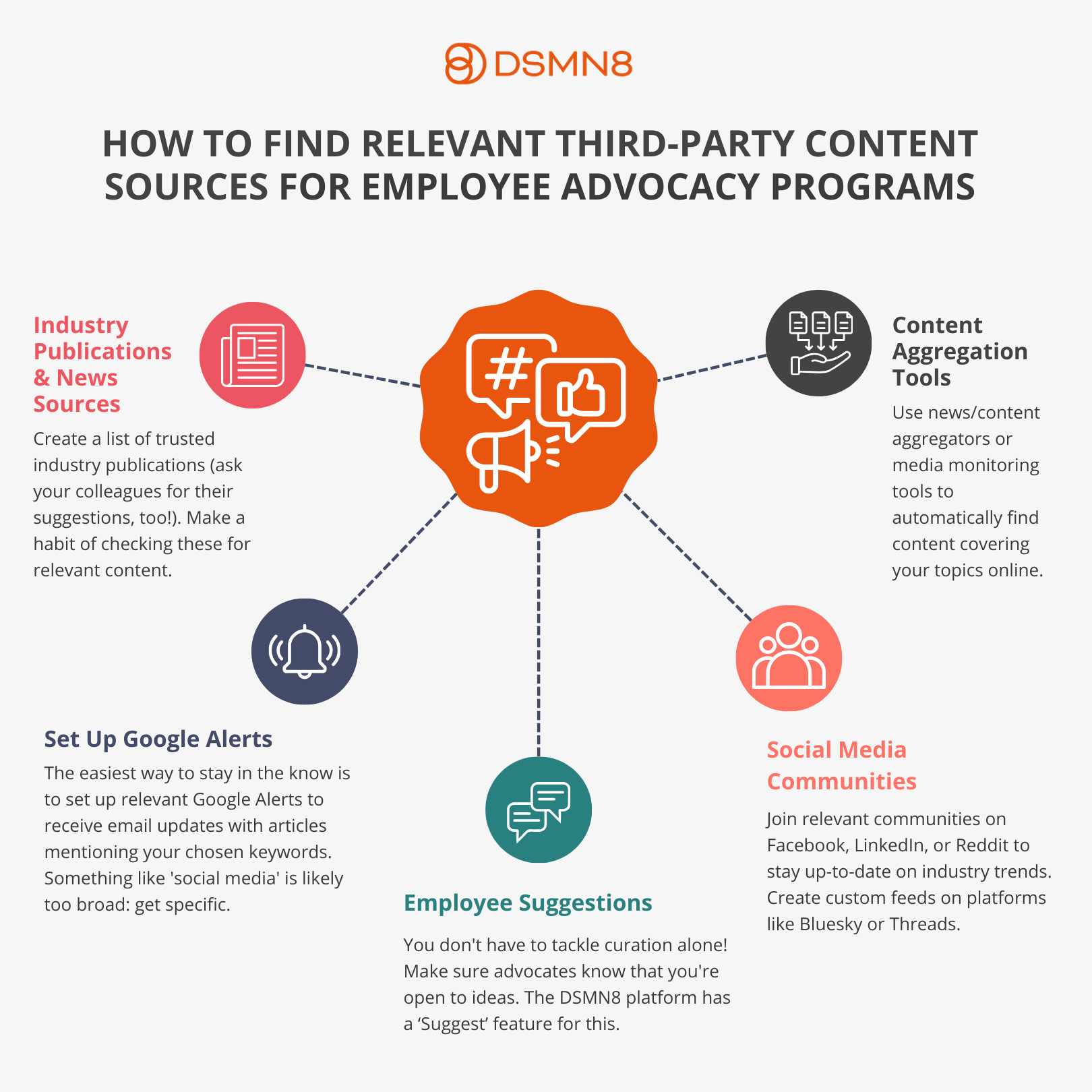
Include plenty of relevant third-party content from trusted industry sources to help employees build credibility and avoid sounding overly promotional, and naturally curate a professional social media portfolio.
Assign Your Team Leaders
If your company operates globally or has diverse departments or business units, consider assigning team leaders to specific regions or divisions.
This ensures users receive localized, relevant content while evenly distributing the workload, preventing the platform from becoming an overwhelming task for one person.
Do You Need a Program Manager?
Not all advocacy programs have a dedicated manager, but having one can make a big difference.
They help track progress, report success to leadership, and keep everyone aligned.
In larger companies with multiple teams, appointing a program manager is especially valuable.
Treat it like any other marketing or comms channel: consistent oversight ensures efficiency and long-term success.

Consider Gamification.
Gamification is a powerful way to boost participation. Leaderboards and rewards create friendly competition and keep teams engaged.
Incentives also help attract hesitant employees and generate buzz, especially during launch.
Prizes could range from merch to charitable donations, offering motivation while aligning with your company’s values.
Employee Advocacy Launch Masterclass with Dropbox
The brilliant Katherine Keenan, leader of Dropbox’s employee advocacy program, joined us for a special episode of our podcast.
She shared excellent tips on how to launch your program effectively.
Here’s a summary of the episode:
Employee Advocacy Is Not One-Size-Fits-All.
- Remember that different employee groups use advocacy tools for different reasons.
- Tailor your messaging and outreach depending on the department or role.
Identify and Prioritize Target Groups Early.
- Highly engaged employees on LinkedIn: Offer them early access as they’re already active and need less convincing.
- Sales teams: Frame the tool as the method for promoting key launches and emphasize analytics features.
- People/HR teams: Equip them with up-to-date, pre-written content to share with potential candidates.
Use a Rolling Onboarding Process.
- Don’t try to launch everything at once.
- Run small onboarding sessions, use feedback to improve, and tailor future sessions.
- Katherine added a 30-minute session on advocacy into all new hire onboarding.
- Doing a live demo and encouraging their first post reinforces that advocacy is part of the company culture from day one.
Build Personal Connections and Lead by Example.
- Connect with employees on LinkedIn after onboarding sessions.
- Like and comment on employee posts. This small gesture amplifies reach and shows real-time support.
- Leading by example (posting authentically yourself) encourages others to follow.
Have a Continuous User Enrolment Plan.
- Plan how you’ll keep recruiting users after the initial rollout.
- Focus on sustainable growth, e.g., regularly onboarding new hires.

Success Post-Launch
Sustaining an employee advocacy program requires ongoing management and a steady supply of content. Without this, employee engagement will decline.
Think of it like managing a CRM, social community, or loyalty program: consistent nurturing and oversight are essential to maximizing results.

Supply Fresh Content.
Consistent content availability is the critical component to program success.
You don’t need daily updates, but regular curation is essential, ideally including a healthy amount of third-party and employee-generated content.
To keep advocates engaged, continue incentivizing participation and aim for DSMN8’s “Holy Trinity” of content, a mix of:
- Company-centered content.
- Employee-centered content.
- Third-party educational content.

Additional best practices we recommend following when curating content for employee advocacy programs:
- Write posts to sound like a person, not a company.
- Create multiple captions and images for every piece.
- Consider different personas, e.g., sales vs executives.
- Use AI to streamline your approach.
- Consider different social media platform requirements, e.g,. short posts for X or Threads.
Senior Leadership Engagement.
Senior leadership plays a vital role in shaping content-sharing habits and setting the tone.
When execs lead by example, employees follow!
Plus, executives often have broad networks, making their participation especially valuable for reaching key decision-makers in both B2B and B2C spaces.
If employees notice a decline in engagement from senior staff, they may perceive the initiative as losing momentum, so make sure they consistently engage.
73% of program managers are prioritizing getting leadership involved in 2025. – The Employee Advocacy Benchmark Report 2025.
At DSMN8, we recently launched new executive influencer features to make this easy. Key features include content approval workflows and delegate access for admins to act on behalf of executives.
Watch the short video below to find out how it works:
Use Internal Comms Tools.
If your platform includes internal communication tools, using them will help keep employees engaged.
Features like comments, likes, internal posts, and polls foster interaction and create a more dynamic experience.
Leaders and program managers should actively show appreciation for advocates, whether within the platform or on social media. This strengthens company culture but also humanizes leadership, making them more approachable and connected.
Additionally, these tools encourage employees to return to the platform regularly, as notifications will trigger a natural desire to stay informed.
Individual Case Studies.
Have you noticed an employee driving significant engagement on social media?
Maybe they’re sharing photos from company events or even creating original thought leadership articles.
Recognize their impact by creating a case study that highlights their contributions and the engagement they’ve generated.
Showcasing these super users will make them feel good while inspiring others to participate.

Share Industry News.
Encouraging employees to share industry news and company content positions them as thought leaders, boosting credibility and social selling.
This is especially helpful for sales teams. In fact, 98% of tech executives in 2024 said personal branding on social media improves business outcomes.
Showcase Company Culture.
Showcasing your company culture is just as important as promoting your brand when attracting top talent.
Many candidates prioritize culture in their decision-making. So lean into this and empower all employees or your super users to create authentic and original content.
Social media managers can’t be everywhere, so get your team to capture moments at events, away days, and charity initiatives. Your social media manager will thank you!
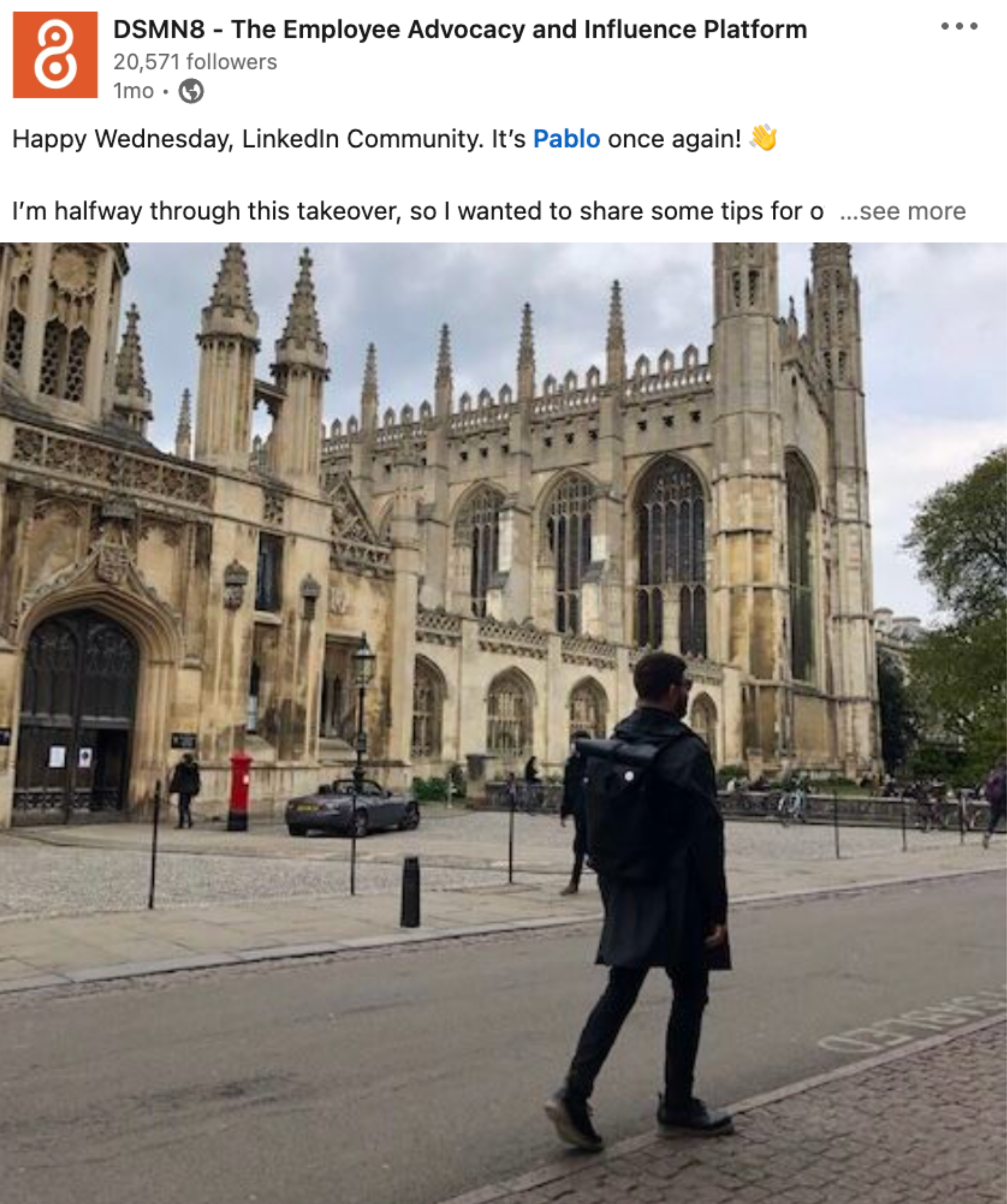
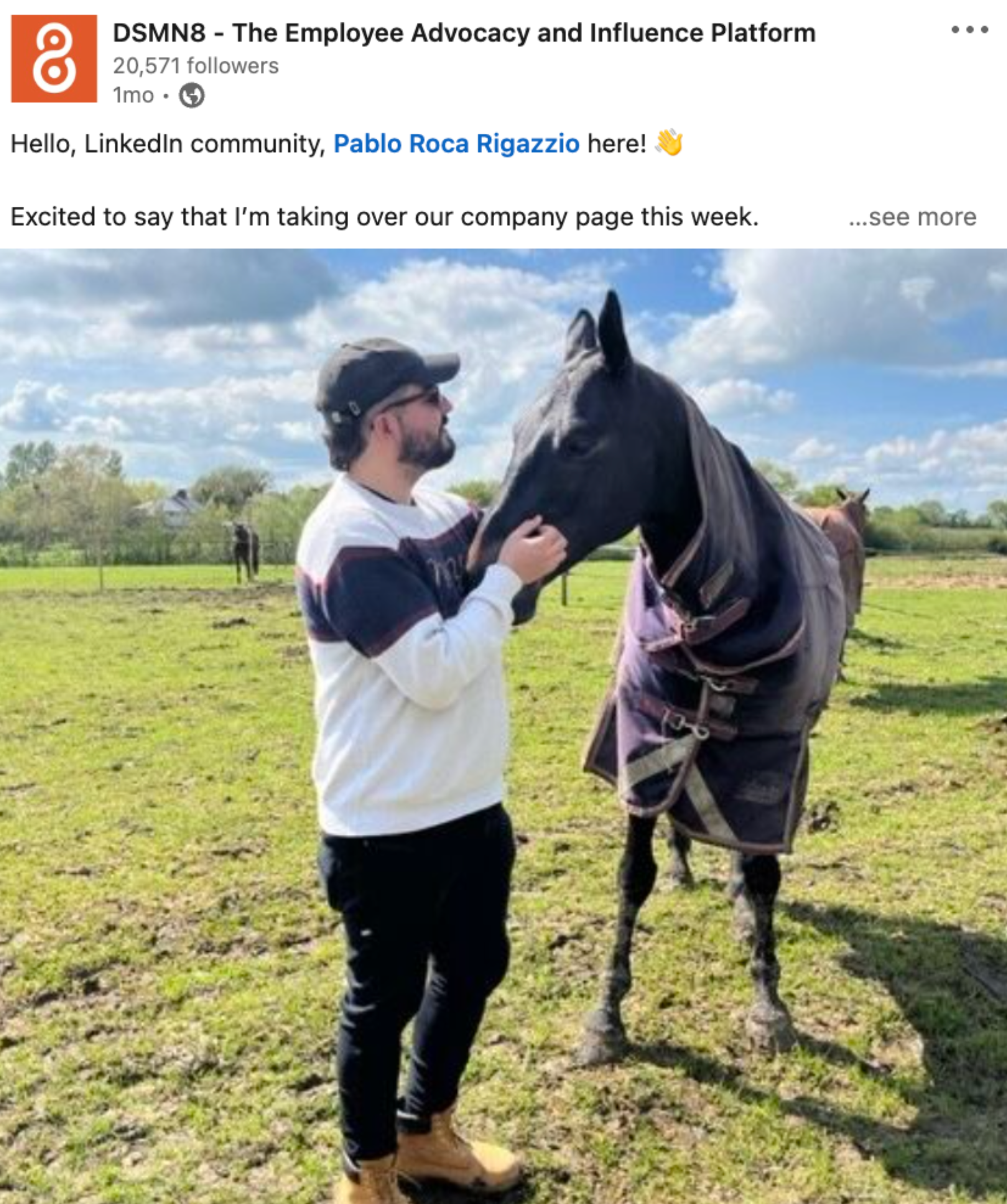
Our week-long company channel takeover by Customer Success Manager Pablo was a huge success! It even led to a press feature.
Analyze Content Performance.
Use your platform’s analytics tools frequently.
These insights help you identify the top-performing content amongst employees within the platform and which pieces are most popular with their networks on social media.
This will enable you to refine your strategy and laser-focus on creating content that truly resonates with your audience.
Thought Leader Snapshot: Andy Lambert, Senior Manager of Product at Adobe on the Future of Employee Advocacy.
We spoke with Andy Lambert, Senior Manager of Product at Adobe and author of Social 3.0, for his expert opinion on the future of employee advocacy.
In the next few years, what do you think employee advocacy will look like?
“Employee advocacy will evolve into something more personal and employee-led. It won’t be branded as “advocacy” anymore, but more like employee personal branding.
The emphasis will shift from promoting the company to helping individuals grow their own platforms—whether on LinkedIn, newsletters, or other channels.
Success will come from aligning company goals with employee ambitions and giving people a reason to participate beyond just representing the brand.”
What are the most important elements for employee advocacy success?
“Success starts culturally and from the top. Leadership needs to lead by example, actively building their own presence and showing what ‘good’ looks like.
Beyond that, incentives matter. Whether it’s financial, career-related, or opportunities like speaking at events or connecting with execs, people need to feel this contributes to their personal growth.
When framed as part of personal development, employees are more likely to engage meaningfully.”
What should you focus on when selling an employee advocacy program to your executive team? What are some things that might resonate with a CEO, CFO, or Sales to get them on board?
“For CEOs, the key message is competitive differentiation. Show them how founder-led brands build influence, get invited to events, and open new doors because visibility builds credibility. If it doesn’t start at the top, the program won’t land.
For sales teams, advocacy creates familiarity and trust before a meeting even starts. It lowers barriers, builds recognition, and scales word-of-mouth in ways traditional marketing can’t.”
Andy joined Lewis and Elliot for a special episode of the Employee Advocacy & Influence podcast to unpack why the broadcast era of social media is over and what comes next: a more human, decentralized, and trust-led approach to social strategy.
Thought Leader Snapshot: Brad Nevin, Nissan’s Editor-in-Chief of Global Digital Communications on the Future of Employee Advocacy
We spoke with Brad Nevin, Nissan’s Editor-in-Chief of Global Digital Communications about the future of employee advocacy. Here’s what he had to say:
In the next few years, what do you think employee advocacy will look like?
“I see EA taking over paid social promotion. Boosting your company posts has its place, but having people reach out to people produces better results.
I also see companies that lean into EA hiring more than a few people to manage it – with tasks of adding users, putting in a variety of content, producing reports to show results to the powers-that-be, and countless more jobs tied to managing a successful program. It’s not a one-person job if done right.
I even see EA being so valuable that it deserves its own group within a company’s comms department.”
What are the most important elements for employee advocacy success?
“Users and content. None of this works without users, and getting employees on board to become an ambassador for a company can be more challenging than you may think.
Add users in batches and then host small meetings (30 mins-ish) to explain the benefits. Then, keep users engaged with lots of fresh content.
Taking content a step further, in your EA tool, put in a wide variety of topics so people can pick the posts they like, making their social profile a better reflection of themselves.”
What should you focus on when selling an employee advocacy program to your executive team? What are some things that might resonate with a CEO, CFO, or Sales to get them on board?
“Make it clear to the suits that employees love it. Sharing on social makes employees feel connected to the company, empowered and in-the-know.
They feel informed about company news on a level they’ve never experienced before.
Plus, employees sharing about your company gets all your company’s bragging points on the minds of millions more people than if you didn’t have an employee advocacy program. This s*** works!”
Brad joined Lewis and Elliot for a special episode of the Employee Advocacy & Influence podcast, revealing how Nissan scaled their program from a small pilot to a company-wide initiative.
Advanced Strategy & Measurement
Advanced Employee Advocacy Strategy
Ready to dive into the nitty-gritty of employee advocacy tactics and strategy?
Sign up for our free on-demand video course.
You’ll become certified in employee advocacy (something you can add to your LinkedIn profile!)
You can also request a free copy of DSMN8 co-founder and CEO Bradley Keenan’s book, Employee Advocacy: 101 Cheat Codes.
From his years of experience, Bradley shares over a hundred insightful tips for starting, managing, and scaling your program, whether you’re using a platform or not.
For now, let’s jump into some advanced strategies & ways to measure success 👇
The 5-Step CEO Content Framework
To maximize your CEO’s impact on LinkedIn, tailored, original content is essential.
But C-Suite time is limited, so it can be helpful to streamline the process with our 5-step framework.
It’ll help you capture their insights without demanding too much of their time:
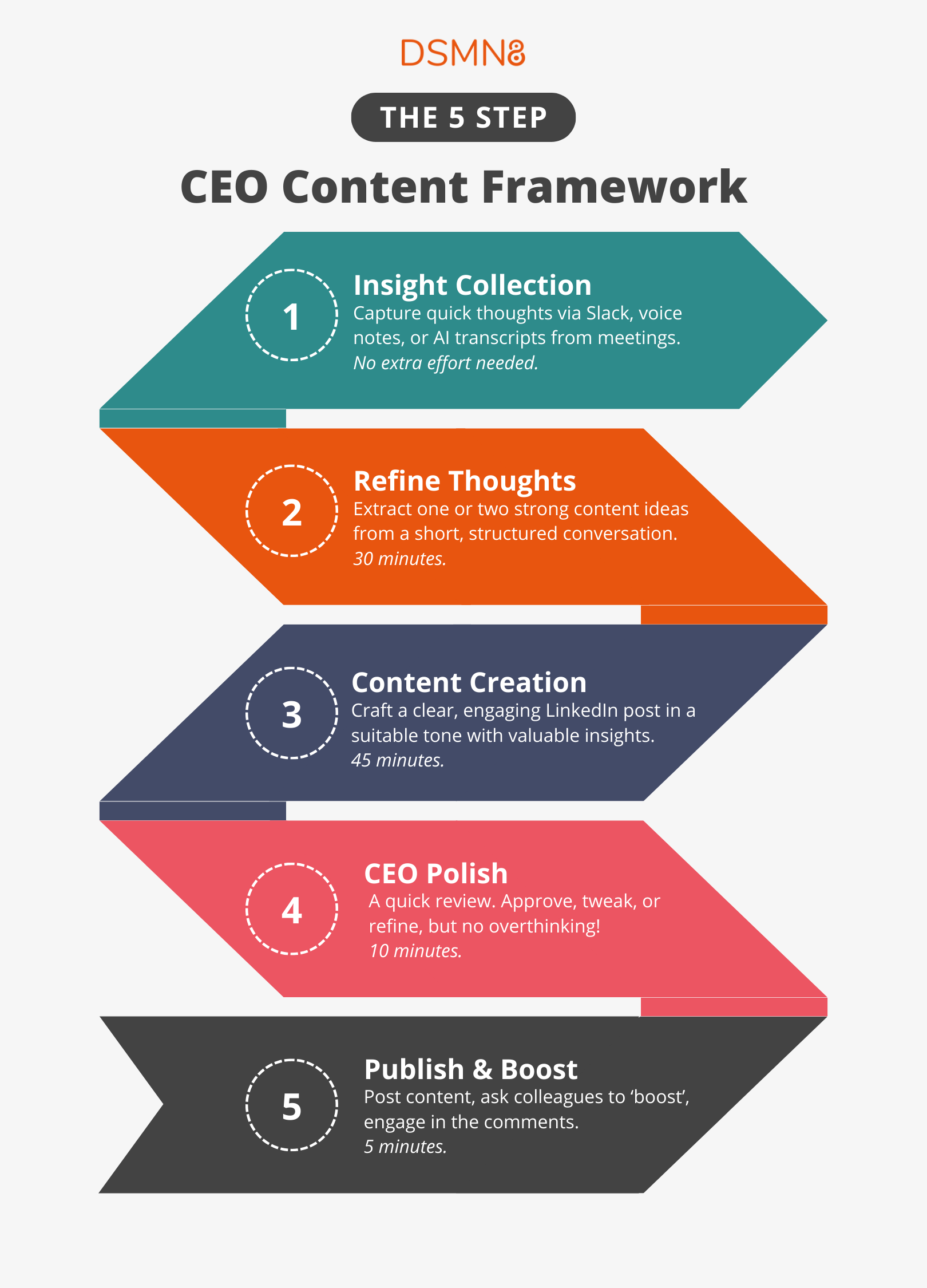
1. Insight Collection:
Capture quick thoughts via Slack, voice notes, or AI transcripts from meetings. No extra effort needed.
2. Refine Thoughts:
Extra one or two strong content ideas from a short, structured conversation. 30 minutes.
3. Content Creation:
Craft a clear, engaging LinkedIn post in a suitable tone with valuable insights. 45 minutes.
4. CEO Polish:
A quick review. Approve, tweak or refine, but no overthinking! 10 minutes.
5. Publish & Boost:
Post content, ask colleagues to ‘boost’, engage in the comments. 5 minutes.
ROI, KPIs and Reporting
Understanding ROI from Employee Advocacy
Most companies start seeing ROI from employee advocacy within the first month, but let’s break it down with real numbers.
Let’s say your company has 200,000 combined followers across LinkedIn, X, and Facebook. That’s your Total Potential Reach (TPR) from official channels.
Now, consider this: the average LinkedIn user has 1,180 connections. If just 170 employees get involved, the Total Employee Reach (TER) would be 200,600, surpassing your company page reach.
If you have 10,000 employees, the TER jumps to 11.8 million. Even with only 15% participation (1,500 employees), the reach is 1.77 million. That’s 785% more than your brand’s social channels alone.
Most companies with advocacy programs see 20-30% employee participation. And on average, employees share 2.2 pieces of content per week, generating 5 clicks per share.
Let’s do the math:
If 1,500 employees each share 8 pieces of content per month, that’s 12,000 shares. At 5 clicks per share, that’s 60,000 clicks per month, or 720,000 per year.
Now, compare that to paid advertising:
LinkedIn ads cost $4-$7 per click. At $4 per click, those 60,000 clicks would cost $240,000 per month.
With employee advocacy, the average cost per click is just $0.50-$0.90, up to 88% cheaper than LinkedIn ads.
According to our 2025 Benchmark Report, 23% of organizations using employee advocacy see a CPC under $1.
Try our ROI Calculator to see what your company could achieve.
6 Ways to Measure the Success of Your Program
1. Adoption Rate
One of the clearest ways to measure success is by tracking employee adoption rates.
On average, companies see 20–30% of employees join their advocacy platform, but why stop there? Some DSMN8 clients have achieved adoption rates as high as 65%.
The more employees you onboard, the greater your social reach and engagement, and the lower your cost-per-click.
2. Active Users
Adoption is just the beginning. The real value comes from sustained participation. That’s why it’s crucial to track active users, not just sign-ups.
To keep engagement high, incentivize participation with leadership support, gamification, and by celebrating individual contributions both internally and externally.
For more tips on driving long-term engagement, download our User Adoption Playbook.
3. Content Uploads
If your platform allows employees to upload content and images, be sure to track how much is being contributed.
Start by reviewing your current content output across your blog and social channels. This baseline helps you set clear goals for increasing production through employee contributions.
Also, compare engagement rates between employee-generated content and posts from your corporate pages. This is a great way to see what truly resonates with your audience.
4. Share Rates
Another key metric to monitor is how many pieces of content are being shared per week.
As always, we say aim high: we believe that users should be encouraged to share as much content as the company sees fit (within reason – no one likes a spammer!)
The average seen with the DSMN8 platform is 2.2 pieces of content per employee per week.
5. Earned Media Value & CPC
We’ve covered potential cost-per-click savings, but tracking CPC is key for maintaining leadership support and securing buy-in to grow your program.
The same goes for earned media value. This metric estimates the monetary value of organic exposure from third-party mentions, like employee shares.
Good news: the DSMN8 platform tracks both for you.
6. Key Business Results
And finally, the metrics that matter most to leadership: leads, conversions, and sales.
Use UTM tracking to monitor these results in Google Analytics (DSMN8 handles this automatically), and listen out for prospects who mention finding you through employee posts.
Pro tip: add an open “How did you hear about us?” field to your website forms to capture valuable first-party data.
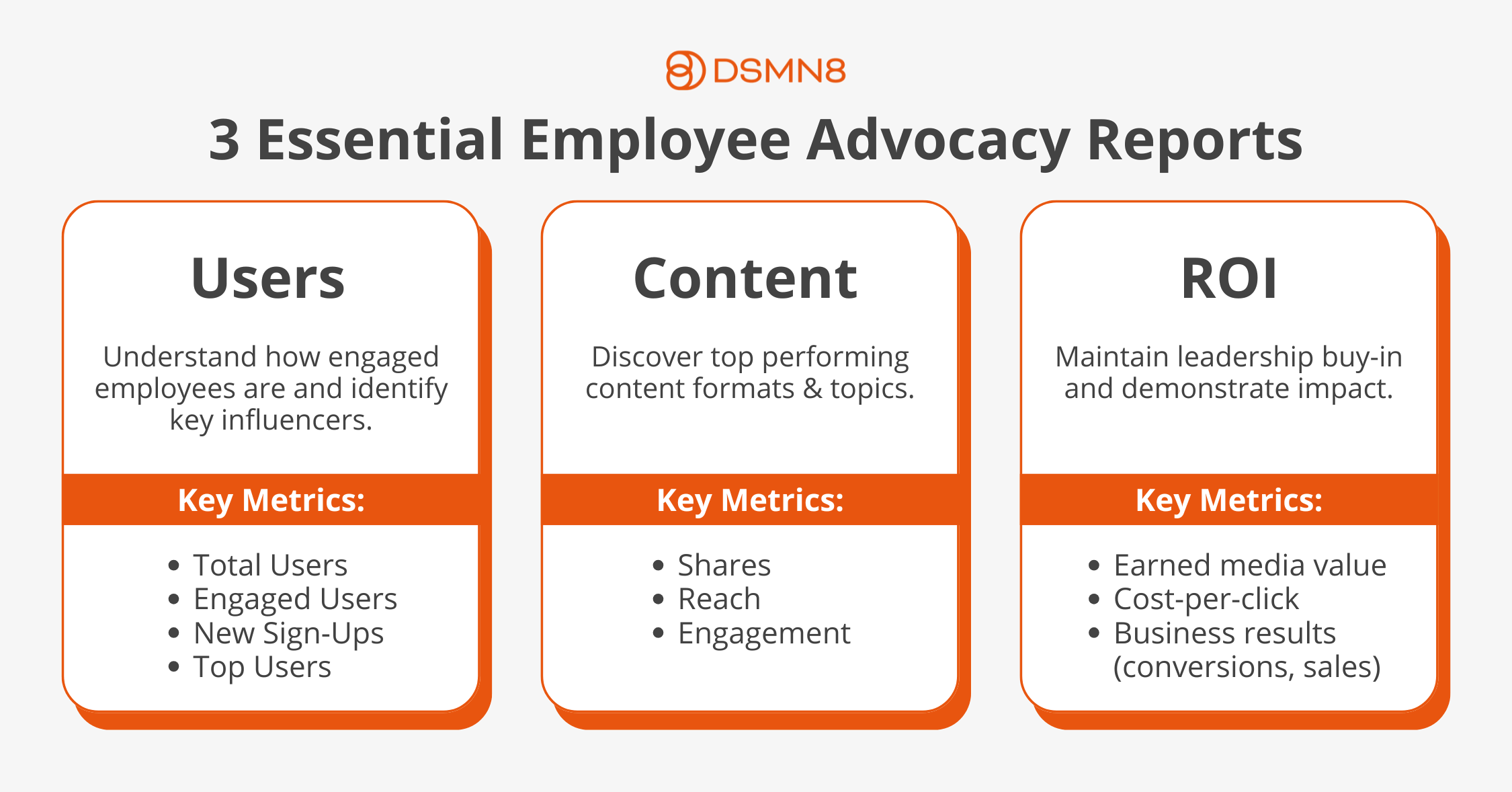
3 Essential Employee Advocacy Reports
1. Users
Understand how engaged employees are and identify key influencers.
Key Metrics:
- Total Users
- Engaged Users
- New Sign-Ups
- Top Users
2. Content
Discover top-performing content formats & topics.
Key Metrics:
- Shares
- Reach
- Engagement
3. ROI
Maintain leadership buy-in and demonstrate impact.
Key Metrics:
- Earned media value
- Cost-per-click
- Business results (conversions, sales)
DSMN8: The All-in-One Employee Advocacy Platform
You’ve got the strategy. Now, how do you manage and scale it efficiently?
To make implementing the strategies in this handbook easy, scalable, and highly measurable, you need a dedicated, all-in-one platform.
What do we do?
In short, we make it easy for employees to become brand ambassadors, social sellers, content creators, and even influencers.
Our innovative platform empowers companies to unlock the full potential of their employees with the #1 user-rated employee advocacy solution on G2.
How do we do it?
DSMN8’s employee advocacy platform helps you stay ahead of algorithm changes, cut ad spend, and get your content seen.
With desktop and mobile access, employees can easily find and share content across social media, messenger, email, and SMS.
Powered by AI, automation, and a built-in gamification engine, plus a full analytics suite, DSMN8 makes it simple for employees to grow their personal brands while boosting yours.
Check out the 90 second demo video below for a brief overview of what you can expect:
Ready to get started?
Additional Resources
Don’t forget to download the Ultimate Guide to Employee Advocacy for a PDF version of this handbook, in case you need to refer to it later!
More resources you’ll find helpful for launching, scaling, and driving results from an employee advocacy program:
- The Employee Advocacy Certification (Free Course).
- Employee Advocacy: 101 Cheat Codes by Bradley Keenan.
- The World’s Biggest Employee Advocacy Study (Data from half a million LinkedIn posts).
FAQs and About the Data
FAQs
What is employee advocacy?
Employee advocacy involves employees sharing content on LinkedIn and other social networks. Instead of relying only on your company page or ads, your people amplify the message to their own networks, building trust and boosting reach.
Is employee advocacy worth it?
Yes, employee advocacy is worth it, as it’s a powerful tool that offers multiple benefits beyond marketing. Employee advocacy drives sales, boosts employee retention, and attracts top talent. It also offers a significant return on investment (ROI) compared to paid media: for example, the average cost per click (CPC) with employee advocacy is often 88% cheaper than LinkedIn ads.
How does DSMN8 work?
DSMN8 provides your employees with a desktop dashboard and mobile app of ready-to-share content. Admins can pre-approve posts and let employees suggest content and add their own voice. With built-in scheduling, automation, and analytics, it’s easy to launch and scale an advocacy program without adding extra workload.
How many employees do you need for an advocacy program?
You don’t need a massive workforce to see results; the key is to prioritize quality over quantity. Even a small number of engaged advocates can make a large impact. The math shows that if you have 10,000 employees, and only 15% (1,500 employees) participate, their collective reach is 785% more than your brand’s social channels alone.
Is employee advocacy paid or organic?
Employee advocacy is fundamentally organic. It relies on employees voluntarily sharing content and promoting the organization because they are thriving in a strong company culture.
The content employees share is generally trusted more than brand messaging or paid sponsored content, as 92% of buyers trust peer content over brand content.
It’s often a cost-effective way to reduce paid media budgets and amplify existing marketing content.
How do you measure employee advocacy ROI?
ROI is measured by tracking key performance indicators across three main reporting areas: Users, Content, and ROI.
Key metrics for measuring ROI include:
- Earned Media Value (EMV): An estimate of the monetary value of the organic exposure from employee shares.
- Cost-Per-Click (CPC): Advocacy can significantly reduce this cost compared to paid platforms.
- Business Results: Tracking leads, conversions, and sales through platforms that use UTM tracking.
- Share Rates: The average is about 2.2 pieces of content shared per employee per week on the DSMN8 platform.
What’s the difference between employee advocacy software and a social media management tool?
A social media management tool typically focuses on managing corporate brand accounts and scheduling content.
Employee advocacy software, like DSMN8, is designed specifically to empower individual employees to share content and grow their personal brands.
A dedicated platform offers features essential for employee adoption and program management that social media tools lack, such as:
- Content Segmentation: Targeting content to specific teams, regions, or seniority levels so employees only see relevant posts.
- Gamification: Using leaderboards and rewards to drive engagement and competition among users.
- Risk Mitigation: Ensuring all content shared is brand-safe and pre-approved, often with multiple caption options to maintain authenticity.
How do you get executives to participate in employee advocacy?
Executive participation is essential because it sets the cultural tone and gives the program instant credibility. Key strategies include:
- Focus on Differentiation: The key message for CEOs is often competitive differentiation, showing how visibility builds credibility and opens new doors.
- Streamline the Process: Use a structured content framework to capture their insights efficiently, often using voice notes or AI transcripts, to minimize the time commitment from their side.
- Provide Support: For executive influencers, platforms like DSMN8 can offer features like content approval workflows and delegate access for admins to post on their behalf.
About the Data
The data in this handbook is supported by original studies conducted by DSMN8, the #1 user-rated employee advocacy platform.
Download the full studies and research reports referenced here:
Take the 2027 employee advocacy benchmark survey
- Get quoted in the final report
- Early access to the results

Emily Neal
Emily is SEO Lead at DSMN8. She focuses on organic growth strategy across search and AI search and co-authors DSMN8's original research, including the Employee Advocacy Benchmark Report and edited CEO Bradley Keenan's book. Her background spans SEO strategy, technical web, long-form content, digital PR, and marketing automation.