
Last Updated: August 25, 2026
What makes a LinkedIn post get cited in AI search? Content quality and structure, not follower count or reaction volume. AI engines select posts based on what they say and how clearly they say it, which means any employee in your advocacy program can earn citations, regardless of audience size.
That changes the brief you give your content creators and curators. Every post your team shares is either building your brand’s presence in AI answers or invisible to it. The difference comes down to a handful of writing and formatting decisions that most advocacy programs have never briefed anyone on until now.
We’ve covered why this matters at the strategic level before. LinkedIn is now the #1 cited domain for professional queries across major AI platforms, and employee advocacy is a core pillar of AI SEO.
This guide covers the execution: how to write posts that AI engines actually cite, based on three major studies published this year and DSMN8‘s own platform usage data.
Why Resharing Isn’t Enough Anymore
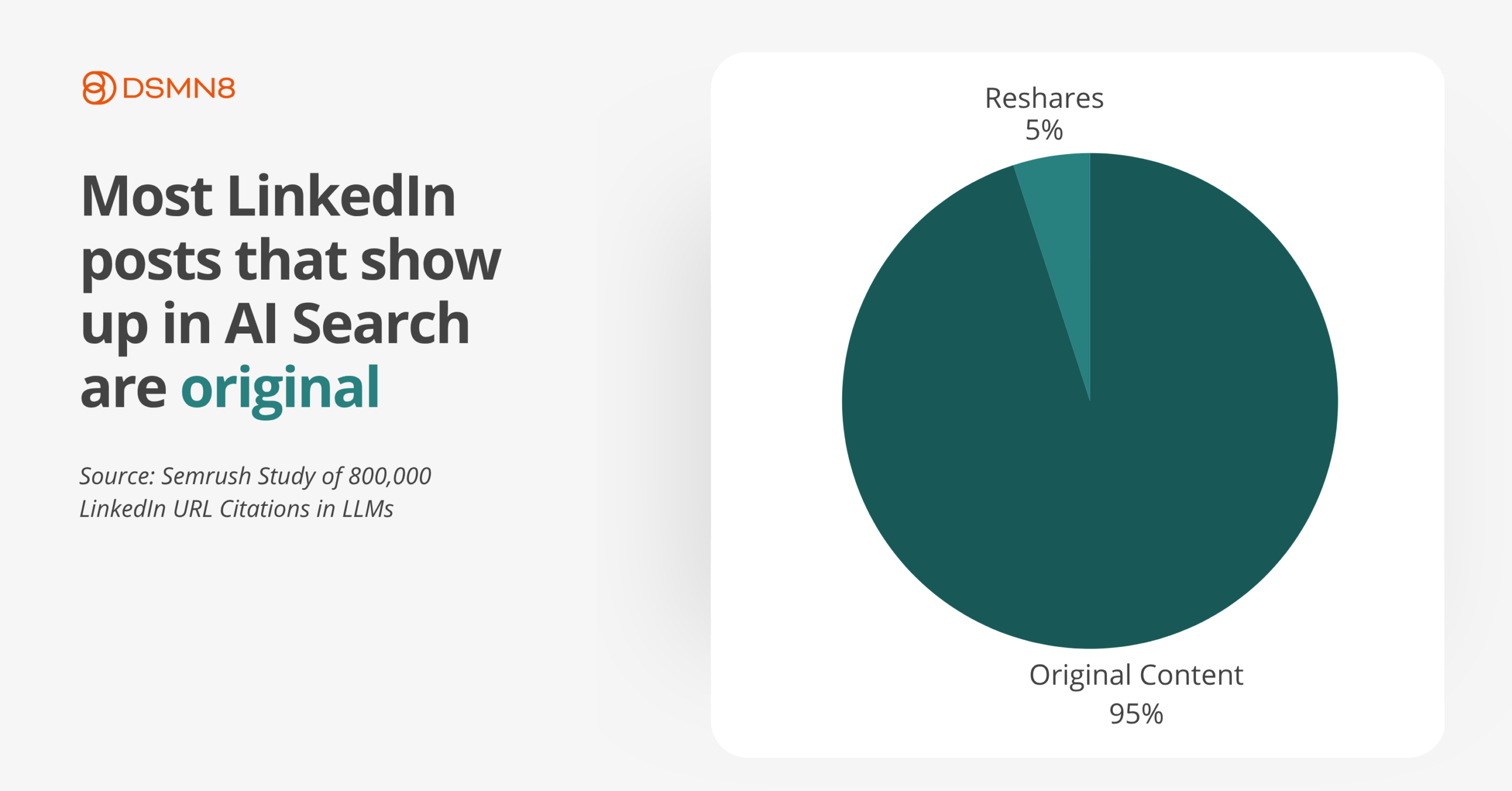
Around 95% of LinkedIn content cited by AI comes from original posts. Reshares account for just 5% of citations, according to Semrush’s analysis of 89,000 LinkedIn URLs cited across ChatGPT Search, Google AI Mode, and Perplexity.
This aligns with our platform data. Edit rates on curated content have continued to climb steadily over H1 2026 (almost doubling from January to June), after our study of half a million posts found last year that even posts with 99% similarity saw a 3x engagement uplift vs unedited posts.
The employees who personalize, edit, and write in their own voice are the ones whose content shows up in AI answers.
💡 The takeaway for program managers: a program built on one-click resharing is opting out of AI search visibility. Using features like Boost Post is valuable for amplifying executive thought leadership, for example, but it shouldn’t be the primary behavior of an employee advocate.
Does Engagement Determine Whether a Post Gets Cited?
No!
The median LinkedIn post cited by AI has 15 to 25 reactions and only around one comment, per Semrush.
A study by Scrunch (covering 12,000 LinkedIn posts cited by AI) found that reaction count has a near-zero effect on citation.
A post with 100 reactions and a post with 10,000 reactions get cited at essentially the same rate.
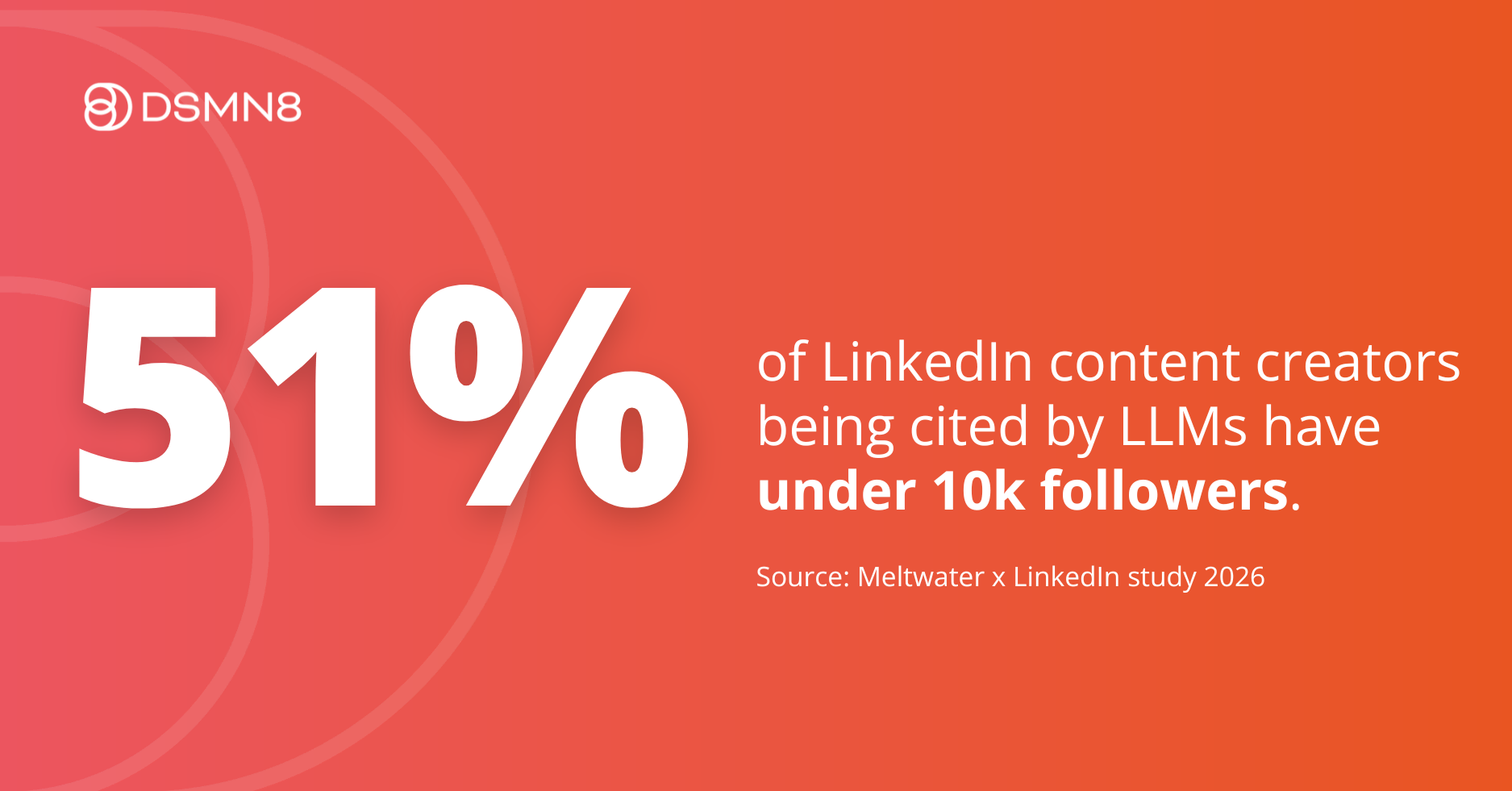
And what about followers?
It hardly matters either.
Meltwater’s analysis of 9.5 million AI citations found that 51% of cited creators have fewer than 10,000 followers, and accounts in the 1,000-10,000 range account for the largest share of citations.
This is the finding that should help you reframe the concept when you’re faced with hesitant potential advocates.
You don’t need all of your employees to become full-blown LinkedIn influencers.
Whether their LinkedIn posts appear in AI Search is not measured by likes, comments, reactions, or impressions.
It’s all about the content itself.
The strongest candidates for AI citations are those with deep expertise. Posts with specific technical details are 77% more likely to be cited in ChatGPT. Precise details, clear explanations of processes, and sharing original data… this is where your post goes from generic to citable.
Your loudest voices make for great employee social media influencers, but your subject matter experts are the key to improving your AI presence.
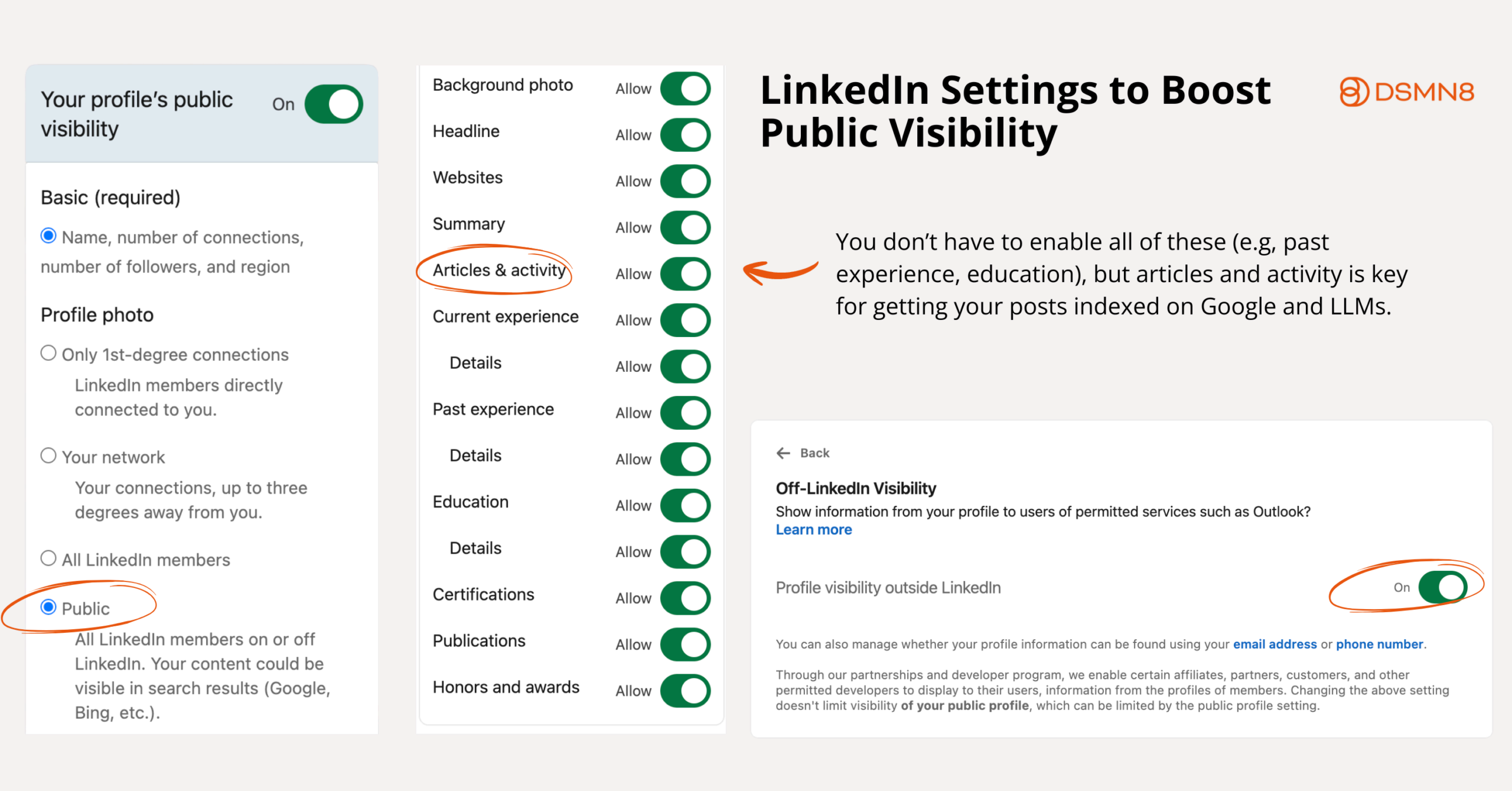
The only other requirement is that employee LinkedIn profiles are public and settings allow search engines to crawl their posts. Each advocate should check their Public Profile and Profile Visibility settings on LinkedIn to do this:
8 LinkedIn Post Best Practices for AI Search
1. Start with a keyword-rich first sentence, because it becomes your URL.
We all know that hooks are important for capturing attention on the feed.
When you’re writing a LinkedIn post, arguably the most important element is those first two lines before a reader has to click ‘see more’.
This is naturally less true for visual assets like video, carousels, or image galleries, but shouldn’t be ignored.
There’s now another reason that your hook matters:
Since your first line serves as the URL slug for your post, LinkedIn recommends optimizing it for AI search.
In a Semrush analysis of 5 million URLs cited by ChatGPT and Google AI Mode, cited pages most often used descriptive, concise slugs in the 17 to 40 character range. Clean, keyword-rich URLs are a citation signal across the board, and on LinkedIn, your first sentence is the only control you have over them.
We’re not suggesting stuffing a bunch of semantic keywords into the first line (and definitely not hashtags!) 😬
Your goal is to show readers (and AI bots) what your post is about, without making it dull.
For example:
A post that opens with “Employee advocacy programs with high edit rates earn more AI citations” produces a clean, keyword-rich URL.
A post that opens with “Big news!” produces a generic one.
You cannot edit post URLs after sharing, so it’s important to think about this before curating content for your team.
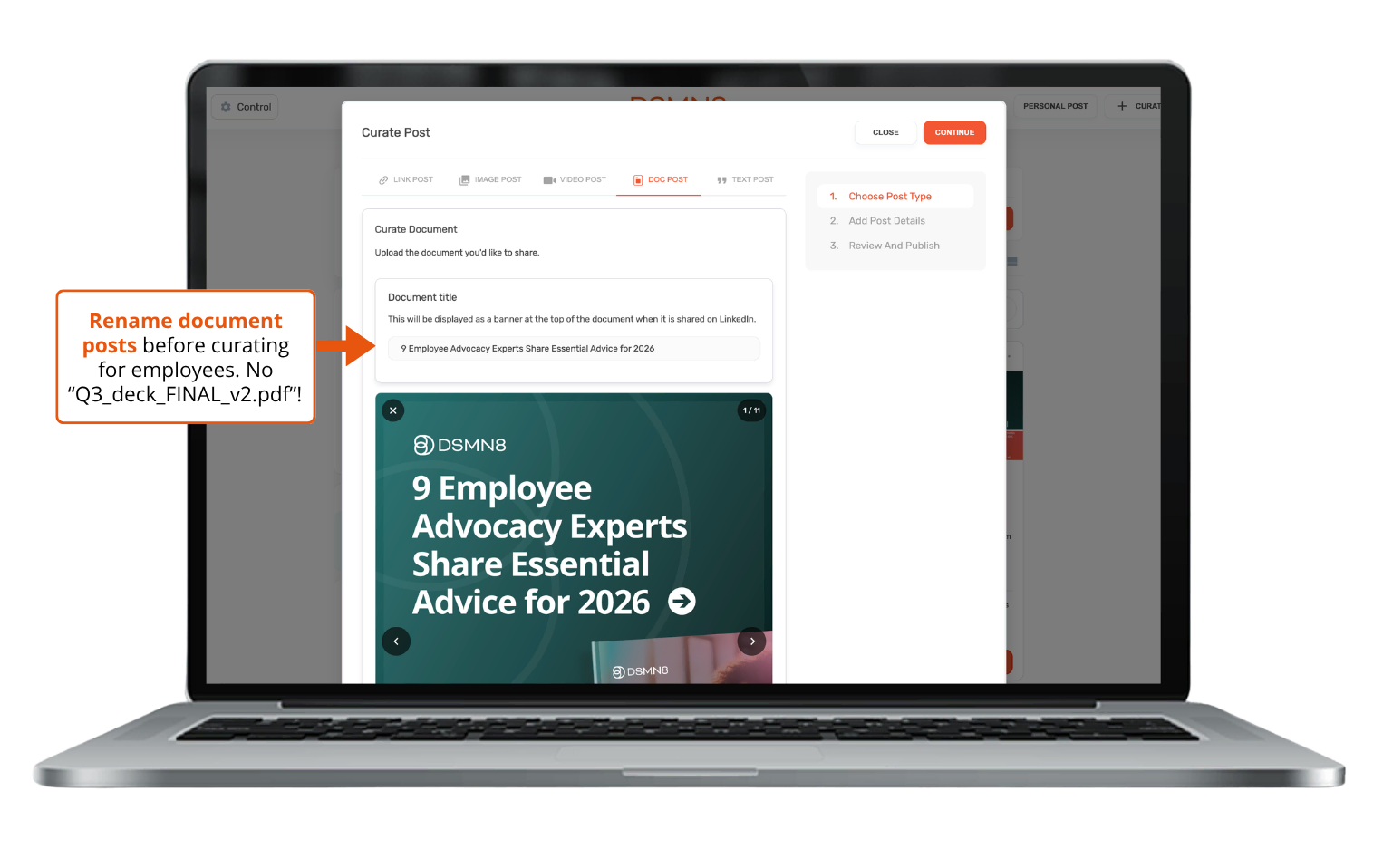
Another thing to keep in mind is that if posts include an attached file, such as a carousel or slide deck, the file name can become the URL instead of the first line.
A document post built from “Q3_deck_FINAL_v2.pdf” carries that string into the URL on LinkedIn and, consequently, into AI search. Rename files before attaching them. DSMN8 allows you to do this in-platform:
2. Write in plain text. No unicode formatting!
The bold and italic text you often see on LinkedIn (and Instagram) is rendered using Unicode, not text. While they may stand out more in the feed, ChatGPT cannot read them properly and is 58% less likely to surface a post using them.
Personally, I’ve been banging on about this for years because, while it looks pretty, it’s not accessible to people who use screen readers. So for accessibility and AI visibility, use regular text.
3. Lead with the point.
This ties into the hook point earlier, but for a reason beyond your URL alone.
AI engines favor posts where the topic is immediately clear, and the first line is often the exact text that gets extracted into an answer.
Lean away from slow-build storytelling and toward direct openers: a claim, an answer, or a question-and-answer pairing.
LinkedIn recommends approaching content as a question followed by a direct answer, since that structure mirrors how people prompt AI tools.
4. Be specific. Name things, people, companies.
Generic or vague professional commentary does not get cited.
Posts that name companies, products, tools, frameworks, and data sources do.
Encourage participants to draw on real work: the client project, the metric that moved, the process they changed.
A sentence like “We cut onboarding time from 14 days to 6 after restructuring our training program” contains the technical detail and specificity AI engines are looking for.
My colleague Lewis does this really well when sharing podcast episodes:
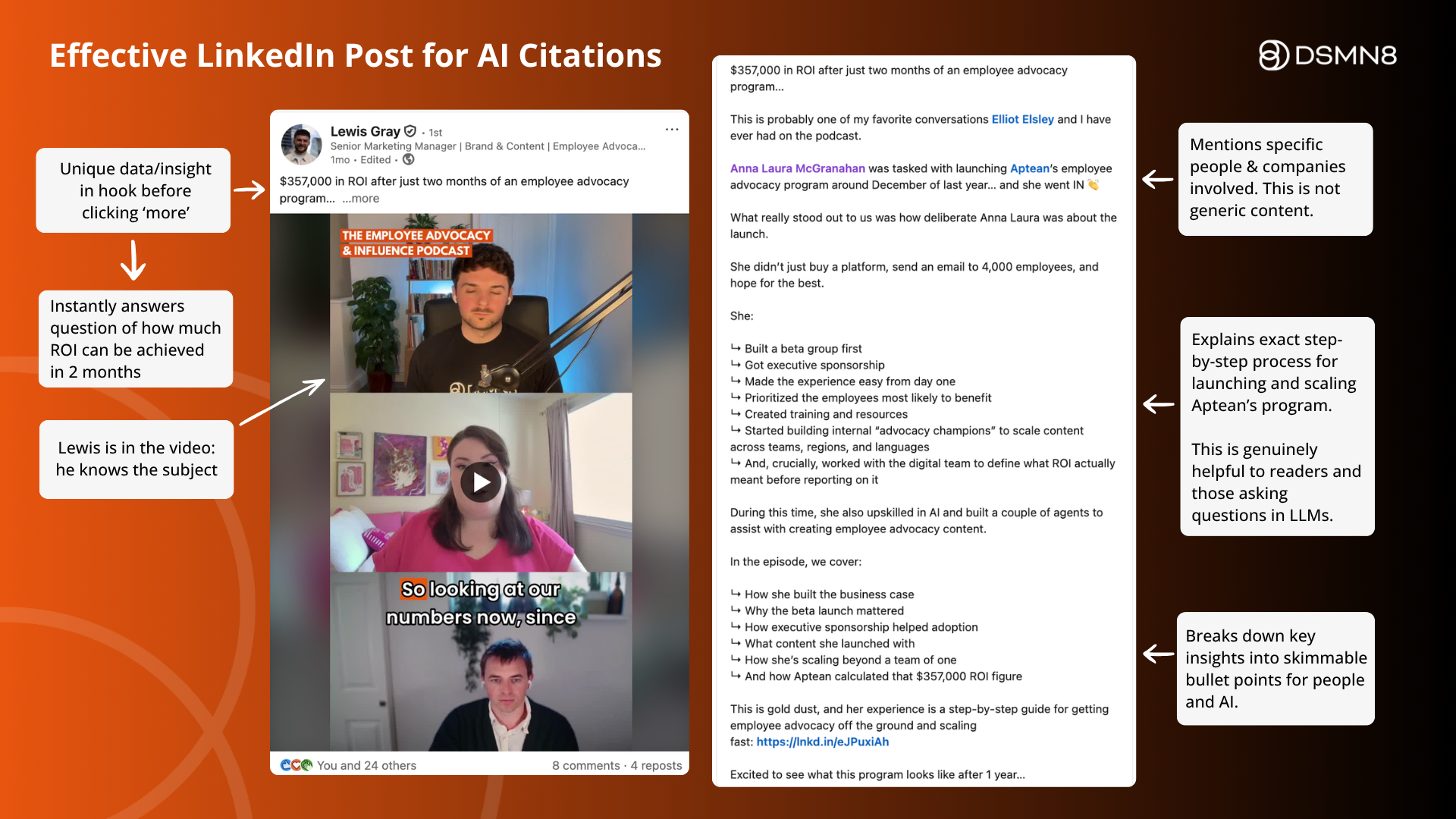
Why this post works:
- Data/key outcome in the first line, intriguing the reader and providing unique data for LLMs.
- He is in the video, so this is a topic he can speak on clearly.
- Mentions the people and companies involved: Elliot at DSMN8, Anna Laura McGranahan from Aptean.
- Went into detail explaining Anna Laura’s exact process for launching Aptean’s employee advocacy program and scaling to $357,000 ROI in 2 months. This is genuinely useful content for those just getting started with employee advocacy.
- Breaks down the main learnings from the episode into a scannable list using bullet points.
5. Write original posts. When sharing company content, add real perspective.
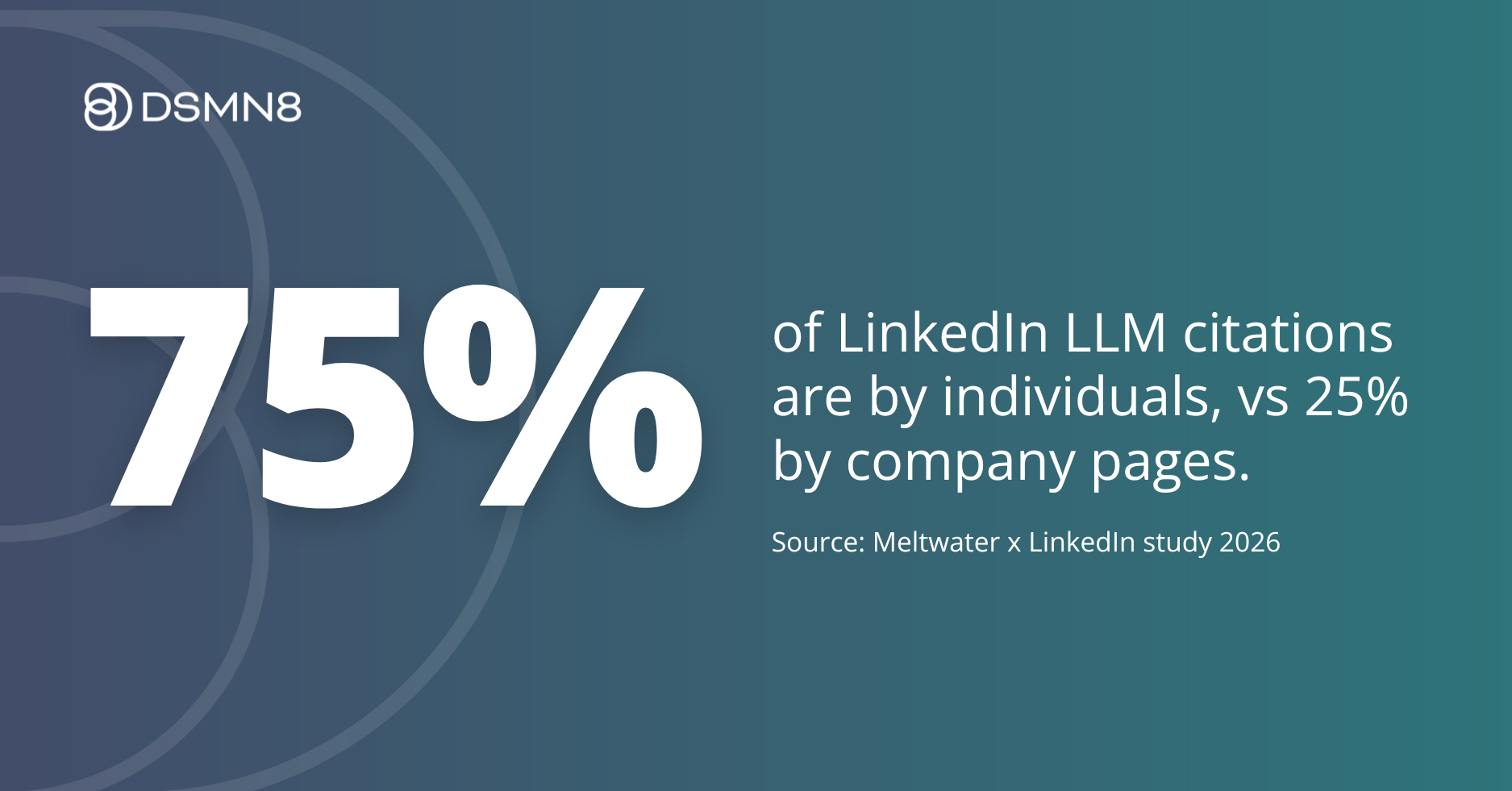
Since Company Page posts only earn 25% of LLM citations (Meltwater x LinkedIn study) and reshares only 5% (Semrush study), there’s one practical step you can take to improve the likelihood of AI Search visibility.
Ensure every employee share includes a personal layer.
The World’s Biggest Employee Advocacy Study showed that this boosts LinkedIn results, too, with up to 9x more engagement for an original post and 3x more for edited, curated content.
What I’m saying is: when advocates add their own thoughts and style to content, it will make your employee advocacy program manager happy, your SEO happy, and your social media manager happy 🙌
Tools like Personal Voice AI make this practical at scale by helping employees adapt content into their own voice.
6. Use links deliberately, not by default.
The never-ending debate on LinkedIn:
Does sharing a link harm reach?
“Link in comments” is common advice for beating the algorithm.
For AI search, it deserves more thought, because the post and the page it links to are treated differently.
LinkedIn’s guidance is that AI systems often treat posts as pathways to more substantial content: when a post links to an external article, the linked page can be used as additional context.
Scrunch’s analysis of 12,000 posts in ChatGPT suggests a trade-off: posts with a link in the comments were 31% less likely to be cited themselves, while the URLs in those comments were cited at roughly double the average rate. However, this is a single study covering one AI platform, so treat the figures as directional rather than settled.
The practical question for each campaign is what you want cited. If the answer is the post itself (e.g., an expert take or a personal insight), a better approach may be to leave out links.
If the answer is a page you own, such as a research report or case study, linking to it turns the post into a delivery vehicle for the destination.
7. Match length to format: posts at 200 to 300 words, articles at 800 to 1,200.
Feed posts between 50 and 299 words earn the largest citation share for their format, and LinkedIn articles between 500 and 2,000 words dominate cited long-form content, per Semrush.
LinkedIn’s own recommendation is 200-300 words for posts and 800-1,200 for articles.
The two formats can work together as a system.
Your subject matter experts and executives publish an article on a topic they own, then break it into three to five feed posts over the following weeks.
Articles establish authority, and posts distribute it.
Naturally, the majority of your advocates won’t be writing articles, but your most credible voices should be if you want to maximize the opportunity.
8. Post consistently: two to three times per week.
Roughly 75% of cited authors post five or more times in a four-week window (Semrush).
Recency compounds this: Meltwater found 48% of cited content was published within the previous three months, against 12% for content older than a year.
Consistency is the part that an employee advocacy program manager can influence significantly. An employee posting twice a week for six months builds a citable body of work. One viral post in January does not.
💡 The takeaway for program managers: ensure that you’re maintaining a content library with frequent updates. Employees need fresh content to share on a regular basis.
Consistency Beats Reach & Engagement
The brands and individuals appearing in AI answers are not the ones with the largest LinkedIn followings.
They are the ones whose employees publish original, specific content on a steady cadence.
Every best practice in this guide follows from that logic, and the good news is that all of it is within a program manager’s sphere of influence.
For the strategic case behind these tactics, read Employee Advocacy Is Now an SEO and GEO Strategy and Employee Advocacy for AI SEO.
If original posting at scale is the sticking point for your program, see how Personal Voice AI helps employees write in their own voice without starting from a blank page.
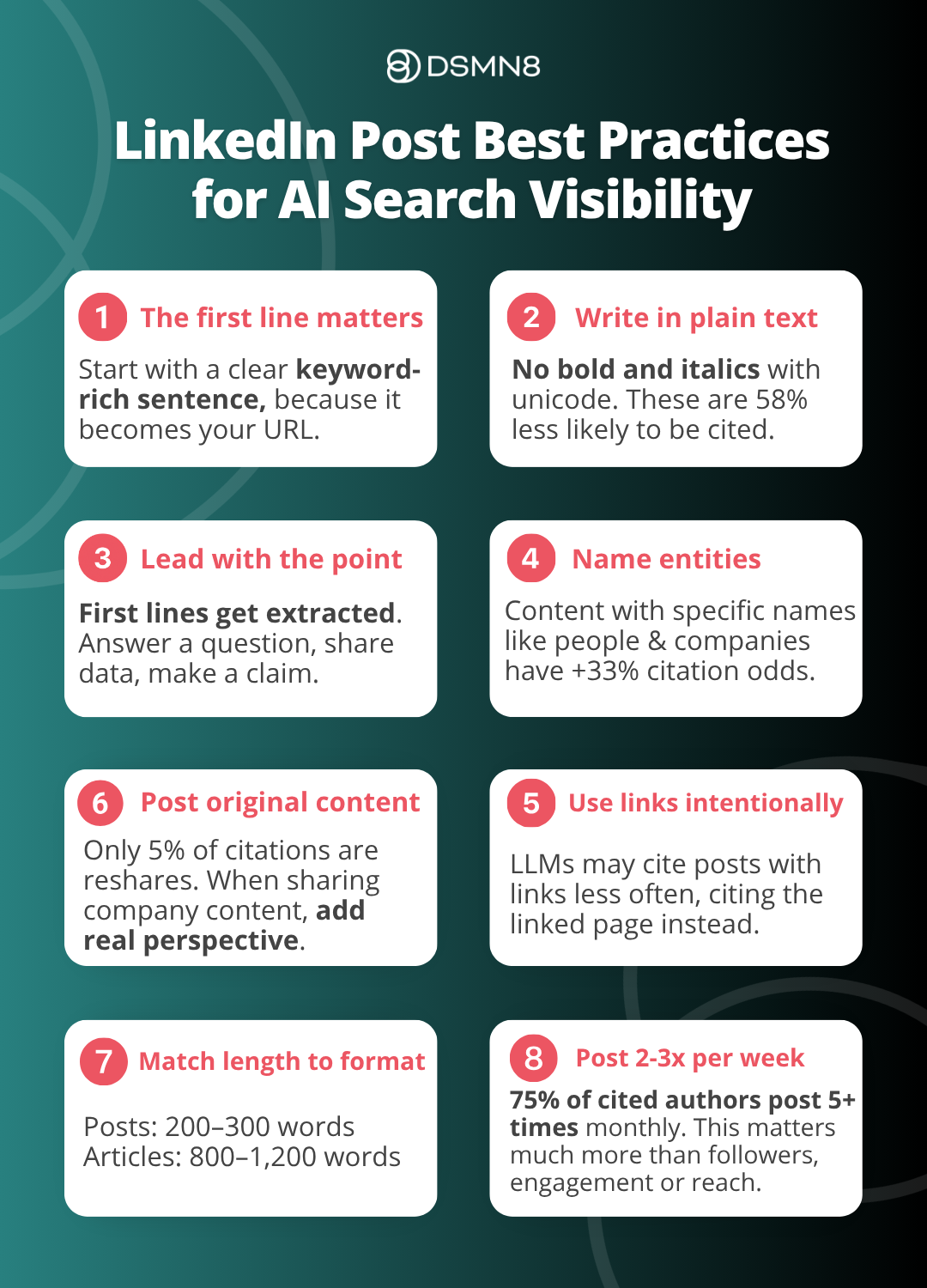
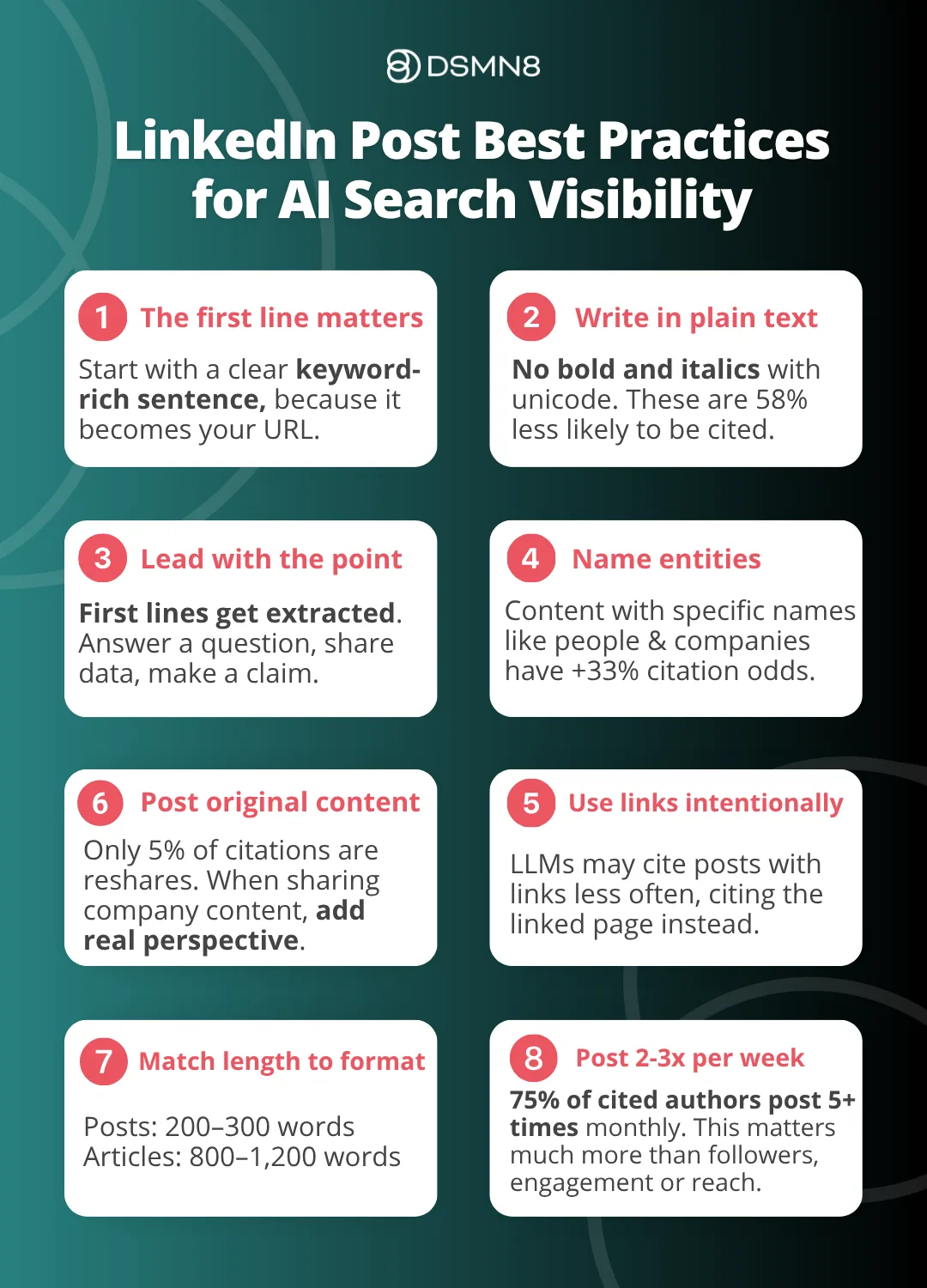
Save the best practices infographic to share with your content curators and employee advocates:
Additional Resources
Ready to get started with the #1 employee advocacy platform?
More on AI & LinkedIn:
- Report: What’s Working on LinkedIn in 2026?
- The Social Media Manager’s Guide to the LinkedIn Algorithm in 2026.
- Why Personal Voice Matters in AI-Powered Employee Advocacy.
Frequently Asked Questions
Do LinkedIn posts need high engagement to be cited by AI?
No. The median LinkedIn post cited in AI search has 15 to 25 reactions and about one comment. Reaction count has a near-zero effect on whether ChatGPT cites a post. AI engines select for relevance and specificity, not popularity.
Do you need a large following on LinkedIn to get cited by AI?
No. In Meltwater’s analysis of 9.5 million AI citations, 51% of cited creators had fewer than 10,000 followers, and accounts with 1,000 to 10,000 followers contributed the largest share of citations. Posting consistently matters more: roughly 75% of cited authors post five or more times per month.
How long should a LinkedIn post be to get cited by AI?
Feed posts between 50 and 299 words earn the largest citation share for their format, and 200 to 300 words is the range LinkedIn recommends. For LinkedIn articles, aim for 800 to 1,200 words. Articles between 500 and 2,000 words attract the most citations overall, according to Semrush data.
Do reshared posts on LinkedIn get cited by AI Search?
Rarely. Around 95% of LinkedIn content cited by AI is original; reshares account for roughly 5% of citations. When employees share company content, adding their own perspective transforms the share into an original post for AI purposes.
How often should employees post on LinkedIn for AI visibility?
Two to three times per week is the benchmark. Consistency and recency compound: Meltwater found 48% of cited content was published within the previous three months, compared with 12% for content older than a year.

Emily Neal
Emily is SEO Lead at DSMN8. She focuses on organic growth strategy across search and AI search and co-authors DSMN8's original research, including the Employee Advocacy Benchmark Report and edited CEO Bradley Keenan's book. Her background spans SEO strategy, technical web, long-form content, digital PR, and marketing automation.