

What's on this page:
- How the LinkedIn Algorithm Works in 2026.
- Personal Profiles Outperform Company Pages.
- The Single Biggest Lever: Caption Personalization.
- Which Content Formats Win on LinkedIn?
- When to Post: Timing and Engagement.
- Network Size: More Connections Doesn’t Always Mean More Reach.
- Mobile vs. Desktop.
- What the 2026 Benchmark Data Tells Social Media Managers.
- Building a LinkedIn Strategy Around the Algorithm: Practical Actions.
- Summary: What the LinkedIn Algorithm Rewards in 2026.
- Additional Resources.
If you manage social media for a B2B brand, you already know that LinkedIn has changed. Company page reach has cratered. Paid costs remain high. And the content that actually gets seen looks very different from what worked three years ago.
But here’s what the data shows: organic reach on LinkedIn isn’t dead. It’s just moved.
It’s moved to personal profiles, to employees. LinkedIn’s algorithm amplifies content shared by real people over brand channels.
This guide breaks down how the LinkedIn algorithm works in 2026, what actually drives reach and engagement, and how social media managers can build a strategy around it.
Backed by DSMN8’s original research: our analysis of over 500,000 employee LinkedIn posts and our 2026 Employee Advocacy Benchmark Report.
How the LinkedIn Algorithm Works in 2026
LinkedIn’s feed algorithm has one primary goal: to show users content that is relevant to them. In practice, that means it heavily prioritizes posts from people users already know and interact with, as well as posts their network has engaged with.
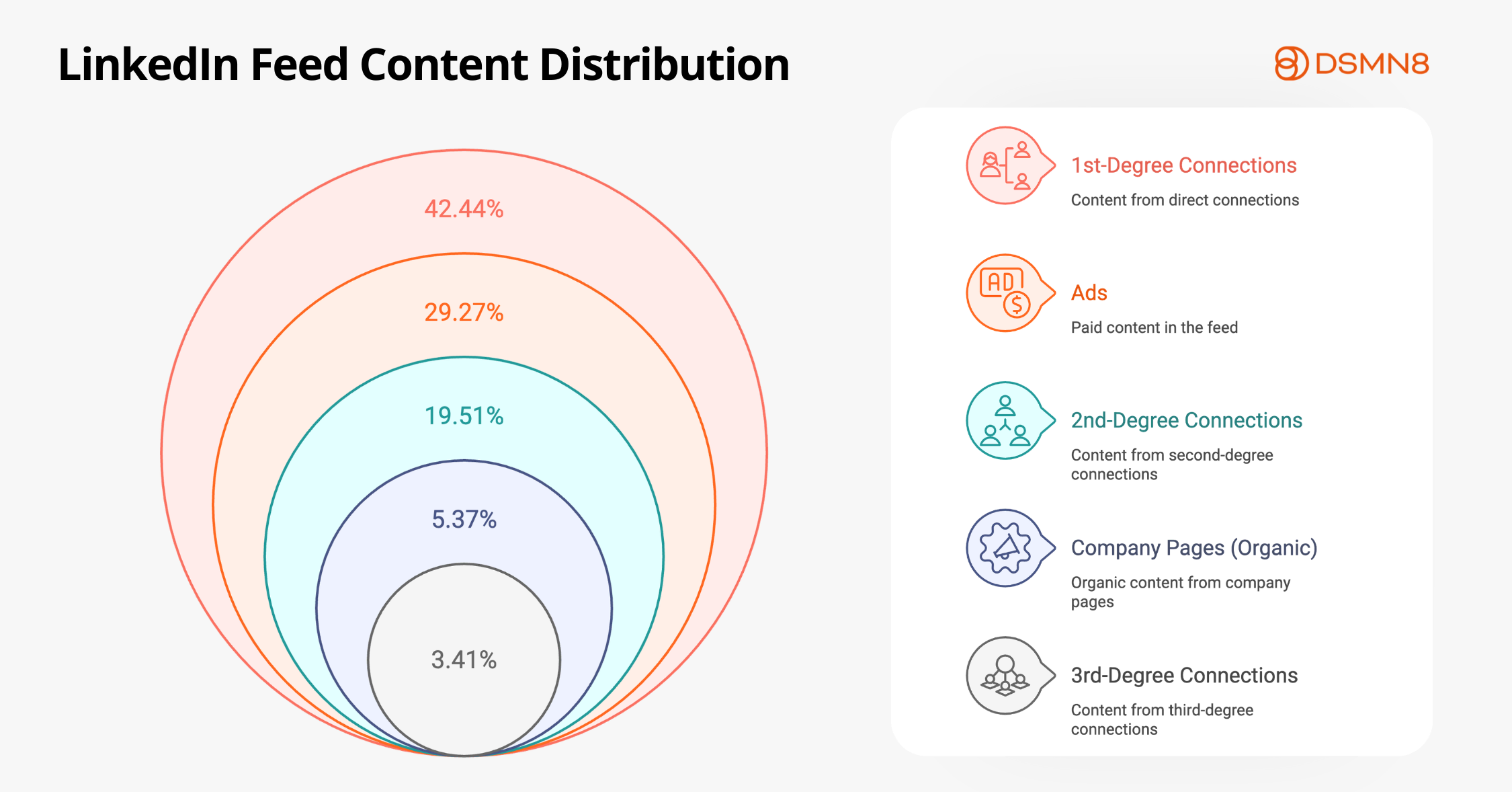
Our LinkedIn organic reach investigation analyzed the first 50 posts in the feeds of four accounts to determine how often company page posts appear. The results were stark.
On average across the four tests:
- 1st-degree connections: 42.44% of feed posts
- Ads: 29.27%
- 2nd-degree connections: 19.51%
- 3rd-degree connections: 3.41%
- Company pages (organic): 5.37%
That last number is the one that matters most for social media managers.
The company page you’ve spent years building, the one with tens of thousands of followers, is appearing in less than one in twenty feed slots.
And nearly a third of the feed is paid advertising.
What triggers content distribution on LinkedIn?
The investigation revealed a crucial mechanic: the most common reason a 2nd-degree connection’s post appears in someone’s feed is because a 1st-degree connection commented or reacted to it.
This is the engine behind employee advocacy.
When an employee posts or engages with a colleague’s post, it distributes that content into the feeds of everyone connected to that employee. The platform is actively rewarding interpersonal engagement and using it as a signal for relevance.
Personal Profiles Outperform Company Pages, By a Long Way
If the algorithm data shows company pages struggle to reach followers, our post-level analysis reveals just how dramatically personal profiles outperform them.
Personal posts (original employee-generated content) vs. company-curated posts
From our study of 500,000 employee LinkedIn posts (The World’s Biggest Employee Advocacy Study):
| Metric | Personal Post | Curated Post | Difference |
|---|---|---|---|
| Average total engagements | 62.74 | 6.94 | 9x more |
| Average clicks | 23.99 | 2.65 | 9x more |
| Average reactions | 36.55 | 4.16 | 8.8x more |
| Average comments | 2.21 | 0.13 | 17x more |
Nine times more engagement. Not 9%. Nine times.
This is the fundamental reason any social media manager focused on LinkedIn should build an employee advocacy and executive influencer program. Content shared through personal profiles reaches exponentially more people.

The Single Biggest Lever: Caption Personalization
Here’s one of the most striking findings from our research, and one of the most actionable for those already running advocacy programs.
Only 3.6% of employee advocates edit the content provided to them before sharing it.
The other 96.4% share it verbatim.
But those who do edit see dramatically different results:
- 3.6x more total engagements
- Nearly 4x more reactions
- Over 3x more clicks
- More than 5x more comments
Even a minimal edit makes a measurable difference.
Posts with 99% similarity to the original caption (meaning only a word or two changed) perform nearly 3x better than completely unedited posts.
The more personalized the post, the better it performs.
Posts with 0-30% similarity to the original caption (heavily rewritten in the employee’s own voice) generate over 4x more engagement, 3x more clicks, and 6x more comments than unedited posts.
What this means for social media managers: your job isn’t to write the perfect post for every employee.
It’s to write a starting point, a draft that they can make their own. Even brief encouragement (“add your take on this”) can unlock significant performance gains at scale.
Tools like DSMN8’s Personal Voice AI take this even further. Employees can define their own tone of voice using example LinkedIn posts or simply describing how they’d like to sound. This gets saved into our Content Assistant, allowing every employee to instantly turn curated content into a post that sounds like them.
Which Content Formats Win on LinkedIn?
The algorithm treats different content formats differently, and the format that employees share most frequently is not the format that generates the most engagement.
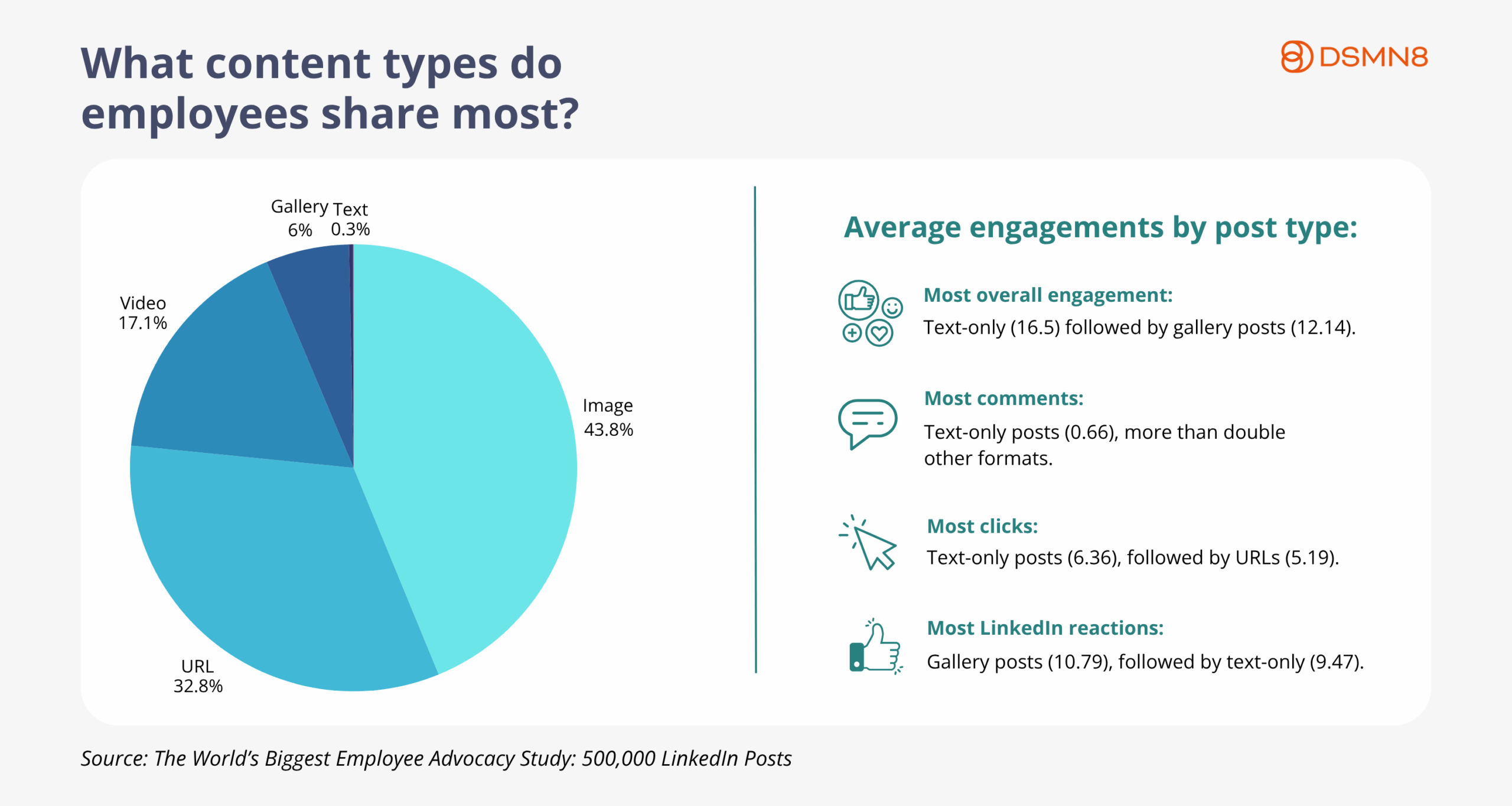
What employees share most
From our 500,000 post dataset:
- Images: 43.8% of posts
- URLs (link posts): 32.8%
- Video: 17.1%
- Galleries (multi-image): 6%
- Text-only: 0.29%
What generates the most engagement
| Format | Avg. Engagements | Avg. Clicks | Avg. Reactions | Avg. Comments |
|---|---|---|---|---|
| Text only | 16.5 | 6.36 | 9.47 | 0.66 |
| Gallery | 12.14 | 1.11 | 10.79 | 0.25 |
| URL | 8.15 | 5.19 | 2.87 | 0.10 |
| Video | 6.86 | 1.18 | 5.52 | 0.16 |
| Image | 6.07 | 1.81 | 4.10 | 0.15 |
Text-only and gallery posts dramatically outperform the formats that employees default to sharing.
Text-only posts perform best because they feel authentic and unpromotional. The LinkedIn algorithm appears to favor them, and audiences respond to the conversational format. They’re ideal for thought leadership, professional opinions, and personal experiences.
Gallery posts (multi-image carousels) are the second-strongest performer, particularly for reactions. They work well for event recaps, culture moments, data visualizations, and step-by-step content.
The strategic implication: if most of your employee advocacy content is image posts linking to blog articles, you’re leaving significant engagement on the table. Build a content mix that includes more text-only posts and gallery formats.
A note on video
Video accounts for 17% of employee posts but generates middling engagement numbers in our dataset.
That said, 60% of advocacy programs surveyed in our 2026 Benchmark Report now offer video content to advocates, and video is a format LinkedIn is actively investing in.
The opportunity is real; the key is to upload native videos directly to LinkedIn rather than use external links to YouTube videos.
When to Post: Timing and Engagement
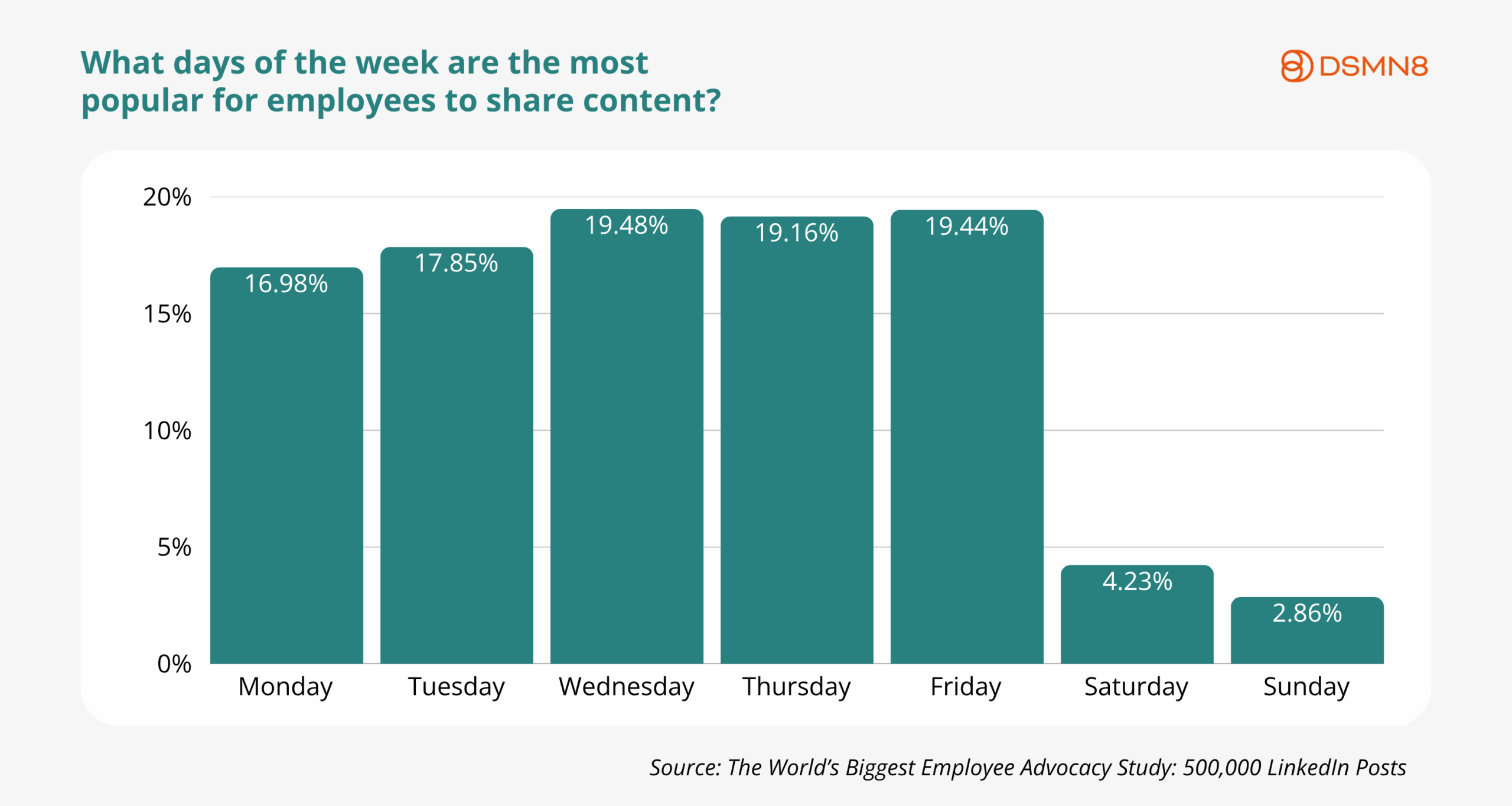
Best days for posting volume
Advocates share content fairly evenly across the working week. Fridays, Wednesdays, and Thursdays see the highest volume of shares. Mondays see the least.
Practical note: if you’re pushing new content to advocates, avoid Monday mornings. Mid-week gives content the most time to gain traction during the working week.
Best days for engagement
The days that generate the most engagement per post differ from those with the highest posting volume:
| Day | Avg. engagements per post |
|---|---|
| Tuesday | 8.22 |
| Thursday | 8.08 |
| Wednesday | 8.00 |
| Monday | 7.86 |
| Friday | 7.47 |
| Sunday | 6.64 |
| Saturday | 6.34 |
Tuesday to Thursday consistently delivers stronger engagement.
Friday is popular for posting but lower for engagement: content shared on Fridays may fall into the weekend drop-off.
Best time of day
Posting is concentrated during business hours, but average engagement is highest late at night.
This likely reflects LinkedIn’s global reach: a post shared at 9am in London is hitting audiences in North America during their working day.
For organizations running international programs, time zone diversity works in your favor.
Network Size: More Connections Doesn't Always Mean More Reach
You might assume that employees with the largest LinkedIn networks would drive the most impact. The data tells a more nuanced story.
Average engagements per post by network size:
| Connections | Avg. Engagements |
|---|---|
| 5,000–10,000 | 12.65 |
| 10,000+ | 12.24 |
| 2,000–5,000 | 10.01 |
| 1,000–2,000 | 6.40 |
| 500–1,000 | 4.98 |
| 0–500 | 3.84 |
Employees with 5,000–10,000 connections outperform even those with 10,000+.
But here’s the more important finding: 60% of all advocacy activity in our dataset came from employees with fewer than 2,000 connections.
The largest group of advocates (27.2%) have between 1,000 and 2,000 connections. Only 3% of posts come from people with 10,000+ connections.
Chasing high-follower employees as your only advocates isn’t the right approach. Enabling a broader base of employees generates more total reach and more diversified distribution.
A hundred employees with 1,500 connections each is worth more than five employees with 10,000 connections each.
Mobile vs. Desktop
Only 7.9% of employee posts are shared from mobile devices. But those mobile posts perform slightly better across almost every metric:
| Metric | Desktop | Mobile |
|---|---|---|
| Avg. total engagements | 11.69 | 13.31 |
| Avg. clicks | 5.03 | 6.21 |
| Avg. reactions | 6.43 | 6.91 |
| Avg. comments | 0.23 | 0.11 |
Mobile posts outperform desktop posts on engagement and clicks (desktop leads only on comments).
One interpretation: employees posting from mobile are more likely to be at events or sharing in-the-moment content – the kind of authentic, personal content that the algorithm rewards.
For social media managers: make sure your advocacy tool has a strong mobile experience. The friction of posting from a phone is a real barrier, and removing it may unlock more engagement.
What the 2026 Benchmark Data Tells Social Media Managers
The Employee Advocacy Benchmark Report 2026 (~ 200 programs) adds another layer to these findings – from the perspective of employee advocates and program managers surveyed.
Here’s what’s relevant for social media managers:
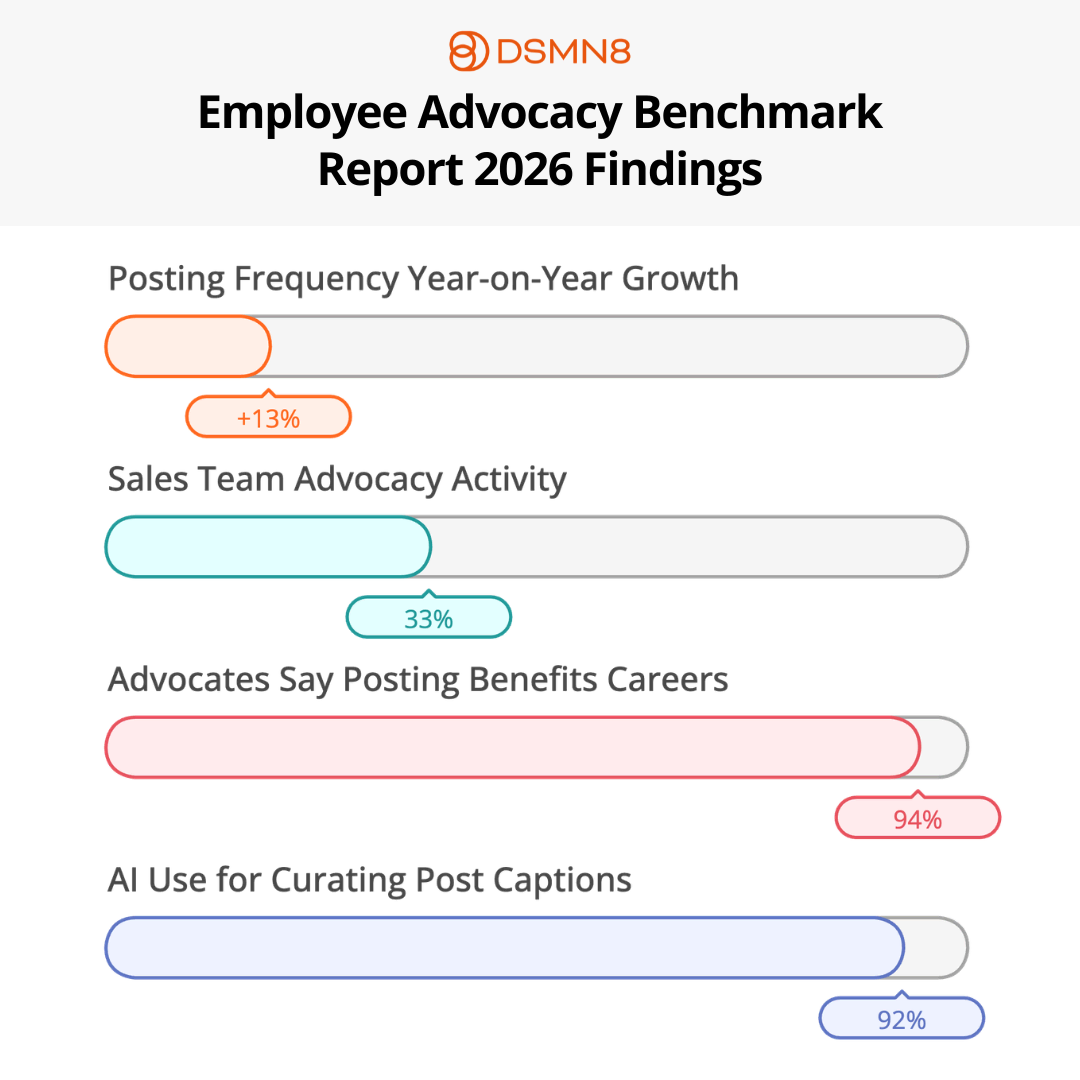
Posting frequency is rising. 68% of advocates now post three or more times per week, up 13% year-on-year. 21% post over five times per week. Regular posting builds algorithmic momentum: LinkedIn rewards consistency, not just quality.
Sales is now the most active department. Sales teams account for 33% of advocacy activity, ahead of marketing (21%) and HR (15.6%). This reflects a broader shift: employee advocacy is no longer a brand awareness exercise run by marketing. It’s a revenue channel.
94% of employee advocates say posting has positively impacted their careers. This is an underused argument for program participation. When employees understand that posting benefits them personally, not just the company, user adoption increases. The career benefit angle makes advocacy a genuine value exchange.
AI is nearly universal. 92% of program managers use AI to scale content production. The risk is homogenisation: content that sounds like everyone else. The data on personalization makes clear that AI-assisted drafts need to be edited and personalized by each employee to perform well. The AI does the heavy lifting; the employee adds the voice.
Cost-per-click from employee advocacy: under $1. Our benchmark data shows that when programs track CPC, the most commonly reported range is $0.25–$1. LinkedIn Ads typically run $5–$10 CPC. The efficiency argument for employee advocacy as a paid media alternative or complementary channel is significant.
Learn more: Employee Advocacy vs Paid Social.
Building a LinkedIn Strategy Around the Algorithm: Practical Actions
Based on everything above, here’s how to build a LinkedIn strategy that works with the algorithm, not against it.
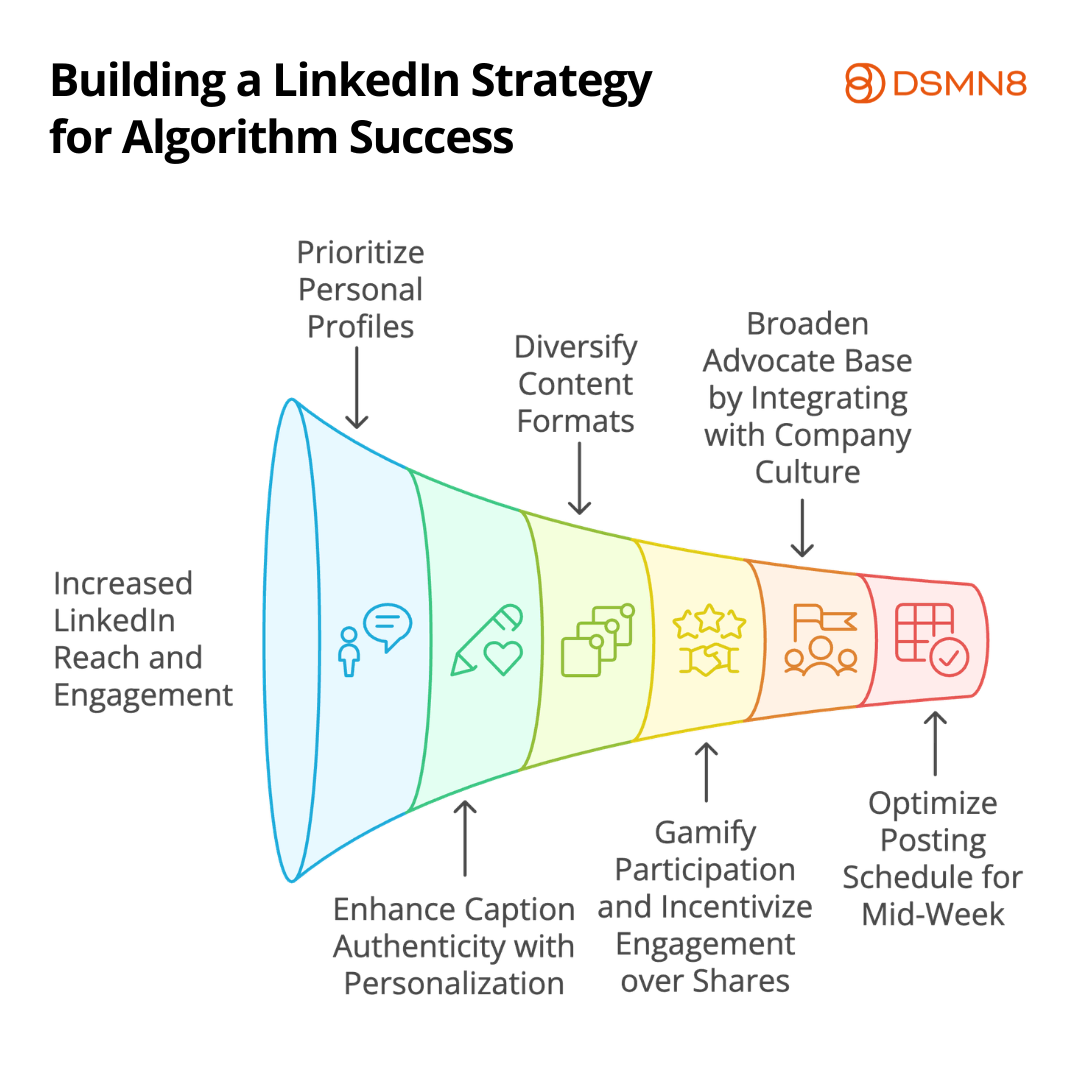
1. Make personal profiles your primary distribution channel
Company pages are not dead. They’re valuable for credibility, follower-building, and paid amplification.
But for organic reach, the algorithm sends viewers to content by personal profiles.
Build your strategy around enabling employees to post, not just around managing the company page.
2. Prioritize authentic captions over polished copy
Write content drafts for employees, then actively encourage them to edit.
Even small changes like a personal opening line, a relevant opinion, or a question at the end dramatically improve performance.
Build this into your content workflow rather than treating personalization as optional.
3. Diversify content formats
If your current content mix is predominantly image posts linking to blog articles, test more text-only posts (thought leadership, professional opinions, data observations) and gallery posts (event recaps, data stories, culture moments). Sticking to one format could be limiting your potential reach.
4. Enable and incentivize engagement, not just posting
Because the algorithm prioritizes 1st-degree engagement when showing content in the feed, encourage employees to like, comment on, and share each other’s posts.
An employee who comments on a colleague’s post is expanding that post’s reach.
DSMN8’s Boost Post feature helps here, especially when you’re looking to push content by your senior leaders.
5. Build a broad base of advocates, not a small group of power users
Don’t limit your program to employees with large networks.
The data shows that employees with 1,000-5,000 connections are the backbone of most programs, and their collective reach far exceeds a handful of high-follower individuals.
6. Publish mid-week for engagement
Tuesday to Thursday consistently delivers higher engagement per post. Build your content calendar around this, particularly for high-priority posts.
7. Make mobile posting frictionless
If your advocacy tools are desktop-only or clunky on mobile, you’re limiting the kind of spontaneous, in-the-moment posting that tends to perform best.
8. Involve leadership
Nearly 80% of programs in our benchmark survey involve executives, and those that do report stronger participation and impact.
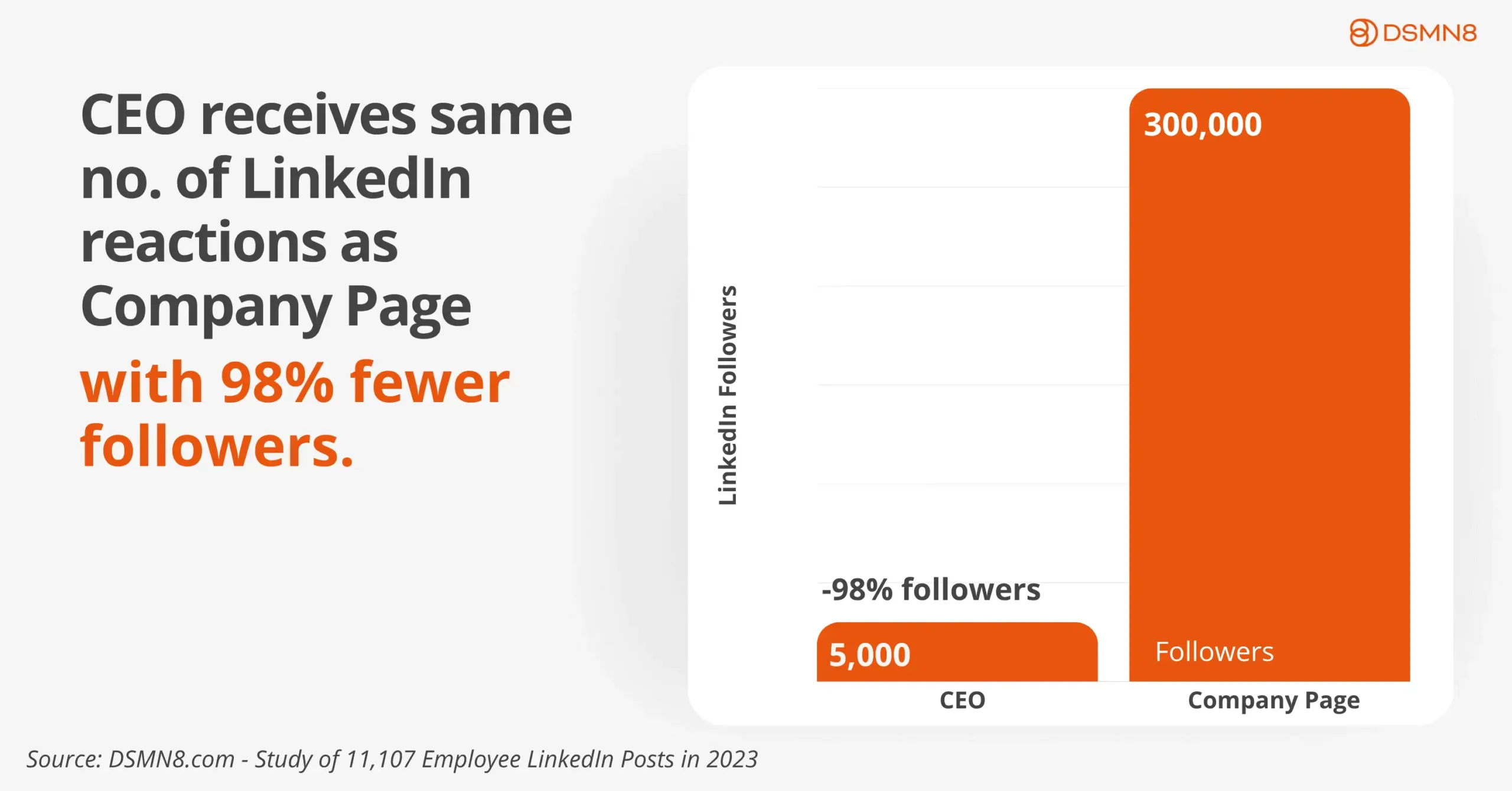
The LinkedIn algorithm (and LLMs) push their posts further than company content. A study we conducted on over 11 thousand posts by one Civil Engineering firm revealed that their CEO reached the same level of engagement as the company page, despite having 98% fewer followers.
A CEO or department head posting regularly signals that advocacy is part of the company culture. This encourages your wider team to get involved.
Summary: What the LinkedIn Algorithm Rewards in 2026
| Signal | Algorithm Response |
|---|---|
| Post from a 1st-degree connection | High distribution priority |
| 1st-degree engagement on a 2nd-degree post | Extends reach to 1st-degree feeds |
| Personal, original post | Outperforms curated content 9:1 |
| Edited/personalised caption | 3–4x better engagement than unedited |
| Text-only or gallery format | Highest engagement per post |
| Mid-week posting (Tue–Thu) | Stronger engagement than Mon or Fri |
| Company page post (organic) | ~5% of average feed; limited reach |
The LinkedIn algorithm in 2026 is not a mystery.
It’s a people-first algorithm on a professional network. It rewards human voices, genuine engagement, and content that feels like it came from a person rather than a brand.
That’s exactly what employee advocacy delivers. And the data proves it works.
Additional Resources
Want to see how active your employees currently are on LinkedIn and how that compares with your competitors?
Get a free competitor analysis review.
Ready to see how the top-rated employee advocacy platform works?
Further reading & studies referenced:
- The World’s Biggest Employee Advocacy Study — 500,000 LinkedIn posts analyzed.
- Employee Advocacy Benchmarks 2026 — survey of 200 programs.
- Does LinkedIn Organic Reach Still Exist? — our feed analysis investigation.
- We Analyzed 11,107 Employee LinkedIn posts.
- 5 Data-Backed Moves Your Employee Advocacy Strategy Needs.
- Employee Advocacy Is Now an SEO and GEO Strategy.

Lewis Gray
Senior Marketing Manager and Employee Advocacy Program Manager at DSMN8. Lewis specialises in content strategy, growing brand visibility and generating inbound leads. His background in Sales lends itself well to demand generation in the B2B niche.