

What's on this page:
- Sales Teams Get the ROI from Employee Advocacy Faster.
- The Problem With Cold Outreach in 2026.
- The AI Angle No-One is Talking About.
- How to Approach Employee Advocacy for Sales Teams.
- Give Salespeople the Right Content.
- Personalization Makes All The Difference.
- Leadership Visibility is the Most Powerful Lever.
- What Good Looks Like.
- Final Thoughts & Additional Resources.
Sales leaders are always looking for an edge.
More pipeline. Faster deals. Reps who don’t have to fight for every conversation. And increasingly, the data points to one lever that’s become a competitive differentiator: employee advocacy.
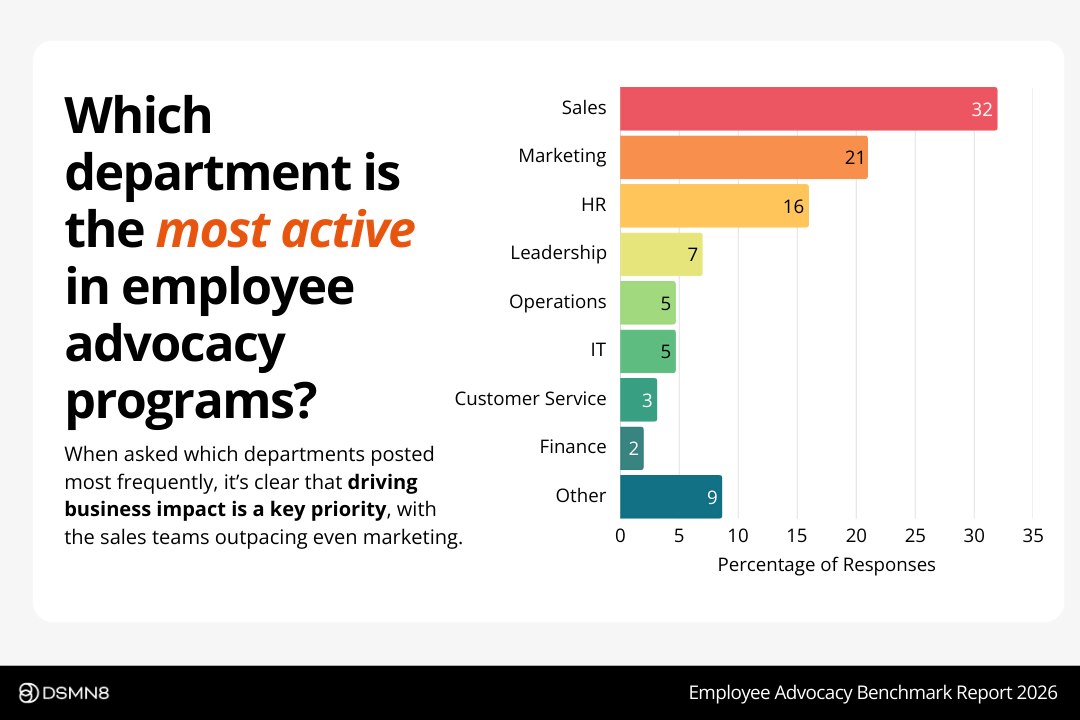
According to the 2026 Employee Advocacy Benchmark Report, which interviewed 200 advocacy programs across industries, sales teams account for 33% of all employee advocacy activity. That’s more than HR (15.6%) and even marketing (21%).
That’s not a coincidence.
Sales Teams Get the ROI from Employee Advocacy Faster
Most employees need to be convinced that posting on LinkedIn is worth their time. Salespeople don’t.
They see the impact directly. When they show up consistently in front of the right buyers and build a reputation as someone worth listening to, deals get easier.
The personal incentive is obvious.
The next step is to turn this into a deliberate initiative that consistently drives pipeline.
This is the guide you need, built from our experience supporting and scaling employee advocacy programs and interviews with sales leaders:
The Problem With Cold Outreach in 2026
Cold email reply rates have been declining for years.
Inboxes are noisier, AI-generated sequences are everywhere, and buyers have become adept at filtering out anything that doesn’t immediately feel relevant.
The reps still getting replies aren’t necessarily writing better emails. They’re often the ones prospects already recognize.
When a salesperson posts consistently on LinkedIn, sharing useful content, commenting thoughtfully, and building a point of view in their category, they stop being a stranger in someone’s inbox.
By the time they reach out, there’s already a layer of familiarity. The prospect has seen their name, scrolled past a post, maybe even engaged with something.
That pre-outreach warming effect is hard to manufacture any other way.
Employee advocacy programs give salespeople the content infrastructure to build that presence without spending an hour a day figuring out what to post.
The AI Angle Nobody's Talking About
As AI-assisted outreach becomes standard, the reps who have built genuine personal presence on LinkedIn become more valuable, not less.
When every competitor’s team is sending AI-generated sequences at scale, the rep with 5,000 relevant LinkedIn connections and a consistent posting history has an asymmetric advantage.
Their name is familiar, and their content has already done some of the selling. Their outreach lands differently because they’re not a stranger.
Employee advocacy is about building this across a sales team in a programmatic way, rather than relying on individual reps who are naturally inclined to post.
The companies winning at pipeline generation in 2026 aren’t choosing between outbound and content. Instead, they use advocacy to make outbound work harder.
How to Approach Employee Advocacy for Sales Teams
The active participation figures say something important: your sales reps want to do this. The motivation is already there.
The question is whether your program is set up to support them effectively.
A few things that separate sales teams that get real results from advocacy versus those that treat it as a box-ticking exercise:
Give Salespeople the Right Content
The single biggest reason a salesperson disengages from an employee advocacy platform is a lack of relevant content for them to share.
If your platform is filled with recruitment and employer branding content, that’s great for HR.
Not so much for sales. Sharing these won’t help them start a conversation with a CFO.
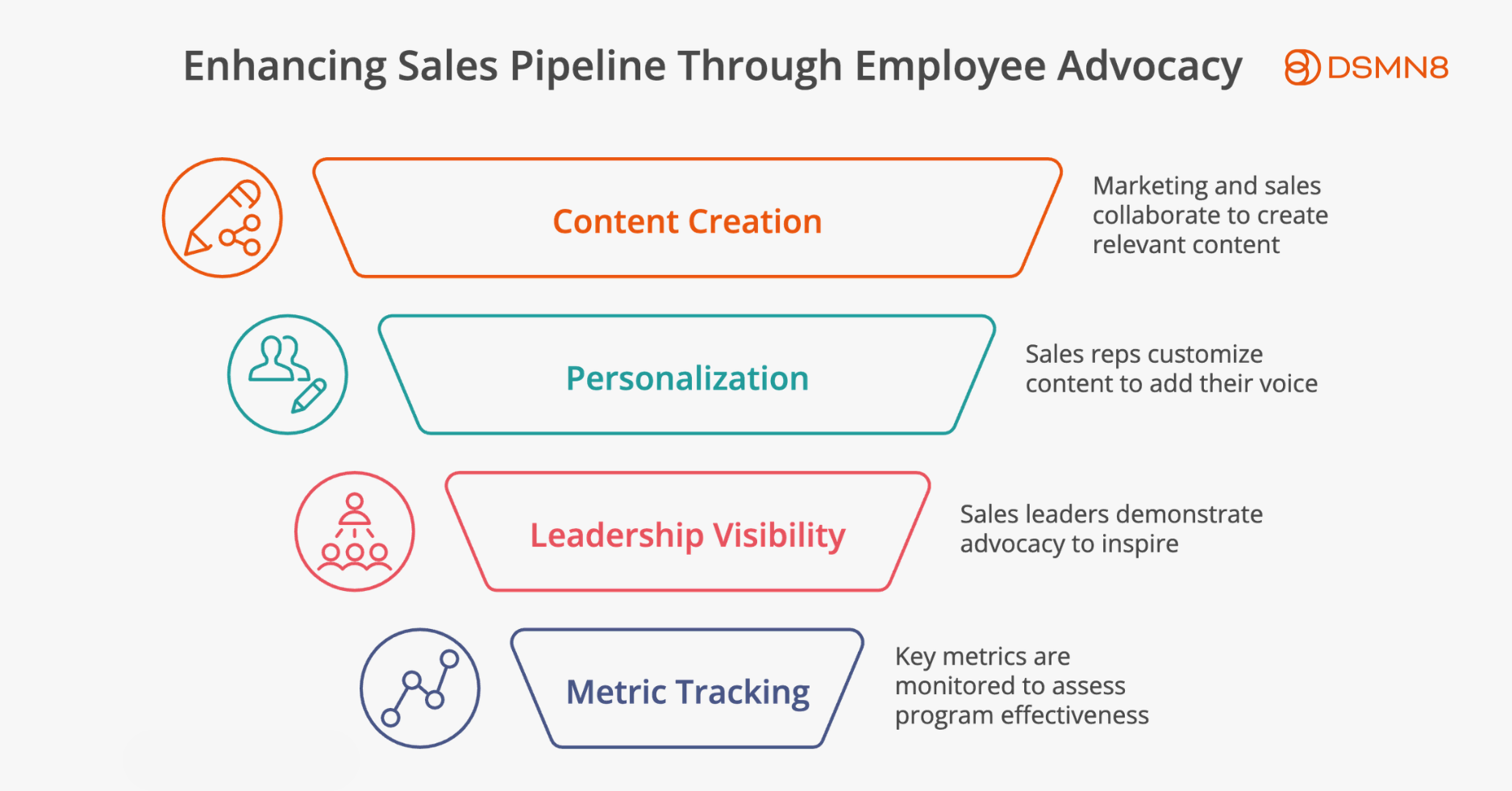
The best approach you (or your employee advocacy program manager) can take is to encourage cross-department collaboration. Marketing can support with content creation, while sales provides insights into topics that regularly come up in conversation to inform the content getting created.
With this in mind, here are some employee advocacy content angles we’ve seen work very well with sales teams:
Personalization Makes All The Difference
Creating an abundance of content for your sales team to share is a great start.
But building authenticity is another.
The last thing you should do is ask salespeople to share every post as-is with no customization.
This won’t perform as well on the LinkedIn algorithm or in resonating with audiences.
Of course, you want to ensure that the value of the content your marketing team has put together remains, but encouraging your salespeople to add their own point of view and tone will make a big difference.
That’s why we built Personal Voice AI, a DSMN8 feature that learns an employee’s personal tone of voice and lets them apply it with one click to any curated post in the platform, without removing your core message or brand guidelines.
Our own research from analyzing half a million LinkedIn posts revealed that even when employees share with very minor tweaks (99% similarity to the original curated caption), they generate 3x more engagement.
Completely original content takes this all to the next level, driving 9x more overall engagement. While not every salesperson will be interested in doing this, it’s worth encouraging and celebrating those who do.
For a rep’s perspective on what this looks like in practice, it’s worth hearing from Tom Boston in the podcast episode below on why salespeople need to show up as individuals, not just company mouthpieces:
Leadership Visibility is the Most Powerful Lever
No incentive structure, leaderboard, or internal campaign will move participation rates as reliably as a sales director who posts visibly and regularly themselves.
When the VP of Sales shares content through the advocacy program, comments on team members’ posts, and shows up consistently in their own network’s feed, the message lands without anyone having to say it explicitly.
The clearest signal you can send to your team is that you’re doing it yourself.
Grab our Executive Visibility Playbook for a step-by-step guide to building your presence in 30 days.
It covers everything from profile best practices to the content that works best for senior leaders.

What Good Looks Like
A sales team with an effective employee advocacy program doesn’t look like everyone posting the same content on the same day.
It looks like a set of individuals who have developed recognizable voices in their category, supported by a steady stream of relevant content they can draw from and make their own.
The leading indicators worth tracking:
- User adoption (post frequency per rep).
- Engagement metrics on shared content.
- Website clicks driven by rep activity via UTM-tagged links.
- Earned media value against a paid equivalent.
The lagging indicator that matters most is one you’ll track qualitatively at first:
How often are reps hearing “I’ve seen your content” before a first meeting? When that starts happening consistently, the program is working.
Those UTM links will come in handy here, too. Let’s say someone downloaded a resource after clicking a link in an employee post, and later the deal was won. You’ll be able to see in your CRM and Analytics that they were influenced by employee LinkedIn content.
Final Thoughts & Additional Resources
Sales teams are already your most engaged advocates. They’re participating more and getting more direct value from it than any other department.
The opportunity for sales leaders isn’t to convince your team that advocacy is worth doing. It’s to build the infrastructure, the tailored content, and the leadership visibility that turns organic participation into a systematic pipeline advantage.
The 33% is a starting point. The question is what you build on top of it.
Ready to get started with the #1 employee advocacy platform?
Wondering how active your team already is, and how this compares with your competitors?
Get a free competitor analysis review.
More on Employee Advocacy for Sales Teams

Emily Neal
SEO and Content Specialist at DSMN8. Emily has 10 years experience blogging, and is a pro at Pinterest Marketing, reaching 1 million monthly views. She’s all about empowering employees to grow their personal brands and become influencers.