

What's on this page:
- The Problem with Paid Social.
- What the Data Says: Employee Advocacy CPC vs. Paid Benchmarks.
- Why Employee Advocacy Costs Less and Converts Better.
- The Hidden Cost of Not Tracking.
- Employee Advocacy vs. Paid Social: It’s Not Either/Or.
- What This Means for Your Marketing Strategy.
- Additional Resources
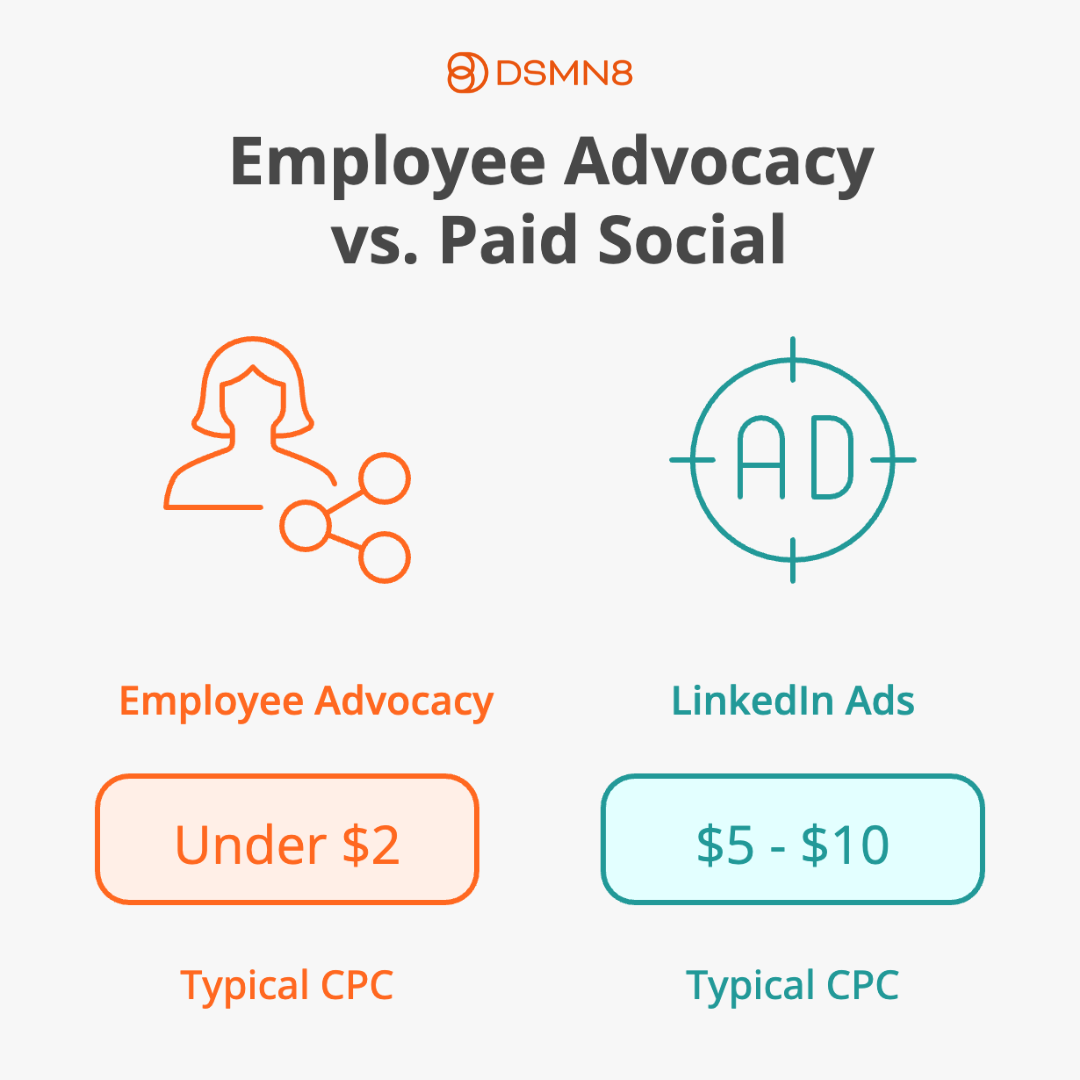
The average LinkedIn ad costs between $5 and $10 per click. Employee advocacy programs, according to DSMN8’s 2026 Employee Advocacy Benchmark Report, most commonly deliver clicks at under $1.
Let’s break down the real cost and performance gap between paid social and employee advocacy, and explain why the highest-performing B2B marketing teams aren’t choosing one over the other; they’re using both strategically.
The Problem with Paid Social
Paid social media built its reputation on precision targeting and predictable scale.
Feed it budget, reach your audience. Simple enough, until it isn’t.
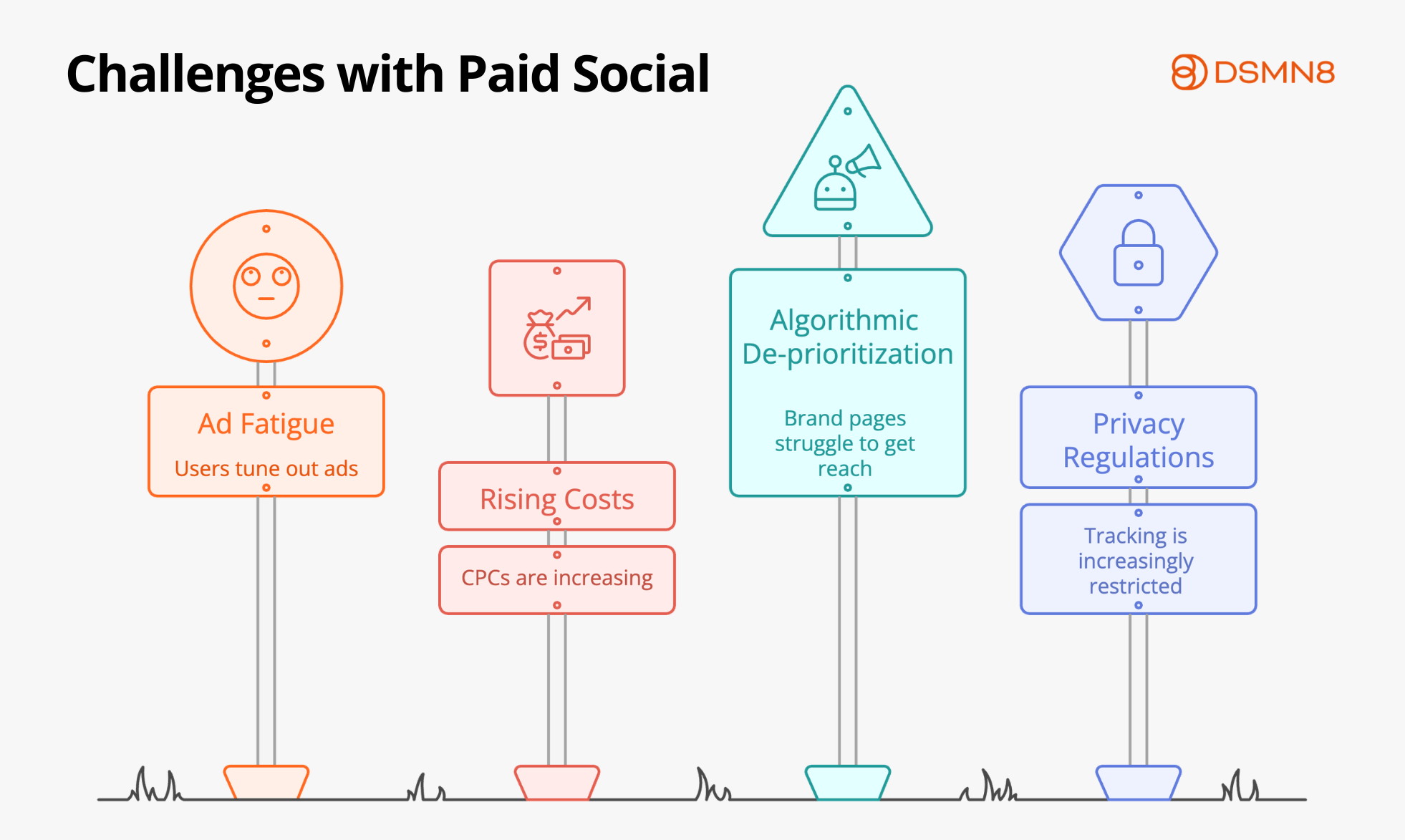
Several converging forces have made paid social significantly less efficient over the past few years:
- Ad fatigue and banner blindness: Users have grown increasingly adept at tuning out commercial content.
- Rising costs: LinkedIn ad CPCs typically range from $5 to $10, with DemandSense reporting an average of $7.80 for B2B in 2025.
- Algorithmic de-prioritization of brand pages: Platforms are actively deprioritizing brand page content in favor of content from real people. Our LinkedIn feed analysis found that company page posts made up just 5.37% of the average feed. Plus, not a single organic company page post appeared without engagement from individuals within the user’s network first.
- Privacy regulations and cookie deprecation: Third-party tracking is increasingly restricted. Safari, Firefox, and Edge already block third-party cookies by default, creating attribution gaps that make optimising paid campaigns harder than ever.
This all results in a greater budget required to maintain existing visibility, with measurably lower efficiency in return.
What the Data Says: Employee Advocacy CPC vs. Paid Benchmarks
DSMN8’s 2026 Employee Advocacy Benchmark Report, based on data from 200 active advocacy programs, provides concrete numbers to back up the cost advantage.
| Average Cost-Per-Click | % of Responses |
|---|---|
| <$0.25 | 5.4% |
| $0.25–$1 | 12.4% |
| $1.01–$2 | 11.6% |
| $2.01–$3 | 5.4% |
| $3.01–$4 | 1.5% |
| >$4 | 0.8% |
| Do not track cost-per-click | 42% |
| Preferred not to answer | 20% |
When measured, the most commonly reported average cost-per-click seen by employee advocacy programs is under $1, with only 0.8% of programs reporting a CPC over $4.
29.4% of programs in the study reported a cost-per-click under $2. The largest group reported a tracked CPC of $0.25-$1. For context: that’s the range where a single LinkedIn ad click can cost ten times as much.
Here’s how that compares to typical paid media benchmarks:
| Channel | CPC (Low) | CPC (High) | Employee Advocacy Cost Efficiency Advantage |
|---|---|---|---|
| LinkedIn Ads | $5 | $10 | +73% |
| Paid Social (B2B) | $2 | $6 | +50% |
| Paid Search | $2 | $5 | +42% |
| Employee Advocacy | $0.25 | $4 | — |
Why Employee Advocacy Costs Less and Converts Better
The cost advantage isn’t arbitrary. It’s rooted in how social algorithms, human psychology, and B2B trust dynamics actually work.
1. Algorithms favor people over brand pages
Every major platform prioritizes content from individuals over content from company accounts.
When your team shares content, their posts receive organic distribution that brand-page content simply cannot access without paid amplification.
This isn’t a loophole; it’s the intended behavior of platforms designed around human connection.
2. Trust drives conversion, and employees carry more of it!
Harris Poll Research revealed that 78% of people find posts from employees more authentic than content from official brand accounts, and 74% describe employees as more influential in shaping a company’s reputation than traditional marketing.
The reason is simple. A prospect who encounters a peer endorsement (even from someone they don’t know personally) processes it differently to an ad. The signal is social validation, not commercial intent.
3. Reach extends beyond the company's existing audience
Employee networks are typically far larger than a company’s follower base.
An organization with 500 employees, each averaging 1,000 connections, has a potential combined reach of 500,000, accessible without any media spend.
Crucially, this reach is into audiences that may never have been exposed to the brand’s paid campaigns.
Try our Reach Calculator to instantly see the audience you could be missing out on!
The Hidden Cost of Not Tracking
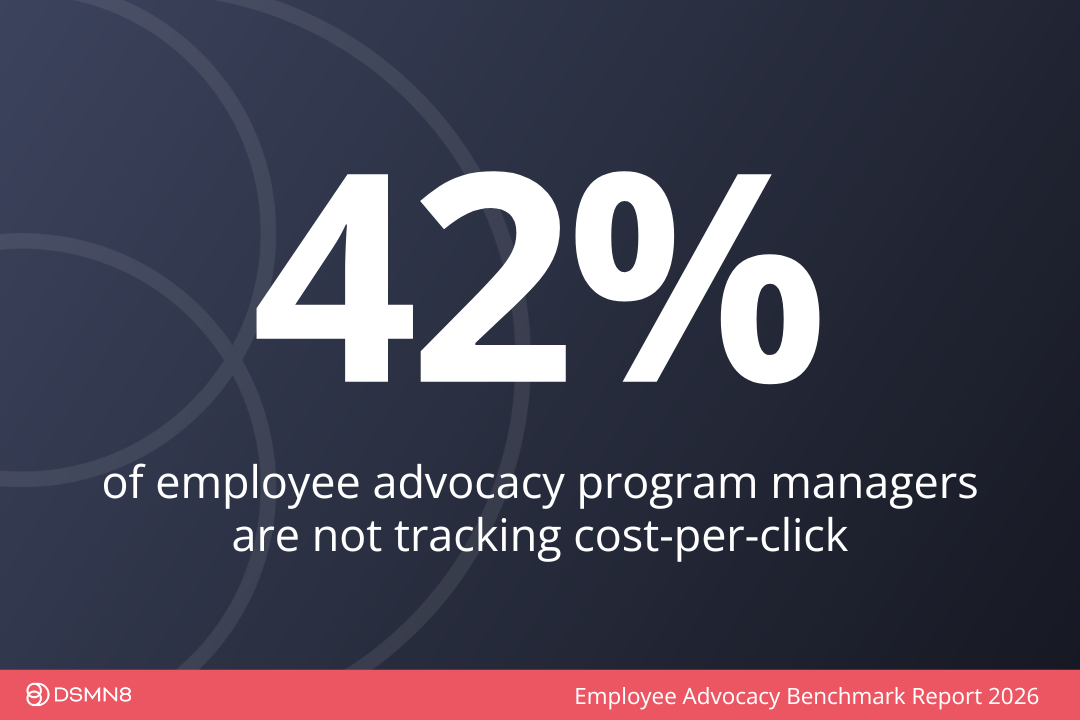
Another finding from the 2026 Benchmark Report that deserves particular attention: 42% of advocacy program managers do not currently track cost-per-click.
This matters because it suggests that a significant share of the B2B marketing community are running advocacy programs without the measurement infrastructure to make the full business case, or to optimize toward it.
If you can’t measure the CPC of your advocacy program, you can’t compare it to the paid social budget it could be supplementing or replacing.
The good news: tracking advocacy-driven CPC isn’t technically complex.
It requires UTM parameters to shared links to segment traffic within your analytics platform, and a consistent reporting cadence. The programs that do track it are consistently finding that the numbers make a compelling case for scaling. If you’re already using DSMN8, all links will include UTM parameters, which can be customized.
Earned Media Value is another metric worth measuring, allowing you to compare the reach from employee shares with what this would have cost vs. your paid social benchmarks. DSMN8 does this too!
Employee Advocacy vs. Paid Social: It's Not Either/Or
Here’s where a lot of the conversation gets oversimplified.
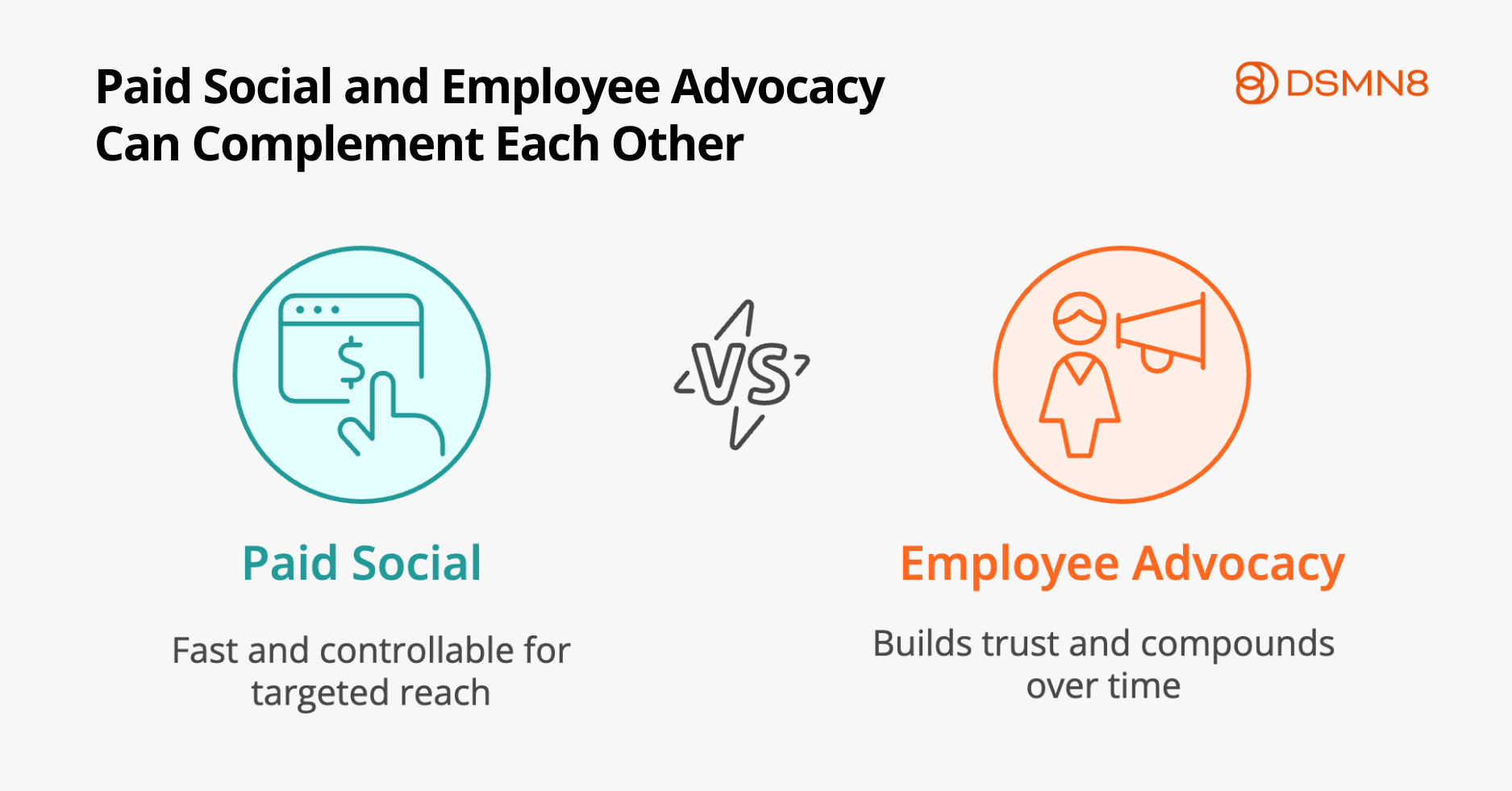
Paid social and employee advocacy aren’t competing budget lines; they’re different tools with different roles in the funnel.
Paid social is fast and controllable. It’s effective for reaching cold audiences with specific offers, retargeting warm prospects, and driving bottom-of-funnel actions with precision. You pay for that control.
Employee advocacy is slower to build but compounds over time. It builds brand familiarity and reaches parts of the funnel that paid media struggles to influence – the private conversations, forwarded links, and peer recommendations that happen long before a prospect visits your website.
The highest-performing B2B marketing teams use the two channels together in a reinforcing loop:
- Use employee content to test messaging organically before committing ad spend.
- Use the trust and familiarity built by advocacy to improve conversion rates on paid campaigns.
- Use retargeting lists built from advocacy-driven traffic (which tend to be higher quality) to reduce cost-per-acquisition on paid channels.
This test-and-scale model means ad budgets get allocated to content that’s already been validated by a human audience. Less waste. Higher returns.
What This Means for Your Marketing Strategy
If you’re currently allocating budget across paid social without an employee advocacy program running alongside it, you’re likely:
- Paying premium CPCs for audiences your employees could be reaching organically.
- Missing the dark social conversations where your category’s buying decisions are made.
- Building an audience that belongs to the platform, not to your brand.
If you already have an advocacy program but aren’t tracking CPC, EMV, or pipeline influence, you’re running a program you can’t fully defend at budget review, and can’t optimize systematically.
The companies seeing the strongest results from employee advocacy in 2026 share a few characteristics: they measure rigorously, they make participation easy, and they treat their employees’ social presence as a strategic asset rather than a nice-to-have.
Employee advocacy doesn’t replace paid social; it makes paid social work better while independently delivering reach, trust, and pipeline influence at a fraction of the cost.
📊 Download the full 2026 Employee Advocacy Benchmark Report for more data-backed insights.
Additional Resources You'll Find Helpful
Ready to get started with the #1 employee advocacy platform?
Want to compare your employee LinkedIn activity with your competitors?
More on Employee Advocacy Measurement and ROI:

Emily Neal
SEO and Content Specialist at DSMN8. Emily has 10 years experience blogging, and is a pro at Pinterest Marketing, reaching 1 million monthly views. She’s all about empowering employees to grow their personal brands and become influencers.