

The social media landscape in 2026 isn’t just competitive, it’s fundamentally different. Algorithms remain unpredictable, paid advertising costs haven’t improved, and audiences are increasingly selective about whose voices they trust due to the rise of AI.
Yet something remarkable is happening: employee advocacy has evolved from a simple amplification tactic into a structured growth channel that’s delivering measurable impact across organizations worldwide.
Our second annual Employee Advocacy Benchmark Report surveyed over 200 programs across industries and regions, including insights from Cisco, Capgemini, Nissan, and Toyota.
The data reveals a clear shift: successful programs aren’t just encouraging participation; they’re building deliberate infrastructure around confidence, training, and measurement.
Key Findings from the Report: Employee Advocacy Benchmarks for 2026
Let’s explore the data showing how employee advocacy has evolved from amplification to infrastructure, and what’s driving results for leading organizations 👇
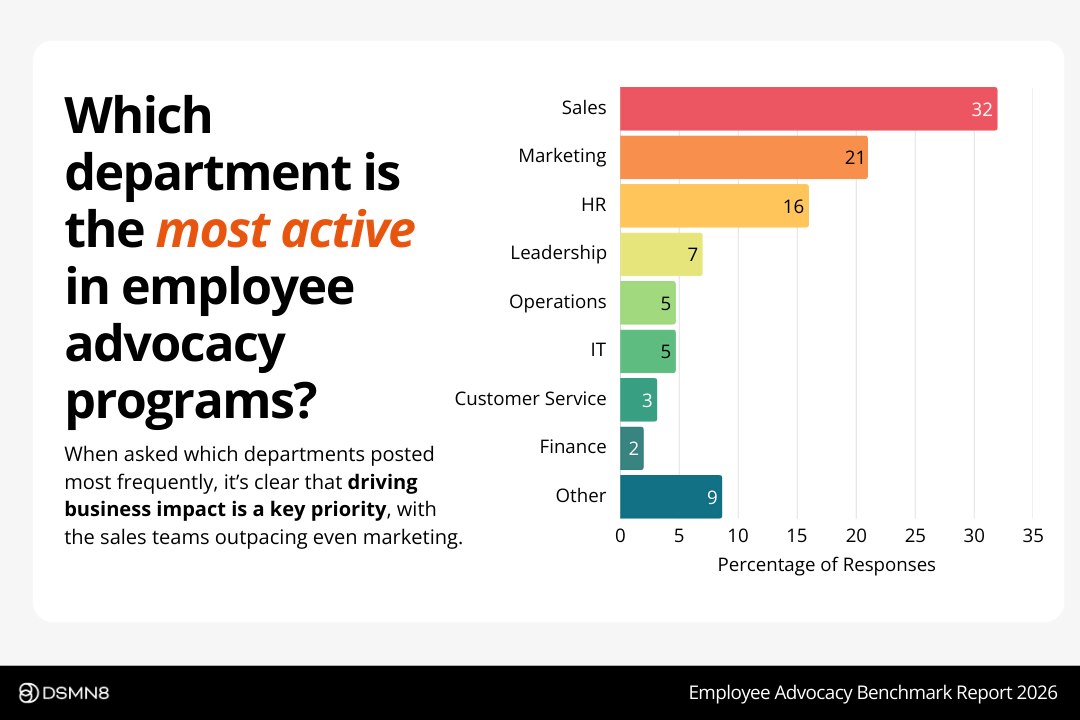
Employee advocacy has moved closer to revenue than ever before.
Sales teams now account for 33% of advocacy activity, making them the most active participants. This represents a fundamental shift in how organizations view employee advocacy. It’s no longer just a brand awareness play championed by marketing, but a channel directly connected to revenue generation.
Meanwhile, program ownership remains distributed:
HR departments manage 39.6% of programs, followed by Marketing at 33.9% and Corporate Communications at 17%, demonstrating that advocacy spans multiple business functions with varied objectives.
Participation is increasing year-on-year.
Advocates are sharing more frequently than ever, with 68% sharing three or more times per week (+13% since last year’s report). And 21% are now posting over five times per week!
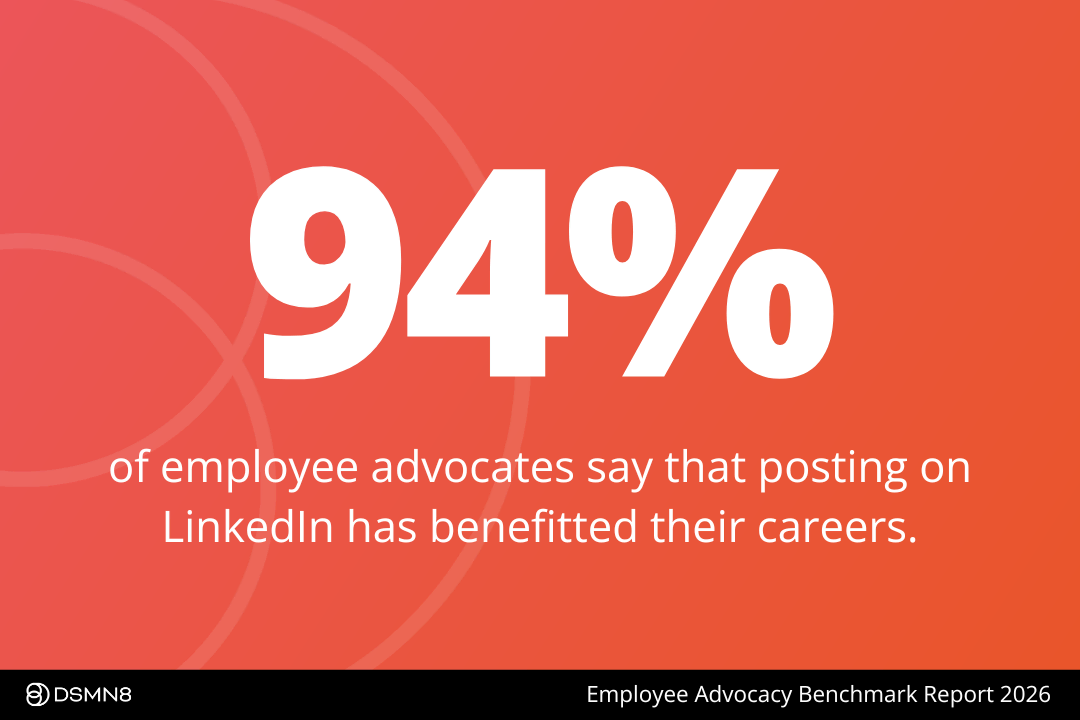
The personal benefits are undeniable: 94% of employee advocates say posting on LinkedIn has benefited their careers. This proves that starting an employee advocacy program isn’t just good for brands; it creates genuine value for the individuals who participate, making it a true win-win.
Training and enablement have become standard practice.
87% of program managers now provide some form of employee advocacy training, signaling a decisive shift toward more structured programs.
This marks a significant improvement, with the percentage of advocates receiving no training or social media policy dropping from 38% to 29% year-over-year.
Why does this matter? Because the data shows the biggest barriers to participation are uncertainty and lack of clarity, not motivation.
When asked what challenges program managers face, “uncertainty about what content to share” ranked highest at 18%, followed by resistance to using social media (16%) and lack of interest in company content (16%).
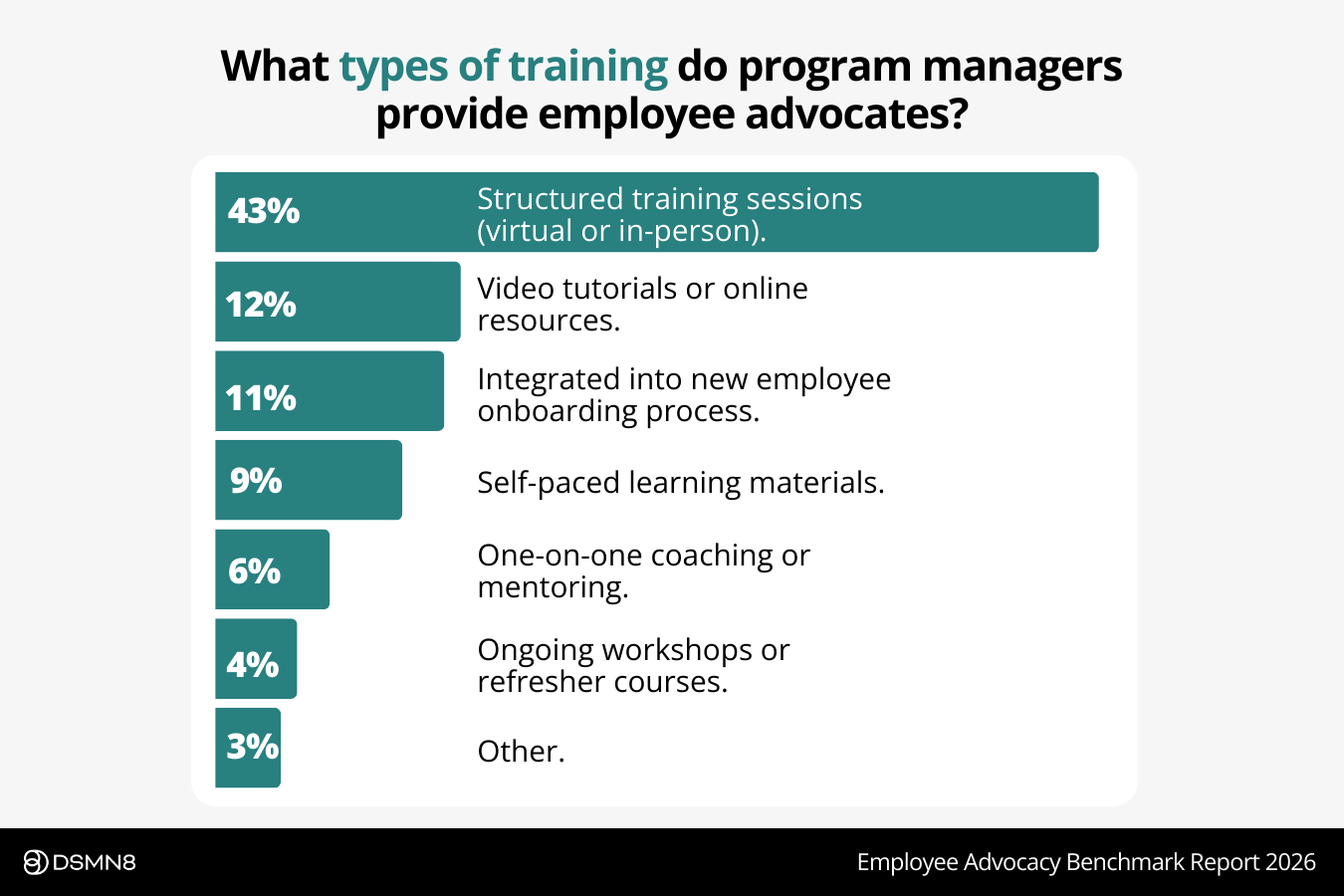
The most common training approach? 43% offer structured training sessions (virtual or in-person), followed by video tutorials (12%), integration into new employee onboarding (11%), and self-paced learning materials (9%).
Advocacy continues to outperform paid social on efficiency.
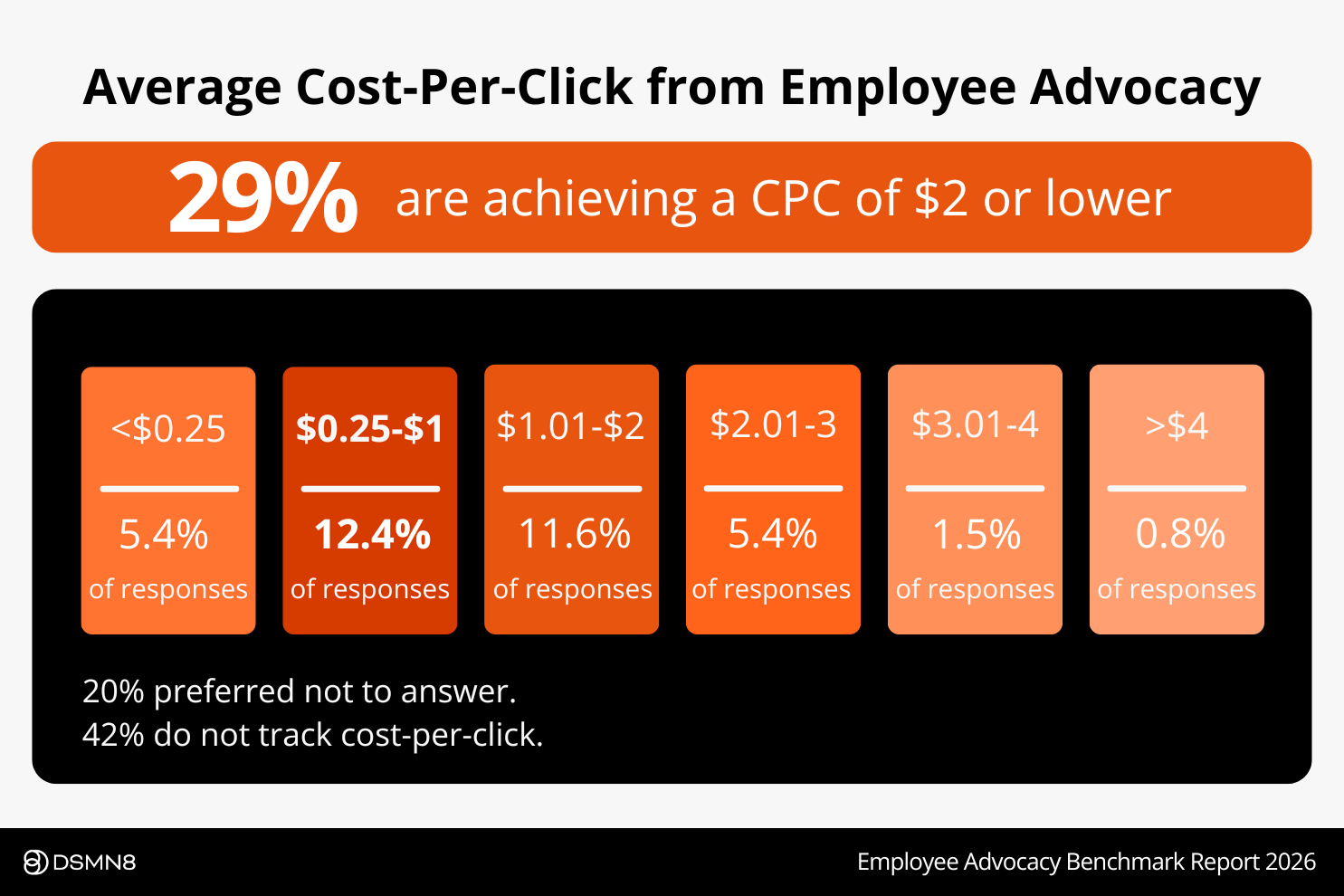
Where tracked, 18% achieved a CPC under $1, and 29.4% are seeing costs under $2.
This is well below typical paid benchmarks of $5-$10 on LinkedIn and $2-$6 for broader B2B paid social.
This dramatic cost advantage reflects a fundamental truth: original, employee-led voices continue to outperform polished brand content because audiences trust authentic human voices over corporate messaging.
Try our free ROI calculator to instantly find out the impact employee advocacy could have for your organization.
How Employee Advocacy Programs are Managed
Technology enables consistent participation and better measurement.
67% of programs now use technology platforms to manage their employee advocacy efforts, while 28% still manage manually. This investment in dedicated tools enables more consistent participation, better measurement, and the ability to scale programs safely.
Program managers report providing an average of four new pieces of content weekly to their advocates, helping maintain momentum and giving employees fresh material to share.
AI is the new norm, but personalization is essential.
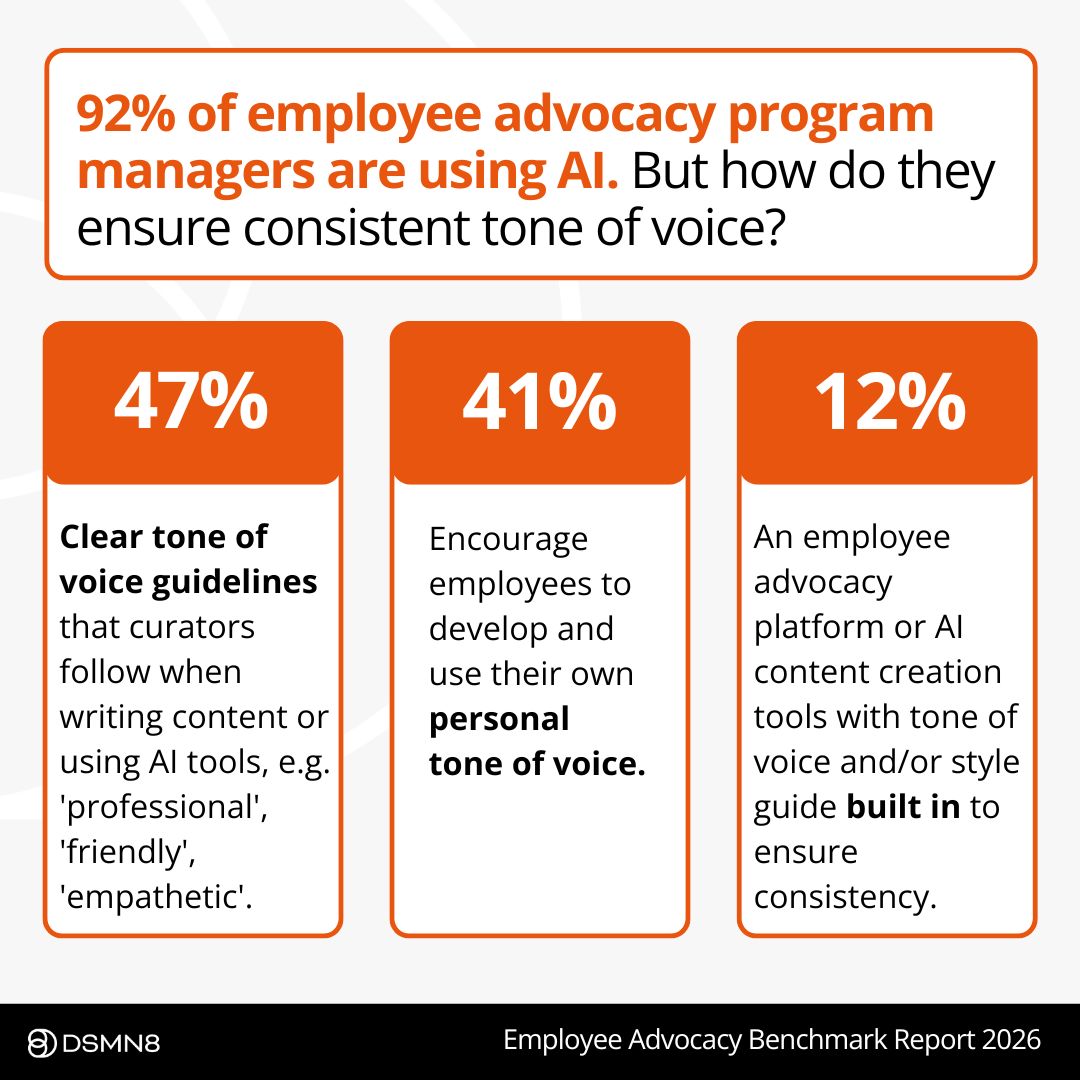
92% of program managers are using AI to scale content production, with another 7% planning to adopt it soon. However, the most successful programs haven’t sacrificed authenticity for efficiency.
47% of program managers have clear tone of voice guidelines that content curators follow when using AI. And 41.18% encourage employees to customize content with their own tone of voice. 12% are using platforms like DSMN8 with AI tone of voice guidelines built in.
When it comes to automation, 57% maintain a balanced mix of automated and manual posting, 29% keep things primarily manual with little automation, and just 14% use primarily automated approaches.
The Impact of Employee Advocacy
Brand awareness leads objectives, but impacts extend far beyond marketing.
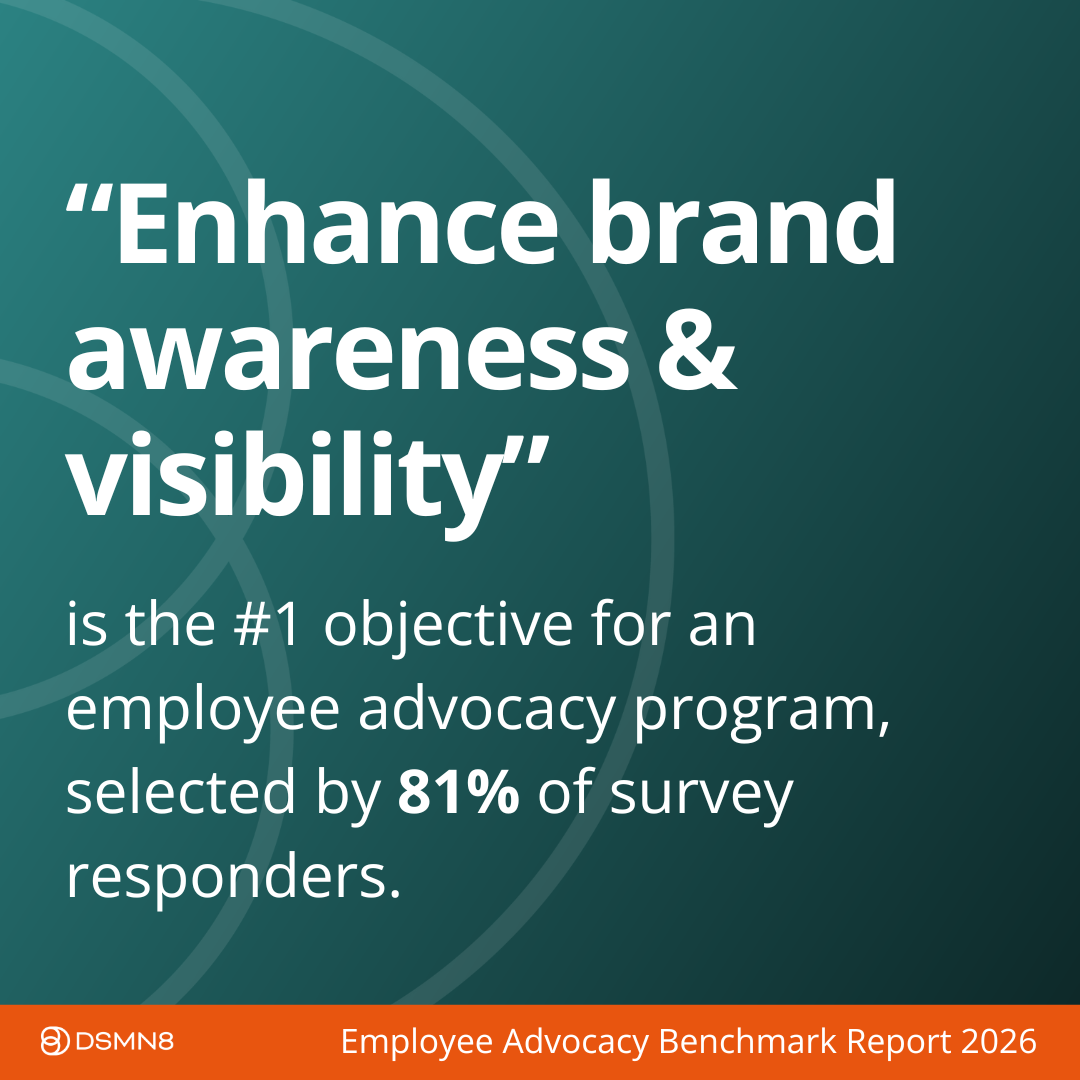
81% of programs identify brand awareness and visibility as their main objective, followed by increasing employee engagement and morale (60%), amplifying company culture and values (53%), and driving lead generation and sales (46%).
But the real-world impacts tell a more diverse story:
When asked about the main benefit of employee advocacy, 36% cited increased brand visibility, followed by enhanced employee engagement (17%), expanded reach and audience engagement (17%), and strengthened brand credibility (15%).
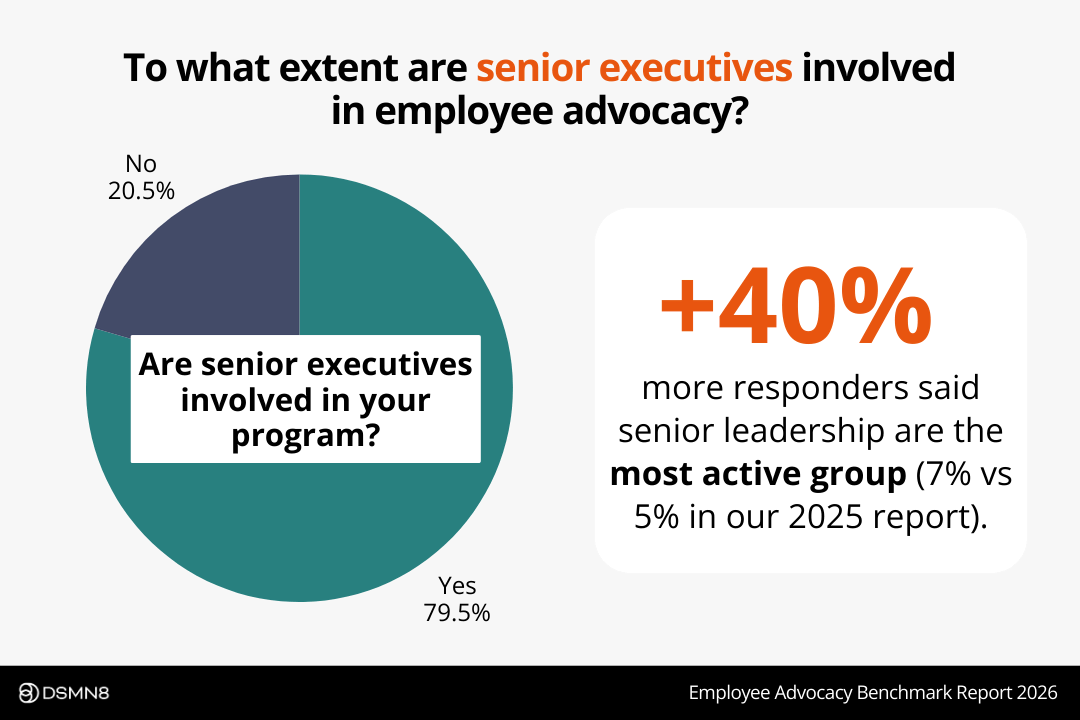
Executive involvement is rising dramatically.
79.5% of programs now involve senior executives, and for those that don’t, getting leadership engaged is the top priority for 2026.
How are executives participating?
45% of leaders actively share content, 41% support the program without direct involvement, and 29% are highly engaged and set an example for the broader organization.
Additionally, 25% encourage and mentor advocates, 20% promote the program internally, and 10% co-develop program strategy.
Respondents reported a 40% increase in senior leadership as the most active participant group compared to 2025 (7% vs 5% in last year’s report).
Explore DSMN8’s Executive Influencer tool to discover how easy it can be to support executives building a presence on LinkedIn.
Measurement focuses on impact, but benchmarking lags.
While 77% of teams track KPIs to monitor program success, only 44.44% are benchmarking against peers, a significant missed opportunity to understand competitive positioning.
The most common measurement methods include:
- Equivalent earned media value or cost-per-click (67%)
- Social media following growth (43%)
- Website traffic and conversions (43%)
- Social media engagement (36%)
- Brand awareness on social media (36%)
- Employee feedback (31%)
Leading organizations are looking beyond social metrics to track leads, cost savings, and business outcomes that reveal the true impact of advocacy.
Get a free competitor analysis review to understand where your program stands against up to 3 of your competitors.
The Future of Employee Advocacy
Looking ahead, program managers are focusing on three key priorities to strengthen their advocacy efforts in 2026:
Additional priorities include:
- Offering incentives or rewards (49%)
- Fostering a culture of sharing and collaboration (46%)
- Providing a wider range of content (38%), developing targeted communication campaigns (35%)
- Implementing feedback mechanisms (34%)
- Establishing clear goals and expectations (33%).
Sign up for our free Employee Advocacy Certification Course to learn more about best practices and strategies for success.
What This Means for Your Organization
Employee advocacy has clearly moved beyond experimental territory.
59% of program managers rate it as extremely or very important to their organization, and the data shows why.
The programs succeeding throughout 2025 and into 2026 share common characteristics:
- They’re deliberately designed with structure and intent.
- They provide training and clear guidance to build confidence.
- They involve executives meaningfully.
- They use technology to enable consistent participation.
- They measure impact beyond vanity metrics.
Most importantly, these organizations have recognized that employee advocacy isn’t about creating an army of corporate megaphones.
It’s about empowering employees to share authentic perspectives that audiences actually trust, creating value for both the organization and the individuals who participate.
The shift is clear: participation, on its own, is no longer the main constraint. Confidence, governance, and structure now determine impact.
About The Study
The Employee Advocacy Benchmark Report 2026 was conducted from August 9, 2025 to January 8, 2026, with 187 respondents.
68% are directly involved in managing their organization’s employee advocacy program.
67% of respondents hold Senior Managerial or Managerial roles. The majority work in Marketing (44%), Communications (20%), Employer Brand (13%), and HR (9%).
Industries represented include Technology (26%), Manufacturing (10%), Professional Services (10%), Telecommunications (4%), Automotive (6%), and Finance (4%), plus 25 other industries.
Most organizations have over 1,000 employees: 26% have 10,000+, 14% have 2,500-5,000, 17% have 500-1,000, and 12% have 1,000-2,000 employees.
Respondents were primarily based in the US (39%), UK (5%), France (7%), Germany (3%), Belgium (6%), and Australia (4%), plus 48 other countries.
FAQ
What is employee advocacy in 2026?
Employee advocacy in 2026 is no longer just about amplifying brand posts. High-performing programs treat it as a structured growth channel built on trust, training, governance, and measurement. Employees are empowered to share authentic perspectives, while organizations provide clear guidance, technology, and leadership support to ensure consistency and impact.
Why has employee advocacy become more important than paid social?
Paid social costs remain high and algorithms are increasingly unpredictable. The 2026 benchmark data shows employee advocacy consistently delivers lower cost-per-click than paid channels, often under $1, while also driving higher trust and engagement. Audiences respond more strongly to real employee voices than to polished brand advertising.
Which departments are most active in employee advocacy programs in 2026?
Sales teams are now the most active participants, accounting for 33% of advocacy activity. This reflects a shift toward revenue-aligned advocacy. Program ownership remains distributed across HR (39.6%), Marketing (33.9%), and Corporate Communications (17%), showing that advocacy supports multiple business objectives.
How often do employees post as part of advocacy programs?
Participation is increasing year over year. In 2026, 68% of employee advocates post three or more times per week, and 21% post more than five times weekly. This increase is closely linked to better training, clearer expectations, and access to ready-to-share content.
Do employees benefit personally from employee advocacy?
Yes. According to the 2026 benchmark report, 94% of employee advocates say posting on LinkedIn has benefited their careers. Advocacy helps employees build personal brands, expand professional networks, and increase visibility within their industries, making programs mutually beneficial for both organizations and individuals.
What role does training play in successful employee advocacy programs?
Training has become standard practice. In 2026, 87% of program managers provide some form of advocacy training. The data shows the biggest barrier to participation is uncertainty about what to share, not lack of motivation. Structured training, clear policies, and practical examples significantly increase confidence and participation.
How is AI being used in employee advocacy programs?
AI is now the norm. 92% of employee advocacy programs use AI to scale content creation. However, the most successful programs combine AI efficiency with personalization. Many organizations provide tone-of-voice guidelines or encourage employees to customize content so posts still feel authentic and human.
How involved are executives in employee advocacy programs?
Executive involvement is rising rapidly. Nearly 80% of programs now involve senior leaders, with executives actively sharing content, mentoring advocates, or supporting strategy. Programs with visible leadership participation see higher engagement, stronger credibility, and greater internal adoption.
How do organizations measure the success of employee advocacy in 2026?
Most teams track KPIs such as reach, engagement, website traffic, and cost-per-click. However, fewer than half benchmark against peers. Leading organizations are moving beyond vanity metrics to measure leads, sales impact, cost savings, and long-term brand value to demonstrate true ROI.
What are the biggest trends shaping employee advocacy in 2026?
Key trends include increased use of AI, stronger executive participation, wider adoption of video content, and a greater focus on training and governance. The most successful programs are deliberately designed rather than improvised.
What makes an employee advocacy program successful in 2026?
Successful programs share common characteristics: clear structure, ongoing training, executive involvement, technology to support scale, and meaningful measurement. Above all, they prioritize employee confidence and authenticity over sheer volume of posts.

Emily Neal
SEO and Content Specialist at DSMN8. Emily has 10 years experience blogging, and is a pro at Pinterest Marketing, reaching 1 million monthly views. She’s all about empowering employees to grow their personal brands and become influencers.