

What's on this page:
- The Funnel Is Dead, But Inbound Isn’t.
- Discovery Has Shifted Upstream.
- LLMs Reward Brands with a Strong Online Presence.
- The Return of Brand Content (On New Terms).
- People Are The New Distribution Layer.
- Brand as a Growth Lever.
- What Modern Brand Marketing Looks Like in Practice.
- From Content Pieces to Brand Ecosystems.
- Final Thoughts & Additional Resources.
- FAQs.
For over a decade, marketing teams optimized for a familiar user journey: attract → convert → close.
Publish the right content, rank for the right keywords, capture demand at the right moment.
That model worked brilliantly for a long time.
But the environment it was built for has evolved.
Today, discovery happens through AI summaries, social media feeds, peer recommendations, and repeated exposure. This often happens long before someone ever lands on your company website.
The issue isn’t that inbound marketing stopped working. It’s that the funnel it relies on no longer reflects how people actually discover, trust, and choose brands.
And that’s why the concept of ‘brand’ is back at the centre of growth.
The Funnel Is Dead, But Inbound Isn’t
Let’s be clear: inbound marketing isn’t obsolete.
Educational content, SEO, and helpful resources still play a critical role, particularly when buyers are already problem-aware and actively researching solutions.
What is outdated is the idea that growth follows a neat, linear funnel.
Modern buyer journeys are non-linear, repetitive, influenced by people as much as platforms, and shaped long before a form fill ever happens.
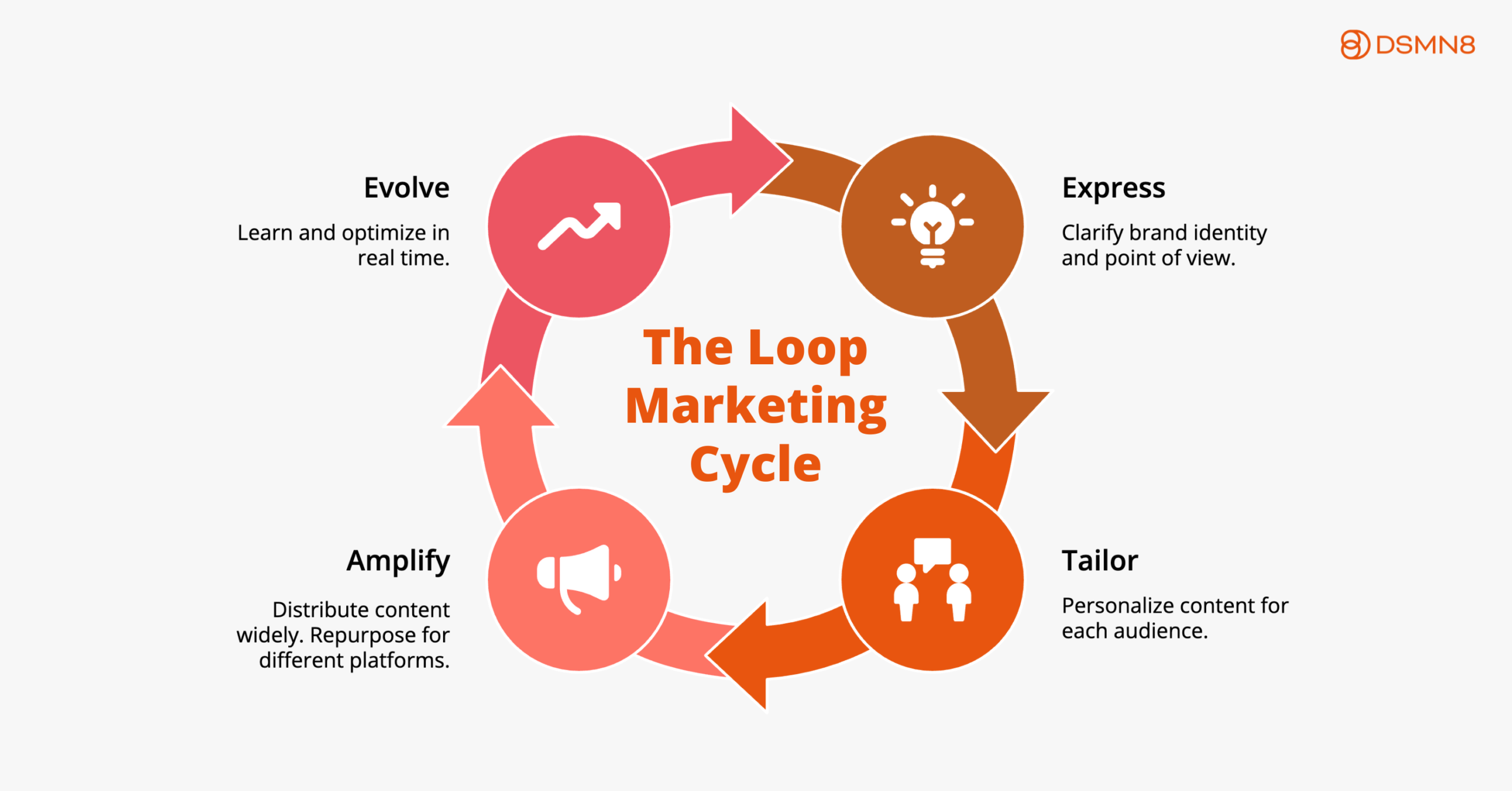
This is why frameworks like HubSpot’s loop resonate today. Growth doesn’t move in one direction. It compounds.
Customers influence prospects. Employees influence perception. And brand experiences echo long after the first interaction.
The funnel assumes control, whereas the loop acknowledges reality.
Discovery Has Shifted Upstream
One of the biggest changes marketers are grappling with is where discovery actually happens.
Increasingly, it’s not on your website.
AI tools primarily summarize answers instead of sending clicks. Search results increasingly resolve intent without a visit.
This creates a visibility paradox: your content can be influential without ever being visited.
In this environment, optimization alone isn’t enough.
If a brand isn’t recognized, remembered, or talked about, it simply doesn’t surface – whether that’s in an LLM response, a buying committee conversation, or a LinkedIn feed.
This is where ‘brand’ re-enters the conversation. Not just as a creative layer, but as a growth mechanism.
LLMs Reward Brands with a Strong Online Presence
Large language models don’t “rank” content the way search engines do. They synthesize patterns.
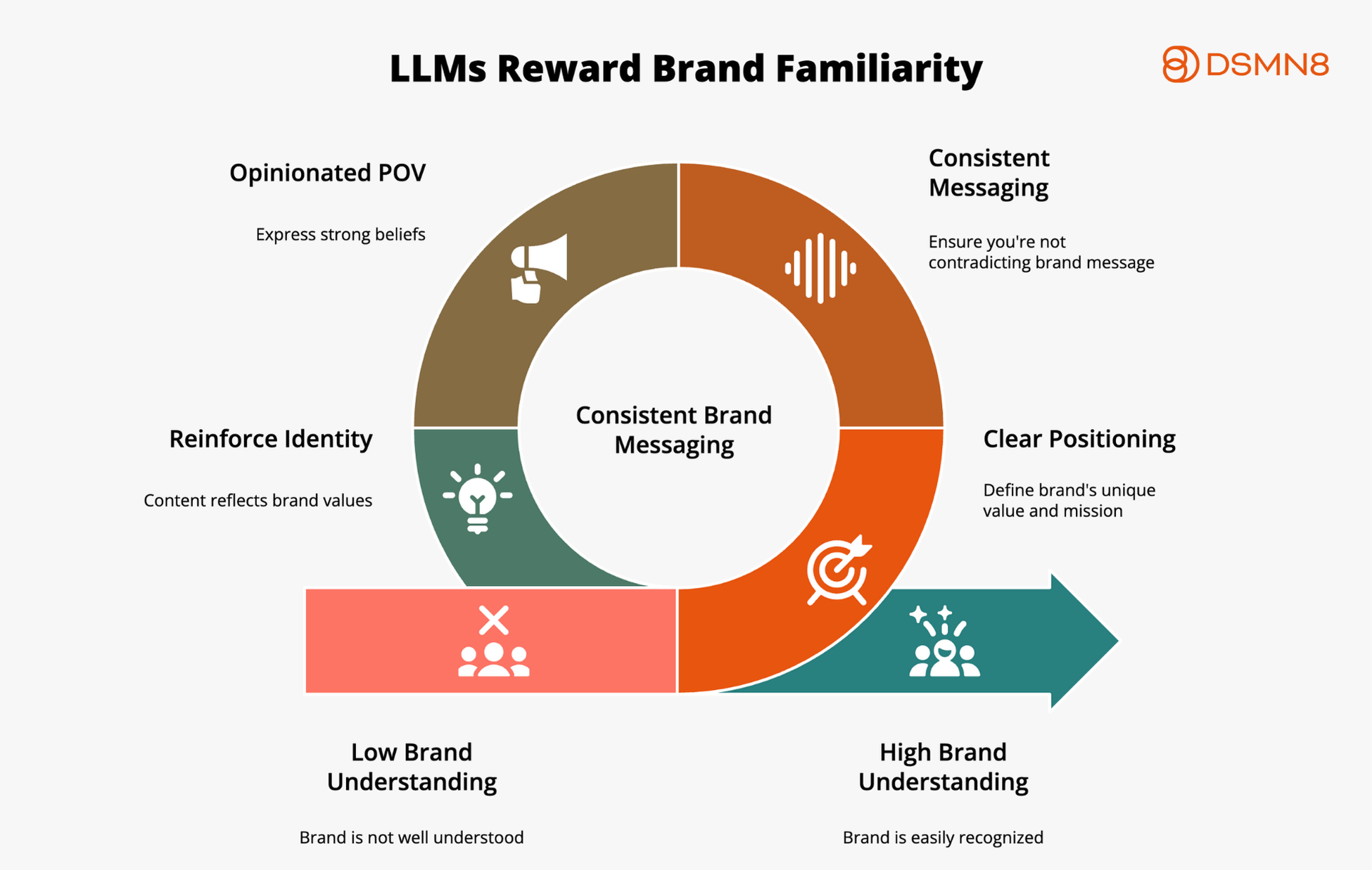
They surface brands that are frequently mentioned across the web, semantically consistent, clearly positioned, and visible across multiple trusted contexts.
In other words, LLMs reward familiarity.
Every mention, shared perspective and repeated narrative contributes to this.
That shift brings brand and content closer together than ever before. It’s no longer enough to publish more.
Brand content means clear positioning and POV, consistent language, and content that reinforces identity rather than just answering questions people might be searching for.
Let’s say your CEO posts on LinkedIn, celebrating positive company culture. Meanwhile, your employees are praised on review sites like G2 for being helpful. At the same time, your employees are sharing content about team meetups and writing positive Glassdoor reviews. This all contributes to an excellent employer brand.
When graduates are looking for great companies to join, they might ask a tool like ChatGPT what it’s like to work at your company. All of the behaviour demonstrated above could be surfaced by an LLM to inform the answer given.
The Return of Brand Content (On New Terms)
When I say “brand content is back,” I don’t mean a return to glossy campaigns or tons of top-of-funnel fluff.
Modern brand content looks different.
It’s human, not corporate. Opinionated, not neutral. Distributed through people, not just company channels.
Brand today is built through familiarity, not virality.
The goal isn’t to win attention once; it’s to be recognized everywhere.
This is fundamentally different from the viral-or-bust mentality that dominated social media marketing for years.
Instead of chasing a single breakout moment, modern brand building is about creating hundreds of small, consistent touchpoints that accumulate into recognition.
Think about the brands you trust in your own buying decisions.
Chances are, you didn’t discover them through a single viral post or a perfectly optimized landing page. You heard them mentioned by colleagues. You noticed their CEO’s perspective in your feed repeatedly. By the time you actively looked for a solution, they were already familiar.
That’s the brand effect in action.
People Are the New Distribution Layer
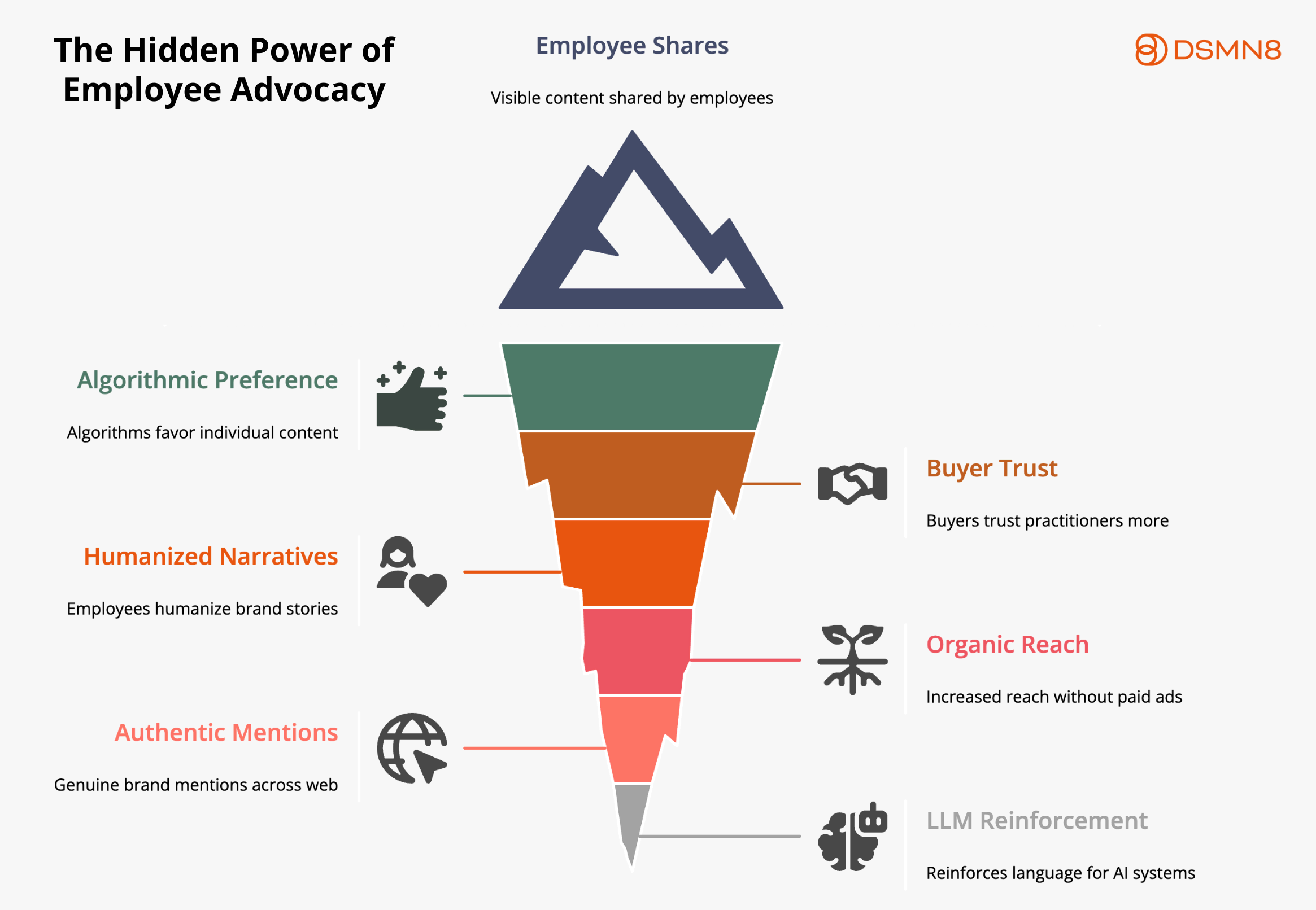
Social media algorithms increasingly reward individuals over organizations.
DSMN8 data revealed that a CEO can dramatically outperform a company page on LinkedIn, generating the same level of engagement with 98% fewer followers. Imagine what they could do with an even larger audience?
This makes employees one of the most powerful (and underused) brand assets available.
When employees share, they humanize your brand, increase reach organically, create authentic brand mentions across the web, and reinforce the narrative and positioning LLMs rely on.
Employee advocacy isn’t a “nice to have” in this environment. It’s infrastructure.
It allows brands to show up repeatedly, credibly, and at scale, without relying on paid demand or one-off campaigns.
If even just 50 people at your organization share content semi-regularly, they’ll create exponentially more touchpoints and reach more people than your corporate account alone ever could.
Each of those shares carries implicit endorsement. Each one extends the brand’s semantic footprint across the web. And each one contributes to the pattern recognition that both buyers and AI systems rely on.
This isn’t about turning employees into corporate spokespeople. It’s about enabling the people who already believe in the work to express that belief in their own voice. The authenticity is what makes it work.
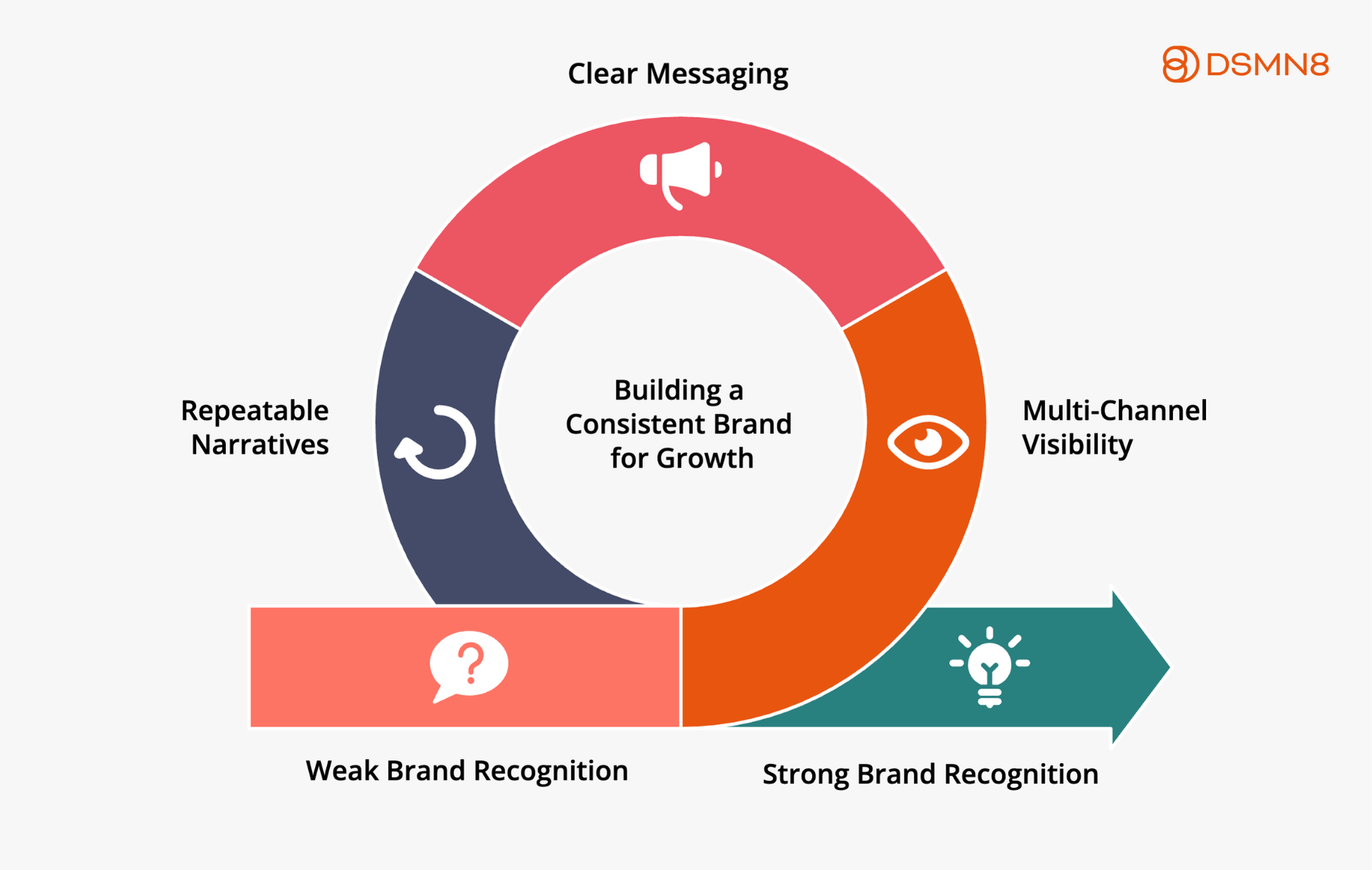
Brand as a Growth Lever, Not a "Nice to Have"
Here’s where the conversation needs to shift for leadership teams.
Brand isn’t soft. It’s not the thing you invest in when everything else is working. It’s not a creative indulgence.
Brand drives shorter sales cycles, higher conversion rates, better hiring, and stronger LLM visibility.
What leaders often miss is this: you can’t “turn on” brand at pipeline risk moments. Brand compounds quietly.
The brands entering 2026 with the most momentum are consistently visible and clear about what they stand for, across the channels where their buyers spend time.
In practical terms, a strong brand means your sales team hears “we’ve been following your content” instead of “tell me what you do.”
It means inbound inquiries come pre-qualified. It means candidates want to work for you. And it means when an AI tool is asked for recommendations in your space, your name appears.
Wondering how active your employees are on social media already?
Get a free competitor analysis review to find out!
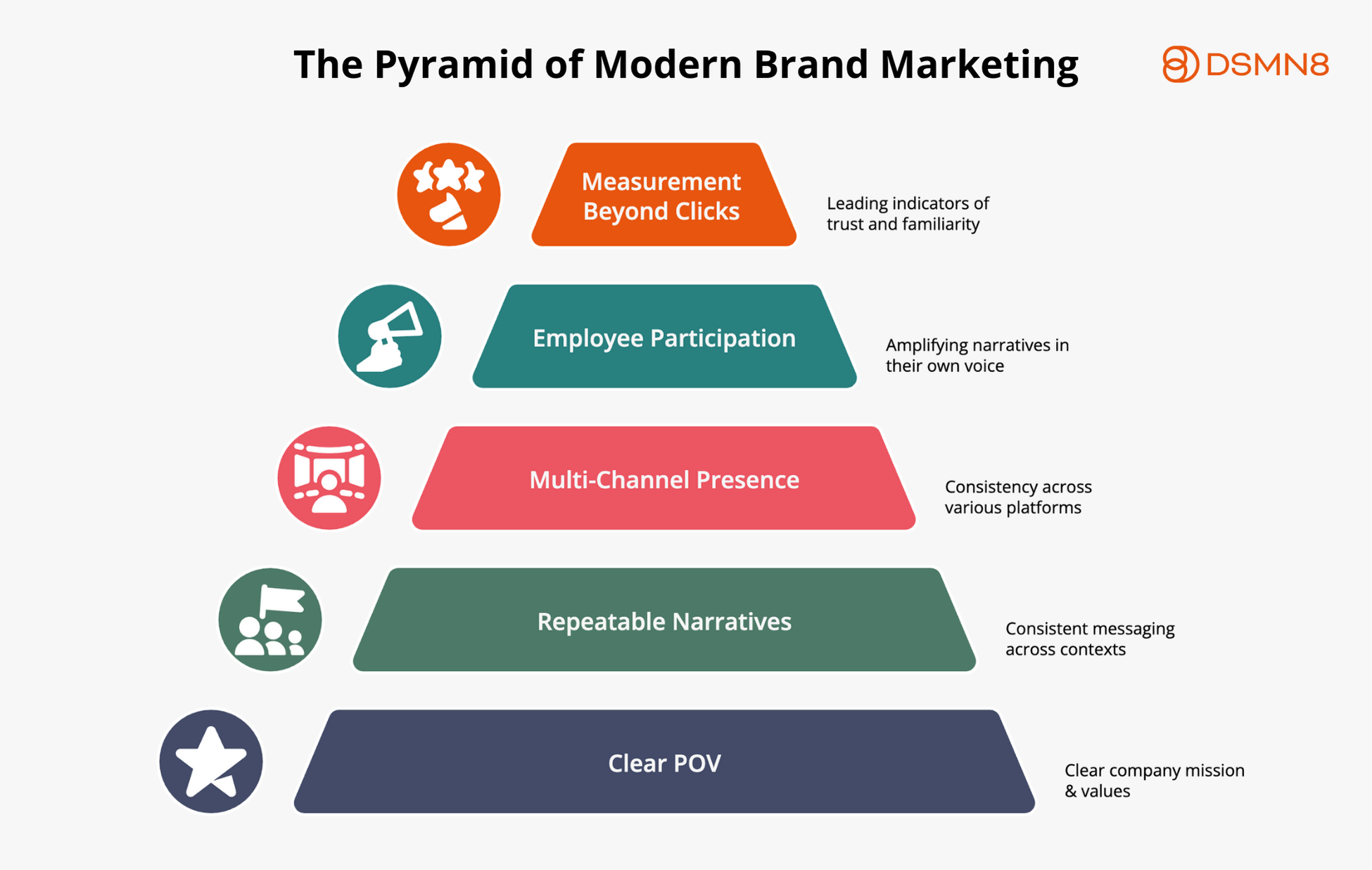
What Modern Brand Marketing Looks Like in Practice
So what does this actually mean for marketing teams trying to build brand in 2026?
It starts with a clear POV. Not just what you sell, but what you believe and stand for.
What you think is broken in your industry and how you’re approaching it differently. This becomes the north star for everything else.
From there, it’s about repeatable narratives. Not saying something different every week, but saying the same essential things in multiple ways, across multiple contexts, until they become associated with your brand.
It requires multi-channel presence, not because you need to be everywhere, but because buyers are everywhere, and consistency across contexts builds recognition.
The final component is employee participation. When the people inside your organization amplify your narratives in their own voice, brand scales in a way corporate channels simply can’t achieve alone.
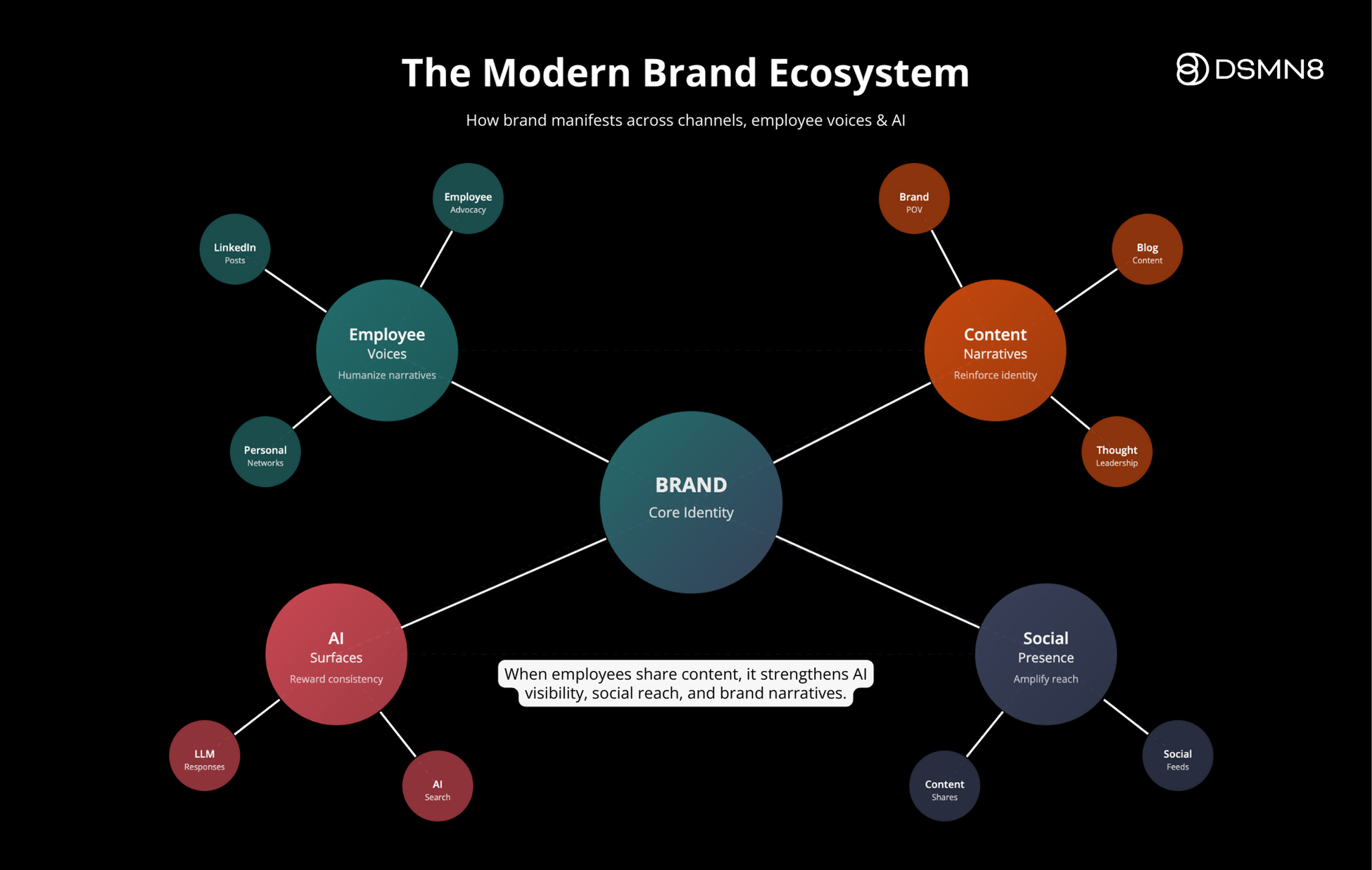
From Content Pieces to Brand Ecosystems
Winning brands aren’t simply publishing more content. They’re building cohesive ecosystems.
That means fewer messages, repeated often. Your goal is to create clear narratives echoed across voices and channels.
I’m talking about participation from marketing, leadership, and employees. Visibility across social, earned media, community, and AI.
At this point, brand stops being owned by one team. It becomes something the organization expresses collectively.
It requires saying no to random content ideas that don’t reinforce core narratives. It means coordinating across teams. It requires patience, because ecosystems don’t produce immediate spikes in MQLs.
But over time, the impact compounds. Every piece reinforces every other piece. Every employee voice strengthens every other employee voice.
This isn’t about abandoning performance marketing. It’s about recognizing that performance marketing works better when it’s built on a foundation of brand.
Final Thoughts & Additional Resources
Inbound captures demand. Brand creates it. Advocacy scales it. LLMs reward it.
The question isn’t whether to invest in brand. It’s whether you can afford not to.
Because while you can turn on paid ads tomorrow, you can’t manufacture familiarity on demand. That only comes from showing up, repeatedly, until recognition becomes trust, and trust becomes choice.
The good news? You can start today. Clear positioning. Consistent narratives. Enabling your people. Building presence where your buyers already are.
And in an LLM-led world, that’s what growth looks like.
Ready to get started with the #1 employee advocacy platform?
Wondering how active your team already is, and how this compares with your competitors?
Get a free competitor analysis review.
More on AI and employee advocacy:
FAQs
Is inbound marketing dead?
No, inbound marketing still plays a vital role in capturing existing demand. What’s changed is the idea of a linear funnel. Buyers now discover brands through AI tools, social feeds, and peer recommendations long before they actively search. Inbound works best when it’s supported by strong brand visibility and trust.
Why do marketers say the funnel is dead?
The traditional funnel assumes a straight-line journey from awareness to conversion. In reality, modern buying journeys are circular, non-linear, and influenced by multiple touchpoints over time. Frameworks like the HubSpot Loop better reflect how growth compounds through brand, experience, and employee advocacy.
Why is brand becoming more important in B2B marketing?
As discovery moves away from websites and toward AI summaries and social platforms, brand recognition and familiarity matter more than ever. Strong brands are remembered, mentioned, and trusted, even when buyers don’t click through to a website.
How do LLMs and AI search tools affect brand visibility?
Large language models don’t rank content in the same way as search engines. They surface brands that are frequently mentioned, clearly positioned, and consistently represented across the web. This makes brand mentions, language consistency, and multi-channel presence critical for visibility in AI-led discovery.
What is semantic branding?
Semantic branding focuses on how a brand is understood, not just found. It’s about using consistent language, messaging, and positioning so both people and AI tools can clearly associate your brand with specific ideas, problems, and expertise.
What role does employee advocacy play in brand building?
Employee advocacy helps scale brand visibility through real people. When employees share content and perspectives, they humanize the brand, extend reach organically, and increase authentic brand mentions across channels. This strengthens trust with buyers and AI systems alike.
How does employee advocacy support inbound marketing?
Employee advocacy creates awareness and trust before inbound tactics capture demand. By increasing brand familiarity upstream, advocacy makes inbound content more effective when buyers are ready to engage.
How should brands measure success beyond clicks and traffic?
In a zero-click, AI-led environment, success is better measured by indicators such as reach, share of voice, brand mentions, and self-attribution (e.g., how did you hear about us? in contact forms).


Emily Neal
SEO and Content Specialist at DSMN8. Emily has 10 years experience blogging, and is a pro at Pinterest Marketing, reaching 1 million monthly views. She’s all about empowering employees to grow their personal brands and become influencers.