

You’re thinking about starting an employee advocacy program…
But it looks like a lot of work. So you’re wondering – is it worth the effort? 🤔
Why is employee advocacy important?
How does brand advocacy benefit my business?
Well, we’ve got the answers!
You probably already know what employee advocacy is.
In case you’re not sure, let’s quickly break it down for you. 👇
What is Employee Advocacy?
In its simplest form, employee advocacy is when employees act as brand ambassadors or spokespeople for their employer.
This can range from word-of-mouth recommendations to sharing brand posts on social media to creating original content about the business.
Let’s take a quick look at the history of employee advocacy to understand why it’s become an important strategic function:
The History of Employee Advocacy
If we go back to its literal definition, employee advocacy has been going on for as long as companies have hired people!
Without encouragement, employees have advocated for their organizations in various ways, whether through word of mouth or by sharing company news with their peers.
However, the concept of employee advocacy as a marketing strategy, and the development of employee advocacy platforms that enable companies to encourage employee advocacy, emerged in the late 00s.
Many would argue that this was too early to try to leverage employee advocacy. After all, sites like Facebook were in their infancy, and LinkedIn was used primarily to host CVs and apply for jobs.
People simply weren’t interested in building their professional personal brand online as they are today, primarily because the opportunity just wasn’t there.
As a result, many companies that launched tools around 2009 pivoted their strategy to employee engagement/internal communications platforms.
Fast forward to 2016/2017, when people began using sites like LinkedIn to advance their careers and build their personal brands, and the employee advocacy trend (as we know it today) exploded.
Then, the pandemic hit in 2020, and the whole world woke up to the potential of employee advocacy at a time when marketing and communications budgets were being slashed.
Why is Employee Advocacy Important for Businesses?
As mentioned, the emergence of personal branding opportunities brought about by LinkedIn’s changes got everyone thinking, but the catalyst for the employee advocacy boom was the COVID-19 pandemic.
When countries began imposing lockdowns in early 2020, markets panicked, triggering a cascading effect that led companies to implement cutbacks and marketers to identify the most cost-effective and impactful marketing methods.
Consumer demands changed, and people craved authenticity from brands above all else. That remains true to this day.
A successful employee advocacy program can skyrocket your business. For real.
Think about it for a sec. If you have a team of engaged employees actively using social media to build brand awareness, share of voice, and their own influence, the results can be tremendous.
Reach
These days, organic reach on social can be pretty limited for brands. X, Instagram, Facebook, LinkedIn… they all want you to pay for ads and sponsored posts 😬
As a marketing team, it can feel like we’re shouting into the abyss. We all have posts that end up with 100 impressions and hardly any likes – it happens to the best of us.
But what if your employees use social media to engage with and share your posts? What if they create their own branded content? The sky’s the limit.
Here’s a crucial insight: LinkedIn’s algorithm does not prioritize company pages. The best way to reach your audiences on the site is through your people.
This became so significant that Gartner predicted that 90% of B2B marketing strategies would include employee advocacy programs by 2023.
Remember, employee-shared messages have been shown to reach up to 561% further than the brand’s own messages.
Meaning if 90% of your competitors are set to launch employee advocacy programs, they’ll be able to reach 5x as many people as you by leveraging their employee networks.
Cost
Alright, so we’ve established that an employee advocacy strategy means you’ll be able to spend less (or maybe zero) on social media ads.
But what is the ROI on employee advocacy programs? Hint: it’s high. Especially if you’re using an advocacy platform to help employees create and share content.
We’ve got a mountain of data from our clients here at DSMN8, and we can reveal some statistics:
- DSMN8 has an average CPC of $0.76. That’s significantly lower than the $10-15 you’ll see on LinkedIn ads.
- AkzoNobel drove $100,000 in comparative media spend in just over a year… with less than 300 employees using the platform!
- General Motors reached 20 million people in just 6 months using DSMN8.
Can you afford to ignore that?

Authenticity
Another key factor to consider is authentic employer branding.
What do you want prospective customers, clients, or recruits to see on your socials? 👇
A) Nothing.
B) Corporate updates.
C) Genuine engagement from employees, insightful thought leadership, cool stuff your business is doing, behind-the-scenes at your office…
If you answered C, you’re on the right track!
People want to hear from people, and as an organization, you’re sitting on a large, untapped marketing resource with its own audience: your people.
Employer branding goes beyond your official channels. You need to consider how employees use social media and how they represent your company.
Think about it in a similar way to dress codes: you might wear a suit to the office, or you might be super casual. It depends on your business and brand.
Now think about social media: what tone of voice do you use? Is it professional and serious, or more chatty and upbeat?
You want to establish a social media presence that represents your business and teach your employees how to manage it. Provide guidelines, a social media policy, and educate employees on how to use social media effectively.
OK, that’s a lot. You might be thinking, “I don’t have enough time for this”, or “Where do I even start?!” 🤷🏻♀️
Don’t panic!
First of all, grab our free social media policy template ✅
Next, read our ultimate guide to employee influencers. It’s jam-packed with info ✅
Finally, why not book a demo with DSMN8? Our intuitive platform makes employee advocacy a piece of cake 🍰

Why Should Employees Use Social Media?
Why would I want my employees using social media at work?
Isn’t that just a waste of time? 😡
Absolutely not!
Employees are the best brand ambassadors.
They know why your company culture is great.
They know all about what the business does, and many of them are experts!
Your senior leadership may already be industry thought leaders, and lots of your colleagues probably have a social media presence. Some of them might even be micro influencers.
Think about the potential! 📈
These days, people trust brands less and less.
We’re constantly seeing adverts, especially online.
So how can marketers create a social presence with authenticity? Employee influencers.
Real people, talking about their work, sharing value with their audience, and building community.
What's In It For The Employees?
We’ve covered the basics and explained why employee advocacy is important…
You need to know why it’s great for employees, too.
An employee advocate gets to:
- Improve their skillset – yes, social media is a valuable skill! 😅
- Build a personal brand, which could lead to incredible opportunities.
- Feel like their voice has value – because it does!
Read our full guide to the benefits of employee advocacy for employees.
Why Use Employee Advocacy for Recruitment?
One of the top benefits of an effective employee advocacy program is that it elevates recruitment.
Candidates today use Glassdoor and LinkedIn to research a company before applying or interviewing for a job.
It’s more important than ever to build a positive online presence. No bad vibes here! 😇
Employee engagement on social media humanizes your brand, highlights your workplace culture, and it’s super convincing, too.
If an employee shares a job opening and says, “Hey, I love working here because of x,y,z, come join us!”, it’s much more persuasive than a brand talking about its company culture.
Encourage employees to grow their LinkedIn presence, especially if they work in recruitment.
How Employee Advocacy Improves Sales
Salespeople benefit massively from employee advocacy 💪
Especially if they’re pros at social selling!
Think about it…
If you’re using LinkedIn for social sales, sharing and creating brand content will:
- Amplify your audience.
- Increase conversations, opportunities, and connections.
- More inbound leads.
There’s no better way to boost your online presence as a salesperson than by adding value.
Why Use An Employee Advocacy Platform?
Now that you know why employee advocacy is important for building brand awareness, recruiting, and employee engagement, it’s time to consider employee advocacy platforms.
Managing an employee advocacy program can be time-consuming and confusing for employees. Especially if they’re not well-versed in content creation!
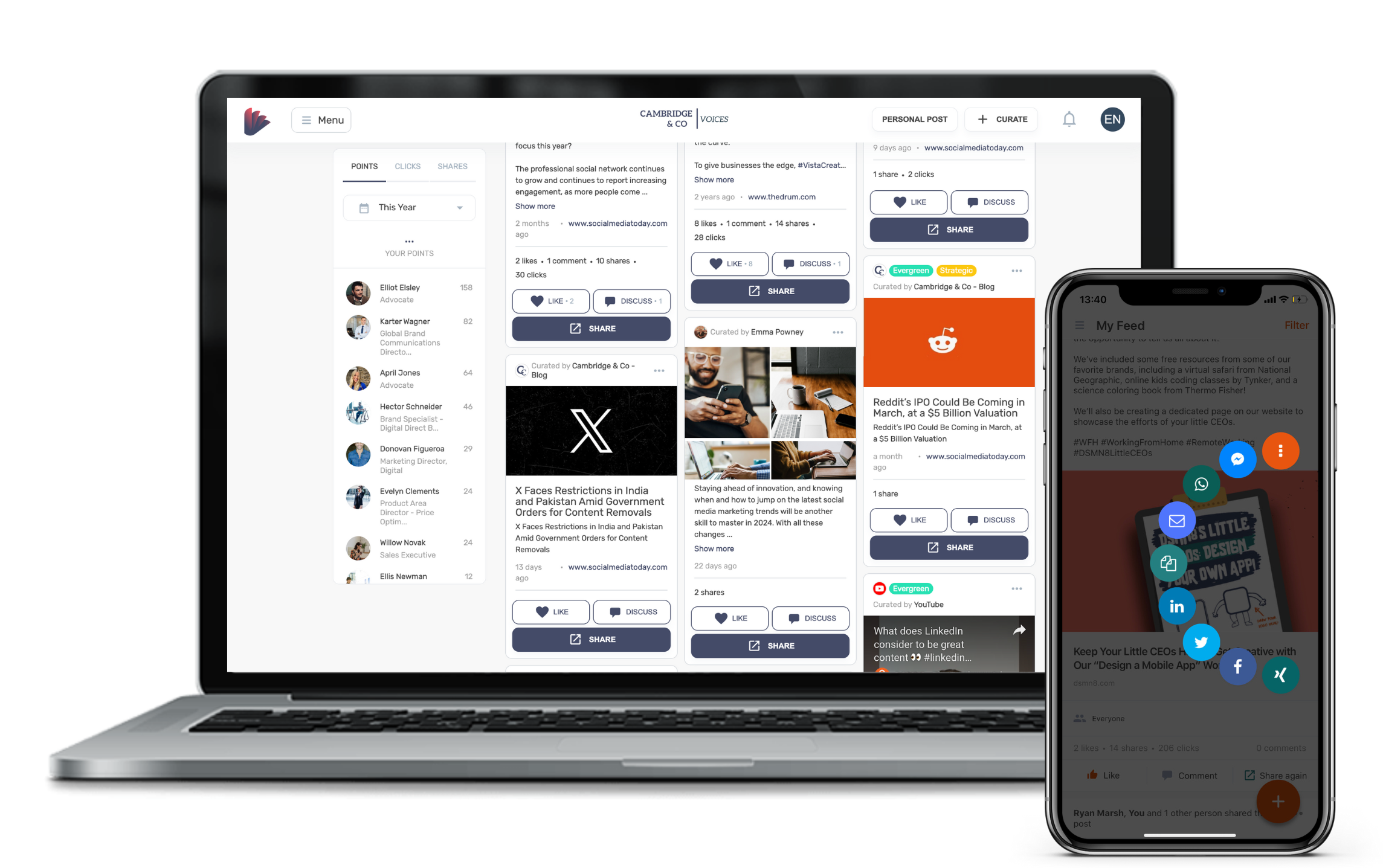
Using a platform like DSMN8 streamlines the whole process.
We make it easy for employees to become influencers through features such as automation, segmenting content for different teams, and detailed analytics.
Let’s break it down 👇
Content Curation
Your marketing team puts a lot of effort into content marketing. Let’s make sure it gets seen.
DSMN8 automatically pulls content from your sources (blog, social channels) into the platform, ready for colleagues to share.
That’s not all.
We also offer a feature called Dynamic Display, which lets content admins add multiple titles, captions, and images to each post. This ensures that all your employees aren’t sharing the same information at the same time. No one likes spam!
Automations keep everyone involved, even if they don’t have time for social media every day. Our platform uses Smart Scheduling to share posts at optimal times to boost impressions and engagement.
Teams
Segment your company content so your employee advocates don’t get overwhelmed! No one wants to see absolutely everything.
Our teams feature is ideal for large enterprises operating in many regions with different languages.
We can also categorize content by department, such as marketing, sales, or events.
This allows each employee to see the content relevant to them and easily share it with their audience.
All the Analytics

With DSMN8, you can keep an eye on all the data, from employee leaderboards to earned media value.
Our analytics dashboard includes automatic UTM tracking, making it easy to see how everyone is doing.
The ability to monitor performance and growth is key, so you can figure out what’s working!
Gamification
Use our gamification functions to encourage participation – keep the momentum going!
DSMN8 leaderboards make it easy to see who on your team is excelling on social.
A great way to build support for your new advocacy strategy is by recognizing your top employee influencers – this could be anything from a thank-you to a prize.
People Also Ask
Why is Employee Advocacy Focused on LinkedIn?
Employee advocacy programs are predominantly focused on LinkedIn because it is a professional network. Employees are less likely to share company content on networks they consider for personal use. While we’ve seen great results from organizations using social media platforms like Instagram and Facebook as part of their strategy, the results seen from LinkedIn are astounding.
What is an Example of Employee Advocacy?
Employee advocacy, in its purest sense, is the promotion of a business or its products and services by the company’s employees. For example, an employee might share company news on LinkedIn. Another form of employee advocacy is an employee promoting their company as a place to work by sharing behind-the-scenes content with their network. Check out some examples of employee advocacy from our client success stories.
Ready to get started with the #1 employee advocacy platform?
Wondering how active your team already is, and how this compares with your competitors?
More resources you’ll find helpful:

Emily Neal
SEO and Content Specialist at DSMN8. Emily has 10 years experience blogging, and is a pro at Pinterest Marketing, reaching 1 million monthly views. She’s all about empowering employees to grow their personal brands and become influencers.