

What's on this page:
- Why Employee Advocacy Program Governance Matters.
- Where Should Employee Advocacy Live in Your Organization?
- The Architecture of an Employee Advocacy Program: Best Practices.
- Best in Class Programs: Advanced Strategy.
- Employee Advocacy Program Structure Template.
- Getting Started.
- Additional Resources
A common challenge for organizations launching employee advocacy programs is determining where responsibility sits.
Who should be responsible for which components of managing a program?
Whose job is it to manage the community with internal posts and newsletters, and who should invite users and provide training?
Beyond initial launch, effective advocacy requires a continuous flywheel of program management that sustains engagement, nurtures participation, and evolves over time rather than relying on a single campaign moment.
While this all depends on your organization’s structure, program size, and the teams involved, there are benchmarks to help you set up for success.
Here you’ll find our recommendations from experience supporting employee advocacy programs in medium-sized businesses to global enterprises, along with a framework and template for program leaders to map out responsibilities and ensure nothing is missed.
Why Employee Advocacy Program Governance Matters
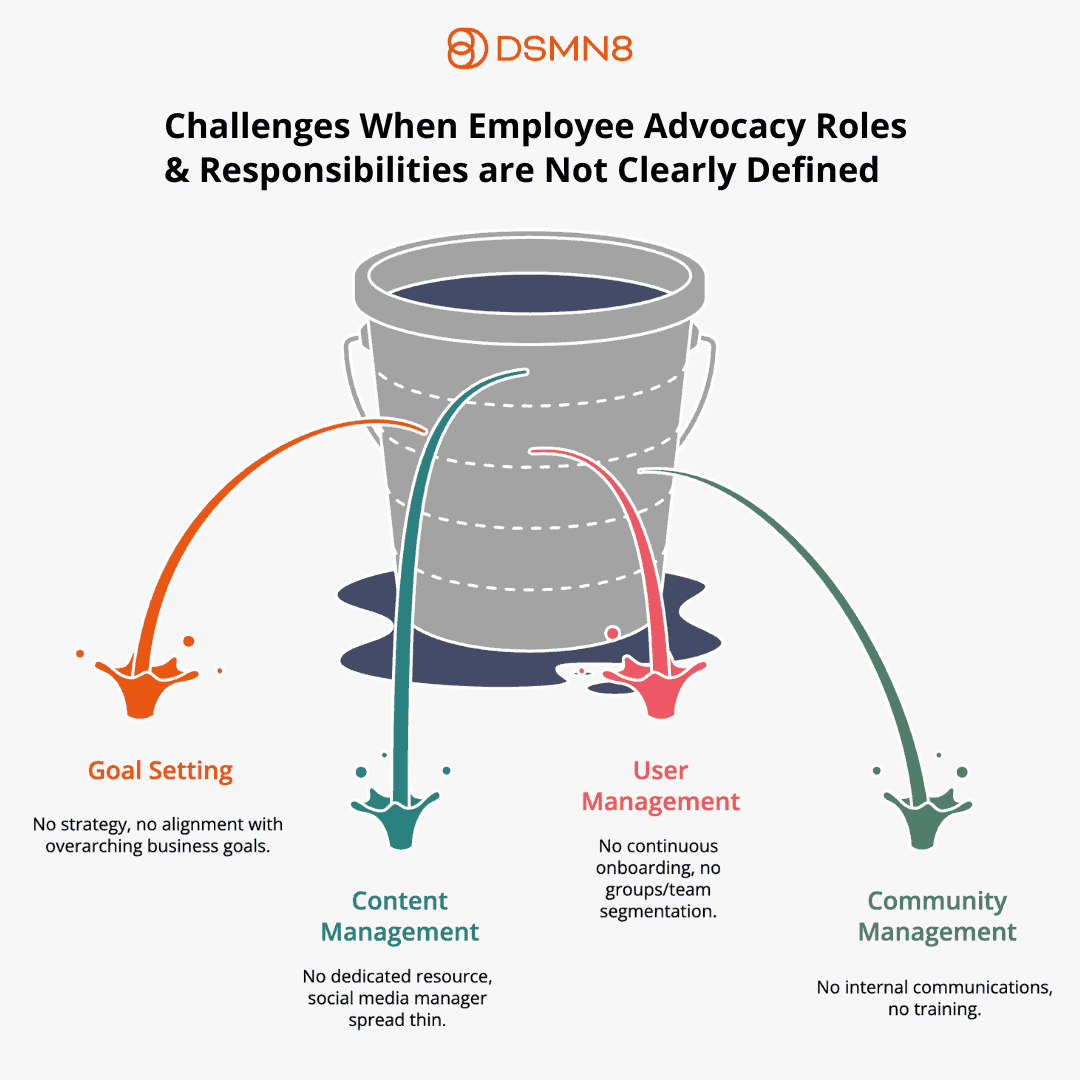
Without clear governance, employee advocacy programs can quickly stall.
Content gets published inconsistently.
Advocates don’t know where to go for help.
Analytics sit unreviewed.
Ultimately, leadership loses confidence in the program.
The most common pitfall we see is assuming one person can handle everything. With a small program, that’s absolutely possible.
But with larger programs, scaling this way becomes extremely challenging.
You’ll need several content curators, admins, and team leaders. This is particularly important when managing multiple regions, departments, and languages.
For a clear structure in program governance, we recommend ensuring these four areas are covered:
1. Goal Setting & Governance: Someone needs to set the strategy, align with business priorities, and report results to leadership.
2. Content Management: Creating and curating shareable content requires dedicated resources with the right skills.
3. User Management: Inviting and managing users and setting up groups and teams as your program expands.
4. Community Management: Internal communications, training, and responding to advocate queries keeps the program alive.
When these responsibilities are clearly assigned, programs scale smoothly. When they’re not, even programs with the best technology struggle.

Where Should Employee Advocacy Live in Your Organization?
There’s no universal answer to departmental ownership, but there are patterns among successful programs.
Marketing-led programs tend to focus on brand awareness, thought leadership, and demand generation. They excel at content creation and measuring business impact but may need support from HR or communications to drive internal adoption.
Communications-led programs prioritize aligning with corporate messaging and are particularly effective during organizational change or crisis management. They have strong internal relationships but may need marketing’s support for content creation and external metrics.
Employer Brand or HR-led programs naturally emphasize talent attraction, culture amplification, and employee engagement. They understand what motivates employees, but often need marketing or communications expertise for content strategy.
Cross-functional programs involving multiple stakeholders tend to produce the strongest outcomes. A marketing lead with an employer brand co-sponsor, for example, can drive both external reach and internal engagement.
The program lead should sit in Marketing, Communications, or Employer Brand/HR. Make sure to involve your Business Development and/or Commercial team as well, as they can significantly impact results and influence participation.
Crucially, your program lead needs sufficient seniority to coordinate across departments, secure resources, and communicate the impact to leadership.
Even when one department owns the program, supporting stakeholders from other functions are a major contributor to success.
In compliance-heavy industries like Financial Services or Pharmaceuticals, your Legal team may need to be in the loop.
The Architecture of an Employee Advocacy Program: Best Practices
The right governance structure depends on your program size. What works for a 100-user program creates bottlenecks at 500 users.
Below are three tiers of program structure, starting with the minimum for small programs and scaling up to enterprise-level initiatives.
Bare Minimum: Small Programs
A single program champion can manage everything in a small program: strategy, content curation, user invitations, community management, and reporting. This works when testing the concept within one department or region.
The limitation is that it doesn’t scale.
One person can’t produce enough content variety, provide adequate support, or analyze results deeply while also managing the strategic direction. Especially if they’re already a social media manager spread thin from creating content for brand channels.
Recommended Structure for Programs with 250-500 Users
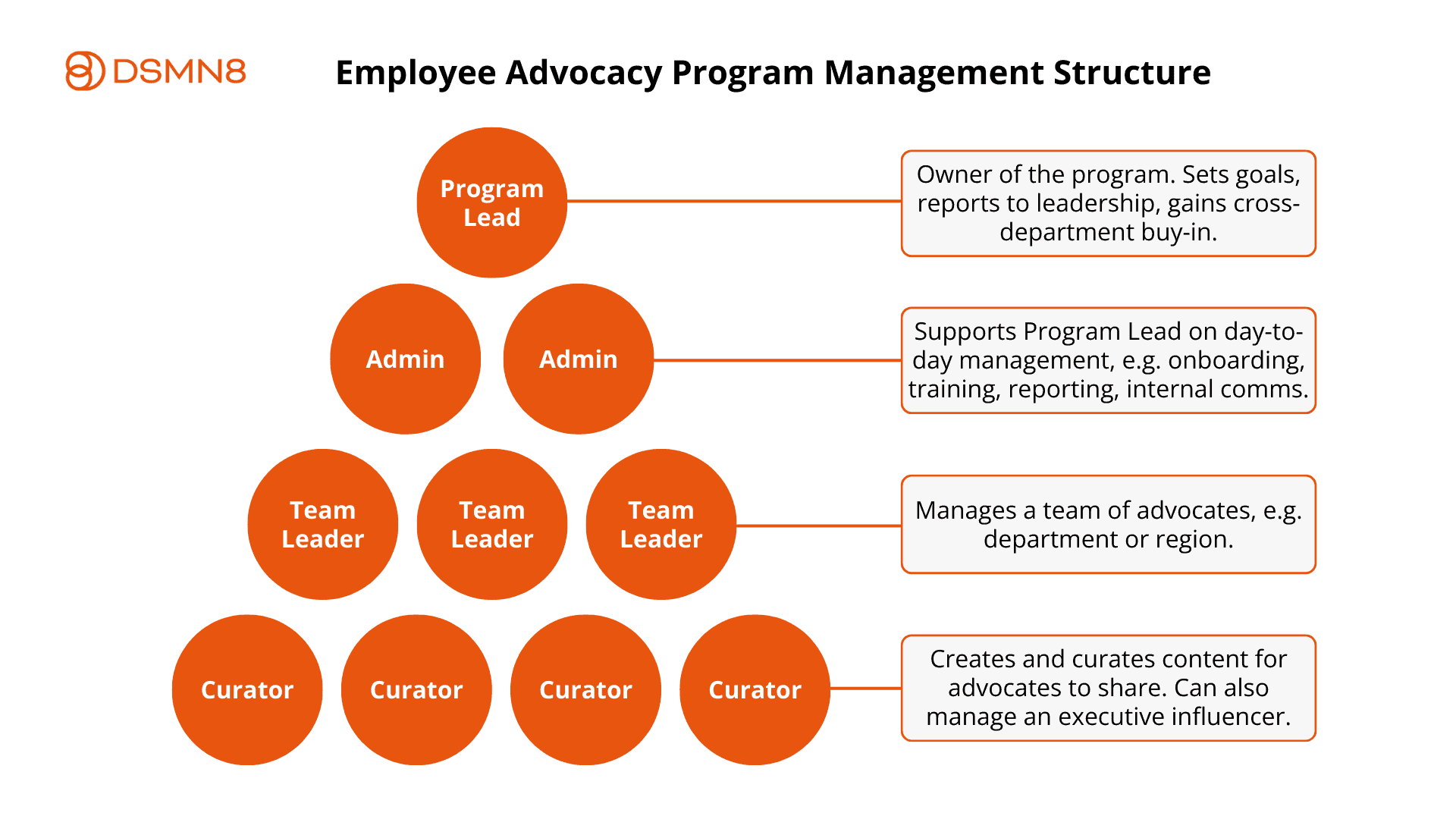
Program Lead (1 person)
This individual owns the program’s success. They set the strategy and goals aligned with business priorities, secure executive buy-in from leaders across departments, and report program impact. They manage user invitations, set up groups and teams, configure integrations, and make platform configuration decisions.
In the DSMN8 platform, their permission level is Admin. They should be the go-to person for the project, supported by other admins and curators.
Content Curators (2-3 people)
Curators create and curate content for employee advocates to share. They develop multiple caption variations for each post (typically five or more), source company news and industry content, and maintain a consistent publishing schedule.
Marketing, employer branding, or communications teams are ideal sources for curators since they have experience creating content for external audiences.
In the DSMN8 platform, Curators can access all content-related functionality but cannot add or remove users, create groups or teams, or control global settings.
Admin/Community Manager (1 person)
This admin supports the Program Lead with day-to-day management: monitoring and reporting on analytics, managing internal communications like newsletters and announcements, supporting training efforts, and facilitating rewards or competitions.
They may also curate content and can assist with user invitations or platform settings adjustments.
In the DSMN8 platform, Admins have the highest level of access. If you have capacity for multiple admins, you might assign specific tasks to each, e.g., one responsible for community management (internal comms, support, newsletters) and another for outcomes (analytics, engagement, gamification).
Recommended Structure for Programs with 500+ Users
All of the roles above, plus:
Additional Content Curators (6-10 total)
More users require more content volume and variety. Consider specializing curators by business unit or region to ensure content relevance. If you’re running an executive influencer program, each executive should be assigned a specific curator.
If your team struggles with content volume or lacks internal resources, DSMN8’s Managed Services can support content creation and curation to keep your program active.
Community Manager (Admin)
This Admin is responsible for driving internal interest to scale your program. They manage internal communications, including newsletters, and gather feedback to improve the program’s structure and content. They also respond to support requests and help with training and onboarding new advocates.
Team Leaders (As required by your organization’s structure)
Depending on your organizational structure, programs may require regional admins who speak different languages or work in different business units.
In the DSMN8 platform, Team Leaders have permissions limited to their specific teams. They can invite users to their team and remove them, approve and delete content curated for their team, and invite additional Team Leaders. They cannot adjust global platform settings or manage users outside their team.
Best in Class Programs: Advanced Strategy
The programs that consistently outperform others go beyond these fundamentals.
They build on solid foundations by implementing specialized ‘micro-programs’ that deepen engagement and drive further impact.
Employee Influencer / Content Creator Programs
High-performing advocates are elevated to influencer or creator status, forming a micro-program within your wider employee advocacy strategy.
These individuals receive 1:1 coaching and training, exclusive content creation support, and sometimes content creator kits with resources for producing high-quality posts.
Barclays, for example, provided members of their ‘Creator Club’ with tools and support to level up their content.
Watch the podcast episode with Catherine McFarlane from Barclays to find out more.
Taking this approach accomplishes several goals:
It rewards your most active participants, creates more original employee-generated content (which typically performs better than curated content), and encourages other advocates to increase their participation to qualify for the exclusive program.
Selection criteria might include top sharers, engagement leaders, and employees building personal brands on social media.
Executive Influencer Programs
Select groups of senior leaders or subject matter experts create original content to build their personal brands.
Having executives active in the program will boost employee engagement, setting the tone and example for employee advocates to follow.
Best practice is not only to encourage executives to share content, but also to assign an executive sponsor to each key pillar of your program. This way, they can champion adoption across their teams and business units.
They also drive significant impact:
Our data revealed that a CEO with 5,000 followers can achieve the same level of engagement on LinkedIn as a Company Page with 300,000 followers.
Executive influencer programs give your company a more human face in the market and demonstrate thought leadership at the highest levels.
A strong example comes from General Motors, where senior leadership played a visible and active role in advocacy adoption.
President Mark Reuss personally endorsed the initiative, invited employees to participate, and actively shared content himself. This level of executive sponsorship helped normalize advocacy across the organization, build credibility, and remove internal barriers to participation.
Within six months, the program exceeded its initial reach targets, with thousands of employee shares generating 20 million content impressions.
And if your leaders don’t have time?
In the DSMN8 platform, curators can ghostwrite content for executives using Delegate Access, making it easier for busy leaders to maintain an active presence.

Employee Advocacy Program Structure Template
To help you map out governance for your program, we’ve created a template that captures the key information you need to clearly assign responsibilities.
Use this template during program planning, when roles or structure change, or whenever there’s confusion about ownership. Having everything documented prevents tasks from falling through the cracks and makes transitions smoother when your program evolves or when team members move on.
Get the Google Sheet and Excel Template:
Getting Started
Begin by appointing your Program Lead and defining your primary goals.
Map out which departments will be involved and fill out the governance template with initial role assignments.
Within the first 60 days, recruit your curators and admins, assign clear responsibilities, set up platform permissions, and establish your content cadence.
By day 90, you should have community management running, early metrics to review, and feedback from advocates about what’s working. Adjust role responsibilities based on what you learn. Then start scaling the program, using the template to clarify which business units are targeted, onboarded, and ready to share content.
Clear governance doesn’t guarantee program success, but unclear governance will certainly cause a headache further down the line. Start with the structure that matches your current size, and scale up as your program grows!
Additional Resources
Ready to get started with the top user-rated employee advocacy platform?
Wondering how active your team already is, and how this compares with your competitors?
More Guides on Managing Your Program:

Emily Neal
SEO and Content Specialist at DSMN8. Emily has 10 years experience blogging, and is a pro at Pinterest Marketing, reaching 1 million monthly views. She’s all about empowering employees to grow their personal brands and become influencers.