

What's on this page:
- The Mindset That’s Holding Employer Branding Back.
- The Fear of Being Poached, And What It Really Signals.
- How to Approach Employee Advocacy for Employer Branding.
- AI Is Changing the Game For Advocates and Candidates Alike.
- What Good Employee Advocacy for Employer Branding Actually Looks Like.
- The Bottom Line.
- Additional Resources.
Imagine being reprimanded at a new job, not for underperforming or missing a deadline, but for sharing a free webinar on LinkedIn to help job seekers.
That’s exactly what happened to Carrie Corcoran, an employer branding consultant with years of experience leading talent attraction programs. Her story is a window into the mindset and employer branding mistakes that still hold many organizations back, and a roadmap for what forward-thinking companies should do instead.
The Mindset That's Holding Employer Branding Back
Carrie’s experience at a nonprofit is almost hard to believe. Within her first week, she was pulled aside for sharing a contact’s free, publicly available webinar on her personal LinkedIn page.
The reasoning? The organization had a social media policy, albeit one so vague it simply advised employees to “use their best judgment.”
It didn’t stop there. She was told not to connect with potential employer partners on LinkedIn, because the director “owns all of those relationships.”
“It was exactly like being treated like we were in third grade,” Carrie told us.
What makes this especially striking is the irony: the nonprofit’s own curriculum taught participants to “make it safe to connect.” They just didn’t apply that principle to their own team.
This kind of rigid control isn’t limited to the third sector. At a previous role at a regional bank, Carrie faced similar pushback for sharing non-competitive job postings and for amplifying third-party articles.
All for doing the very things that make someone a valuable, well-connected professional.
“Unless you were going to post our content, we don’t want you posting,” she recalls of the bank’s philosophy.
These experiences aren’t outliers.
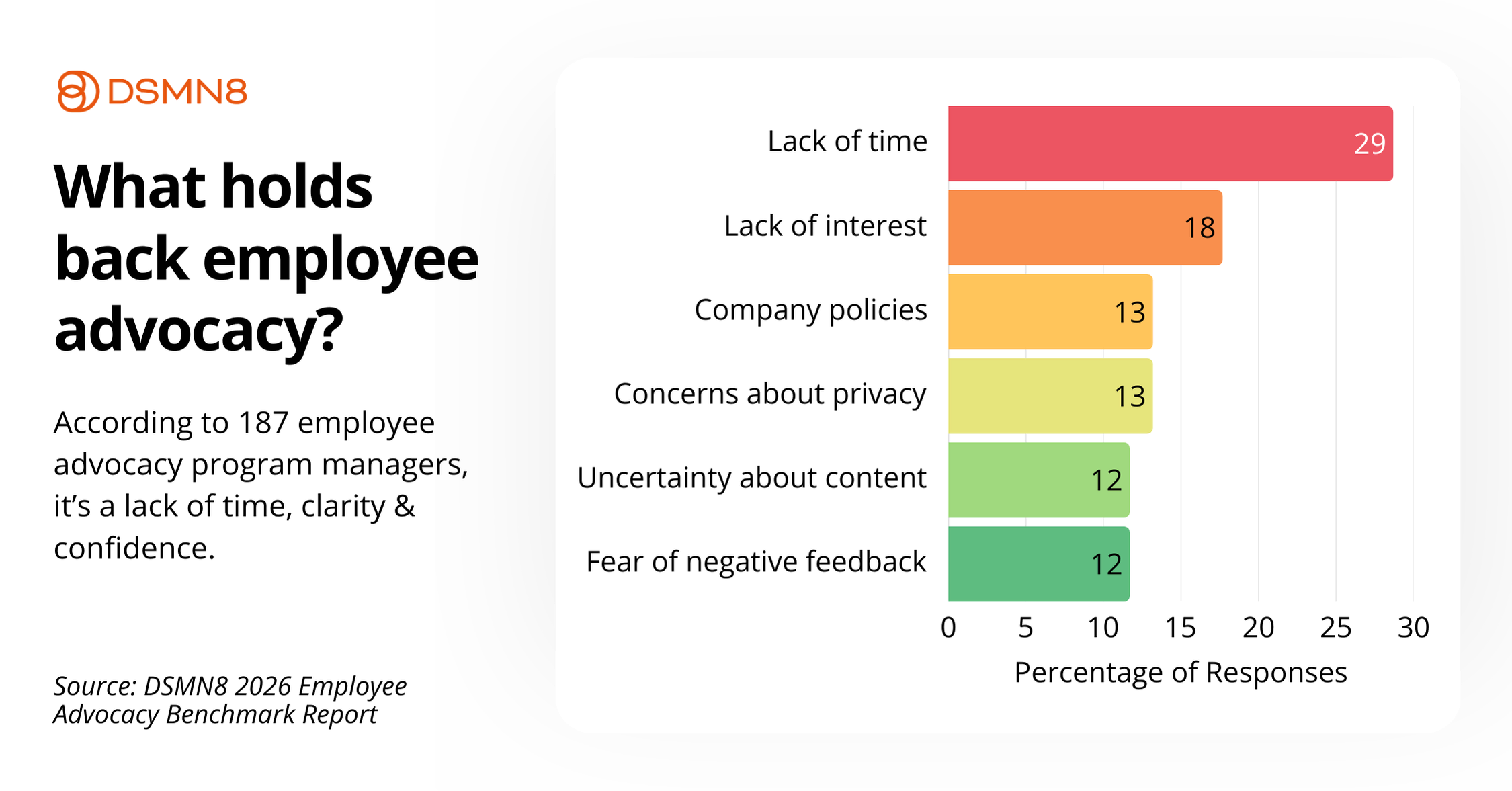
According to the DSMN8 Employee Advocacy Benchmark Report 2026, which draws on insights from 200 programs, 13.2% of employees cite company policies as a barrier to participation, making restrictive rules one of the most commonly reported obstacles to advocacy.
And that’s among organizations that already have programs in place. The figure is likely far higher where advocacy hasn’t even been attempted.
The Fear of Being Poached, And What It Really Signals
One of the most common reasons organizations clamp down on employee social media activity is the fear of poaching.
If your people are visible, the thinking goes, competitors will come for them.
Carrie has a sharp response to that:
“If you’re afraid someone is going to poach your employees, there’s a bigger issue there. What are you doing to keep them?”
In reality, visibility is inevitable. Recruiters can find candidates whether or not they’re posting on LinkedIn. Suppressing employee voices doesn’t protect retention.
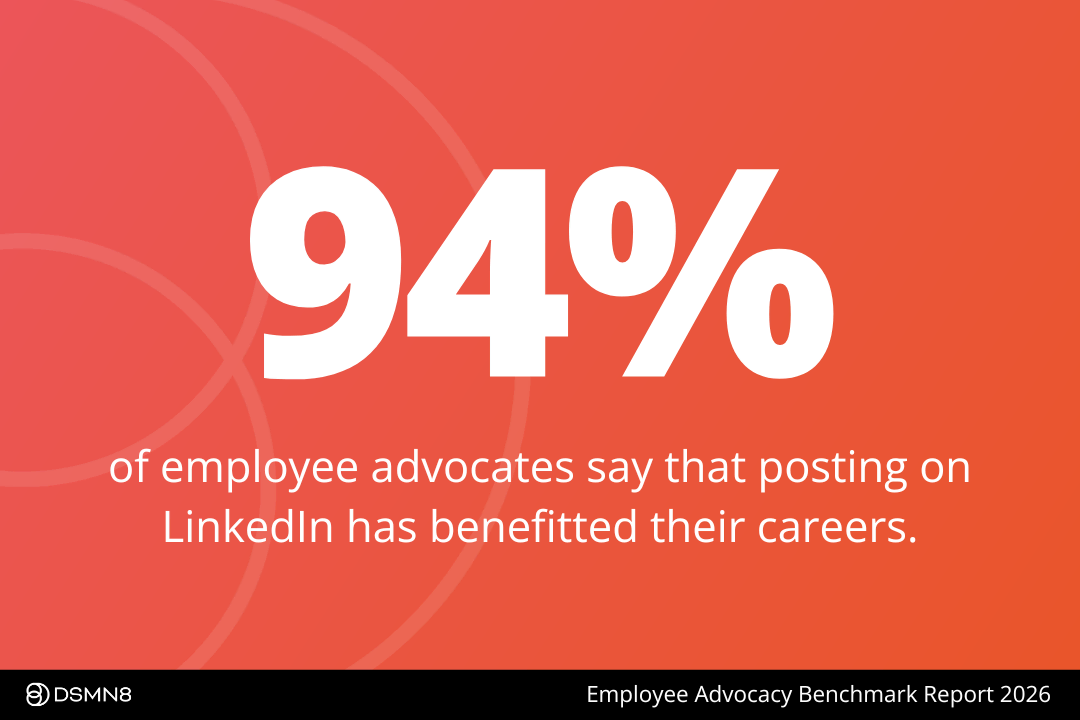
According to the 2026 Benchmark Report, 94% of employee advocates say that posting on social media has positively impacted their career.
Employees aren’t building personal brands in order to leave. They’re doing it because it benefits them professionally, right where they are.
How to Approach Employee Advocacy for Employer Branding
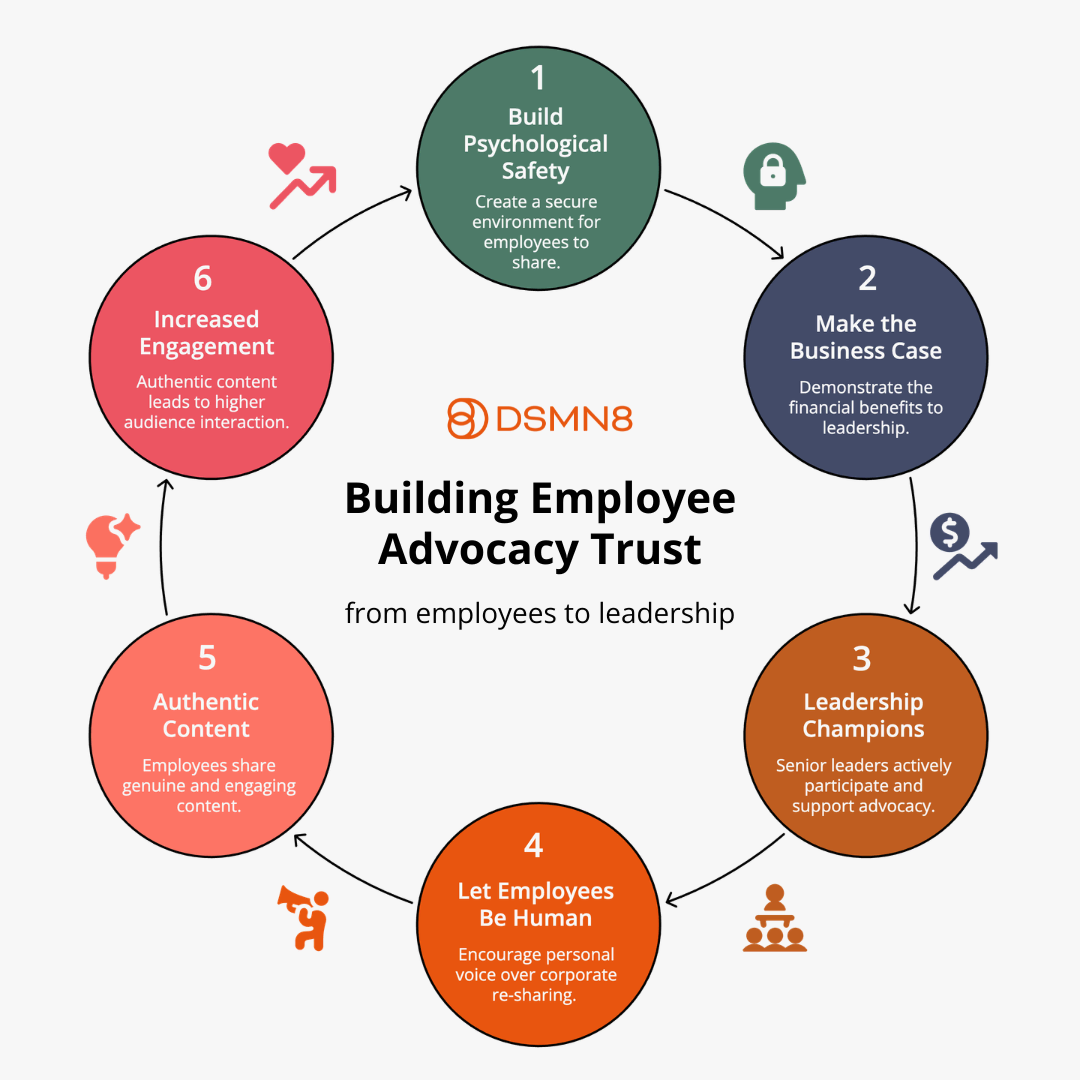
1. Build Psychological Safety First
You cannot launch an employee advocacy program without psychological safety.
If employees have been criticised or disciplined for their social media activity in the past, they’re unlikely to participate, even if you suddenly say it’s encouraged.
“There has to be psychological safety around it,” Carrie says. “That has to be non-negotiable.”
This means leadership needs to model the behavior they want to see.
When employees see senior leaders posting online, it sends a clear signal: this is allowed, this is encouraged, this is part of how we work.
The 2026 Benchmark Report backs this up: 75% of program managers plan to encourage leadership involvement and support as their top tactic for boosting advocacy engagement this year.
2. Make the Business Case
For anyone in employer branding or talent acquisition looking to build or expand an advocacy program, getting leadership buy-in starts with speaking their language: numbers.
The numbers are there. According to our benchmarks, employee advocacy typically delivers a cost-per-click of under $1, compared to $5–$10 for LinkedIn Ads and $2–$6 for paid social. For any leader who needs a business case, that efficiency gap is hard to ignore.
Beyond cost, framing advocacy as an always-on employer brand channel, rather than a one-off initiative, tends to resonate with both marketing and HR leadership.
Employer branding sits at the intersection of talent acquisition, marketing, and internal communications, making it a naturally cross-departmental effort. Getting all three functions aligned and having a champion who drives it forward is what separates programs that stagnate from those that scale.
3. Let Employees Be Human
The most effective advocacy isn’t a steady feed of company announcements. It’s a mixture of types and formats that serve different purposes.
It’s a recruiter sharing an industry article they found interesting with their network.
It’s a salesperson commenting on a trend in their field to stay top of mind with prospects when they’re ready to buy.
It’s an employee offering a glimpse of their day-in-the-life to showcase company culture.
According to The World’s Biggest Employee Advocacy Study, our analysis of over half a million employee LinkedIn posts, personal posts generate 9x more engagement than company-curated content.
Even minor caption edits, such as adding a personal intro or tweaking a sentence, result in 3x more engagement than sharing content without edits.
Authenticity isn’t just a nice-to-have for advocacy. It’s measurably more effective.
Carrie recalls one of her most impactful employee advocacy x employer branding wins: spotlighting a leader alongside a hard-to-fill private banker role in a LinkedIn article.
The leader shared it. Their network shared it further. The eventual hire came through a second-degree connection, someone who would never have been reached through traditional advertising alone.
“Had they not posted that article,” Carrie says, “they never would have reached that person.”
AI Is Changing the Game For Advocates and Candidates Alike
AI in Advocacy
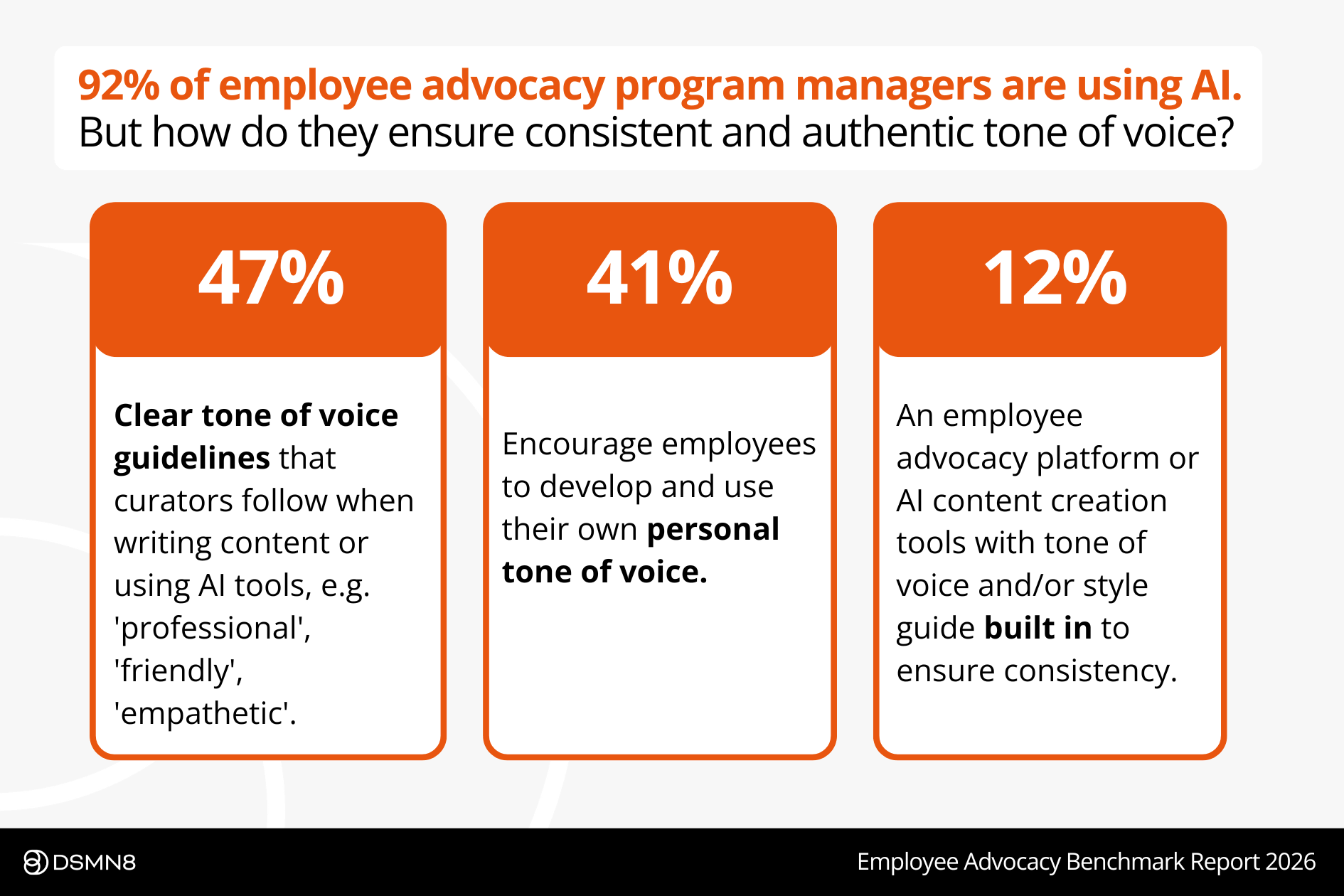
92% of employee advocacy program managers are now using AI to scale content creation, and a further 7% plan to do so.
Carrie is a convert herself, using ChatGPT to draft articles and then editing the output to reflect her own voice.
The case for integrating AI into advocacy is compelling. If a post can be drafted in 30 seconds and refined from there, the “I don’t have time” objection largely disappears.
“Build it into the training,” Carrie suggests. “Tell people: it’s okay to use ChatGPT. Just do something and be active.”
The key, as the data reinforces, is personalization. AI can generate the starting point; the employee needs to make it their own. Even a small edit dramatically improves performance. The goal isn’t to automate advocacy entirely, but to remove the friction that stops people from starting.
This is exactly the balance DSMN8’s AI tools are built around.
Company Voice generates on-brand content that reflects your organization’s tone and messaging, ensuring it adheres to guardrails. Personal Voice goes a step further by learning how each individual employee actually sounds, rewriting curated posts in their voice, so every share feels natural. The result is content that’s both consistent and authentic, without the time investment that puts most people off.
AI in Job Hunting
The AI shift isn’t only affecting how content gets created. It’s transforming how candidates research employers.
During our conversation, Carrie ran a live search on ChatGPT, prompting it to pull culture examples for Hilton. Within seconds, it had synthesised Hilton’s presence across LinkedIn, Instagram, and Facebook, surfacing employee spotlights, recognition posts, inclusion content, career growth stories, and community impact narratives.
It then offered to compare Hilton’s employer brand directly against Marriott and Hyatt.
Think about what that means.
A candidate no longer needs to scroll through five different platforms to get a feel for your culture. They can get a synthesised picture in a single prompt.
And if your organization doesn’t have employer branding or employee-generated content, that comparison will favor whoever does.
What Good Employee Advocacy for Employer Branding Actually Looks Like
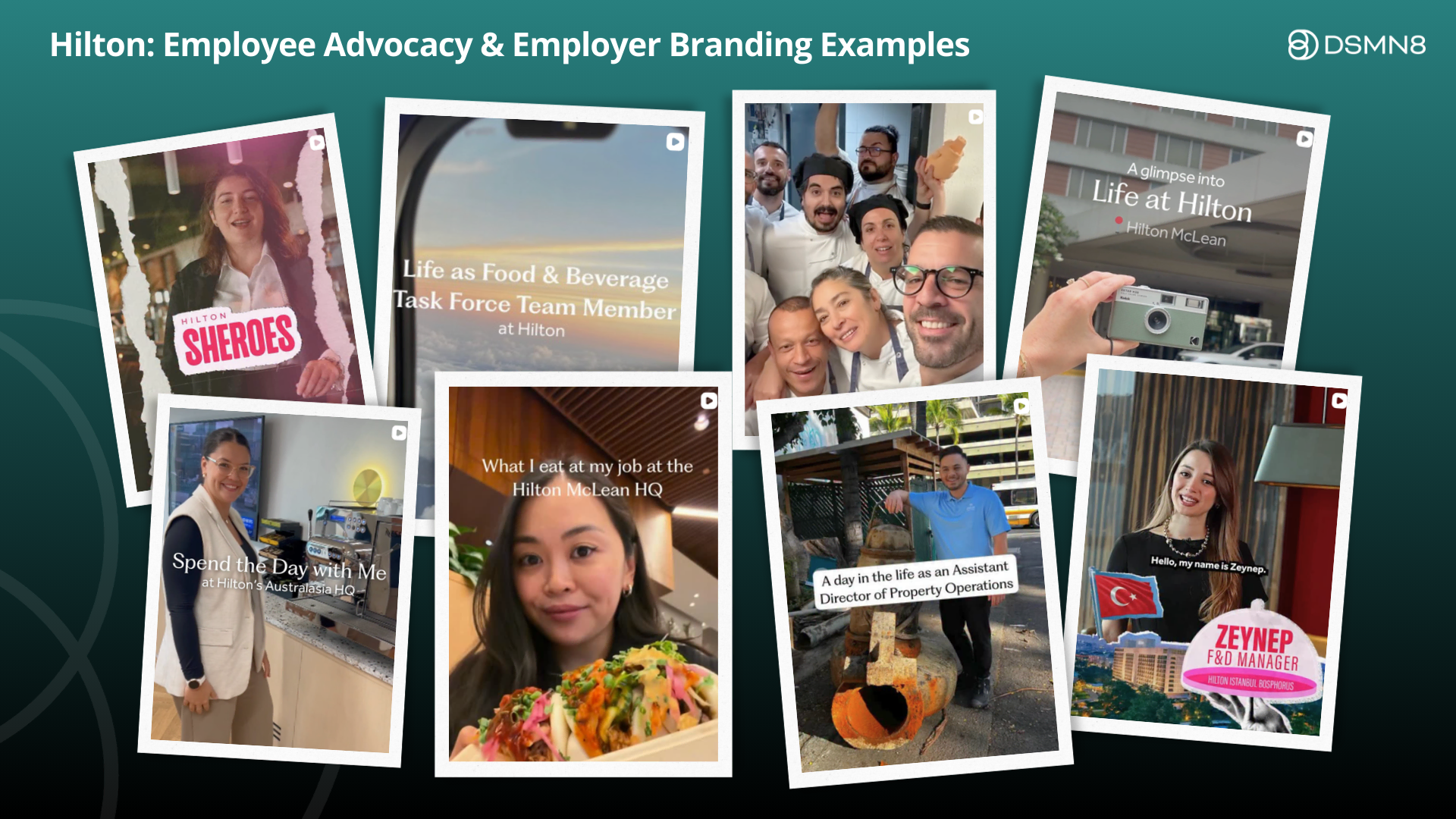
Not every story is a cautionary tale. Carrie points to Hilton as a standout example of what employee advocacy can look like when a company commits to it properly.
In 2016–2017, Hilton launched Hilton Careers on Instagram: a dedicated channel bringing the employee experience to life through day-in-the-life takeovers, cultural spotlights, and behind-the-scenes content spanning APAC, EMEA, and the Americas.
It gave candidates a genuine window into what it meant to be part of the Hilton team, long before they ever submitted an application.
Carrie credits her friend and colleague Megan McCarthy as the driving force behind that initiative. It’s a useful reminder that behind every successful advocacy program is a champion: someone who believed in it enough to push it to the top of the agenda.
That kind of culture-forward content is exactly what AI now surfaces for candidates doing their research. Organizations that have invested in it are reaping the rewards. Those who haven’t are increasingly invisible.

The Bottom Line
Employee advocacy isn’t just a nice-to-have anymore.
59% of program managers say it is “extremely” or “very” important to their organization, and that number is only going to grow as AI accelerates the way candidates research and compare employers.
The companies that will win on employer brand are those that build psychological safety, give employees the freedom and tools to show up authentically online, and invest in cross-functional programs with clear champions driving them forward.
Thank you to Carrie Corcoran for sharing her experience. You can connect with her on LinkedIn.
Additional Resources
Ready to get started with employee advocacy?
Wondering how active your team already is, and how this compares with your competitors?
👉 Get a free competitor analysis review.
More on Employer Branding & Employee Advocacy:

Emily Neal
SEO and Content Specialist at DSMN8. Emily has 10 years experience blogging, and is a pro at Pinterest Marketing, reaching 1 million monthly views. She’s all about empowering employees to grow their personal brands and become influencers.