

LinkedIn has become the #1 most-cited domain for professional queries across every major AI platform.
New research shows it doubled in citation rank on ChatGPT in just three months, and the content driving those citations is posts and articles created by individuals.
If your employees aren’t on LinkedIn, your brand might be invisible in AI search.
Search visibility has always required playing a long game: building authority, earning links, producing content that ranks. But the shape of that game has changed.
AI tools like ChatGPT, Perplexity, Google AI Overviews, and Microsoft Copilot now answer millions of queries every day, often without a single click going anywhere.
A new discipline has taken root alongside traditional SEO: Generative Engine Optimisation (GEO), the practice of getting your brand and expertise cited in AI-generated answers.
And right now, there is one platform where LLMs are increasingly turning for those citations. Not Reddit or Forbes. It’s LinkedIn.
Here’s what that data shows, and what it means for your employee advocacy and SEO/GEO strategy.

The LinkedIn Data You Need to Know About
Two separate studies published in late 2025 and early 2026 tell a consistent story.
The first, from SEO platform Semrush, analyzed 230,000 prompts (queries) across ChatGPT, Google AI Mode and Perplexity. This 3-month study was carried out between July and October 2025.
LinkedIn appeared among the top five most-cited domains across all three platforms.
According to their research, Google AI Mode cited LinkedIn in nearly 15% of its responses, with ChatGPT and Perplexity also trending upward. This was particularly evident after mid-September, when Reddit and Wikipedia citations on ChatGPT dropped sharply.
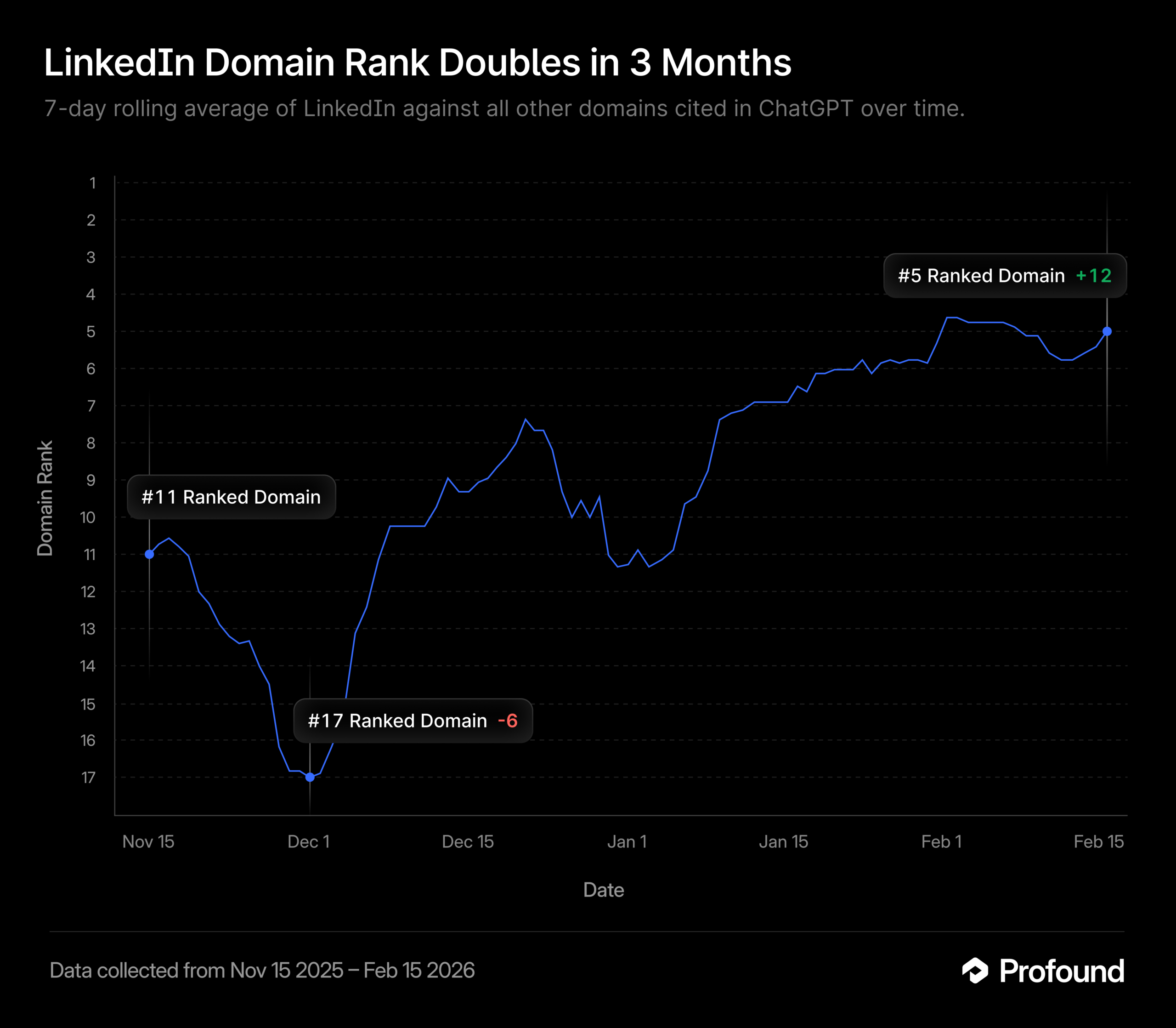
This trend has continued according to Profound, an AI analytics platform.
They tracked 1.4 million citations across six AI models (ChatGPT, Gemini, Google AI Overviews, Google AI Mode, Microsoft Copilot, and Perplexity) between November 2025 and February 2026.
Their finding: LinkedIn doubled its domain rank on ChatGPT in just three months, climbing from around #11 to #5.
And across all six platforms, LinkedIn is now ranked #1 for professional queries, ahead of every other domain.
What LinkedIn Content is Cited by LLMs?
At this point, you might be thinking it’s just LinkedIn articles getting cited in LLMs: long-form content similar to company website blog posts (and traditional SEO!).
But according to Profound’s data, that assumption is incorrect. LinkedIn feed posts (user-generated content) are actually steadily rising:
- LinkedIn posts (feed) rose from 20.9% to 26.0% of all LinkedIn citations.
- Long-form articles rose from 6.0% to 8.9%.
- Combined, posts and articles now account for ~35% of all LinkedIn citations within ChatGPT responses, up from 27% three months earlier.
The shift is toward content created by individuals: posts, articles, newsletters.
In other words, it’s not LinkedIn as a platform that AI is citing, it’s the people publishing on it.
”Everything from your SDR’s morning take to your CEO’s quarterly reflection to your PM’s product update becomes part of how your brand shows up in AI Search.
- Profound
Why Employee Advocacy Makes This Work
Anyone in the employee advocacy and executive influence/thought leadership space should be very excited about this.
For B2B brands in particular, the professional query space is now LinkedIn’s territory in AI search.
If your buyers are asking ChatGPT, Gemini, or Copilot about topics your business owns, this is a huge opportunity.
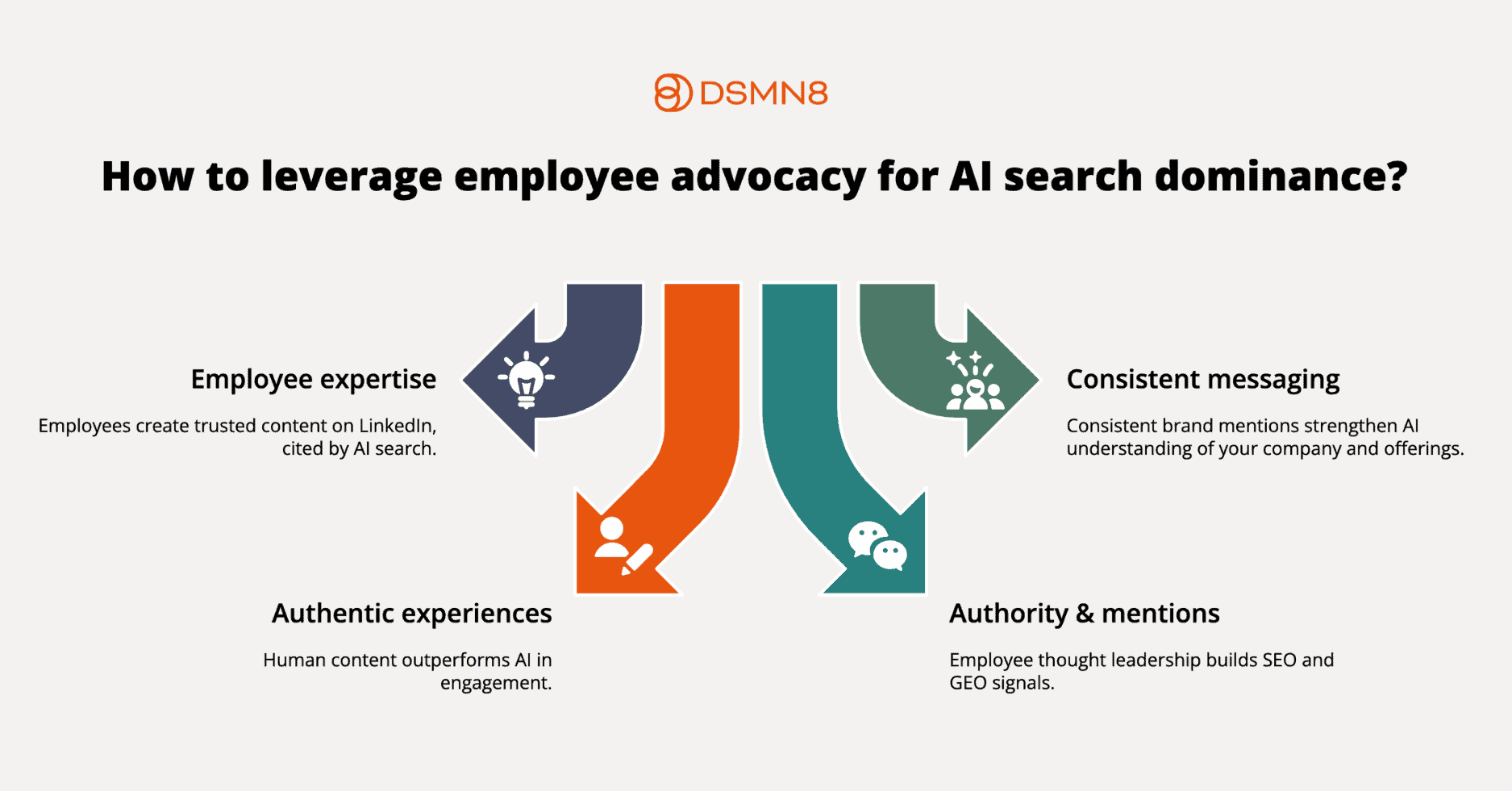
1. Your employees create content on the domain AI trusts most for professional queries
LinkedIn’s authority comes partly from the structure of the platform: every post is tied to a real professional with a verifiable employment history, credentials, and industry context.
This is where it differs from the previous LLM dominance of Reddit, where any user can anonymously publish content.
When your employees publish about their work, their expertise, and your industry, they’re creating exactly the content AI tools are increasingly reaching for.
2. Advocacy at scale creates consistent entity signals for your brand
Every time an employee mentions your company name alongside the topics your business owns, they strengthen the semantic association between your brand and those terms.
Search engines and AI models use these signals (your brand name appearing alongside relevant professional topics, across many credible profiles) to understand what your brand is known for.
Scale matters here. Fifty employees posting once or twice a week creates a stronger entity signal than one person posting daily.
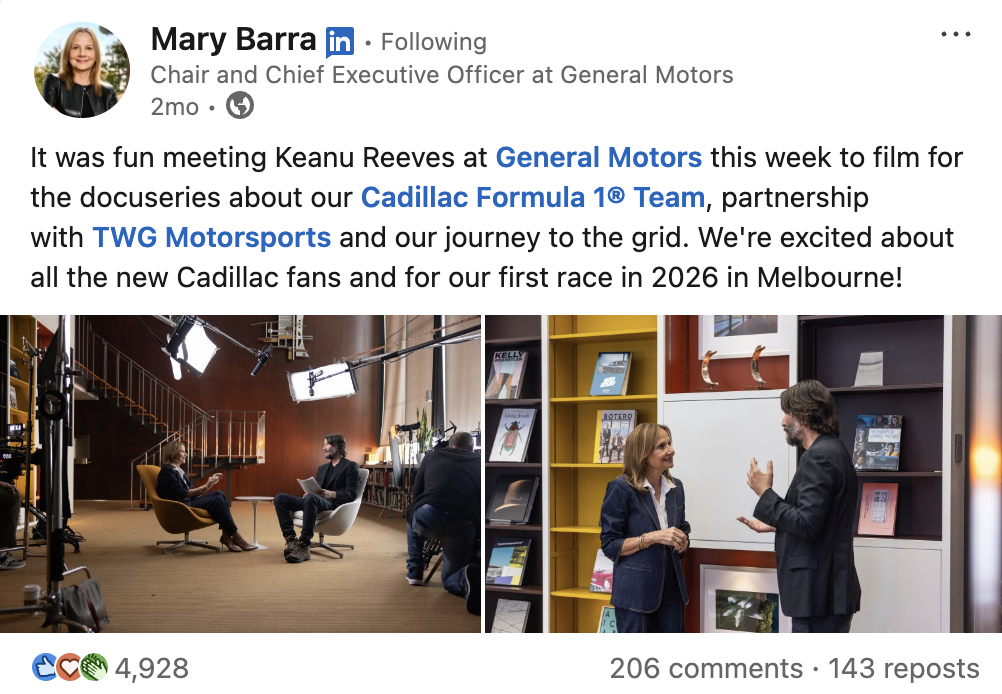
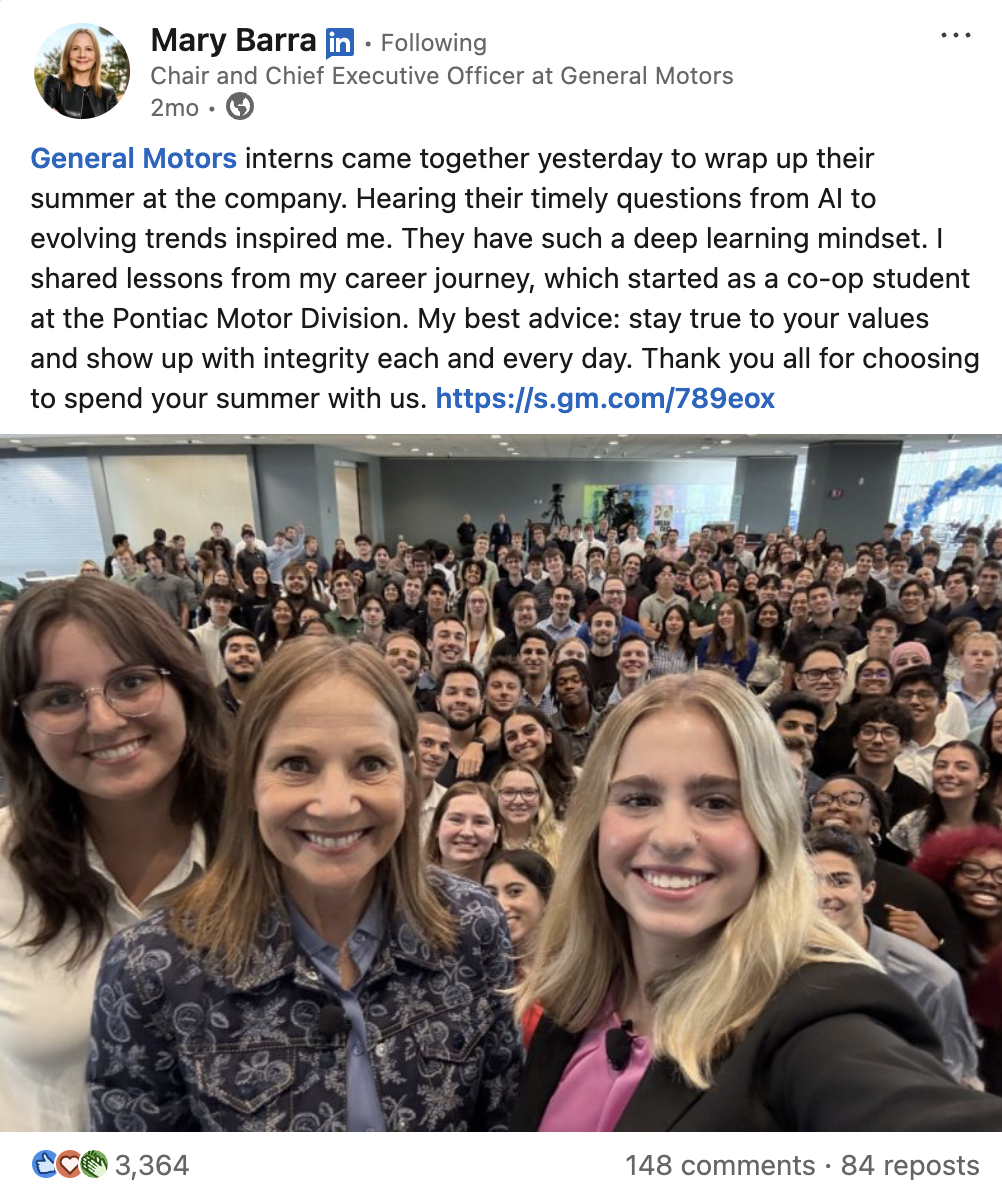
General Motors reached 20 million people in just 6 months through its employee advocacy program using DSMN8. Check out the case study.
3. Human-authored content outperforms AI-generated content in this context
Research found that AI-generated LinkedIn posts receive 45% less engagement than human-written ones.
That’s not to say LLMs aren’t citing AI-generated content, but technology is increasingly sophisticated at distinguishing expert, experience-backed content from generic filler. It’s something to keep in mind when scaling employee content.
Employee advocacy done well — where employees add their own perspective and authentic voice — produces the kind of content that performs on both measures: it earns engagement from humans and credibility signals from AI.
Check out our Personal Voice AI tool to see how to make this easy for your team.
4. It builds the domain authority and brand mentions that underpin traditional SEO
Employee thought leadership, whether on LinkedIn or in industry publications, naturally generates the brand mentions, inbound links, and authority signals that lift your domain over time.
Brands are 6.5x more likely to be cited by AI through third-party sources than from their own domain.
Employee content on LinkedIn is, structurally, third-party content: professionally credible, independent, and attributed to real people.
This connects to a broader point about brand as a growth lever, which we explored here: Why Brand is Back: Marketing Beyond the Funnel.
What to Prioritize in Your Advocacy Program for SEO and GEO Impact
💡 Learn More: We’ve covered the broader shift from traditional SEO to AI-visible content in more depth here – Employee Advocacy for AI SEO: Your Secret Weapon in the Age of ChatGPT.
The Bottom Line
Search has always been about being the most trusted answer to the question someone is asking. AI tools have changed where that answer gets delivered, but the underlying logic hasn’t changed.
LinkedIn has become the domain that LLMs trust most for professional queries. Employee advocacy is what puts your brand and your people’s expertise front and center in their answers.
The brands investing in employee advocacy right now aren’t just winning on LinkedIn.
They’re building a professionally credible presence that earns them a seat in the AI search engines shaping how buyers discover and evaluate solutions before they ever visit your website.
”The ones that do early will build a compounding advantage as Answer Engines continue to treat LinkedIn as a trusted, go-to source. The ones that wait will find themselves at the back of a very long line.
- Profound
Ready to get started with the #1 employee advocacy platform?
Wondering how active your team already is, and how this compares with your competitors?

Emily Neal
SEO and Content Specialist at DSMN8. Emily has 10 years experience blogging, and is a pro at Pinterest Marketing, reaching 1 million monthly views. She’s all about empowering employees to grow their personal brands and become influencers.