
Last Updated: 27th April 2026.
Employer branding has moved well beyond its origins as an HR buzzword. What started as a response to Glassdoor and social media transparency has evolved into a strategic discipline that sits at the intersection of marketing, culture, and talent. In 2026, the pressure to get it right has never been higher.
Organizations are competing for candidates in a market shaped by economic uncertainty, rapid AI adoption, and a workforce with fundamentally different expectations of what work should look, feel, and sound like. And the employers winning on brand aren’t necessarily the biggest or the best-funded.
This piece covers where employer branding is heading, what that means for how you build and communicate your brand, and the practical levers that make the biggest difference.
To understand where employer branding is heading, we spoke to four practitioners and experts who have been directly involved: Dawn Hollingworth, Global Employer Brand Lead at Rolls-Royce; Rebecca Foden, Head of Talent Acquisition & Diversity Hiring at Transport for London; Ivan Brezak Brkan, CEO and Founding Editor of Netokracija; and Piyush Sharma, global CEO coach and C-Suite advisor, Executive-in-Residence at ISB and UCLA.

What is an Employer Brand?
Your Employer Brand is your reputation as a place to work, among both your current and prospective employees.
Social media and employee reviews on platforms like Glassdoor have led brands to consider what they can do to bolster their position as a desirable employer.
Businesses have realized that, while an employer brand is something they must own and take responsibility for, it is not entirely under their control.
According to LinkedIn, firms that invest in Employer Branding cut their cost-per-hire by 50%.
Your employer brand simply cannot be ignored and must be continually built on if you want to attract and retain top talent.
Why Employer Branding Matters More in 2026
The talent market has matured significantly since employer branding first gained mainstream attention. Candidates are more informed, more skeptical of corporate messaging, and more likely to conduct deep research before applying or accepting an offer.
In 2026, potential candidates can simply ask LLMs like ChatGPT what it’s like to work at your company and get an immediate response based on reviews and social posts.
This makes it more important than ever to build a strong employer brand, and not just on your careers site.
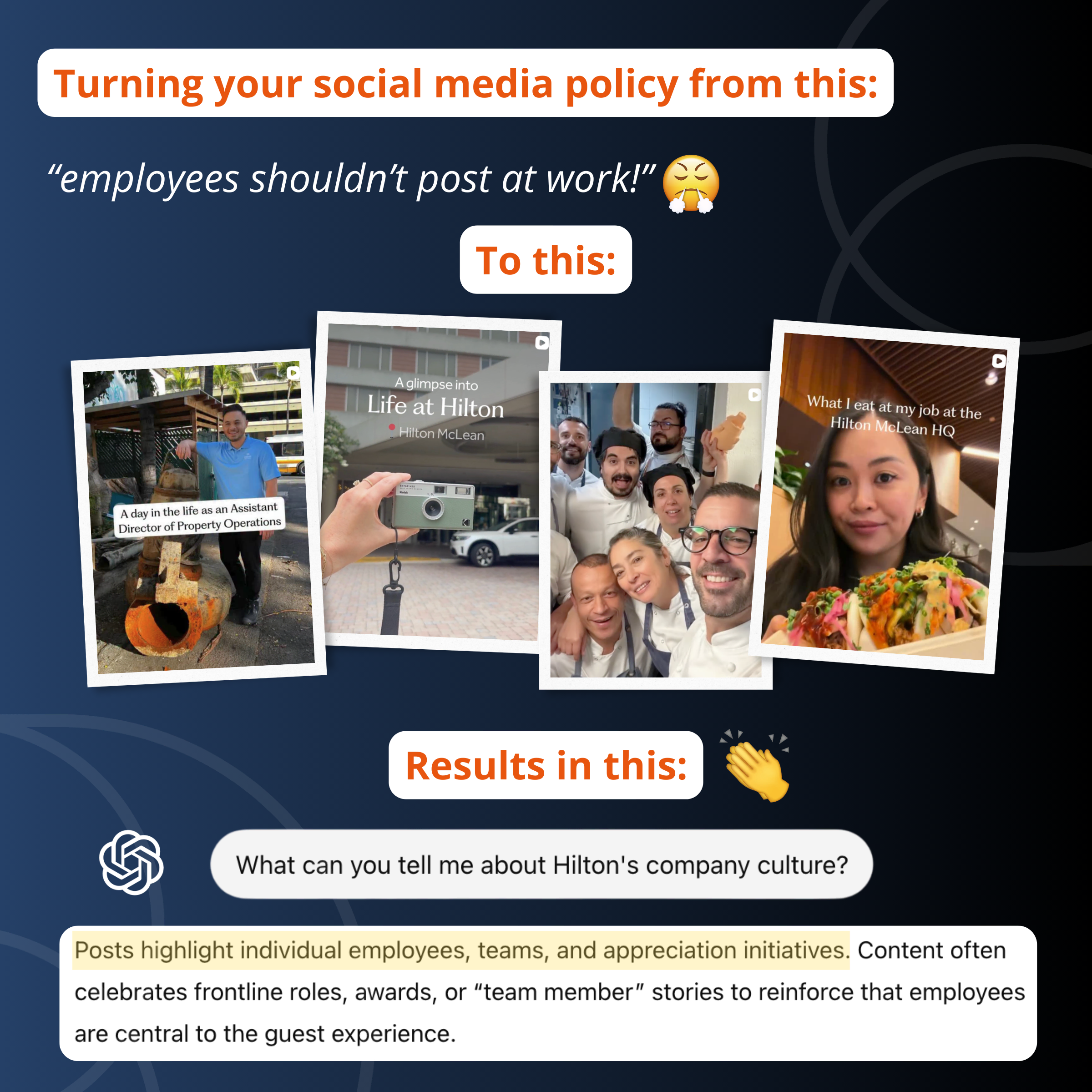
Example above is Hilton, a strong employer brand presence in LLMs. Read the interview with Carrie Corcoran, Employer Branding Consultant.
The Trends Defining the Future of Employer Branding
According to Google Trends, global searches for ’employer branding’ have been steadily growing since 2004, peaking in March 2026.

So, what will be the employer branding best practices of the future? We spoke with industry experts to find out.
1. Your Employees Are Your Brand's Most Credible Channel
As a business, your employees are the most trusted voices within your organization.
People trust people, and 76% say they’re more likely to trust content shared by “normal” people than by brands.
In an employer branding context, that asymmetry is even more pronounced.
A candidate deciding whether to apply isn’t going to be swayed by a careers page headline. They’re going to look at what your employees are actually posting.
Dawn Hollingworth, Global Employer Brand Lead at Rolls-Royce — with prior experience at Ernst & Young and Cielo — frames it in terms of natural amplification:
”Employees are natural amplifiers of experience. Organizations that invest in cultivating a positive culture that brings out the best in people can harness the resulting goodwill. Employees can amplify an employer brand by endorsing their company through social shares, likes and comments; by sharing their own content about life at the company and by leaving positive reviews on sites like Glassdoor and Indeed."
Dawn HollingworthGlobal Employer Brand Lead at Rolls-Royce
Ivan Brezak Brkan, CEO and Founding Editor of Netokracija — Southeastern Europe’s leading digital media company — goes further, identifying two distinct roles employees play:
”First of all, as influencers, since potential employees will trust the content they see on individual employee accounts more than a corporate/company one… Second, being the authors of truly authoritative and authentic content on their industry, wherever it's published. No agency, copywriter or brand journalist can create the content a team member can create in terms of showing the real situation."
Ivan Brezak BrkanCEO and Founding Editor of Netokracija
The implication is direct: the most effective employer branding investment right now is helping your employees become visible, credible voices.
Rebecca Foden, Head of Talent Acquisition & Diversity Hiring at Transport for London — with nearly 20 years of experience across banking, financial services, and transport — brings a talent acquisition lens to the same point:
”The most successful organizations empower their talent to share real-life stories about their experiences, roles and achievements. They bring their own diversity of thought and a window into the culture of an organization by a real person that provides transparency and trust, rather than a cold logo. The faces behind the brand working tirelessly every day provide a deeper sense of trust in a brand, valuable insight enabling talent to imagine themselves as employees."
Rebecca FodenHead of Talent Acquisition at Transport for London
2. Authenticity Has Become the Baseline
For years, “authentic” was a direction employer brands aspired toward.
In 2026, it’s the baseline expectation.
Polished employer brand campaigns produced by agencies (aspirational copy and curated photography) no longer move candidates. They register as marketing, which is exactly what they are.
Ivan puts it plainly:
”It's better to keep both PR, marketing agencies and employer branding agencies far away from expert content in order to keep it truly authentic. There's a reason most employer branding content isn't true thought leadership — it's very obviously propaganda and what we need to do is focus on value. It's far more productive to help employees create content through workshops and with the help of editors rather than trying to mimic them. You can't."
Ivan Brezak BrkanCEO and Founding Editor of Netokracija
Dawn reinforces this from another angle, pointing to the deeper organizational challenge, the gap between what companies say and what they actually do:
”CV-19 shone a bright light on any gaps between a company's values/promise and actions, so employer brands now need to work harder than ever to be authentic and credible and 'walk the talk."
Dawn HollingworthGlobal Employer Brand Lead at Rolls-Royce
That challenge hasn’t diminished. If anything, it’s been sharpened by greater workforce scrutiny, more visible leadership, and a candidate pool that has learned to read between the lines of employer brand messaging.
3. Employee-Generated Content Is the Next Major Channel
You’re probably familiar with User-Generated Content (UGC) and the commercial impact it’s had for consumer brands. Employee-Generated Content (EGC) is its employer brand equivalent, and it’s gaining serious traction.
Where brand-produced content tells candidates what you want them to think, EGC shows them what working at your company is actually like.
A team member’s LinkedIn post about a challenging project, a short video walking through a typical week or a candid take on how decisions get made. These carry a weight that no produced asset can replicate.
The question Ivan raises about culture transparency is one every employer brand team should sit with:
”'What's the culture?' not in terms of grand vision, but the water cooler things. Are they interested in gaming or more of a wine and dine crowd? Do they like selling or creating content?"
Ivan Brezak BrkanCEO and Founding Editor of Netokracija
The idea of handing the reins of communications to your employees can seem anxiety-inducing to many. This is especially true for organizations in sensitive industries like pharmaceuticals and oil & gas.
However, there’s now an array of intelligent employee communications tools that promote employee advocacy within a more controlled platform. DSMN8’s advocacy tool, for example, allows admin users to select, customize, and pre-approve content for sharing.
The messaging can be controlled as needed, and captions can be instantly adjusted to each employee’s tone of voice with Personal Voice AI.
Employee advocacy can be used for far more than just marketing purposes; an advocacy program should include a content pool that spans corporate content, company culture content, and original employee-generated content.
If people trust people, then what better way to authentically showcase your working environment than through the people at the heart of your organization?
4. Your EVP Needs to Reflect How Work Has Changed
The EVPs that were written for a pre-2020 world — built around office perks, linear career progression, and company-wide uniformity — no longer reflect the reality most employees are living. The workforce expects flexibility, individual recognition, and employers who treat the EVP as a living commitment rather than a recruitment marketing document.
An EVP that promises one thing and delivers another doesn’t just fail to attract talent. It actively damages the employer brand when employees share their real experience, as they increasingly do.
”We've changed. As individuals, as societies and as employees. Organizations must evolve their employee value proposition to reflect the new environment and the changed needs of employees. I anticipate that personalized ways of working will feature highly on most EVPs."
Dawn HollingworthGlobal Employer Brand Lead at Rolls-Royce
Rebecca adds that leadership behavior is now inseparable from employer brand credibility:
”Leadership visibility will play an important future role, including organizational values to show how the organizations intend to deliver on any new promises. Many organizations will be forced to review their EVP and Employer Branding to see whether it is authentic and relevant. Values will become a top priority focus most likely focusing on purposeful, trusting and caring attributes."
Rebecca FodenHead of Talent Acquisition at Transport for London
5. Employee Communications Is an Employer Brand Investment
Too many organizations treat internal communications and employer branding as separate disciplines. In practice, they’re deeply connected. The companies that recognize this are building more coherent, credible brands as a result.
Piyush Sharma, a global CEO coach and C-Suite advisor who serves as Executive-in-Residence at both ISB and UCLA, frames the convergence clearly:
”“Content, technology and employee advocacy will all play a critical role in employer branding that is set to become one of the most critical investments in a company’s arsenal."
Piyush SharmaGlobal CEO Coach and C-Suite & Start-Up Advisor
When employees are informed, engaged, and equipped to communicate internally and externally, your employer brand expresses itself naturally through their behavior. When they’re not, no amount of external brand activity will paper over the gap.
Structured employee advocacy programs bridge this by giving employees a curated content pool to draw from while still leaving room for their own voice.
6. AI Is Reshaping How Candidates Research Employers
The way candidates research employers is changing significantly.
AI tools, from ChatGPT and Perplexity to LinkedIn’s own AI-powered features, are increasingly the first stop for “what’s it like to work at [company]?” queries, alongside traditional search.
This has direct implications for employer brand strategy. Content that once needed to rank on page one of Google now also needs to be consistent, credible, and well-structured enough to be surfaced and cited by AI systems.
Employee advocacy and EGC posts on LinkedIn are also being surfaced in LLMs, impacting your GEO strategy.
Organizations building a consistent volume of authentic, employee-driven content will be better positioned in this environment than those relying on a single polished web presence.
7. LinkedIn Remains the Anchor, but the Ecosystem Has Widened
LinkedIn remains the most important platform for employer branding.
Its professional user base and reputation as a career-oriented environment make it the natural home for employer brand activity.
According to LinkedIn data, over 75% of people who recently changed jobs used LinkedIn to inform their decision.
And recruits sourced via LinkedIn were 40% less likely to leave the company within the first 6 months.
But the platforms that matter for reaching candidates, particularly younger professionals entering the workforce, have expanded.
Video-first formats across TikTok and YouTube have opened up new ways of communicating culture.
Ivan’s point about channel-native formats is worth considering:
”Brands can use social media to show a real behind-the-scenes look at their company which will make a team-fit far easier, but to do that they need to find the formats that are authentic for a specific channel. For example, while not being an EB initiative, Corridor’s 'SFX Artists react' series uses the YouTube 'react' format to create an insight into their team members as expert commentators. It’s not just one more 'podcast', one more 'interview'. It’s fun, engaging and still communicates their expertise."
Ivan Brezak BrkanCEO and Founding Editor of Netokracija
A talking-head LinkedIn video and a YouTube “day in the life” are not interchangeable: the format itself signals as much as the content.
Employer brands that understand this, and give employees the creative latitude to find the right format for the right platform, will generate content that actually lands.
Rebecca’s point about generational diversity adds an important dimension here:
”We're now working across a multi-generational workforce of 5 generations and organizations will need to engage differently to attract and retain the very best talent. Those organizations that have a social media strategy or employer branding team have a competitive edge. Mobilizing and engaging with this community through events and wider engagement will develop diverse pipelines of talent that were previously unreachable."
Rebecca FodenHead of Talent Acquisition at Transport for London
Dawn’s point about two-way dialogue extends this further:
”Employer branders need to create structured content strategies that illustrate the employee value proposition through personal stories and engaging mediums. Two-way dialogue deepens engagement and can help fuel talent pipelines. Remember to measure, iterate and optimize to get the best ROI."
Dawn HollingworthGlobal Employer Brand Lead at Rolls-Royce

What This Means in Practice
The future of employer branding isn’t a set of new channels or tools, it’s a shift in posture. The organizations building the strongest employer brands in 2026 are:
- Treating employees as the primary channel, not a supplementary one
- Investing in content enablement alongside content production
- Building advocacy programs that give employees structure without removing their individual voice
- Evolving their EVP to reflect how work has genuinely changed
- Measuring brand health through trust signals and candidate quality, not just application volume
DSMN8’s employee advocacy platform is built to support exactly this approach: giving teams a way to surface, structure, and amplify employee content at scale, without sacrificing the authenticity that makes it work in the first place.
Want to see how active your team currently is?
Get a free competitor analysis review.
Ready to explore the DSMN8 platform?
Additional Resources & Further Reading
For the comprehensive guide to all things employee advocacy and influence, download The Ultimate Guide to Employee Advocacy.


Lewis Gray
Senior Marketing Manager at DSMN8. Lewis runs DSMN8's own employee advocacy program, putting the platform into practice from the inside, hosts The Employee Advocacy Podcast, and launched the Employee Advocacy Certification Course. His background in sales informs his approach to demand generation and B2B content strategy.