
[Episode Ninety-Three of ‘The Employee Advocacy and Influence Podcast] 🎧
In this special episode, host Lewis Gray breaks down the insights from the second annual Employee Advocacy Benchmark Report. Drawing on data from global programs, including giants like Cisco, Nissan, and Toyota. Lewis reveals why 2026 is the year advocacy moves from an optional extra to a vital revenue and talent-attraction engine.
Key Takeaways:
- Sales teams are now the most active participants, accounting for 33% of all activity, as advocacy directly correlates with pipeline and win-rate improvements.
- 92% of managers use AI for heavy lifting, while ensuring 41% of employees still customize content to retain authenticity.
- Discover why uncertainty is the biggest barrier to posting and how structured training can drop non-participation rates significantly.
- Why 80% of successful programs now involve senior leadership to drive legitimacy and internal competition.


Sales Teams are Now the Primary Drivers of Program Activity
A major shift in the data shows that advocacy is no longer strictly a marketing or HR function, as sales teams now account for nearly 33% of all program activity. This transition is driven by the realization that advocacy is a powerful commercial tool for building trust, filling pipelines, and hitting quotas. For example, Nick Martin at Tipalti shared how a salesperson closed a whale of a deal after a lost account re-engaged via a LinkedIn product spotlight post. One organization even reported a 64% improvement in win rates when its sales team aligned its social messaging. Marketers must recognize that when sales teams see advocacy as a way to help them sell, participation and ROI skyrocket.
Leveraging AI as a Creative Assistant to Scale Personalization
The report finds that 92% of program managers now use AI to scale content production, but the goal is to relieve blank-page syndrome rather than achieve total automation. Vicky Cunningham from Efficio uses “LinkedIn Post Pro” custom GPTs to guide employees through prompts that help them structure their expertise into engaging posts. The key is to use AI for the heavy lifting while encouraging employees to infuse their own tone of voice into the final output. This approach prevents employees from becoming walking billboards and ensures that the content remains authentic to their specific audience. For social media managers, AI serves as an assistant that turns subject matter experts into consistent content creators.
Proving Financial ROI Through Cost-Per-Click
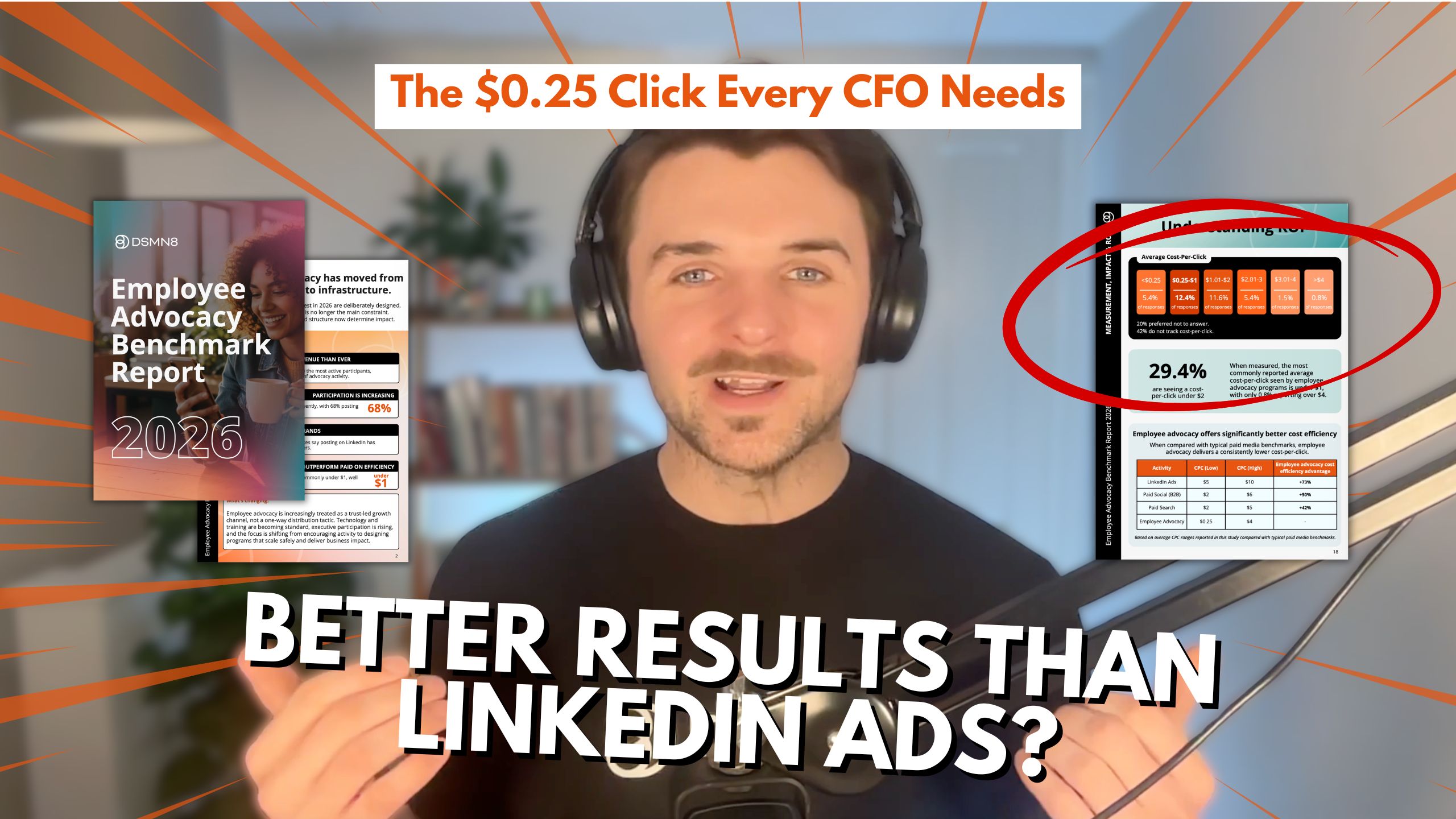
For organizations looking to secure internal investment, the financial efficiency of advocacy remains its strongest selling point to the CFO. The majority of respondents in the report pay a cost-per-click (CPC) between $0.25 and $1.00, which is significantly lower than the cost-per-click for traditional LinkedIn ads. Lewis emphasizes that advocacy should not be a false choice between brand awareness and lead generation; it can effectively do both if designed with business goals in mind. By tracking website conversions and earned media value, teams can prove that advocacy is a more efficient alternative to paid media. This data-driven approach moves the conversation from vanity metrics like “likes” to real-world business outcomes.
Ready to start your own employee advocacy program?
Whether you’re exploring employee advocacy or considering DSMN8 as your platform, we can help you get started with confidence.
Learn More About Employee Advocacy:

Lewis Gray
Senior Marketing Manager at DSMN8. Lewis runs DSMN8's own employee advocacy program, putting the platform into practice from the inside, hosts The Employee Advocacy Podcast, and launched the Employee Advocacy Certification Course. His background in sales informs his approach to demand generation and B2B content strategy.